
Novo at a glance
Novo is a financial technology platform offering a business checking account through Middlesex Federal Savings, F.A., Member FDIC. It pairs core banking with debit cards, ACH, wires, mobile check deposit, mailed checks, invoices, expense categorization, bookkeeping, Reserve allocations, and direct connections to common commerce and accounting software.
The product is built for independent and small businesses that collect electronically and already use tools such as Stripe, Shopify, Square, QuickBooks, or Xero. There is one main checking relationship rather than a ladder of monthly subscription plans.
| Review question | DollarScout finding |
|---|---|
| Best for | Online, service, and ecommerce businesses prioritizing free checking and integrations |
| Monthly service charge | $0 |
| APY | 0% |
| Budgeting | Up to 20 Reserves inside the same checking account |
| Deposit protection | Up to $250,000 through Middlesex Federal Savings |
| Main limitation | No cash deposits; limited yield, ATM reimbursement, and advanced team controls |
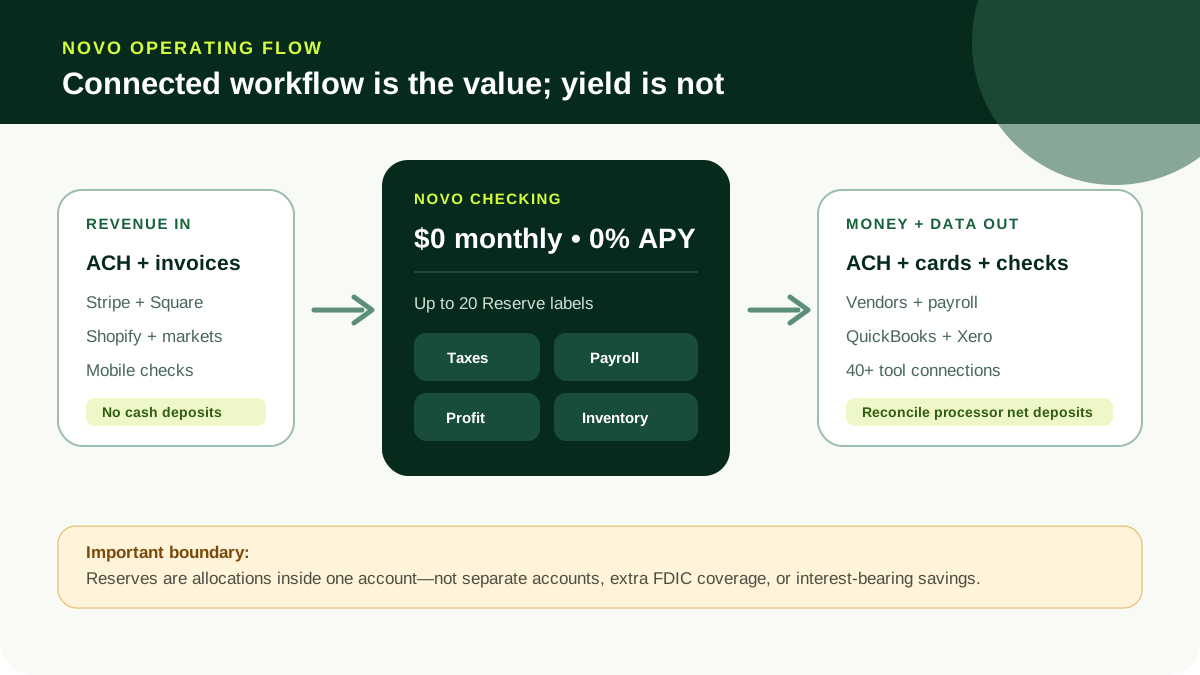
:::note Novo Reserves are labels and allocations within one checking account. They are not separate bank accounts, do not create additional FDIC coverage, and earn the same 0% APY as the underlying account. :::
Fees and minimums
Fees score 4.8/5. Novo’s current schedule lists a $0 monthly service charge, $0 minimum balance, $0 early-closing fee, free incoming and outgoing standard ACH, free incoming domestic and foreign wires, free stop payments, no insufficient-funds charge, and no charge for ordinary mailed check bill payment.
The schedule calls $1,000 a recommended initial deposit but lists the actual minimum as $0. That distinction matters: a recommendation is not an opening or maintenance requirement.
Optional speed and wire services cost more. Outgoing Express ACH is 1.5% of the transfer, with a $0.50 minimum and $20 maximum. Express check deposit can cost up to 2% of the check amount, with a $0.50 minimum. An outgoing domestic wire can cost up to $45. Businesses that frequently send wires should model that expense rather than judging Novo only by its $0 monthly fee.
Novo does not impose its own ATM charge and reimburses third-party ATM fees, but only up to $7 per customer per month under the current schedule. That can cover one or two ordinary withdrawals, not unlimited high-fee usage. ATM operators and international transactions can still create costs or exchange-rate spreads.
The free structure is strongest for standard ACH, card spending, incoming funds, and routine checks. It is less compelling for urgent movement or many outgoing wires.
APY and cash allocation
Yield scores 2.5/5 because the current fee schedule lists 0% APY. Novo is an operating account, not a yield account. A business keeping substantial idle cash should compare an external insured savings or money-market deposit account and account for transfer time and coverage.
Novo Reserves allow up to 20 custom categories for taxes, payroll, profit, expenses, inventory, or other goals. Users can set allocation rules and pay directly from a Reserve. This is useful envelope budgeting without opening many bank accounts.
The interface should not change the accounting. Reserves remain part of the same checking account, appear under the same bank relationship, and do not multiply the $250,000 insurance limit. Moving money between the available balance and a Reserve is not income, expense, or a bank transfer.
Allocation also does not guarantee affordability. A tax Reserve can reduce accidental spending, but the business must choose the percentage, reconcile taxable income, and pay the correct authority by the deadline. Novo does not become a tax adviser because it provides a label.
FDIC insurance and provider structure
Novo is not a bank. Eligible deposits are held by Middlesex Federal Savings, F.A., and Novo states that they are insured up to $250,000. The limit applies per depositor, per insured bank, per ownership category and includes other deposits the same business holds at Middlesex in the same capacity.
Novo does not advertise a multi-million-dollar sweep network on its current business-checking page. Businesses consistently holding more than $250,000 should plan how excess operating cash is placed rather than assuming the fintech interface expands coverage.
The Novo Business Credit Card uses a different issuing bank, and financing can involve Novo Funding or another provider. Deposit insurance on checking does not protect card balances, credit eligibility, software behavior, fraud outside applicable rules, or merchant-cash-advance obligations.
Integrations and bookkeeping
Integrations score 4.8/5. Novo says it connects natively with more than 40 business tools, including Stripe, QuickBooks, Shopify, Square, and Xero. The integration catalog also covers ecommerce, payroll, payment, and marketplace services.
For the right business, the value is a connected sequence: processor revenue enters the account, transaction data syncs to the ledger, invoices show payment status, expenses receive categories, and Reserve rules allocate cash. That can reduce CSV exports and repetitive entry.
Connections still need controls. A bank transaction and a processor payout are not always one-to-one because fees, refunds, chargebacks, tips, and settlement batches can change the net deposit. QuickBooks or Xero should reconcile the processor clearing balance to the bank, not simply book every deposit as gross revenue.
Novo’s bookkeeping can suggest categories and produce reports, but unusual purchases, transfers, owner draws, loan proceeds, principal payments, and inventory require review. Receipt attachment improves evidence; it does not establish deductibility by itself.
Built-in invoices are useful for a service business with straightforward billing. Card or ACH processing can involve Stripe and its current fees. Businesses with subscriptions, usage billing, complex revenue recognition, or collections workflows may still need dedicated billing software.
Payments, cards, and cash
Novo supports standard ACH, incoming and outgoing wires, mobile check deposit, mailed checks, debit cards, and electronic funding from payment processors or linked accounts. Processing time, holds, and limits depend on the method and account history. The absence of a stated maximum deposit does not remove transaction limits.
The principal physical limitation is clear: Novo does not accept cash deposits. Its support page recommends electronic transfers, mobile checks, payment processors, invoices, or supported peer-to-peer funding instead. Converting business cash through a personal app can complicate records and may violate another provider’s terms; cash-heavy companies should use a bank designed for commercial deposits.
Virtual and physical cards support ordinary spending. Novo also markets separate card and credit products, but availability and rewards can depend on balance and eligibility. Do not treat a checking approval as a guaranteed credit line.
Team functionality is adequate for straightforward small-business use, but Novo’s public positioning is less focused on many granular accounts, multilayer approvals, and complex finance teams than Relay or Mercury. A growing company should test who can see balances, initiate payments, approve them, and use cards before consolidating.
Onboarding and eligibility
Onboarding scores 4.6/5. Novo advertises a digital application for eligible independent businesses, sole proprietors, LLCs, corporations, partnerships, and other supported entities. There is no minimum opening balance.
Prepare government identification, Social Security number, EIN or tax details, formation documents, beneficial-owner information, operating address, business description, and expected activity. Federal identity and beneficial-ownership rules apply even when the front-end application takes only minutes.
Approval can require manual review and feature limits can change. After opening, test a small ACH, mobile check, card, invoice, Reserve rule, and accounting connection. Request higher transfer limits before a deadline, not while payroll or a closing payment is waiting.
Customer support
Customer Service scores 3.9/5. Novo offers digital support and a searchable help center rather than branch bankers. DollarScout did not submit timed cases, so the score does not claim a particular response time.
The simpler product structure reduces some support complexity, but issues can still cross Novo, Middlesex, a card issuer, Stripe, a payment network, or a connected application. Save payment references, check images, processor payout IDs, statements, and screenshots. State which layer failed when escalating.
A business that needs immediate phone ownership of high-value wires or in-person document handling may prefer a traditional relationship bank or keep one as a backup.
Alternatives
Choose Relay for up to 20 or 50 checking accounts, unlimited users, approval workflows, Profit First organization, and interest-bearing savings. Choose Bluevine for interest-bearing checking and more payment-acceptance options. Choose Mercury for global payments, sophisticated permissions, APIs, and startup finance tools.
Choose Found for stronger sole-proprietor tax estimates and Pockets, or Lili for a tiered path into tax, accounting, invoices, and reports. A branch bank is better for routine cash deposits and in-person service.
Who should use Novo
Novo is a strong candidate for businesses that:
- Receive most revenue through ACH, card processors, marketplaces, or checks.
- Already use several of Novo’s 40-plus integrations.
- Want free standard ACH and no monthly balance requirement.
- Need simple Reserve budgeting rather than many legal bank accounts.
- Keep balances within a comfortable insured operating range.
It is easier to skip when interest, frequent outgoing wires, cash deposits, branches, or complex approval structures are central.
Bottom line
Novo earns 4.2/5. It is one of the cleaner free choices for a digitally paid small business, with excellent integrations, useful Reserves, straightforward invoices, and few routine fees. The Middlesex relationship provides standard FDIC protection.
Its value comes from workflow, not yield or physical banking. The account pays 0%, Reserves do not create separate coverage, cash is unsupported, and expedited transfers can be expensive. Use Novo when its integrations remove work, keep large idle balances elsewhere when appropriate, and maintain a second banking path if cash or urgent wires matter.