Many products on this page are from partners who compensate us. This doesn't influence our ratings. Our opinions are our own.
SoFi vs Marcus Personal Loans: 2026 Status Comparison
By Sophie Brown, Senior Finance Editor · Updated Jul 2026 · Fact-checked Jul 18, 2026
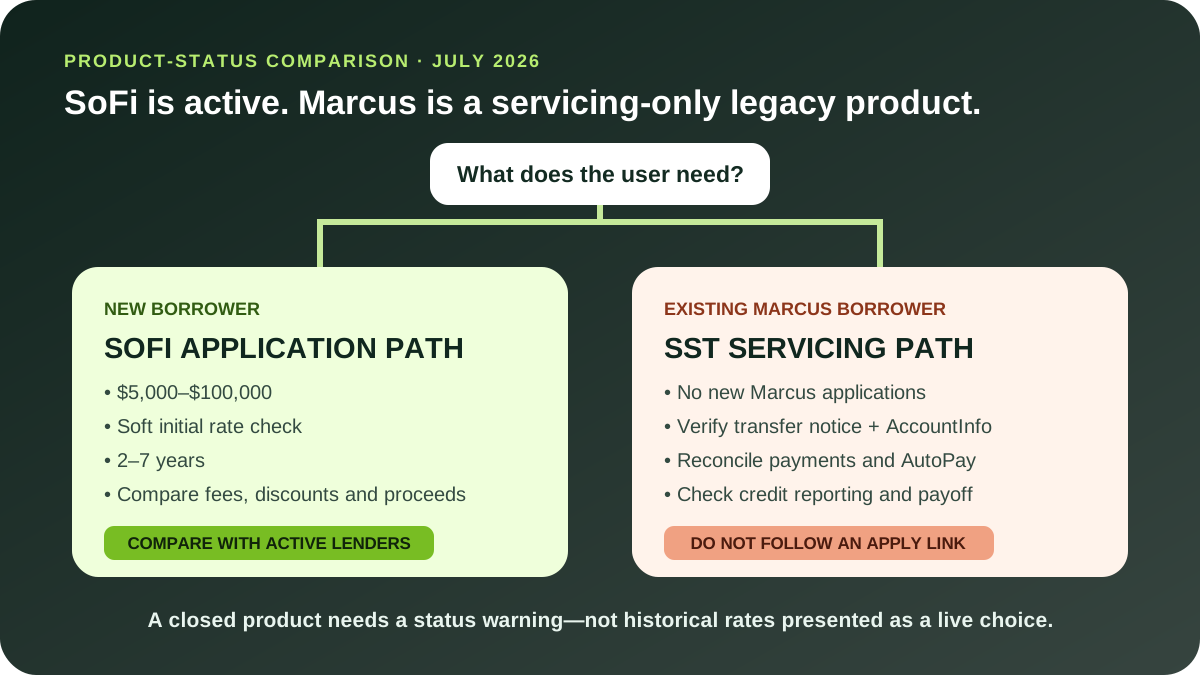
SoFi is the only current borrowing option in this matchup. It advertises $5,000 to $100,000 fixed-rate personal loans, soft initial rate checks, two- to seven-year terms, and both no-fee and optional fee-bearing structures. Marcus stopped originating new unsecured personal loans, sold substantially all of the portfolio, and transferred existing Marcus and MarcusPay servicing to SST in December 2023. Existing Marcus borrowers should manage their original loan through verified servicing channels; new borrowers should compare SoFi with other active lenders, not with historical Marcus rates.
Head-to-head
| Feature | SoFi Personal Loans | Marcus by Goldman Sachs Personal Loans |
|---|---|---|
| DollarScout Rating | 4.5/5 ★ | 1.9/5 ★ |
| APR | 6.99% to 35.49% fixed APR with the 0.25% AutoPay and 0.25% member discounts, current July 6, 2026; the actual offer depends on term, creditworthiness, income, fees, and other factors | Not available: Goldman Sachs began ceasing new Marcus unsecured personal loans in 2023 and does not publish a current applicant APR |
| Origination Fee | 0% to 7% optional origination fee reflected in APR and deducted from proceeds when selected; a no-origination-fee option is available, and SoFi states no prepayment or late fee | Not applicable to new borrowers; existing customers remain bound by their original loan agreements and should use SST servicing records for current account terms |
| Loan Amounts | $5,000 to $100,000 with two- to seven-year terms, subject to underwriting, state minimums, partner-bank exclusions, and availability | No new personal-loan applications; servicing of existing Marcus and MarcusPay loans moved to SST effective December 11, 2023 |


Category-by-category breakdown
APR
Fees
Loan Amounts
Funding Speed
Customer Service
Detailed analysis
The essential answer
This is not a normal lender-versus-lender choice. SoFi accepts personal-loan applications; Marcus does not. Goldman Sachs disclosed in 2023 that it was ceasing new Marcus unsecured-loan originations and later reported selling substantially all of the portfolio. Servicing for existing Marcus Personal Loan and MarcusPay accounts transferred to Systems & Services Technologies, Inc. (SST) effective December 11, 2023.
SoFi currently advertises fixed-rate unsecured loans from $5,000 to $100,000, two- to seven-year terms, and 6.99% to 35.49% fixed APR after both its published AutoPay and member discounts. It offers a soft initial rate check, a no-origination-fee option, possible 0% to 7% fee structures, Direct Pay for eligible consolidation, and possible same-day funding under stated conditions.
The correct decision is therefore:
- New borrower: evaluate SoFi against active lenders such as LightStream, Upstart, Happen, and credit unions.
- Existing Marcus borrower: verify the SST account, preserve the original agreement and transfer notice, and resolve servicing or reporting issues through authenticated channels.
- Researcher: treat every old Marcus APR, amount, reward, or “Apply” button as historical, not a current offer.
| Decision factor | SoFi Personal Loans | Marcus Personal Loans |
|---|---|---|
| New applications | Available, subject to underwriting | Not available |
| Current applicant APR | 6.99% to 35.49% after published discounts | No current applicant APR |
| Current amount range | $5,000 to $100,000 | No new loan amount |
| Origination fee | No-fee option; possible 0% to 7% fee structures | Not applicable to new borrowers |
| Current account destination | SoFi authenticated account and servicer | SST/AccountInfo for transferred existing accounts |
| Appropriate CTA | Check a personalized rate | Compare active lenders or manage an existing loan |
Why old Marcus comparisons are misleading
Marcus launched its consumer lending product in 2016 and historically promoted fixed rates, no fees, a payment reward, and a simple online experience. Those terms still appear in old reviews, cached pages, search snippets, and affiliate content. They describe a product that cannot be opened in 2026.
There is no current Marcus applicant APR, origination fee, loan amount, approval speed, or funding process. Repeating a historic range next to SoFi's current range creates a false impression that a user can choose either offer. A closed product receives the minimum availability-adjusted scores in categories that require a live offer; missing information is not published as zero and is not replaced with stale data.
Goldman Sachs still operates Marcus deposit products, including savings accounts and certificates of deposit. An active banking website does not mean personal-loan originations resumed. Always identify the exact product and agreement before acting.
SoFi's current offer
SoFi's advertised APR range is 6.99% to 35.49% fixed after a 0.25-percentage-point AutoPay discount and a separate 0.25-point member discount. The final rate depends on creditworthiness, income, obligations, amount, term, fee structure, discounts, state rules, and other underwriting factors. The lowest rate is not a planning assumption.
The initial rate check uses a soft inquiry. Selecting an option and continuing triggers a hard inquiry and verification. A prequalified screen is not approval, and the final terms can change after identity, income, employment, bank, and credit checks.
SoFi can present a no-origination-fee structure and offers with a 0% to 7% fee deducted from proceeds. If a $20,000 obligation carries a 5% fee, only $19,000 reaches the borrower. Compare APR, fee dollars, cash delivered, monthly payment, and total repayment. A lower nominal rate can still be more expensive after the fee.
Amounts, terms, and funding
SoFi publishes amounts from $5,000 to $100,000 and terms from two to seven years. State minimums and individual underwriting can narrow the available set. The $5,000 floor makes SoFi unsuitable for a small emergency when a much lower principal would solve the problem.
Most eligible approved borrowers can receive funds the same business day when the agreement is signed by the published cutoff, but verification, partner-bank originations, weekends, holidays, incorrect data, and receiving-bank processing can delay availability. Do not commit to a contractor or creditor deadline until the money posts.
Direct Pay can send eligible consolidation proceeds to qualifying credit cards and personal loans. Mortgages, auto loans, and student loans are excluded. Continue required payments until every old creditor records the transfer and resolve any residual interest.
Marcus has no comparable current amount, term, or funding offer. Its relevant operational question is where an existing borrower sends a payment—not how quickly a new application funds.
What the SST servicing transfer changed
Marcus states that the transfer did not change an existing loan's contractual interest rate or due date. It changed the servicer, portal, account number, payment destination, and credit-reporting administration. Existing borrowers should use their signed note, Marcus-to-SST notice, and authenticated SST account as the controlling record.
SST identifies itself at AccountInfo.com and displays NMLS 950746. Inside the verified account, confirm principal, accrued interest, rate, next due date, AutoPay, payment history, contact details, and payoff instructions. Save the last Marcus statement, first SST statement, transfer letter, and original note.
A manual payment may not cancel AutoPay. Before sending a duplicate payment, confirm whether the scheduled debit is still pending. For extra principal or payoff, request allocation instructions and retain confirmation.
Credit reporting and dispute controls
Marcus reported account information before the transfer and SST reports afterward. A servicing transfer itself is not a new loan or a hard inquiry, but the servicer name can change on the tradeline. Review reports from all three national bureaus through AnnualCreditReport.com and check balance, status, opened date, payment history, and possible duplication.
If information is wrong, dispute the exact item with the bureau and furnisher and attach statements and payment records. Document dates, representatives, confirmation numbers, letters, and bank evidence. The CFPB complaint channel is available after the company has had a reasonable opportunity to respond, but a complaint does not automatically suspend payments, interest, collection activity, or contractual deadlines.
Scam and stale-link risk
A discontinued product attracts impostors because borrowers recognize the brand but may not know the current process. Red flags include a new-loan approval from Marcus, an advance “release” fee, gift-card or cryptocurrency payment, a one-time-code request, remote-access software, or an urgent shortened link.
Neither a logo nor caller ID proves identity. Type the official destination independently, match the account number to a known statement, and use contact information from the transfer notice. If an unexpected collector claims the account, request validation and verify the servicing or ownership chain before paying.
Scorecard interpretation
SoFi scores 4.5/5 overall across APR, Fees, Loan Amounts, Funding Speed, and Customer Service. Marcus scores 1.9/5 because there is no live applicant product. SoFi leads every category, but the scorecard should not imply that an existing Marcus borrower needs to refinance.
Refinancing an existing fixed-rate Marcus loan with SoFi makes sense only if the personalized SoFi disclosure improves the borrower's position after fees, term, and lost contractual benefits. A lower monthly payment can come from extending the debt and increasing total interest. Compare the current Marcus payoff, remaining term, APR, monthly payment, and total remaining cost with equal SoFi net proceeds and payoff date.
Alternatives for a new borrower
SoFi belongs in an active comparison set. LightStream can suit strong-credit borrowers prioritizing no origination fee and purpose-specific terms, although its application does not offer the same soft-pull shopping experience. Upstart can surface partner offers using broader underwriting inputs but can deduct an origination fee. Happen supports soft rate shopping, Direct Pay on eligible consolidation loans, and joint applications where offered. A credit union can add relationship or secured pricing.
Collect at least three soft-pull offers where possible. Record creditor, APR, fee, net proceeds, term, payment, total of payments, funding conditions, and hard-inquiry point. Marcus should not be one of those live columns.
Which path should you take?
Choose the SoFi application path when a new loan of at least $5,000 is needed, a soft comparison is useful, and the personalized total cost beats active alternatives. Model the payment without each conditional discount and compare fee-bearing and no-fee structures on equal proceeds.
Choose the Marcus servicing path only when an existing Marcus or MarcusPay obligation remains. Confirm SST, reconcile payments around the transfer, protect AutoPay, inspect credit reports, and preserve payoff records. Do not click an Apply or Check Rate call to action.
Choose neither when the new debt does not improve cost or repayment sustainability, or when the immediate task is simply correcting an existing Marcus servicing issue.
Final verdict
SoFi wins the new-borrower comparison by default because it is the only active lender. Its soft rate check, current amount and term range, Direct Pay, funding potential, and flexible fee structures make it a legitimate quote—not an automatic best loan.
Marcus remains on DollarScout to document a shutdown and guide existing borrowers safely. The accurate comparison does not revive its old pricing. It sends new borrowers to active offers and existing borrowers to verified SST servicing.
Which one is right for you?
- Best for New personal-loan application: SoFi Personal LoansCheck Your Rate
- Best for Soft-pull rate comparison and Direct Pay: SoFi Personal LoansCheck Your Rate
- Best for Existing Marcus account servicing: Marcus by Goldman Sachs Personal LoansCompare Active Lenders
- Best for Confirming Marcus product status: Marcus by Goldman Sachs Personal LoansCompare Active Lenders
Final verdict
SoFi is the only current lender in this matchup and is the appropriate path for a new personalized quote. Marcus stopped new originations; its page exists to document the closure and direct existing borrowers to verified SST servicing. Do not compare historical Marcus pricing with a live SoFi offer.
Frequently asked questions
Sources and verification
Scores and product facts come from the underlying DollarScout reviews and were checked against these primary sources.
- SoFi personal loans, current APR, fees, and amounts
- SoFi personal-loan rates and terms
- SoFi Personal Loan Direct Pay
- SoFi eligibility and application help
- Marcus servicing transfer FAQ
- SST AccountInfo servicing portal and identity
- Goldman Sachs first-quarter 2023 Form 10-Q
- Goldman Sachs second-quarter 2024 Form 10-Q
- CFPB servicing-transfer guidance
- AnnualCreditReport federally authorized reports
Related content
More from DollarScout on this topic.
