Many products on this page are from partners who compensate us. This doesn't influence our ratings. Our opinions are our own.
Margin Trading Explained
By Sophie Brown, Senior Finance Editor · Updated Jul 2026 · Fact-checked Jul 18, 2026
A margin account lets a broker extend credit secured by cash and securities in the account. Borrowing increases market exposure without increasing the investor’s capital, so gains and losses move faster while interest, changing collateral values, house requirements, and forced liquidation add separate risks. The broker can require more equity and may sell positions without advance notice. This guide explains the account math, the 2026 intraday-rule transition, and the controls to review before any leveraged trade.
Key takeaways
- Margin is a secured broker loan; the account’s securities are collateral and do not place a hard ceiling on loss.
- Equity equals current market value minus the debit balance, while the equity percentage falls faster when leveraged assets decline.
- Regulatory minimums are floors: a broker can impose higher house requirements, change them quickly, and liquidate positions.
- FINRA’s 2026 intraday-margin framework replaces legacy PDT provisions, but brokers may transition at different times through October 2027.
- Model price decline, interest, concentration, liquidity, and forced-sale tax effects before borrowing, then maintain a cash buffer outside the account.
Understand the loan and collateral
In a cash account, purchases generally must be fully paid under the applicable payment and settlement rules. In a margin account, the broker may lend part of the purchase price and hold account assets as collateral. The investor owes the debit balance plus interest regardless of whether the securities rise or fall.
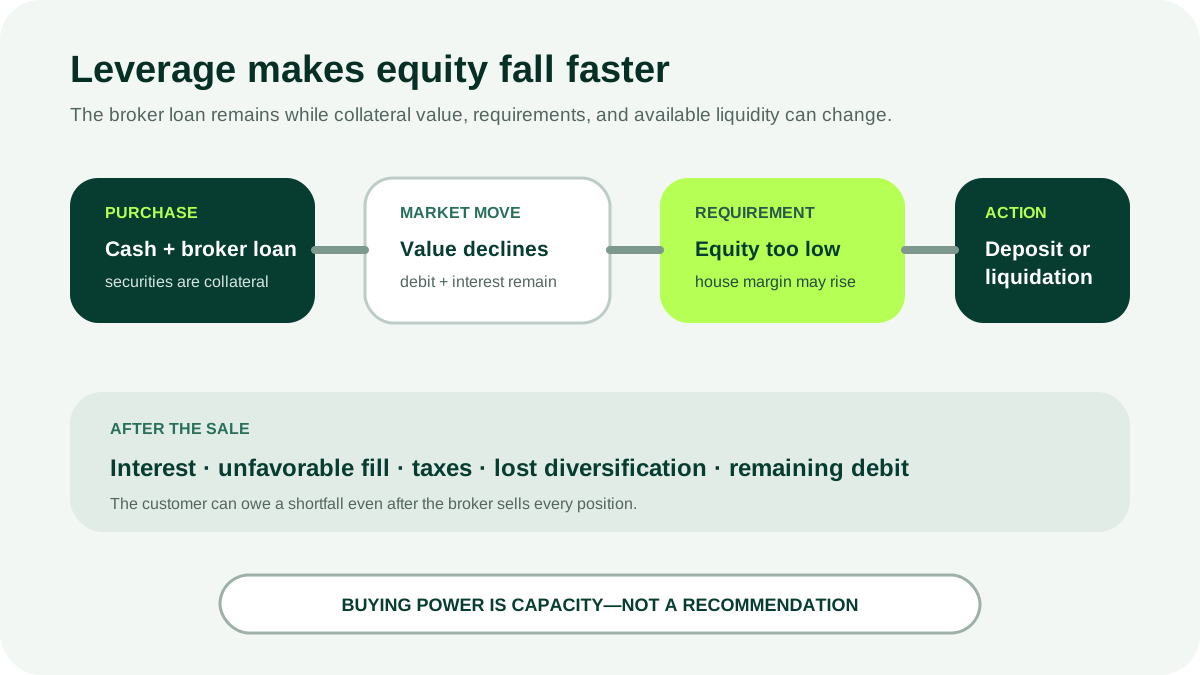
The margin agreement gives the firm important rights. FINRA explains that a firm can set house maintenance requirements above regulatory levels, raise them for a security or account, and sell assets to cover a deficiency. The investor may not receive advance notice or choose which position is sold and remains responsible for any shortfall.
Learn the basic account math
Three values matter:
market value = current value of positionsaccount equity = market value - debit balanceequity percentage = account equity / market value
Suppose an investor deposits $10,000 and borrows $10,000 to buy $20,000 of securities. Initial equity is $10,000, or 50% of market value. If the securities fall 25% to $15,000 and the debit remains $10,000 before interest, equity is $5,000. The asset fell 25%, but investor equity fell 50%.
If the securities instead rise 25% to $25,000, equity becomes $15,000 before interest and costs—a 50% increase on the deposited capital. Leverage magnifies both directions, while borrowing costs make the relationship asymmetric over time.
Separate initial and maintenance requirements
Initial margin applies when a position is established. The Federal Reserve’s Regulation T and FINRA rules establish requirements for covered securities and accounts. Maintenance margin is the equity that must remain as market values change.
Regulatory requirements do not guarantee that a broker will lend the maximum amount. A firm can require more initial equity, set higher ongoing percentages, classify a security as nonmarginable, or concentrate risk under its house policy. Volatile, low-priced, concentrated, leveraged, or thinly traded positions can receive materially higher requirements.
Read the broker’s schedule for long stock, short stock, concentrated positions, options, leveraged exchange-traded products, and securities near corporate events. A percentage displayed when entering the trade may change later.
Calculate a maintenance threshold carefully
For a simplified long position with market value V, debit D, and maintenance rate m, the account meets the requirement when:
V - D >= m × V
Solving for the threshold gives V >= D / (1 - m). With a $10,000 debit and a 30% maintenance rate, the simplified threshold market value is about $14,285.71. Above that amount, the account may meet this one requirement; below it, a deficiency can arise.
This is only an illustration. Real accounts can contain multiple positions, cash movements, accrued interest, options, short positions, concentration add-ons, and different security-level requirements. The broker’s live calculation governs the account.
Understand a margin call and forced liquidation
A margin call is a demand for additional equity, typically satisfied by depositing cash or eligible securities or by reducing positions. It is not a guaranteed grace period. FINRA states that firms can sell securities to eliminate a deficiency and are not required to contact the customer first.
Forced liquidation can create several problems at once:
- sale during a temporary or disorderly decline;
- selection of a position the investor preferred to keep;
- realization of taxable gains or losses;
- sale at a poor price in a thin market;
- remaining debit after collateral is exhausted;
- loss of diversification if only liquid assets are sold;
- restrictions on future trading.
Keeping the broker’s maintenance minimum by a narrow margin is not a safety plan. Market gaps and requirement changes can move the account from compliant to deficient without an opportunity to act.
Account for the 2026 intraday transition
FINRA’s new intraday-margin requirements became effective June 4, 2026. They replace legacy provisions based on the pattern-day-trader designation, day-trade counting, special buying power, and the $25,000 PDT equity minimum. Instead, firms monitor whether a margin account has enough equity relative to its actual intraday exposure.
However, FINRA permits firms to phase in the new framework through October 20, 2027. During this transition, one broker may apply the new intraday system while another continues the legacy PDT rules. Ask the firm which framework applies, when it will change, how deficits are calculated, and whether real-time controls can block an order.
The change does not eliminate ordinary initial and maintenance margin, house requirements, or the risk of losing more than deposited capital.
Model interest as part of the position
Margin interest accrues on the debit under the broker’s rate schedule. Rates can be tiered and variable, often linked to a base rate. Ask how the daily balance is measured, when interest compounds or posts, and whether short balances, currency, or other products have separate charges.
A leveraged position must overcome interest, spread, transaction charges, and taxes before adding value. The longer the debit remains, the larger the hurdle. A position that is flat in price can lose net value through financing cost.
Do not compare only the broker’s advertised lowest rate. Calculate the rate for the actual debit tier and a range of holding periods. Preserve monthly statements so the effective charge can be reconciled.
Treat short selling as a distinct margin risk
In a short sale, borrowed shares are sold and later must be repurchased. Because a security’s price can rise without a fixed upper limit, short-sale loss can be theoretically unlimited. The account can also face stock-borrow charges, dividend-equivalent payments, buy-ins, recalls, and changing requirements.
Short proceeds are not freely withdrawable cash in the ordinary sense. A price rise increases the amount needed to close and can create a margin deficiency. A halt or loss of borrow can make the planned exit unavailable.
Review securities-lending permissions
Margin agreements can permit the broker to lend securities held in a margin account under applicable rules and contract terms. Securities lending can affect voting, dividend treatment, tax reporting, and counterparty arrangements. Fully paid lending programs are separate agreements with their own disclosures.
If lending or voting treatment matters, ask which securities can be lent, how compensation works, who receives distributions, and how the position can be recalled or transferred. Paying off the debit or moving eligible assets to a cash account may change the broker’s rights, subject to the agreement.
Stress-test before borrowing
Build at least five scenarios:
| Scenario | Questions to calculate |
|---|---|
| Moderate decline | Equity, equity percentage, and loss after interest |
| Overnight gap | Whether a stop or deposit can act before the market opens |
| Higher house margin | New required equity with no price change |
| Concentration penalty | Requirement if one holding becomes most of the account |
| Forced sale | Tax, remaining holdings, and possible debit shortfall |
Also model a market closure, trading halt, job loss, bank-transfer delay, and a simultaneous fall across correlated holdings. Do not assume another volatile security will remain acceptable collateral when funds are needed.
Use risk controls outside the broker minimum
If margin is used at all, conservative controls can include:
- a leverage ceiling well below account capacity;
- a liquid reserve outside the brokerage account;
- limits by issuer, sector, and correlated exposure;
- no borrowing against emergency or near-term goal assets;
- alerts based on equity and maintenance excess, not only price;
- written steps for a requirement increase or transfer delay;
- regular reconciliation of interest and house rules;
- an exit plan that does not depend on a guaranteed stop fill.
A broker’s available buying-power number describes permitted capacity, not a recommended position size. More available leverage does not increase the amount the household can afford to lose.
Compare margin with alternatives
Ask what problem borrowing solves. If the objective is simply long-term diversified investing, a smaller unleveraged position may preserve flexibility and eliminate margin-call risk. If cash is needed for spending, selling and addressing tax consequences may be safer than a loan whose collateral can fall and be liquidated.
Other loans have their own cost and collateral risks, but they do not automatically make a margin loan appropriate. Compare rate variability, term, repayment, collateral, tax treatment, and what happens after a market decline with a qualified adviser.
Bottom line
Margin turns an investment account into a secured credit relationship. Calculate equity and maintenance under adverse prices, read the broker’s house rules, include interest and shortfall risk, and understand which 2026 intraday framework the firm uses. Because requirements and markets can change faster than cash can arrive, the only reliable way to eliminate margin-call risk is not to borrow.
Related content
Frequently asked questions
Sources
Related content
More from DollarScout on this topic.
