How to Start Day Trading
By Sophie Brown, Senior Finance Editor · Updated Jul 2026 · Fact-checked Jul 18, 2026
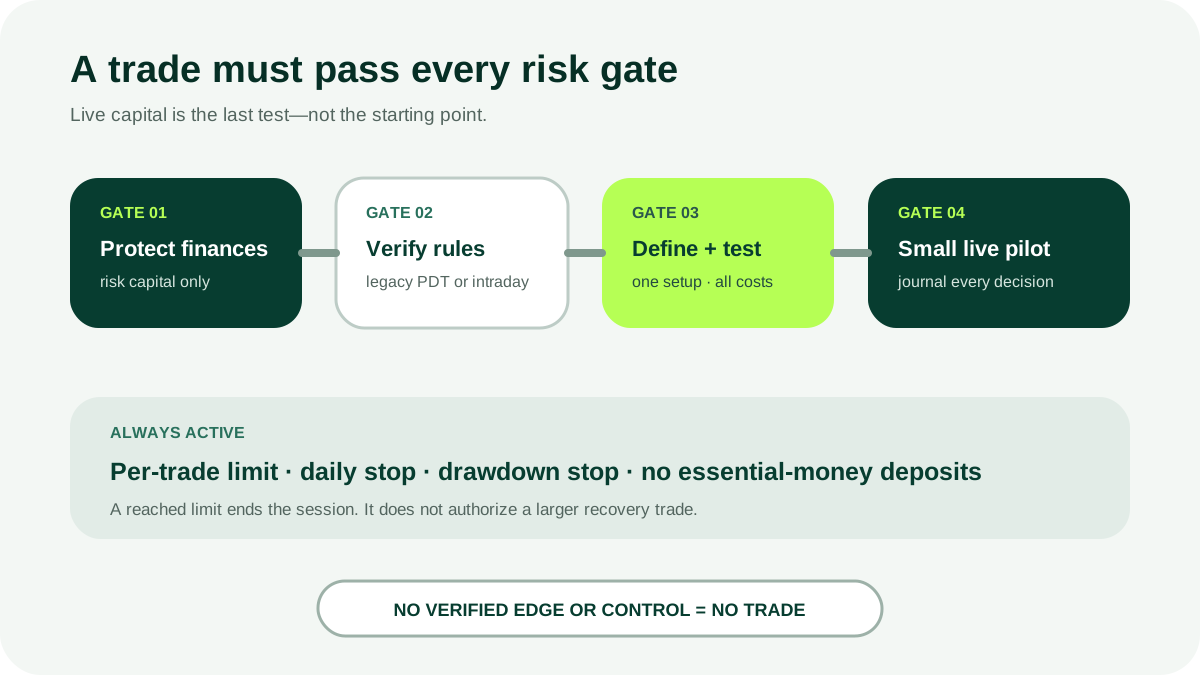
Day trading means opening and closing positions within the same trading day in an attempt to profit from short price moves. It is a high-risk activity, not a shortcut to dependable income. A responsible starting process separates essential money from risk capital, verifies the broker’s current margin regime, specifies one testable setup, models every trading cost, practices without leverage, and uses hard loss limits. This guide explains that process without promising profitability.
Key takeaways
- Use only risk capital; rent, emergency savings, tax money, borrowed funds, and retirement goals do not belong in a day-trading account.
- Ask the broker whether the account follows legacy pattern-day-trader rules or FINRA’s new intraday-margin framework during the transition period.
- Define one market, session, setup, entry, invalidation, exit, and maximum risk before measuring results.
- Include spreads, slippage, data, platform charges, margin interest, options fees, and taxes in every performance calculation.
- Treat simulation and a detailed journal as tests of a process; neither proves that live trading will be profitable.
Decide whether day trading fits the financial plan
Day trading concentrates decisions, volatility, execution risk, and costs into a short window. FINRA’s day-trading risk disclosure says the strategy generally is not appropriate for people with limited resources, limited experience, or low risk tolerance. Short selling and margin can produce losses beyond the initial amount committed.
Before opening a trading account, protect a separate emergency fund, required bills, taxes, insurance deductibles, and near-term goals. Do not count expected trading profits in the household budget. If losing the entire trading allocation would change housing, debt payments, education, health care, or retirement contributions, the allocation is too large.
Understand the 2026 margin-rule transition
The rules changed in 2026, but firms do not all have to switch on the same date. FINRA says its new intraday-margin requirements became effective June 4, 2026, with a permitted broker transition period through October 20, 2027.
Under the legacy framework, a margin-account customer can be designated a pattern day trader based on day-trade frequency and generally faces a $25,000 minimum-equity requirement plus day-trading buying-power rules. Under the new framework, the trade-count designation and special $25,000 PDT minimum are replaced by risk-based intraday-margin monitoring. A firm may block a transaction that would create a deficit or calculate the intraday deficit and require it to be satisfied promptly. Repeated failures can lead to restrictions.
During the transition, ask the broker in writing:
- Has this account moved to FINRA’s intraday-margin framework?
- If not, how does the firm count day trades and apply PDT restrictions?
- What initial, maintenance, and house-margin levels apply to each product?
- Can the firm raise requirements or liquidate positions without prior notice?
- How does it handle options expiration, assignment, short positions, and unsettled funds?
Do not assume a social-media post or another broker’s policy describes your account. Cash accounts also have payment and settlement rules; calling an account “cash” does not make unrestricted rapid trading permissible.
Choose one liquid market and session
Beginners often multiply risk by switching among small-cap stocks, leveraged products, options, futures, and crypto. Start with one product type that the account is approved to trade and whose hours, settlement, quotation, halt, and order rules you understand.
Assess average spread, typical volume, volatility, price increments, market hours, and behavior around news. A narrow quoted spread does not guarantee execution at the displayed price. Liquidity can disappear, prices can gap, and trading can halt.
Define a fixed session. Pre-market and after-hours trading can have different liquidity, spreads, order availability, and execution conditions. A strategy tested during regular hours cannot be assumed to work in an extended session.
Write one complete setup
A setup must be specific enough that two careful reviewers could identify the same historical examples. Record:
- eligible symbols and minimum liquidity;
- exact trading session and chart interval;
- market context required before entry;
- entry trigger and acceptable order type;
- price that invalidates the idea;
- profit-taking and time-exit rules;
- events that prohibit a trade;
- maximum position size and dollar loss;
- maximum trades and daily loss;
- evidence that ends the experiment.
“Buy momentum” or “trade a bullish candle” is not a complete rule. It leaves selection, entry, risk, and exit to emotion after money is exposed.
Understand orders and execution
A market order prioritizes execution, not price. A limit order controls the worst acceptable price but might not execute. A stop order generally becomes a market order once triggered, so the fill can be materially different from the stop price in a fast market. Stop-limit orders add price control but can remain unfilled.
FINRA advises investors to ask how their broker handles orders, especially during volatile markets. Learn whether quotes are real-time, which venues or sessions are included, how partial fills work, and whether an order can trigger outside regular hours.
Never size a trade on the assumption that a stop guarantees the planned loss. Model a worse fill and a price gap. Use the broker’s real order ticket in simulation so routing and order-condition errors appear before live capital is at risk.
Size from the invalidation point
Determine where the trade thesis is wrong before calculating shares. A simple planning formula is:
position quantity = maximum planned dollar loss / risk per unit
If the entry is $50 and the invalidation price is $49.50, the planned price risk is $0.50 per share before slippage and fees. A $25 risk budget would imply no more than 50 shares, and less after a realistic execution allowance. The formula limits planned exposure; it does not cap actual loss.
Set account-level controls as well:
- maximum loss per trade;
- maximum aggregate open risk;
- maximum daily and weekly loss;
- maximum number of trades;
- no adding to a losing position unless explicitly tested;
- no new trade after the platform, data, or connection becomes unreliable.
A daily stop should end trading, not become a target that invites one final oversized attempt.
Measure every cost
“Commission-free” does not mean cost-free. Build a ledger for:
| Cost | How it affects results |
|---|---|
| Bid-ask spread | Creates an immediate difference between buying and selling prices |
| Slippage | Moves the actual fill away from the modeled price |
| Regulatory and contract fees | Can apply per sale or options contract |
| Market data and platform | Recurring fixed cost raises the break-even result |
| Margin interest and borrow fees | Add financing cost and can change quickly |
| Tax | Frequent realization and wash-sale issues can alter after-tax results |
Record gross profit, execution costs, fixed costs allocated to the test, and net profit. Also compare the result with a passive benchmark and the time spent. A positive gross result can be negative after realistic friction.
Simulate, then conduct a small controlled pilot
Replay historical sessions and use paper trading across different volatility conditions. Preserve screenshots and order logs rather than remembering only the best examples. Simulation has limitations: fills may be generous, market impact is absent, and real losses change behavior.
Before live trading, define a sample size and evaluation metrics. Useful measures include expectancy per trade, win rate, average win, average loss, maximum drawdown, rule violations, time in market, slippage, and results by setup and market condition.
If the tested process remains positive after costs and has tolerable drawdowns, use the smallest practical live size. The goal of the pilot is to test execution and behavior, not to generate income. Increase size only under a written rule after a new evidence threshold; never increase it to recover losses.
Keep an audit-quality journal
For every eligible and executed setup, record date, instrument, context, screenshot, entry, planned invalidation, size, orders, fills, costs, exit, result, and rule adherence. Include valid setups skipped and trades taken outside the rules.
Review weekly. Separate strategy failure from execution failure and discipline failure. A profitable rule violation is still a process defect. A correctly executed losing trade can be valid evidence. Change only one meaningful variable at a time and start a new test version when rules change.
Define stop conditions before starting
Stop live trading and reassess when:
- the maximum drawdown or loss limit is reached;
- fills or costs materially exceed test assumptions;
- the setup no longer appears under the defined conditions;
- repeated rule violations occur;
- sleep, work, relationships, or health deteriorate;
- trading losses create pressure to deposit essential money;
- the broker changes margin, product, or execution terms.
Taking a break is a risk control, not a trading failure. If a process cannot survive small size and documented limits, more capital or leverage does not repair it.
Bottom line
Starting day trading responsibly means protecting the household first, confirming the account’s current rules, testing one precise setup, understanding execution, limiting planned and realized losses, and measuring net results. The default outcome of weak evidence should be no trade. Day trading remains speculative even when the process is disciplined, and no chart, course, or tool can make returns dependable.
Frequently asked questions
Sources
Related content
More from DollarScout on this topic.
