
PocketGuard at a glance
PocketGuard is a personal budgeting app organized around a simple question: how much money remains after income, bills, planned savings, debt payments, and budgeted spending? Its Leftover calculation turns that answer into a current spending guide. The app also supports category budgets, rollovers, recurring bills, goals, subscription tracking, debt payoff, rules, imports and exports, and connected or manual accounts.
The simplicity is useful when a complex dashboard prevents action. It can also hide assumptions. A Leftover value is only dependable when income dates, future bills, transfers, debt minimums, and account balances are correct. Users must understand the inputs rather than treating one large green number as permission to spend.
| Review question | DollarScout finding |
|---|---|
| Best for | Simple safe-to-spend guidance and structured debt payoff |
| Annual price | $74.99, equivalent to about $6.25 per month |
| Monthly price | $12.99 |
| Trial | Seven days; subscriptions auto-renew unless canceled in time |
| Main limitation | No durable free tier advertised and lighter investment depth |
Pricing, trial, and lifetime offer
Value earns 4.1/5. PocketGuard’s current pricing page lists $74.99 billed annually or $12.99 billed monthly in U.S. dollars. The annual plan equals about $6.25 per month and saves $80.89 compared with twelve monthly payments. A seven-day trial provides access before renewal.
PocketGuard’s pricing FAQ says some users may see a lifetime offer inside the app. The public page does not promise the same lifetime price or availability to everyone. Its terms define lifetime as the lifetime of the service, not the purchaser’s life; access ends if PocketGuard ceases operating. Evaluate the actual in-app offer and refund terms rather than repeating a historical price.
The pricing page presents Premium as the current product and does not advertise a stable permanent free plan. PocketGuard’s terms describe limited basic access for a short period after cancellation, but that is not equivalent to an ongoing free tier on which a long-term budget should depend.
All subscriptions auto-renew. PocketGuard instructs users to cancel at least 24 hours before renewal. Apple, Google, and web purchases can use different management portals, so save the confirmation from the channel that actually charged the subscription.
Before paying annually, build at least one rollover budget, add every irregular bill due in the next quarter, and compare Leftover with the actual checking cushion. That short test reveals whether the simplified number is complete enough to guide spending.
Leftover and budgeting strategies
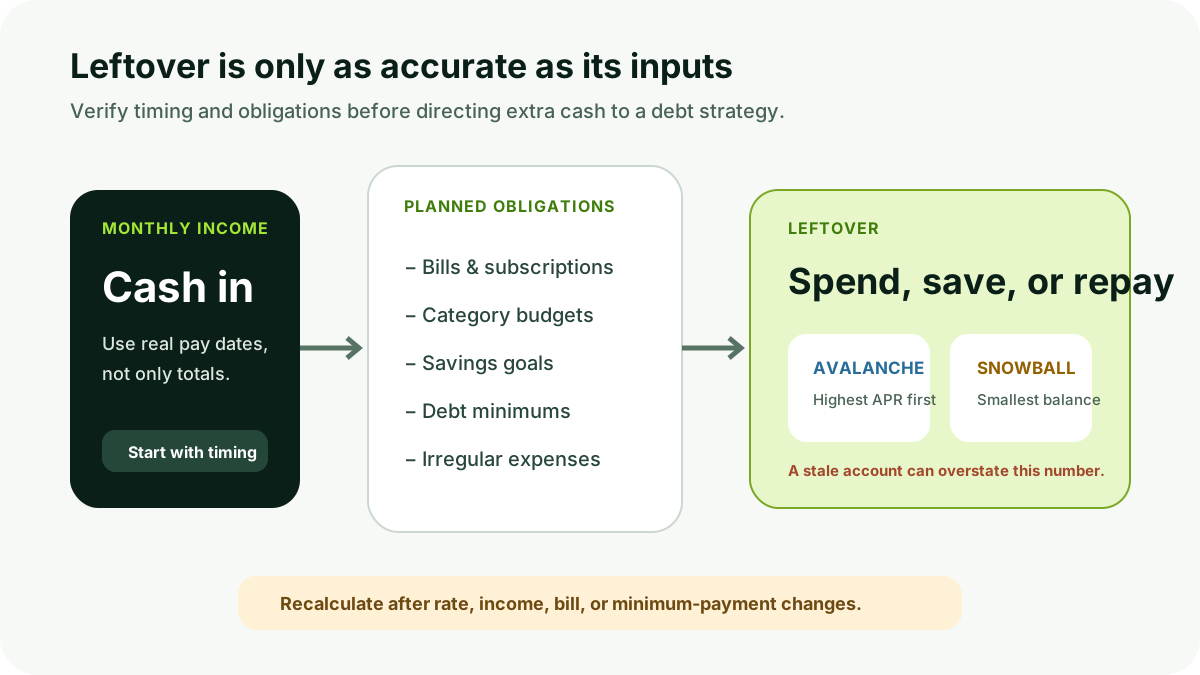
Ease of Use scores 4.6/5. Leftover begins with monthly income and accounts for bills, budgets, goals, and other planned obligations. It answers a narrower question than net worth: how much appears uncommitted within the current plan.
The calculation is helpful for variable daily spending. It is not a substitute for cash-flow timing. A paycheck due next week cannot cover a bill due tomorrow, even if both appear in the same monthly model. Review dates and keep a checking cushion.
PocketGuard supports both its Leftover strategy and custom budgeting. Unlimited categories, rollovers, custom goals, and insights allow more control than the name’s simple premise suggests. A rollover can carry underspending or overspending forward rather than resetting the plan artificially each month.
Budget categories should reflect decisions, not every merchant. Too much granularity creates maintenance without changing behavior. A small number of flexible categories plus fixed and irregular obligations makes the Leftover figure easier to audit.
Debt payoff plan
Features earns 3.9/5. The debt payoff plan is one of PocketGuard’s most useful specialized features. Users enter balances, minimum payments, APRs, any promotional terms, and a total monthly debt budget. The app can prioritize accounts by snowball—smallest balance first—or avalanche—highest APR first.
Avalanche generally minimizes interest when balances, rates, and payments behave as modeled. Snowball can produce faster account closures and psychological momentum. Both require minimum payments on all debts and apply the remaining payoff budget to the priority account.
The plan is a projection. Variable rates, new charges, fees, deferred-interest promotions, and payment allocation rules can change the result. Creditors’ statements control required amounts and dates. A 0% promotion should include its expiration and any deferred-interest condition, not merely a zero APR.
PocketGuard allocates the debt payoff budget from Leftover. If income or essential bills change, users should recalculate before following the old schedule. An aggressive plan that causes overdrafts or new card balances can increase total cost.
Bills, subscriptions, and goals
Recurring and upcoming bill views help identify obligations before they post. Subscription tracking can surface repeated charges, while pricing materials advertise tools to lower bills and cancel unwanted subscriptions. Confirm what is self-service versus assisted in the current account before assuming a concierge outcome.
Goals can be manual or connected to accounts. They support emergency funds and planned purchases, but a goal label does not isolate money at the financial institution. A user can still spend the underlying balance outside PocketGuard.
Investment tracking is not the product’s strength. PocketGuard is better suited to spending, bills, savings, and debt than portfolio allocation, holding-level analysis, or performance measurement. Households needing comprehensive investments and collaboration should compare Monarch.
Account connections
Account Syncing receives 4.0/5. PocketGuard supports U.S. and Canadian institutions and announced Plaid as a second aggregation provider in 2026. Users with a missing bank or persistent error can attempt the Plaid route when available. A second provider improves options but does not eliminate institution-specific failures.
Common errors require action at the bank: accepting new terms, changing authentication, completing multi-factor verification, or unlocking an account. Language settings and institution outages can also interfere. PocketGuard directs unresolved cases to support.
Manual accounts and cash transactions provide a fallback. Imports and exports help migrate or preserve data. The workflow should be tested with a small sample because category formats and signs can differ among apps.
Apple Card, pending transactions, and freshness
PocketGuard added an Apple Wallet connection for Apple Card, Apple Cash, and Savings. Its June 2026 guide requires iOS 17.4 or later, the current PocketGuard app, and Background App Refresh. The connection is initiated on iPhone, not from the web or Android.
Pending transactions can change amount or merchant data when they post. PocketGuard’s June 2026 update preserves edits to pending activity and lets users transfer those edits to the replacement posted transaction. This is useful, but the user must match the correct records.
No aggregator guarantees a live balance. Compare PocketGuard with the bank before making a large payment, and investigate any account that has not refreshed on its normal schedule.
Platforms and support
PocketGuard lists web, iPhone, Apple Watch, and Android. That is broader native support than Copilot. The web app is useful for setup and larger-screen review, while mobile access supports day-to-day checks.
Customer Service scores 3.8/5. Premium advertises priority human support and AI chat, and PocketGuard publishes a help center and support email. DollarScout did not submit timed cases. The score recognizes accessible documentation but leaves room for the dependency on banks and aggregators during connection disputes.
AI chat should not be treated as individualized financial advice. Verify debt rates, contractual terms, and account information in primary statements before acting.
Privacy and security
PocketGuard says it has no ads, does not sell data, and monitors for suspicious activity. Bank connections pass through aggregation providers. Users should read the authorization scope, protect account and email credentials, and remove unused connections.
CSV exports, debt details, and net-worth information are sensitive. Store exports securely and delete unneeded copies. A lifetime purchase does not reduce the importance of reviewing privacy changes over time.
Alternatives
Choose Rocket Money when subscription cancellation assistance and bill negotiation are the primary jobs. Choose YNAB for a more rigorous allocation method, longer trial, and household sharing. Choose Copilot Money for a more polished U.S. transaction and investment interface if Android is not needed.
PocketGuard has a lower current annual price than these major paid alternatives and a clearer debt workflow. It is less compelling for deep investment tracking or a household requiring separate collaborator logins and account visibility controls.
Who should use PocketGuard
PocketGuard fits users who:
- Want a single Leftover number backed by a visible budget.
- Need avalanche or snowball debt projections.
- Prefer web plus iOS or Android support.
- Can test bank connections during the seven-day trial.
- Value a $74.99 annual plan more than broad investment analytics.
It is easier to skip when a permanent free plan, advanced portfolio tools, unlimited household collaboration, or aggregator-independent data is required.
Bottom line
PocketGuard earns 4.1/5. It combines an approachable Leftover calculation with capable budgets, bills, goals, subscriptions, rules, account connections, and an unusually practical debt payoff planner. The annual price is competitive, and the new Plaid option improves connection resilience.
The user must still validate the model. Seven days is a short trial, lifetime offers vary, aggregators can fail, and Leftover can be wrong when inputs are stale. Test the important accounts immediately, add irregular obligations, compare the debt schedule with statements, and confirm the number remains useful across several pay cycles before committing long term.