Many products on this page are from partners who compensate us. This doesn't influence our ratings. Our opinions are our own.
The 50/30/20 Rule Explained
By Sophie Brown, Senior Finance Editor · Updated Jul 2026 · Fact-checked Jul 18, 2026
The 50/30/20 rule divides after-tax income among needs, wants, and saving or extra debt payments. It is a diagnostic starting point, not a pass-or-fail test. This guide shows the exact calculation, resolves the categories people commonly misclassify, and explains how to adapt the percentages when housing, benefits, or debt make the textbook split unrealistic.
Key takeaways
- Start with spendable after-tax income, including payroll deductions that already fund savings.
- Treat contractual minimum debt payments as needs and payments above the minimum as saving or debt reduction.
- Use the three percentages to locate pressure in the budget, not to judge a household whose costs differ from the model.
- Track a three-month average and change one category at a time instead of forcing a perfect split immediately.
- Keep irregular necessities and payroll retirement contributions in the calculation so the result is not falsely optimistic.
What the 50/30/20 rule actually measures
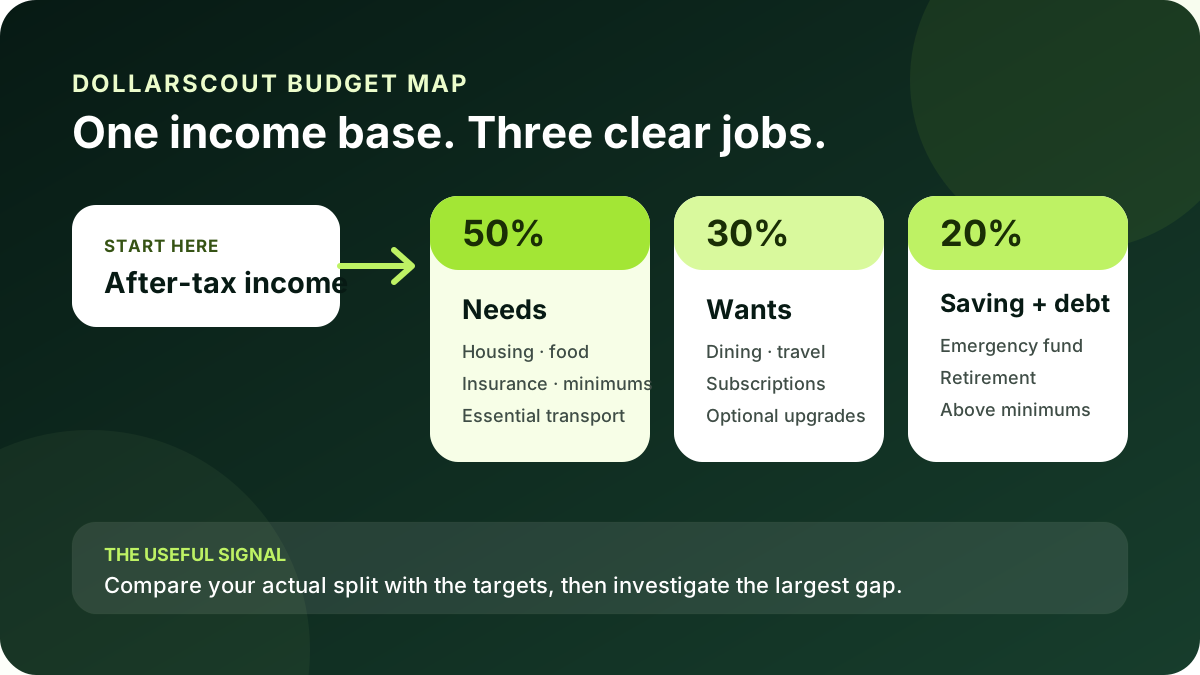
The rule assigns 50% of after-tax income to needs, 30% to wants, and 20% to saving plus payments above required debt minimums. Its useful output is not the three target numbers. It is the gap between those targets and the household’s actual spending. A household at 63/17/20, for example, does not automatically have a spending-discipline problem. The result says that necessities consume more of its cash flow than the model anticipates. Housing, health insurance, child care, transportation, or debt minimums may explain the difference.
That distinction matters because a ratio cannot decide whether rent is locally reasonable, a car is essential for work, or a medical bill can be renegotiated. The CFPB’s “rules to live by” worksheets describe percentage rules as guidelines that should be adapted to a person’s circumstances. Consumer.gov’s budgeting guidance makes the broader point: list income and expenses, subtract expenses from income, track actual spending, and use the result to adjust the next month. The percentage framework sits inside that process; it does not replace it.
Step 1: calculate the right income base
Use money that is genuinely available after federal, state, local, Social Security, and Medicare taxes. For a salaried employee, the bank deposit alone may still be the wrong number because the pay stub can contain deductions that belong in the budget. A traditional 401(k) contribution, Roth contribution, health savings account deposit, or automatic savings deduction is money already directed toward the 20% bucket. If it is omitted from both income and saving, the household’s saving rate will appear lower than it really is.
A practical reconciliation starts with gross pay and records every deduction:
| Pay-stub item | Treatment in this calculation |
|---|---|
| Income and payroll taxes | Remove from the income base |
| Employee health premium | Count as a need |
| Required pension contribution | Count as saving unless the plan requires a different household treatment |
| Voluntary 401(k), 403(b), IRA, or HSA contribution | Count toward the 20% bucket |
| Wage garnishment or required debt payment | Count according to the underlying obligation |
| Net deposit | Reconcile to the checking-account credit |
Someone with variable income should not build the plan from a single strong month. Consumer.gov suggests using prior-year income divided by 12 when pay does not arrive monthly. A more cautious household can use the lower of that average and a recent rolling average, then decide in advance how to allocate income above the baseline. Self-employed readers should separate business revenue, business expenses, and tax reserves before treating an owner draw as household income.
Step 2: distinguish needs from wants consistently
A need is an expense required to maintain basic life, earn income, meet a legal or contractual obligation, or keep essential protection in force. Typical needs include basic housing, utilities, groceries, required transportation, essential insurance, child care needed for work, minimum debt payments, and necessary medical care. The amount counted should be the necessary version of the expense, not automatically the full bill. A basic mobile plan may be a need; premium device financing and extra entertainment services can be wants on the same statement.
A want improves convenience, comfort, or enjoyment and can be reduced or delayed without violating an obligation. Restaurants, vacations, optional subscriptions, premium upgrades, hobby purchases, and the discretionary portion of housing or transportation usually fit here. The classification depends on function rather than merchant. A grocery-store purchase can include food, medicine, cosmetics, and alcohol; importing the entire transaction as “groceries” can hide wants inside a needs category.
Three difficult cases deserve explicit rules:
- Debt: the required minimum belongs with needs because missing it has contractual and credit consequences. Principal paid above the minimum belongs with the 20% saving/debt-reduction bucket.
- Housing: the current rent or mortgage payment is a need in the short term. The portion attributable to a deliberately larger or more expensive home may be discretionary for long-range planning, but pretending it can change next month is not useful.
- Annual bills: vehicle registration, insurance premiums, school costs, and predictable repairs remain needs even when they are not monthly. Divide the expected annual amount by 12 and reserve that amount each month.
Write the classification policy in the budget. Consistency makes month-to-month comparisons meaningful and prevents a category from moving merely to make the ratios look better.
Step 3: calculate the three percentages
Add every item in each bucket, including payroll deductions and monthly reserves for irregular expenses. Then divide each bucket by after-tax income.
For a household with $5,000 of monthly after-tax income, the starting targets are:
- Needs: $5,000 × 0.50 = $2,500
- Wants: $5,000 × 0.30 = $1,500
- Saving and extra debt payments: $5,000 × 0.20 = $1,000
Suppose the actual totals are $3,050 of needs, $950 of wants, and $1,000 of saving. The result is 61/19/20. The household is meeting the saving target, but the needs share is 11 percentage points above the guideline. The next question is not “How do we force needs to $2,500?” It is “Which large necessity creates the gap, when can it change, and does the low wants share make the current plan sustainable?” If rent is responsible and the lease has nine months remaining, the immediate plan may be to preserve the 20% saving rate and revisit housing before renewal.
How to adapt the rule without making it meaningless
Keep the three buckets but change the targets deliberately. A high-cost-city renter might use 60/20/20. A household attacking high-interest debt could use 55/15/30. A lower-income household may begin at 70/25/5 while it works on income, housing, benefits, and the first emergency reserve. Write the temporary target, the reason, and the date it will be reviewed.
Prioritize the constraint with the largest financial consequence. Missing rent, utilities, insurance, or required debt payments is more urgent than preserving a 30% wants allowance. At the same time, eliminating every want indefinitely often produces a plan that is abandoned. A small, explicit discretionary allowance is more honest than a zero-wants budget that repeatedly breaks.
The 20% bucket also needs an internal order. A reasonable sequence can include capturing an employer retirement match, building a starter emergency reserve, paying high-cost debt, expanding the emergency fund, and investing for long-term goals. The exact order depends on interest rates, job stability, insurance, taxes, and employer benefits. The rule says how much cash flow is available; it does not resolve every tradeoff inside that amount.
Common errors that make the ratio unreliable
- Using gross income. The targets then claim money that taxes have already removed.
- Ignoring payroll saving. Retirement or HSA contributions disappear from the 20% total.
- Counting credit-card purchases and the card payment. This double-counts the same spending. Categorize purchases, then treat the payment as a balance transfer between accounts unless it includes repayment of earlier debt.
- Leaving out non-monthly necessities. The budget looks affordable until insurance, registration, or repairs arrive.
- Calling every current expense a need. The result cannot reveal adjustable spending.
- Treating every target miss as a personal failure. Percentages do not account for location, disability, dependents, health costs, or income volatility.
A monthly review that takes 20 minutes
Reconcile income to pay stubs and deposits. Confirm that every transaction appears once. Review uncategorized and split transactions. Add payroll saving and monthly reserves. Calculate actual percentages and compare them with both the original 50/30/20 guideline and the household’s temporary target. Finally, choose one action for the next month: cancel one unused subscription, request an insurance re-quote, move a windfall to debt, increase an automated transfer, or research a major expense before its renewal date.
The goal is a budget that improves decisions, not a report card. When the ratio changes, write the reason. A higher needs share after an insurance premium increase is different from a higher needs share caused by misclassification. A lower saving share during a planned emergency is different from quietly abandoning the goal.
Bottom line
The 50/30/20 rule is most useful as a common language for cash flow. Start with reconciled after-tax income, classify expenses by function, include irregular costs and payroll savings, and examine a rolling average. Keep the percentages flexible enough to reflect reality but stable enough to expose the household’s true constraint. If the split is far from 50/30/20, the output is a question to investigate—not a verdict.
Related content
Frequently asked questions
Sources
Related content
More from DollarScout on this topic.
