Many products on this page are from partners who compensate us. This doesn't influence our ratings. Our opinions are our own.
Rocket Money vs PocketGuard: 2026 Budget App Comparison
By Sophie Brown, Senior Finance Editor · Updated Jul 2026 · Fact-checked Jul 19, 2026
Rocket Money wins narrowly at 4.2/5 versus PocketGuard at 4.1/5. Rocket Money has the stronger feature set and a usable free mobile tier, with Premium generally offered on a sliding scale around $7 to $14 per month after a seven-day trial. PocketGuard is the more structured spending-and-debt planner, charging $74.99 annually or $12.99 monthly after a seven-day trial. Choose Rocket Money for subscription visibility, optional bill negotiation, and a free starting point; choose PocketGuard for its Leftover framework and built-in avalanche or snowball debt plan.
Head-to-head
| Feature | Rocket Money | PocketGuard |
|---|---|---|
| DollarScout Rating | 4.2/5 ★ | 4.1/5 ★ |
| Pricing | Free mobile tier; Premium typically $7–$14/month after a 7-day trial; successful bill negotiation costs 35%–60% of first-year savings | $74.99/year or $12.99/month after a 7-day trial; a separate lifetime offer may appear to some users in the app |
| Platform Support | iOS and Android; full desktop web experience requires Premium | Web, iPhone, Apple Watch, and Android |
| Account Linking | Plaid connections for checking, savings, credit cards, and investment accounts, with refresh frequency dependent on plan and institution | U.S. and Canadian connections through aggregation providers including Plaid, plus manual cash accounts and Apple Wallet support |


Category-by-category breakdown
Features
Ease of Use
Account Syncing
Value
Customer Service
Detailed analysis
The short answer
Rocket Money is the better subscription and bill-management hub; PocketGuard is the better structured spending-and-debt planner. DollarScout rates Rocket Money 4.2/5 and PocketGuard 4.1/5. Rocket Money wins Features. Ease of Use, Bank Syncing, Value, and Customer Service are ties.
| Decision factor | Rocket Money | PocketGuard |
|---|---|---|
| Best fit | Subscription review, bill tools, and a free mobile start | A clear spendable amount and debt payoff plan |
| Free access | Ongoing mobile tier with core features | Seven-day trial; paid plans are the standard offer |
| Current paid price | Premium generally $7–$14 monthly; user selects within the offered range | $74.99 annually or $12.99 monthly |
| Web access | Full web app is a Premium benefit | Web included with paid access |
| Signature tool | Subscription identification and optional bill negotiation | Leftover plus avalanche or snowball debt planning |
| Platforms | iOS, Android, and Premium web | iPhone, Apple Watch, Android, and web |
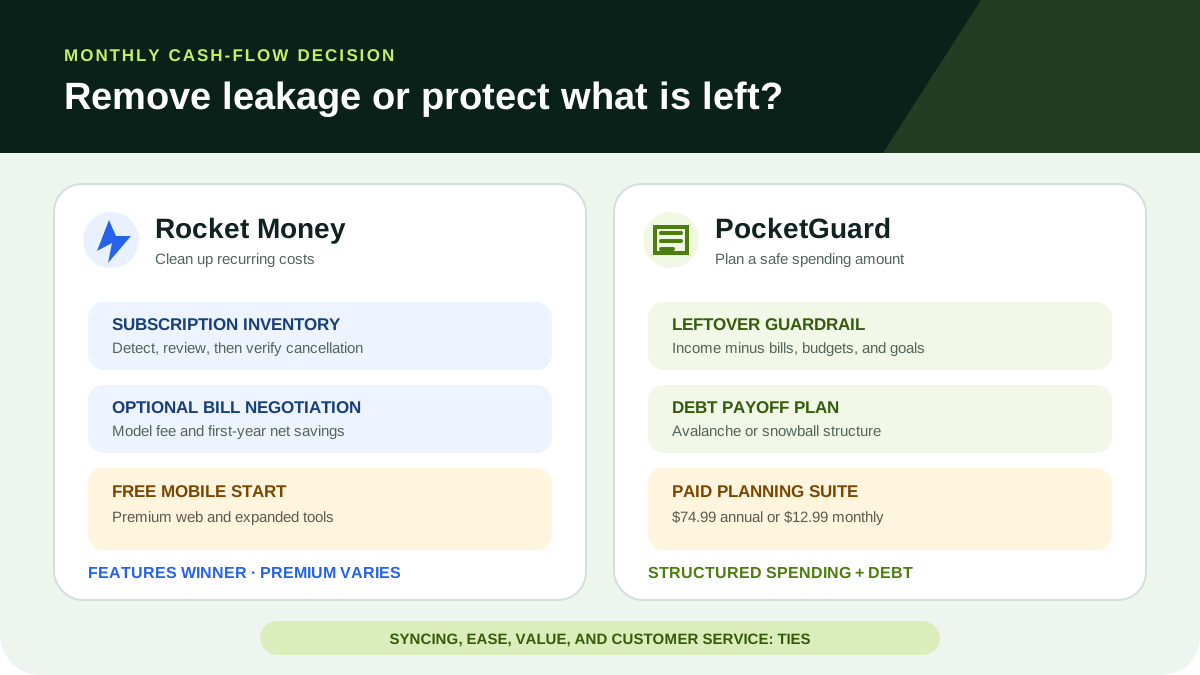
Pricing is not a simple monthly comparison
Rocket Money maintains a free mobile tier for linked accounts, alerts, subscription visibility, and basic spending tools. Premium adds the full desktop experience, more customization and budgets, premium support, net-worth and credit-related features, cancellation assistance, and other tools described in the current membership page. Rocket says Premium commonly uses a sliding price selected by the customer, generally around $7 to $14 per month after a seven-day trial.
PocketGuard lists $74.99 per year, equivalent to about $6.25 per month when divided across 12 months, or $12.99 billed monthly after a seven-day trial. Its paid product includes unlimited linked and manual accounts, custom categories, cash and bill planning, debt payoff, transaction import and export, web access, and support. Lifetime pricing may appear in an app or promotion, but it should not be assumed from the standard public page.
For one paid year, annual PocketGuard is usually lower than paying Rocket's upper monthly Premium price. Rocket can be cheaper when the free mobile tier does enough. The comparison changes if a customer purchases bill negotiation, Premium+, or another optional service.
Value is a tie: Rocket Money 4.1/5, PocketGuard 4.1/5. Rocket offers a credible zero-dollar entry; PocketGuard offers a clear annual price for its complete planning workflow.
Features: Rocket Money wins
Rocket Money combines account and transaction aggregation, subscription detection, upcoming bills, category budgets, spending reports, savings goals, net worth, credit information on eligible plans, cancellation assistance, and optional bill negotiation. Its strongest use case is identifying recurring charges and moving from awareness to action.
PocketGuard provides linked and manual accounts, recurring bills and income, category budgets, savings goals, transaction rules, cash-flow forecasting, data import and export, net worth, Leftover, and a debt payoff plan. It offers a more coherent budgeting structure than its name might suggest.
Rocket wins Features 4.3/5 to 3.9/5 because its subscription and bill-service layer reaches beyond standard tracking. That does not make every add-on a good purchase. A feature deserves weight only when it saves more than its full monetary and privacy cost.
The difference between a detected subscription and a canceled one
Rocket Money is good at grouping recurring activity so a customer can see subscriptions, memberships, and bills in one place. Detection is probabilistic. A quarterly insurance premium, an annual domain renewal, a variable utility bill, or a merchant with inconsistent descriptors may be missed or classified incorrectly.
Cancellation assistance also has limits. Some merchants require the account holder to contact them, return equipment, pay an early-termination charge, or complete a provider-specific process. Removing a recurring item from a dashboard does not cancel the legal agreement or payment authorization.
Use the app to build an inventory, then verify cancellation directly with the merchant. Save the confirmation number, effective date, final charge, equipment receipt, and next statement. Check the linked card again after the next expected billing date.
PocketGuard can identify recurring bills and subscriptions too, but it is less centered on a cancellation-service promise. Customers who prefer to handle merchants directly may not value Rocket's feature advantage as highly.
Bill negotiation: model the fee before saying yes
Rocket Money can seek a lower rate or new promotion for eligible bills. Its help center says the ordinary success fee is selected between 35% and 60% of estimated first-year savings and is charged only after a successful negotiation. The current terms also describe Premium+, a separate membership that can include bill negotiation without the negotiation success fee. Customers should verify which product, fee, payment schedule, and service rules appear in their account.
Suppose a bill falls by $20 per month for 12 months. Estimated first-year savings are $240. A 35% success fee would be $84; a 60% fee would be $144. Net first-year savings would be $156 or $96 before any taxes, service changes, new contract term, equipment charge, or later price increase.
That calculation assumes the discount lasts a full year. A six-month promotion, a package change, or an estimate based on a different baseline can produce a different economic result. Read the confirmation and compare service level, speed, data allowance, channels, equipment, contract term, autopay requirements, and expiration date.
Rocket's terms explain that negotiation may require authorization and provider-account information. Limit the scope, change exposed credentials where appropriate after the process, and verify the resulting account directly with the biller. A customer who is comfortable calling the provider can negotiate without sharing a success fee.
PocketGuard's Leftover framework
PocketGuard's core calculation starts with expected income, planned bills, goals, budgets, and other obligations to estimate what remains available. The company has evolved the language around “In My Pocket” into Leftover, but the decision concept remains useful: translate a complicated month into a conservative amount that has not already been assigned.
The number is only as reliable as its inputs. A missed annual premium, irregular medical bill, stale bank balance, optimistic income estimate, or credit-card payment counted incorrectly can overstate spendable cash. Customers with variable income should use a lower confirmed-income baseline and maintain a buffer rather than treating the entire displayed Leftover as permission to spend.
Rocket Money also supports budgets and upcoming bills, but PocketGuard makes this residual-spending decision more central. That can be valuable for someone who wants one guardrail rather than many reports.
Debt payoff: math plus behavior
PocketGuard's debt payoff plan supports avalanche and snowball strategies. Avalanche prioritizes the highest interest rate and generally minimizes interest when payments and rates behave as expected. Snowball prioritizes the smallest balance, creating earlier account closures that some customers find easier to sustain.
Neither strategy changes minimum-payment obligations. Enter the balance, annual percentage rate, minimum, due date, promotional expiration, and extra payment accurately. A deferred-interest retail offer is not the same as a conventional 0% introductory card: failing to pay under the offer's terms can trigger retroactive interest.
Rocket Money can track debt and financial progress, but PocketGuard's explicit payoff workflow is the stronger reason to choose it. A planner is not a credit counselor; customers facing missed payments, collections, or unaffordable essentials should contact creditors early and consider a reputable nonprofit counseling resource.
Ease of use: a tie
Rocket Money scores 4.5/5 and PocketGuard 4.6/5. PocketGuard's Leftover concept gives the home screen a clear purpose. Rocket Money's subscription-centered dashboard is immediately understandable and its mobile free tier reduces commitment during setup.
Both products can become noisy after many accounts and categories are connected. Start with checking, the primary credit card, and the most important recurring bills. Confirm transfers are excluded from spending, reimbursements are handled consistently, and credit-card payments do not double-count an expense already captured at purchase.
Ease of Use is a tie. PocketGuard has the slightly higher score; the 0.1-point difference is not large enough to claim a meaningful universal advantage.
Bank syncing: a tie
Rocket Money and PocketGuard depend on data aggregators and the institution's supported access. PocketGuard publishes troubleshooting for connection errors and guides for Plaid and Apple financial accounts. Some institutions require periodic reauthentication; others restrict transaction history or refresh timing.
Rocket Money's linked accounts similarly can experience delays, duplicates, missing accounts, and pending-to-posted changes. Its free tier is useful for testing whether the actual institution works before paying for a broader feature set.
DollarScout scores Rocket 4.1/5 and PocketGuard 4.0/5 for Bank Syncing, a tie. Test the actual household, not a logo list. Compare balances with statements, observe several posting cycles, and keep a manual route for unsupported property, cash, loans, or small institutions.
Do not repeatedly enter credentials into a connection loop without checking the domain and provider. A persistent failure may be institution-side and should be escalated through official support.
Pending transactions and manual edits
PocketGuard explains that pending transactions can be edited but may later be removed and replaced when the bank sends the posted record. Categorizing both can temporarily double-count spending. Rocket Money faces the same underlying aggregation behavior even when its interface presents the transition differently.
Wait for posting before performing a final reconciliation. If a pending transaction needs immediate planning treatment, flag it and verify that the posted version replaces it. Review transfers, refunds, cash withdrawals, tips, and split purchases separately.
Manual accounts are useful for completeness but become stale quickly. Add a monthly reminder to update balances and record the valuation date. Net worth should not imply precision that the underlying data does not have.
Web and device access
Rocket Money says its full desktop/web experience is exclusive to Premium, while free members continue to use core mobile features. That distinction matters for a customer who expects to manage categories and reports on a large screen before paying.
PocketGuard's paid subscription supports web, iPhone, Apple Watch, and Android. The Apple Watch view is convenient for a quick number but does not replace a monthly reconciliation. Platform availability can change, so confirm device and regional eligibility in the relevant app store.
Choose based on the device used for the weekly review, not merely the phone used during sign-up.
Security and privacy
PocketGuard states on its pricing page that the paid model is ad-free and that it does not sell customer data. Rocket Money publishes a privacy notice covering account, transaction, device, service, and partner data. Both services process highly sensitive financial information even when a connection is read-only.
Use a unique password, multifactor authentication where offered, and a protected email account. Review connected institutions, support sessions, bill-negotiation permissions, and downloaded exports. Remove obsolete accounts and do not send passwords, full account numbers, or one-time codes through ordinary support messages.
Subscription detection can reveal health, political, religious, relationship, and location information from merchant names. Treat exported transaction files as sensitive records and encrypt them outside the service.
Customer service: a tie
Rocket scores 3.9/5 and PocketGuard 3.8/5. Both use help centers, chat, and digital support workflows. PocketGuard advertises priority human support alongside its AI chat on the paid plan. Rocket's support burden extends into cancellation and negotiation services, where the responsible party may be Rocket, the provider, or a third-party service path.
For a connection problem, include institution, account type, last successful refresh, error text, and sanitized screenshots. For a negotiation or cancellation, include the authorization date, merchant, service level, confirmation, and disputed charge. Escalate billing disputes through official channels rather than social-media replies.
Who should choose Rocket Money?
Choose Rocket Money to audit subscriptions, test account aggregation without a paid annual commitment, use its mobile alerts and spending tools, or evaluate optional cancellation and negotiation help. It is the stronger choice when recurring-cost cleanup is the main financial project.
Do not authorize negotiation until the success fee or Premium+ treatment, estimated savings, affected service, and contract consequence are clear. Free access does not make every optional service free.
Who should choose PocketGuard?
Choose PocketGuard when the customer wants a structured Leftover number, a built-in avalanche or snowball debt plan, broad paid device access, and a predictable $74.99 annual subscription. It is a good fit for someone who wants to turn bills and goals into a daily spending guardrail.
Do not rely on Leftover until irregular expenses, income volatility, transfers, and debt payments have been tested across a complete monthly cycle.
Final verdict
Rocket Money wins narrowly because it has the broader feature set and an ongoing free mobile route. PocketGuard can still be the better product for disciplined budgeting and debt repayment. Because four of five scored categories are ties, the decision should turn on subscription cleanup versus structured cash allocation—not the 0.1 overall rating gap.
Which one is right for you?
- Best for Subscription inventory and cancellation workflow: Rocket MoneyTry Rocket Money
- Best for Free mobile starting point: Rocket MoneyTry Rocket Money
- Best for Structured daily Leftover guardrail: PocketGuardView PocketGuard
- Best for Built-in avalanche or snowball debt plan: PocketGuardView PocketGuard
Final verdict
Rocket Money wins 4.2/5 to 4.1/5 for its broader subscription, bill, and optional negotiation tools plus an ongoing free mobile tier. PocketGuard is the better structured choice for Leftover-based spending and avalanche or snowball debt planning. Price optional services separately and test bank feeds before committing.
Frequently asked questions
Sources and verification
Scores and product facts come from the underlying DollarScout reviews and were checked against these primary sources.
- Rocket Money pricing and Premium cost
- Rocket Money Premium membership features
- Rocket Money desktop access
- Rocket Money Premium membership management
- Rocket Money bill-negotiation savings process
- Rocket Money getting-started guidance
- Rocket Money product overview
- Rocket Money privacy notice
- PocketGuard pricing and included features
- PocketGuard debt payoff plan
- PocketGuard account-connection troubleshooting
- PocketGuard Plaid connection guide
- PocketGuard Apple financial-account linking
- PocketGuard pending-transaction behavior
- PocketGuard terms of service
Related content
More from DollarScout on this topic.
