
Monarch Money at a glance
Monarch Money is a paid personal-finance platform designed to assemble a household’s accounts, transactions, budgets, bills, investments, goals, and net worth in one place. It is closer to a broad financial dashboard than a strict budgeting method. Users can choose category budgeting or the more flexible Flex Budget, build transaction rules, create reports, track recurring charges, and collaborate with a partner or adviser.
The breadth is the reason to consider Monarch and also the reason to configure it carefully. A dashboard containing duplicate accounts, stale investment balances, misclassified transfers, and categories nobody reviews creates false confidence. The app works best when the household establishes a clean starting date, verifies its most important connections, and assigns ownership for reviewing new transactions.
| Review question | DollarScout finding |
|---|---|
| Best for | Households wanting one shared view across spending, investments, and goals |
| Current annual offer | $99.99 billed annually, plus tax where applicable |
| Trial | Seven days on the current web offer |
| Connections | Plaid, MX, and Finicity, plus manual accounts and CSV imports |
| Main limitation | All invited household members can see every connected account |
Pricing and trial
Value earns 4.1/5. Monarch’s current web pricing offer lists $99.99 billed annually, equivalent to about $8.33 per month, with a seven-day trial. The checkout also presents a monthly option, and promotional codes or app-store prices can differ. DollarScout uses the continuing annual list price for comparison and does not treat a new-customer discount as the long-term cost.
There is no permanent free plan. The subscription includes unlimited account connections, the complete feature set, web and mobile access, and unlimited collaborators. The price is competitive for a couple replacing several spreadsheets or dashboards. It is harder to justify for one person who needs only a simple spending total.
Seven days is a short test for financial aggregation. Some institutions require repeated authentication, investment data may update on a different schedule, and a full monthly bill cycle will not complete. Trial users should connect the hardest institutions on day one, import the needed history, invite the intended collaborator, and test a weekly review before the cancellation deadline.
Budgeting choices
Features scores 4.7/5. Monarch offers category budgeting for detailed allocations and Flex Budgeting for a simpler distinction between fixed, non-monthly, and flexible spending. That choice makes the product more adaptable than an app built around one doctrine.
Category budgets suit households that want a limit for groceries, dining, travel, or personal spending. Flex Budgeting is useful when the user cares more about a total discretionary amount than predicting every category. Rollover behavior, future budgets, and a forecast view help with irregular expenses, although the budget forecast is documented as a desktop feature.
Rules can rename merchants, change categories, add tags, hide transactions, set review status, or link activity to a goal. Rule order matters because multiple matches run sequentially. A broad early rule can override a more precise later rule, so automation should be tested on a small set before being trusted at scale.
Cash flow, reports, and recurring bills
Monarch’s cash-flow and report tools separate income from spending and allow filters by account, category, merchant, and tag. This is useful for questions that a category budget does not answer: how housing cost changed, which subscriptions grew, whether travel is seasonal, or which account produces duplicate activity.
Recurring detection and bill statement balances can surface upcoming obligations. Detection is informational, not a guarantee that a bill is correct or paid. A missing recurring item, a variable utility bill, or an annual renewal can escape an automated pattern. Calendar reminders and issuer autopay settings remain separate controls.
Transactions can be split and marked for review. A shared household can assign cleanup work rather than relying on one person to remember every purchase. Reports only become reliable after transfers, refunds, reimbursements, and credit-card payments are categorized consistently.
Investments and net worth
Monarch tracks investment accounts, holdings, performance, crypto integrations, real-estate estimates, vehicles, and manual assets or liabilities. That creates a broader net-worth view than a budget-only app. It is appropriate for monitoring household allocation and long-term direction, not for calculating tax lots, execution quality, or investment performance with brokerage-grade precision.
Institution feeds can omit or mislabel holdings. Monarch’s own help documentation supports manual investment holdings when automatic data is incomplete. A manual holding does not automatically change a connected account balance, and deleting a synced holding can have consequences for re-adding it. Users should compare a quarterly snapshot with brokerage statements before acting on an allocation chart.
Real-estate and vehicle estimates are approximations, not executable sale prices. Net worth is most useful as a consistent trend using conservative values rather than a daily score optimized by optimistic asset estimates.
Account connections and provider choice
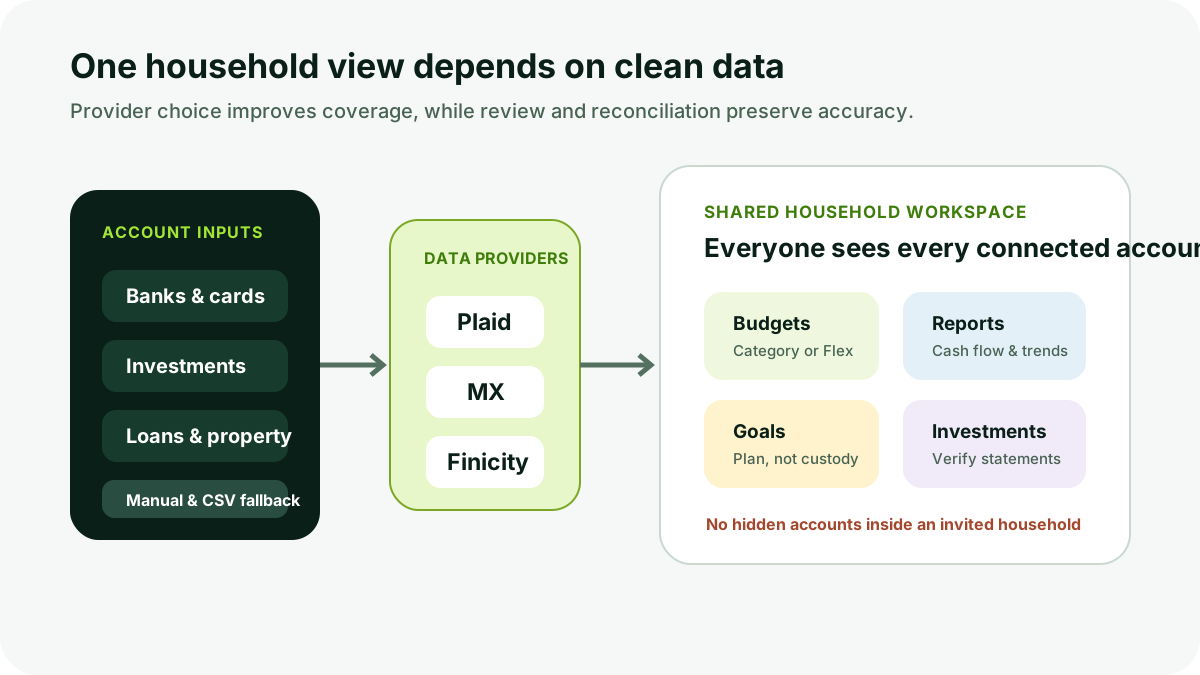
Account Syncing receives 4.4/5. Monarch uses multiple aggregators—Plaid, MX, and Finicity—and advertises coverage across more than 13,000 institutions. On the web, a user can try a different provider when the default connection fails or updates poorly. That fallback is a meaningful advantage over single-provider apps.
Three providers do not make aggregation infallible. Financial institutions can change authentication, restrict refreshes, omit pending transactions, or stop supporting a provider. Monarch publishes connection status information and documents known cases where one provider works better than another. Reliability must be evaluated institution by institution.
A forced refresh and re-verification can repair some issues. Reconnecting carelessly can also create duplicate accounts or split balance history. Monarch supports merging account history, deleting data before a chosen date, manual accounts, and CSV imports. Large migrations should use a small test file first because imported data can require bulk cleanup and there is no universal undo.
Household collaboration and privacy
Collaboration is one of Monarch’s strongest features. Unlimited invited people are included without a separate subscription, making it suitable for partners, family planning, or a financial adviser. Members share one household budget and can flag transactions for review.
The visibility rule is important: Monarch’s getting-started documentation says household members can see all connected accounts and there is no option to hide specific accounts or transactions from another member. A person should not invite someone until that level of financial transparency is intentional.
Collaboration does not change account ownership at the institution. It also does not create separate budgets for each member. Custom categories and tags can represent personal allowances, but the household retains one shared planning environment.
Ease of use
Ease of Use scores 4.6/5. The dashboard is visually organized and can be customized, while the web interface is especially useful for initial setup, reports, rule management, imports, and provider selection. Mobile apps cover recurring review and transaction cleanup.
The challenge is information density rather than awkward design. A new user can encounter accounts, budgets, cash flow, goals, recurring items, investments, reports, rules, and settings before deciding what actually matters. A smaller starting dashboard and category set improves clarity. Additional widgets should earn their place by changing a decision.
Privacy, security, and business model
Monarch states that it is ad-free and does not resell financial data. Subscription revenue aligns the product with paying members rather than advertising clicks. Connections are supplied by third-party aggregators, so the authorization screen and provider privacy terms remain part of the risk review.
Users should enable available account security, use a unique password, protect the email account that receives recovery messages, and remove unused household members. Exporting transactions creates another sensitive copy that must be stored securely.
Customer service
Customer Service earns 4.2/5. Monarch provides a help center, connection troubleshooting, published status information, in-product support, and migration guidance. The multi-provider model gives support more alternatives than simply waiting for one aggregator.
DollarScout did not time a support ticket. Some bank-linking failures originate at the financial institution or data provider, so Monarch may document or escalate a problem without being able to fix it immediately. A lower service score than YNAB reflects that aggregation-heavy support can be more dependent on third parties.
Alternatives
Choose YNAB when prospective allocation and a defined budgeting method matter more than broad net-worth reporting. Choose Copilot Money when an especially polished U.S.-only experience and automated transaction review are more important than Android support or unlimited household collaboration. Choose Rocket Money when subscription cleanup and bill negotiation are the primary job.
Monarch is strongest for a household with many account types and a shared review habit. A simpler app may be more durable when the user will not maintain investments, goals, reports, or collaboration.
Who should use Monarch
Monarch fits users who:
- Want budgets, reports, investments, goals, and net worth in one subscription.
- Need web, iOS, Android, and iPad access.
- Will use partner or adviser collaboration with full account visibility.
- Benefit from switching among Plaid, MX, and Finicity.
- Are willing to audit imported data rather than assuming it is complete.
It is easier to skip when a permanent free tier, hidden personal accounts inside a household, brokerage-grade performance, or a highly prescriptive budgeting method is required.
Bottom line
Monarch Money earns 4.4/5. It combines a polished interface with unusually broad personal-finance coverage, flexible budgets, meaningful reports, investment views, goals, recurring tracking, three connection providers, and unlimited collaboration. At $99.99 annually, the feature-to-price ratio is strongest for households using several of those capabilities.
The limitations are not cosmetic. The trial is short, bank syncing remains institution-specific, collaborators see everything, and comprehensive dashboards require cleanup. Test the difficult connections, verify opening balances, define the household’s review routine, and decide whether the breadth replaces real work. If it does, Monarch is a compelling paid home base. If not, a narrower tool will be easier to sustain.