
YNAB at a glance
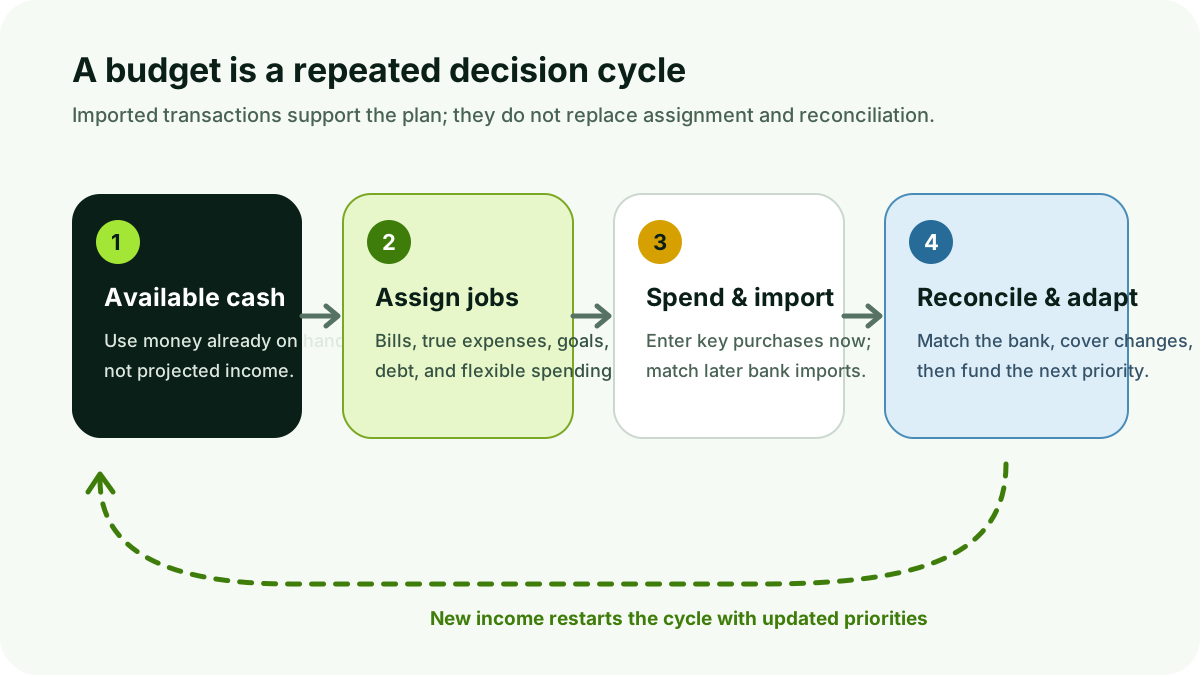
YNAB is not primarily a report about what happened last month. It is a planning system that asks the user to allocate money already available across current obligations, future bills, goals, debt, and discretionary categories. Spending then reduces those category balances. When circumstances change, the user moves money between categories instead of treating the first plan as fixed.
That distinction explains both the app’s value and its learning curve. A passive tracker can categorize purchases with little intervention. YNAB expects recurring decisions: assign new income, cover overspending, reconcile accounts, and decide which priority gives way. People who want that feedback loop can gain more control than a dashboard alone provides. People who only want automatic charts may find the method demanding.
| Review question | DollarScout finding |
|---|---|
| Best for | Hands-on budgeting with clear tradeoffs and shared household planning |
| Current direct price | $109 annually or $14.99 monthly, plus applicable tax |
| Trial | 34 days for direct signups; no card required on YNAB’s site |
| Bank import | Optional MX/Plaid connections; posted activity can take up to 24–72 hours |
| Main limitation | More setup and maintenance than a passive expense tracker |
:::note YNAB publishes marketing claims about average savings and user sentiment. DollarScout does not treat those self-reported figures as guaranteed results. The useful test is whether the method changes decisions enough to justify the subscription and maintenance time for a specific household. :::
Pricing, trial, and renewal
Value scores 4.2/5. YNAB’s current pricing page lists $109 billed annually or $14.99 billed monthly, in U.S. dollars and plus tax where applicable. The annual price works out to about $9.08 per month and saves $70.88 versus twelve monthly payments. There is no permanent adult free tier.
Direct signups receive a 34-day trial without entering a credit card. YNAB says the trial ends without a charge unless the user elects a subscription. App-store enrollment can use different payment and trial mechanics, so a person starting through Apple or Google should read that store’s confirmation rather than assuming the direct-site rule applies.
The price is reasonable only if YNAB is used. A dormant annual subscription costs $109 for reports that could be produced by a spreadsheet or free bank tools. A weekly planning habit, avoided fee, corrected subscription, or better-timed purchase can exceed the price, but that outcome comes from behavior rather than software ownership.
Students can qualify for a separate 365-day offer after supplying current enrollment evidence. Employer wellness access and gift subscriptions use their own rules. Those programs should not be mixed into the standard consumer price comparison.
The YNAB method in practice
Features earns 4.7/5. The app combines category planning, targets, scheduled transactions, credit-card handling, loan tools, reports, account registers, notes, transaction splitting, and reconciliation. The organizing idea remains simple: every dollar available receives a purpose, including money reserved for irregular expenses that have not arrived yet.
Targets can turn annual insurance, holidays, repairs, tuition, or travel into monthly funding amounts. Credit-card purchases move money from a spending category toward the card-payment category when accounts are set up correctly. Loan accounts can model progress and interest. These mechanics help a household see that a large checking balance is not fully available if most of it is already committed.
YNAB is not accounting software, tax preparation, or investment advice. Its reports are useful for personal cash-flow decisions, but they do not replace business books or a brokerage performance system. Investment accounts can be tracked, often as non-budget accounts, without making YNAB a portfolio analytics product.
Setup and learning curve
Ease of Use receives 4.1/5. The interface is coherent once the method is understood, and the mobile and web apps sync the same plan. Initial setup still requires choices about account scope, category structure, starting balances, scheduled expenses, targets, and credit cards. Importing years of history is not necessary and can create more cleanup than insight.
A clean start usually works better: add current balances, create a manageable category list, fund immediate obligations, and let new activity build the record. Reconcile balances against the bank regularly. If YNAB and the institution disagree, imported categories and polished charts cannot make the plan reliable until the balance difference is resolved.
Overspending is not a software failure. It is a prompt to move money from another priority or change the plan. Users who interpret a red category as judgment can abandon the process; users who treat it as current information tend to adapt more productively. YNAB’s free workshops, guides, videos, chat, and email support reduce this conceptual barrier.
Direct Import and transaction timing
Account Syncing scores 4.3/5. Direct Import is optional. YNAB’s July 2026 documentation says it uses MX and Plaid, plus select direct connections, to retrieve balances and transactions from supported institutions. YNAB says it does not receive bank login credentials from the provider and that data is encrypted in transit and at rest.
Import is not real time. Most connections refresh once or twice per day, banks can limit frequency, and a posted transaction may take 24–72 hours to appear. Pending activity, institution outages, multi-factor prompts, and provider changes can extend the gap. A category balance is therefore safest when users enter important purchases at the time of spending and later match the imported transaction.
Multiple providers improve coverage, not certainty. The experience is institution-specific. Before committing, connect the household’s hardest accounts during the trial, not only a mainstream checking account. Test a credit card, regional bank, retirement account, and any institution that has historically resisted aggregation.
Manual and file-based workflows
Manual entry remains a first-class option. A user can keep every account unlinked, enter transactions from a receipt or notification, and reconcile against statements. This maximizes control and reduces dependency on aggregators, but it raises the maintenance burden.
File-Based Import accepts QFX, OFX, QIF, and formatted CSV data. YNAB recommends QFX or OFX and can skip exact date-and-amount duplicates. The feature is available on the web app and iPad, not iPhone or Android. That platform limit matters for someone planning to use file downloads as the primary workflow.
Direct and manual entry can coexist. Entering a transaction today and accepting the matching import later provides timely category information without duplicating the expense. The match should be reviewed; similar amounts on the same date can still represent separate purchases.
Couples and YNAB Together
One subscription can be shared with up to five additional people through YNAB Together. That can materially improve value for a household. Members use separate logins, and plans can be shared for joint decisions.
Privacy inside the group requires attention. YNAB’s support documentation explains that a group manager can see plans owned by group members. Joining with an existing account can expose plans to that manager, while using a separate email can keep an unrelated plan separate. A couple should decide which budgets are genuinely joint before accepting invitations.
YNAB Together is not a substitute for bank authorization. Sharing a plan does not add someone to a bank account, grant authority to transact, or change legal ownership. It is a collaborative software view.
Privacy and data model
YNAB states that subscription revenue is its business model and that it does not sell user financial data. Direct Import uses third-party providers, so a user should still read the privacy terms for YNAB and the provider shown during connection. Removing a bank link stops future imports but does not automatically answer every data-retention question.
The app is not a bank. Category balances do not move or reserve cash at the institution. If YNAB says $800 is assigned to rent, the bank still sees one account balance and will allow transactions according to its own rules. Reconciliation is the bridge between the planning layer and actual money.
Support and education
Customer Service earns 4.7/5. YNAB provides chat and email support, an extensive help center, live workshops, recorded education, and method-specific guidance. That depth is particularly valuable because many problems are not button errors; they involve credit-card flow, reimbursements, transfers, shared plans, or the difference between account and category balances.
DollarScout did not submit timed support cases. The score reflects channel availability and educational depth, not a claim about a guaranteed response time. Users with a bank-connection issue may also depend on an aggregator and financial institution, which limits what YNAB support can resolve directly.
Alternatives
Choose Monarch Money for broader net-worth, investment, reporting, and household collaboration features with less commitment to one budgeting doctrine. Choose Copilot Money for a polished U.S.-only interface, automated categorization, investment views, and a lighter day-to-day planning model. Choose PocketGuard when a simpler leftover number and debt payoff workflow are more important than detailed allocation.
A spreadsheet remains a legitimate alternative for users willing to maintain formulas and imports. The cost is time and weaker bank automation; the benefit is complete customization and no subscription dependency.
Who should use YNAB
YNAB fits people who:
- Want to make spending tradeoffs before money leaves the account.
- Will review and reconcile the plan at least weekly.
- Need targets for irregular expenses and future obligations.
- Can test their important institutions during the 34-day trial.
- Will use YNAB Together or the education enough to improve subscription value.
It is easier to skip when:
- The goal is passive tracking with almost no manual review.
- Bank data must appear instantly for the plan to feel useful.
- Multiple currencies need to coexist inside one spending plan.
- A free product is required and spreadsheet maintenance is acceptable.
Bottom line
YNAB earns 4.4/5. Its method, targets, credit-card mechanics, sharing, education, and flexible import options make it one of the most capable personal budgeting systems. The 34-day trial is long enough to test a monthly income cycle, and the annual price is transparent.
The tradeoff is active work. Bank import can lag, setup has conceptual friction, and $109 per year is wasted if the plan becomes another unopened dashboard. Use the trial to complete real tasks: fund the next bills, reconcile every account, enter a purchase before import, cover an overspent category, and conduct one weekly review. If those actions improve decisions, YNAB can justify both its price and its learning curve.