Many products on this page are from partners who compensate us. This doesn't influence our ratings. Our opinions are our own.
Monarch Money vs Copilot: 2026 Budget App Comparison
By Sophie Brown, Senior Finance Editor · Updated Jul 2026 · Fact-checked Jul 19, 2026
Monarch Money wins narrowly at 4.4/5 versus Copilot Money at 4.3/5. Monarch is the more complete household finance system: it supports web, iOS, and Android, connects through three data providers, and includes unlimited collaborators for $99.99 per year. Copilot has the faster, more polished individual workflow and costs $95 per year or $13 monthly, but it remains U.S.-only, has no Android app, and its web version does not yet match every Apple-app feature. Choose Monarch for shared planning and broad device access; choose Copilot for an Apple-first personal dashboard.
Head-to-head
| Feature | Monarch | Copilot |
|---|---|---|
| DollarScout Rating | 4.4/5 ★ | 4.3/5 ★ |
| Pricing | $99.99 billed annually on the current web offer; 7-day trial and separate monthly checkout option | $95/year or $13/month with a one-month trial for new users; no permanent free tier |
| Platform Support | Web, iPhone, iPad, and Android apps | U.S. only on iPhone, iPad, Mac, and web; no Android app listed |
| Account Linking | Plaid, MX, and Finicity connections, with manual accounts and CSV transaction import | 10,000+ U.S. institutions plus direct integrations such as Apple Card, Venmo, and Coinbase; manual accounts supported |


Category-by-category breakdown
Features
Ease of Use
Account Syncing
Value
Customer Service
Detailed analysis
The short answer
Monarch Money is the better all-purpose choice; Copilot Money is the better Apple-first individual experience. DollarScout rates Monarch 4.4/5 and Copilot 4.3/5. Monarch wins Features, Copilot wins Ease of Use, and Bank Syncing, Value, and Customer Service are ties.
| Decision factor | Monarch Money | Copilot Money |
|---|---|---|
| Best fit | Couples, households, and cross-platform planning | Individuals who value speed and visual polish |
| Current price | $99.99 billed annually | $95 annually or $13 monthly |
| Direct trial | 7 days | 1 month |
| Platforms | Web, iPhone, iPad, and Android | iPhone, iPad, Mac, and web; no Android |
| Account connections | Plaid, MX, and Finicity routes | Automatic and manual account support; institution coverage varies |
| Collaboration | Unlimited collaborators on one household | Primarily an individual workspace |
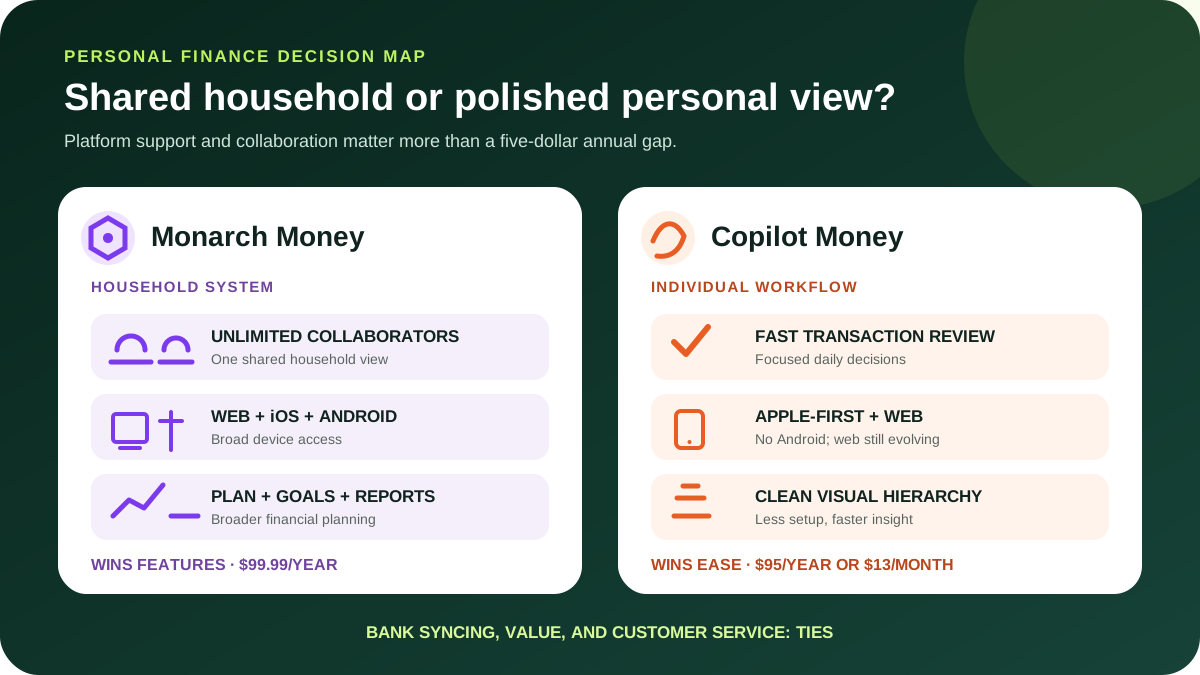
Price: close enough that workflow should decide
Monarch lists one consumer plan at $99.99 per year after a seven-day trial. That is about $8.33 per month when the annual price is divided by 12, but the full amount is billed up front. The subscription includes unlimited connected accounts, unlimited collaborators, web and mobile access, and the product's budgeting, goals, reports, investment tracking, and net-worth tools.
Copilot lists $95 per year or $13 per month after a one-month trial. Annual Copilot is $4.99 cheaper than annual Monarch; monthly Copilot offers a lower-commitment route but costs $156 across 12 paid months. Prices, taxes, app-store billing, renewal timing, and promotions can change, so the checkout screen controls.
The five-dollar annual gap should not drive a year-long decision. One missed recurring charge, an app nobody opens, or the need to buy a second product can overwhelm it. Use the trials with the same accounts and complete a real weekly review before subscribing.
Value is a tie. Monarch scores 4.1/5 and Copilot 4.0/5, a difference too small to declare a useful winner. Monarch includes more household and planning capability; Copilot offers exceptional execution for a narrower audience.
Features: Monarch wins
Monarch combines a flexible budget, recurring-item calendar, savings goals, cash-flow reporting, investment holdings, net worth, custom dashboards, transaction rules, tags, and planning forecasts. Its Plan can use category budgeting or the broader Flex Budget approach. Goals connect a target to accounts and monthly contributions, while reports let a household examine income, spending, savings rate, and merchant or category trends.
Copilot covers the core personal-finance loop well: consolidated balances, transaction review, category budgets, recurring detection, net worth, investments, cash flow, rules, tags, transaction splitting, and notifications. Its classification experience is particularly fast. The app learns from reviewed transactions, and the visual hierarchy makes an inbox-style review feel less like bookkeeping.
Monarch wins because it covers more planning and collaboration scenarios without giving up the essentials. Copilot's narrower scope can be an advantage for a single user who does not want a financial-planning suite, but that is an ease advantage rather than a feature advantage.
Features winner: Monarch, 4.7/5 to 4.4/5. Do not count every dashboard tile equally; test the two or three workflows that will actually change a decision.
Ease of use: Copilot wins
Copilot's strongest quality is interaction design. Transactions arrive in a focused review flow, category feedback is immediate, charts are legible, and the iPhone and Mac experiences feel deliberately designed for frequent use. A customer can understand recent spending and unusual activity without configuring a complex planning model first.
Monarch is still approachable, but breadth creates more decisions: category or Flex budgeting, account ownership, goals, tags, rules, dashboards, planning assumptions, and household permissions. Its guided setup helps, and web access is valuable for cleanup, yet a new user can spend too long perfecting categories before establishing a weekly habit.
Copilot's advantage has boundaries. It is available in the United States on iPhone, iPad, Mac, and web, but not Android. Copilot says its web product, released in December 2025, supports most core functionality while some features remain exclusive to the native apps. Someone who uses an Android phone or expects complete browser parity will find Monarch easier in practice.
Ease-of-use winner: Copilot, 4.8/5 to 4.6/5. That score assumes compatible devices; platform mismatch overrides interface polish.
Bank syncing: a tie, not a guarantee
Monarch supports connections through Plaid, MX, and Finicity. Multiple providers can improve the chance that an institution has a usable route and give support another option when a feed is unreliable. Monarch also supports manual accounts and CSV import, which matters for assets, liabilities, or banks that do not maintain a stable connection.
Copilot supports automatic and manual accounts and provides institution-specific support guidance. Its classification and review flow makes imported data productive quickly. Neither company can promise continuous coverage for every bank, credit union, brokerage, card, loan, or multi-factor authentication method. Institutions can change APIs, aggregation credentials can expire, and pending transactions can duplicate or later disappear when a posted item replaces them.
DollarScout scores Monarch 4.4/5 and Copilot 4.3/5 for syncing, which is a tie under our comparison method. The correct test is not the provider's total institution count. Link the customer's actual checking account, credit cards, brokerage, mortgage, and loan; then observe update latency, pending-to-posted matching, balance accuracy, duplicate handling, and reauthorization over several days.
Keep statements as the authoritative record. A budget app is a decision aid, not a bank ledger or accounting system.
Rules, splits, and data cleanup
Monarch's rules can rename merchants, set categories, add tags, hide transactions, and apply other repeatable actions. Its manual import path lets a switcher bring historical transactions from another service, but imported rows require careful date, amount, and duplicate review. Rules should be specific enough that a pharmacy purchase does not get treated like a prescription every time.
Copilot supports transaction splitting and recurring detection, which handle common real-world cases such as a supermarket receipt divided between groceries and household goods or a payroll deposit with an irregular date. Its model benefits from review feedback, but automation still needs supervision.
On either product, start with fewer categories than seem necessary. Review uncategorized and high-value transactions weekly, reconcile account balances monthly, and audit rules after a merchant or spending pattern changes. A beautifully classified dataset with a missing account is still wrong.
Household collaboration and privacy
Monarch's annual plan includes unlimited collaborators. That makes it suitable for partners, family financial planning, or a trusted professional working from the same household data. It also creates a material privacy decision: Monarch's household model is designed around shared visibility, and members can see connected accounts in the household. Do not invite someone under the assumption that one bank account will remain private.
Copilot is primarily designed around the individual account owner. A couple can coordinate outside the app or use shared devices and accounts where permitted, but it is not the equivalent of Monarch's collaborator model. That may be preferable when a customer wants a personal view rather than a common household ledger.
Before sharing any finance app, agree on account scope, who may edit categories or rules, how discretionary spending will be discussed, and what happens after a relationship or advisory engagement ends. Never reuse a password as a collaboration method.
Budgeting philosophy
Monarch works well for customers who want to observe actual cash flow and then plan forward. Category budgets support detailed limits; Flex Budgeting separates fixed, non-monthly, and flexible spending so the customer can focus on the amount that can still move. Its forecast shows how planned income and expenses affect future months.
Copilot emphasizes awareness, clean categorization, recurring costs, and visual feedback. It can support category budgets, but the experience feels closer to a responsive financial dashboard than to an envelope method that requires every available dollar to receive a job.
Neither philosophy is inherently more responsible. A detailed plan that is abandoned after two weeks is weaker than a simple dashboard reviewed every Friday. During the trial, enter one irregular expense, one annual bill, one savings goal, a credit-card payment, and a split transaction. The friction in those five actions is more predictive than a feature list.
Investments and net worth
Both products can place investment accounts alongside cash and debt to calculate net worth. This is useful for seeing the whole household and avoiding the mistake of treating a brokerage balance as spendable cash. Holdings data can lag, security classifications may be incomplete, and neither dashboard replaces a brokerage statement or portfolio-analysis process.
Monarch's reporting and planning breadth make it the better home for a mixed household balance sheet. Copilot's presentation is excellent for checking performance and allocation at a glance. Avoid daily reactions to market-driven net-worth changes; separate contributions, withdrawals, debt payoff, and market movement when evaluating progress.
Security and data rights
Monarch states that it uses encryption, read-only financial connections where supported, and does not sell customer financial data. Copilot publishes privacy and security explanations and says its business model is the paid subscription rather than advertising. Those are useful commitments, not immunity from account takeover or vendor risk.
Use a unique password and multifactor authentication, protect the linked email account, and review active sessions and authorized connections. Connect only the accounts needed for the stated purpose. When closing an account, export the records required for continuity, disconnect financial institutions, request deletion under the current policy, and verify what retention obligations remain.
The Consumer Financial Protection Bureau's financial-data materials are useful context: consumers should understand which data a third party receives and be able to manage authorization. The practical question is not simply “Does it use Plaid?” but which company receives which fields, for how long, and for what purposes.
Customer service: a tie
Monarch scores 4.2/5 and Copilot 4.1/5. Both rely primarily on digital support and documentation rather than a branch or personal adviser. Response quality can depend on whether a problem is an app defect, an aggregation issue, or an institution-side authentication change.
Before committing, send a precise support request containing the institution name, account type, connection provider if shown, timestamps, screenshots with sensitive values removed, and the troubleshooting already attempted. Never send bank passwords or one-time codes to someone claiming to be support.
The tie recognizes that Monarch has a broader support burden while Copilot operates across a narrower platform set. Neither service score should be interpreted as guaranteed response time.
Who should choose Monarch Money?
Choose Monarch Money for couples or households, Android access, a full browser experience, multiple aggregation routes, long-range planning, goals, and a broader balance-sheet view. It is also the stronger fit when several trusted people need to work from one shared set of transactions.
Do not choose it merely because it has more settings. Confirm that every collaborator accepts the visibility model and that the household will maintain the plan after initial setup.
Who should choose Copilot Money?
Choose Copilot Money for an individual in the United States who uses iPhone, iPad, or Mac and values a quick, visually refined transaction review. Its annual price is slightly lower and the one-month trial gives more time to observe recurring items and connection stability.
Do not choose it if Android is required, complete feature parity on the web is non-negotiable, or multiple household members need a mature shared workspace.
Final verdict
Monarch wins narrowly because its cross-platform access, collaboration, planning, and connection options solve more household use cases. Copilot is the more elegant individual product and wins ease of use. With pricing and overall ratings this close, the customer's devices, sharing needs, and actual bank feeds—not a 0.1-point difference—should decide.
Which one is right for you?
- Best for Couples and shared household planning: MonarchStart Free Trial
- Best for Android and full cross-platform access: MonarchStart Free Trial
- Best for Fastest Apple-first transaction review: CopilotTry Copilot
- Best for Longer direct trial before paying: CopilotTry Copilot
Final verdict
Monarch Money wins 4.4/5 to 4.3/5 for broader platforms, household collaboration, planning depth, and multiple connection providers. Copilot Money is the better Apple-first personal dashboard and the easier daily review experience. Test the same accounts during both trials and let device support, household visibility, and connection reliability decide.
Frequently asked questions
Sources and verification
Scores and product facts come from the underlying DollarScout reviews and were checked against these primary sources.
- Monarch Money pricing and plan inclusions
- Monarch security practices
- Monarch getting-started guide
- Monarch household and member access
- Monarch manual data import
- Monarch transaction rules
- Monarch Plan and forecast
- Copilot Money product and pricing
- Copilot Money frequently asked questions
- Copilot Money for web
- Copilot Money quick-start guide
- Copilot transaction splitting
- Copilot product updates
- Copilot Money terms of service
- CFPB consumer financial-data resources
Related content
More from DollarScout on this topic.
