Many products on this page are from partners who compensate us. This doesn't influence our ratings. Our opinions are our own.
YNAB vs Monarch Money: 2026 Budget App Comparison
By Sophie Brown, Senior Finance Editor · Updated Jul 2026 · Fact-checked Jul 19, 2026
YNAB and Monarch Money tie at 4.4/5 overall, but they solve different problems. YNAB is the stronger active budgeting system: it asks users to assign available money to priorities and backs the method with exceptional education and support. Monarch is the easier household financial dashboard, costs $99.99 annually versus YNAB at $109 annually or $14.99 monthly, and combines flexible budgeting with net worth, investments, reports, and unlimited collaborators. Choose YNAB to change day-to-day allocation behavior; choose Monarch to coordinate and observe the broader household.
Head-to-head
| Feature | YNAB | Monarch |
|---|---|---|
| DollarScout Rating | 4.4/5 ★ | 4.4/5 ★ |
| Pricing | $109/year or $14.99/month, plus tax where applicable; 34-day direct-signup trial | $99.99 billed annually on the current web offer; 7-day trial and separate monthly checkout option |
| Platform Support | Web, iPhone, iPad, and Android; file import is limited to web and iPad | Web, iPhone, iPad, and Android apps |
| Account Linking | Optional Direct Import through MX and Plaid for supported institutions, plus manual and file-based entry | Plaid, MX, and Finicity connections, with manual accounts and CSV transaction import |


Category-by-category breakdown
Features
Ease of Use
Account Syncing
Value
Customer Service
Detailed analysis
The short answer
YNAB is the better active budgeting method; Monarch Money is the better all-around household dashboard. Both earn 4.4/5 overall. Features, Bank Syncing, and Value are ties. Monarch wins Ease of Use; YNAB wins Customer Service.
| Decision factor | YNAB | Monarch Money |
|---|---|---|
| Best fit | Assigning available money and changing spending behavior | Household cash flow, planning, reporting, and net worth |
| Current direct price | $109 annually or $14.99 monthly | $99.99 annually |
| Direct trial | 34 days, no card required | 7 days |
| Core model | Give available dollars jobs before spending | Category or Flex Budget plus forecast and reports |
| Sharing | Up to five additional people through YNAB Together | Unlimited household collaborators |
| Direct import | Select U.S., Canadian, U.K., and EU institutions; file import available | Plaid, MX, and Finicity routes; manual import available |
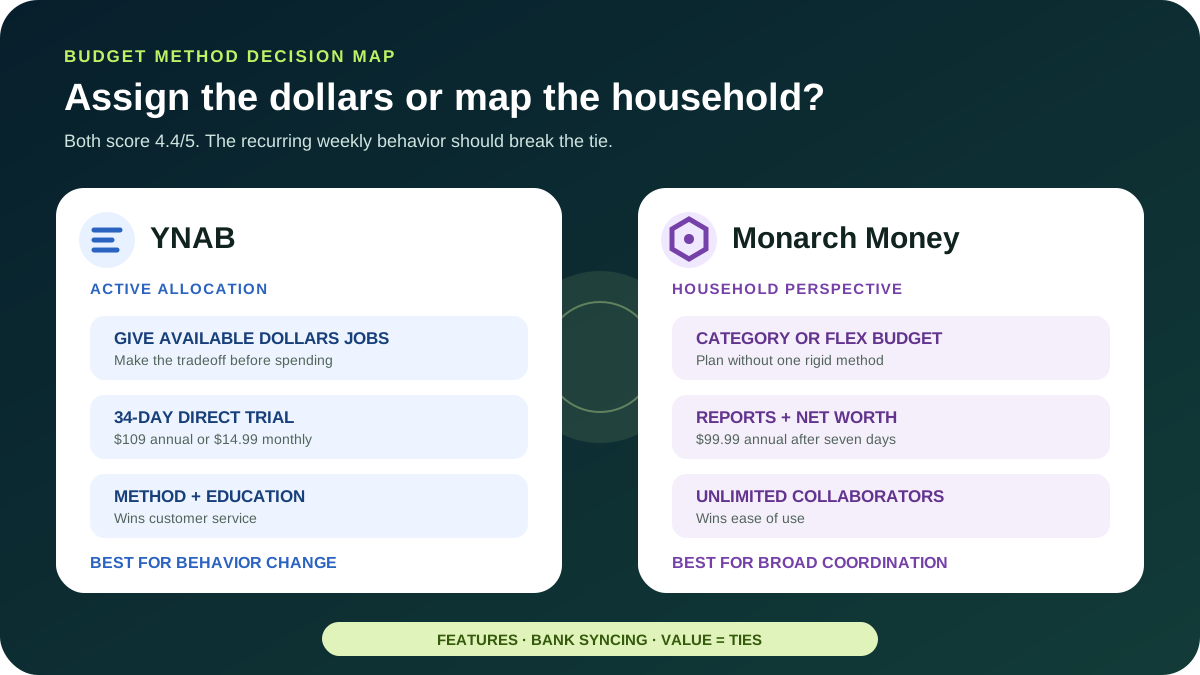
There is no overall winner because the methods differ
YNAB is not simply a spending tracker. Its method asks the customer to work with money already available, give dollars specific jobs, plan for non-monthly costs, and adjust deliberately when reality changes. The app's categories are an allocation system: moving money between them is part of the method, not evidence that the budget failed.
Monarch can use detailed category budgets, but it also offers Flex Budgeting, forecasts, cash-flow reports, goals, investments, and net worth. It is comfortable beginning with observation—what came in, what went out, what is recurring, and what the household can change—before imposing a strict allocation habit.
Both approaches can produce good decisions. YNAB is stronger when the problem is spending money before deciding what it must do. Monarch is stronger when the problem is fragmented household information and weak coordination. A rating tie is more honest than forcing one philosophy to win every use case.
Price and trial
YNAB currently costs $109 per year, equivalent to about $9.08 per month when divided across the annual term, or $14.99 billed monthly. Its direct 34-day trial does not require a credit card; third-party app stores can impose different trial and billing conditions. YNAB Together is included and allows the group manager to invite up to five additional people.
Monarch lists $99.99 per year after a seven-day trial. Its annual price is $9.01 lower than YNAB's and includes unlimited accounts and collaborators. Monarch does not advertise a standard month-to-month consumer plan on the cited pricing page.
The cheaper annual subscription is not automatically the better value. YNAB's longer trial covers an ordinary monthly billing cycle and its education may replace the need for another learning product. Monarch includes investment and net-worth views that can replace a separate dashboard. Calculate the cost of the complete tool set, then judge whether the household actually uses it.
Value is a tie: YNAB 4.2/5 and Monarch 4.1/5. The 0.1 score gap is smaller than the effect of fit and follow-through.
The YNAB method: allocate before spending
YNAB's central practice is to assign the dollars already on hand to categories that represent immediate bills, variable spending, true expenses, debt, and goals. A customer paid twice monthly does not need to predict an entire future month perfectly; the question is what the current money must cover before the next income arrives.
This makes tradeoffs visible. If a car repair exceeds its category, the customer moves money from a lower priority rather than leaving the overage unexplained. Annual premiums and holidays become monthly contributions instead of emergencies. Credit-card spending is reflected in both the purchase category and the amount reserved for payment when the plan is maintained correctly.
The method requires participation. Someone seeking a passive dashboard may find transaction approval and category decisions demanding. That friction is intentional when it changes behavior, but unnecessary when the household already has strong cash reserves and mainly wants consolidated reporting.
Monarch's Plan and Flex Budget
Monarch's Plan supports category-level budgeting and a more flexible structure. Flex Budgeting groups planned spending into fixed, non-monthly, and flexible components, reducing the need to predict every discretionary category precisely. Forecasts project income and spending into future months, while goals and reports connect the plan to longer-term patterns.
This is easier for a household that wants one flexible spending pool or has many collaborators who would not maintain envelope-level detail. It can also accommodate irregular expenses through non-monthly categories without forcing the same workflow as YNAB.
The tradeoff is behavioral softness. A flexible total can hide which priority should give way when spending runs high. Users must still review exceptions, protect future bills, and distinguish a forecast from available cash.
Ease-of-use winner: Monarch, 4.6/5 to YNAB's 4.1/5. YNAB's learning curve is productive for the right user, but it remains a learning curve.
Features: a tie
YNAB scores 4.7/5 and Monarch 4.7/5. YNAB offers unlimited plans, targets, loan and debt tools, reports, direct and file-based import, mobile and web apps, subscription sharing, transaction matching, reconciliation, and an extensive education system. Its features reinforce a coherent money-allocation method.
Monarch combines budgets, Flex Budgeting, goals, recurring-item review, transaction rules, tags, custom dashboards, cash-flow and savings-rate reports, investments, net worth, forecasts, and unlimited collaborators. Its breadth is better for a household balance sheet.
Calling this a tie does not mean the products have identical checklists. YNAB has the deeper active-budget workflow and teaching layer. Monarch has the broader tracking, reporting, investment, and household-planning surface. Weight the functions that change decisions rather than counting menu items.
Direct import and reconciliation
YNAB says direct import supports select institutions in the United States, Canada, the United Kingdom, and the European Union. It uses import providers including MX and Plaid depending on region and institution. Imported transactions are commonly delayed relative to a bank and must be approved or matched; file-based import remains available for supported exports.
Monarch provides Plaid, MX, and Finicity connection routes and manual CSV import. Multiple routes can help when an institution behaves better with one provider, but a provider choice does not guarantee complete history or permanent access.
DollarScout scores YNAB 4.3/5 and Monarch 4.4/5 for Bank Syncing, a tie. Test the customer's exact institutions through several posting cycles. Check balance freshness, pending transactions, duplicates, transfer matching, loan treatment, investment holdings, and reauthorization.
Reconciliation is the safety control. Compare the cleared balance in the app with the institution statement or current bank balance. Investigate the difference instead of inserting an adjustment automatically. A plan based on unreconciled data can be confidently wrong.
File import and migration
YNAB's file-based import accepts supported transaction files and matches imported activity with manually entered transactions when the data aligns. Monarch provides a migration and manual import path for bank exports and other finance apps. Both require the customer to inspect date formats, sign conventions, account mapping, duplicates, and beginning balances.
Historical import can help reports, but years of imperfect categories may create more cleanup than insight. Consider importing a clean recent period and preserving the old service's exports separately. Reconcile each account at the migration cutoff and document that date.
Before canceling the old app, export transactions, account lists, categories, rules, goals, reports, and any tax-relevant notes. Confirm the new app can reproduce the current balances and upcoming obligations.
Sharing is not the same privacy model
YNAB Together lets one group manager invite up to five additional people under one subscription. Each person has a separate login and can own or share multiple plans. The group manager has broad access: current YNAB guidance says a manager can access plans in the group, and an existing user who joins with an existing account can automatically expose existing and new plans to that manager. Someone who needs to keep prior plans private may need a separate account and subscription.
Monarch includes unlimited collaborators in its household. The household model is broad: members can see connected household accounts and work from the same transactions and plan. This is straightforward for partners with fully shared finances but inappropriate when a collaborator expects account-level secrecy.
YNAB offers more plan separation; Monarch offers simpler whole-household coordination and no five-invite ceiling. Neither should be configured without explicit consent. Decide who can view, edit, connect, export, and retain data before inviting anyone.
Couples and financial professionals
For a couple who wants to decide together how every available dollar will be used, YNAB creates a strong shared ritual. A weekly plan review can turn ambiguous disagreements into an explicit choice between categories. Separate logins avoid unsafe password sharing.
For a couple who wants consolidated cash flow, investments, property, loans, goals, and trends, Monarch provides the more complete household dashboard. Unlimited collaborators can also support a trusted adviser, although the product is not a regulated custody, accounting, or tax system.
Agree on meeting cadence and edit responsibility. A shared app does not solve differences in priorities by itself; it makes those differences measurable.
Customer service and education: YNAB wins
YNAB scores 4.7/5 and Monarch 4.2/5 for Customer Service. YNAB's advantage includes not only direct support but a substantial education system: method guides, live workshops, help documentation, videos, and practical explanations of credit cards, reconciliation, targets, overspending, and shared planning.
Monarch has a detailed help center and support workflows for connections, imports, household access, rules, and planning. It covers the product well, but it does not match YNAB's method-driven teaching ecosystem.
Customer Service winner: YNAB. Education is particularly valuable during the first month, when a user is deciding whether an apparent problem is a bank feed issue, a category setup issue, or a misunderstanding of the method.
Reports, investments, and net worth
Monarch has the stronger broad reporting and net-worth experience. It places investments, cash, property, and liabilities alongside income and spending, making it easier to discuss the entire household. Custom dashboards and reports can surface savings rate, merchant patterns, category trends, and account changes.
YNAB reports are deliberately tied to the spending plan. They help a customer understand age of money, income versus expense, and category behavior, while investment accounts are generally tracked rather than treated as a portfolio-analysis center.
Neither app replaces brokerage statements, tax lots, performance attribution, or a fiduciary plan. A market-driven increase in net worth should not be confused with improved monthly saving behavior. Track contributions and debt reductions separately from price movement.
Security and financial-data permissions
Both services rely on encrypted systems and third-party connection providers for supported direct import. Monarch says connections are read-only and it does not sell customer financial data. YNAB says subscriptions, rather than sale of customer data, fund the product. Review the current privacy and security documents for exact terms and retention.
Use unique credentials, multifactor authentication, and a protected email account. Do not invite a household member or group manager until access implications are understood. Remove obsolete bank authorizations, export only to secured storage, and verify deletion and retention procedures when leaving.
The CFPB's consumer financial-data resources provide a useful principle: access should be understood and controlled. Ask what data the app and each connection provider receive, whether the link uses an institution authorization flow, how consent is revoked, and which records remain after disconnection.
A practical 34-day comparison test
YNAB's direct trial is long enough to test both products over the same period if Monarch is started during the final week. Build a small scorecard instead of importing everything blindly:
- Connect the primary checking account and credit card.
- Enter an annual expense and one savings goal.
- Split a mixed purchase and handle a refund.
- Reconcile balances after transactions post.
- Invite the intended collaborator only after reviewing permissions.
- Complete two weekly reviews and one month-end check.
Record minutes spent, connection failures, uncategorized transactions, duplicate corrections, decisions changed, and whether the partner participated. The best app is the one the household can operate accurately after the setup excitement ends.
Who should choose YNAB?
Choose YNAB when money arrives at different times, competing priorities need explicit allocation, irregular expenses cause surprises, or the customer wants a method and education—not only charts. It is also the stronger choice for users who value plan-level sharing and high-touch learning support.
Do not choose it expecting passive automation. Its value comes from reviewing, assigning, reconciling, and adjusting.
Who should choose Monarch Money?
Choose Monarch Money when the household wants an easier consolidated dashboard, flexible planning, investment and net-worth context, multiple data providers, Android and web access, and unlimited collaborators. It costs slightly less annually and asks less method-specific behavior.
Do not share the household until every participant understands that connected accounts have broad visibility.
Final verdict
YNAB and Monarch tie overall because each is excellent at a different job. Choose YNAB to build an active allocation habit backed by superior education. Choose Monarch to coordinate a complex household and see the broader financial picture. The right choice is the method the household will reconcile and use every week.
Which one is right for you?
- Best for Active allocation of every available dollar: YNABStart Free Trial
- Best for Method education and budgeting support: YNABStart Free Trial
- Best for Broad household dashboard and net worth: MonarchStart Free Trial
- Best for Unlimited household collaborators: MonarchStart Free Trial
Final verdict
YNAB and Monarch Money tie at 4.4/5. YNAB is the stronger active budgeting method and wins support; Monarch is easier and provides the broader household, reporting, investment, and collaboration dashboard. Use the trials to test actual accounts, permissions, and a complete weekly review before selecting a method.
Frequently asked questions
Sources and verification
Scores and product facts come from the underlying DollarScout reviews and were checked against these primary sources.
- YNAB pricing and plan details
- YNAB direct 34-day trial
- YNAB direct import guide
- YNAB file-based import guide
- YNAB subscription sharing
- YNAB Together guide
- Joining YNAB Together as an existing user
- Monarch Money pricing and plan inclusions
- Monarch security practices
- Monarch getting-started guide
- Monarch household and member access
- Monarch manual data import
- Monarch transaction rules
- Monarch Plan and forecast
- CFPB consumer financial-data resources
Related content
More from DollarScout on this topic.
