Many products on this page are from partners who compensate us. This doesn't influence our ratings. Our opinions are our own.
Upstart vs Happen Bank: 2026 Personal-Loan Comparison
By Sophie Brown, Senior Finance Editor · Updated Jul 2026 · Fact-checked Jul 18, 2026
Upstart is the better first quote for an applicant who wants broader underwriting inputs, a fast marketplace decision, and three- or five-year unsecured terms. Happen Bank—formerly LendingClub—is the better operational fit for eligible debt consolidation, joint applications where offered, Direct Pay, and a broader 24- to 84-month term range. Both use soft initial rate checks, advertise up to $75,000, can deduct an origination fee, and reach 35.99% APR. Compare the actual creditor, fee dollars, net proceeds, term, and total repayment rather than choosing by approval speed.
Head-to-head
| Feature | Upstart | Happen Bank (formerly LendingClub) |
|---|---|---|
| DollarScout Rating | 4.0/5 ★ | 4.1/5 ★ |
| APR | 6.2% to 35.99% fixed APR for unsecured personal loans with three- or five-year terms, based on five-year rates offered in March 2026; actual range, approval, and terms vary by state and profile | 5.96% to 35.99% fixed APR under the offer disclosed as current from June 1, 2026; the actual rate depends on credit, amount, term, and other underwriting factors |
| Origination Fee | Partner-specific and included in APR; the current representative $10,000, 60-month example uses a 7.25% fee deducted from proceeds, and no prepayment penalty is advertised | 0% to 8% of the loan amount on most personal loans, deducted from proceeds and incorporated into APR; no application, brokerage, or prepayment fee |
| Loan Amounts | $1,000 to $75,000; state minimums include $3,100 in Georgia, $1,500 in Hawaii, and $7,000 in Massachusetts, and maximums can vary by state | $1,000 to $75,000 with terms from 24 to 84 months; amounts and terms vary by state, channel, credit, and product availability |


Category-by-category breakdown
APR
Fees
Loan Amounts
Funding Speed
Customer Service
Detailed analysis
The bottom line
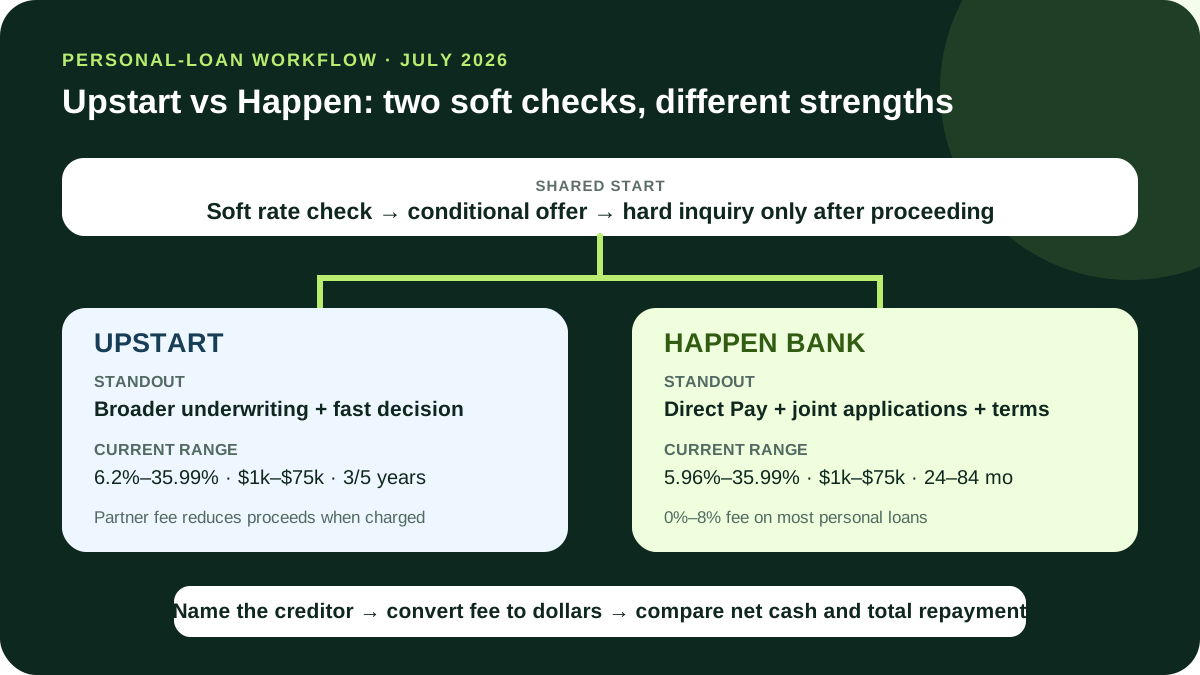
Upstart and Happen Bank both let borrowers check possible personal-loan terms before committing to a hard inquiry, but they are not the same kind of lending relationship. Upstart Network is a technology marketplace, not the creditor. It connects applicants with partner banks and credit unions and can use broader application inputs alongside conventional credit data. Happen Bank is the June 2026 name of LendingClub Bank and offers personal loans with its own current disclosures, including Direct Pay and joint applications in eligible situations.
Upstart currently discloses 6.2% to 35.99% fixed APR, $1,000 to $75,000, and three- or five-year unsecured terms, with state-specific minimums. Happen discloses 5.96% to 35.99% fixed APR, $1,000 to $75,000, and terms from 24 to 84 months, subject to state, product, credit, and channel availability.
Choose Upstart when broader underwriting could help a thin or nontraditional file and the resulting partner offer remains competitive after its fee. Choose Happen when debt-consolidation operations, a possible joint application, Direct Pay, or more term choices are important. Neither is automatically cheap: the high end of both APR ranges is expensive debt.
| Decision factor | Upstart | Happen Bank (formerly LendingClub) |
|---|---|---|
| Role | Marketplace connecting applicants to partner creditors | Bank and current personal-loan provider |
| Published APR | 6.2% to 35.99% fixed | 5.96% to 35.99% fixed |
| Published amount | $1,000 to $75,000, with state minimums | $1,000 to $75,000, subject to availability |
| Published terms | Three or five years | 24 to 84 months |
| Origination fee | Partner-specific; representative example uses 7.25% | 0% to 8% on most personal loans |
| Standout use case | Broader underwriting and rapid initial decision | Direct Pay, consolidation, and possible joint application |
Company role and creditor identity
Upstart collects application information and uses its model plus partner criteria to surface possible terms. The bank or credit union identified in the note originates the loan. The applicant should record the creditor and servicer rather than assuming Upstart itself owns every debt.
Happen Bank is the official new name of LendingClub Bank following the June 2026 rebrand. Older agreements, legal pages, credit-report entries, and search results can still use LendingClub. The name transition does not make an old offer current; use the Happen disclosure and the creditor shown in the final note.
The distinction matters for complaints, payments, privacy, hardship, and payoff. A marketplace introduction is not the same as the institution legally owed money. Save the platform consent, creditor identity, promissory note, and servicing contact for either path.
Clarity edge: Happen for a more direct product identity. Discovery edge: Upstart for partner matching.
APR ranges and actual price
Upstart's current unsecured disclosure shows 6.2% to 35.99% fixed APR for three- or five-year loans, based on five-year rates offered in March 2026. Its representative example uses a $10,000, 60-month loan at a 17.50% interest rate with a 7.25% fee. The borrower receives $9,275, and the fee raises APR to 21.23%.
Happen's disclosure shows 5.96% to 35.99% fixed APR under an offer stated as current from June 1, 2026. The final APR depends on credit, amount, term, and underwriting. The slightly lower floor does not mean Happen will be cheaper for a particular applicant.
At the high end, both products can be costly. A 30% or 35.99% APR can make a discretionary purchase much more expensive and leave little room for an income shock. Compare a credit union, secured option, payment plan, smaller amount, or delayed purchase before accepting a high-end offer.
DollarScout scores APR 3.8/5 for Upstart and 4.0/5 for Happen. Happen receives the category edge, but personalized disclosures decide the actual winner.
Published APR edge: Happen.
Origination fee and net proceeds
Upstart's fee depends on the partner and offer and is included in APR. The representative 7.25% example shows why net proceeds matter: a $10,000 face amount delivers $9,275. Upstart advertises no prepayment penalty, but an upfront fee is not normally recovered when the loan is repaid early.
Happen states that most personal loans carry a 0% to 8% origination fee, deducted from proceeds and reflected in APR. It discloses no application, brokerage, or prepayment fee. A 0% offer is possible, but applicants should not assume they qualify until the disclosure shows it.
Normalize the comparison. If $10,000 of cash is required, increase any fee-bearing face amount enough to deliver $10,000, then compare APR, payment, finance charge, and total of payments. A lower rate can lose after fee dollars and a longer term are included.
The category scores—3.4/5 Upstart and 3.5/5 Happen—are within DollarScout's 0.15-point tie threshold.
Fee result: tie; offer-level math required.
Amounts, terms, and state limits
Both advertise a national amount range of $1,000 to $75,000. Upstart publishes state minimums including $3,100 in Georgia, $1,500 in Hawaii, and $7,000 in Massachusetts. State maximums and available products can also vary.
Happen publishes $1,000 to $75,000 with 24- to 84-month terms, subject to state, channel, credit, and product availability. Upstart's ordinary unsecured offers use three or five years. Happen therefore provides the broader documented term range.
More term choice is useful only when used deliberately. Extending repayment can reduce the monthly obligation while increasing lifetime interest. Compare the shortest payment the household can sustain through a realistic interruption. A seven-year term should not convert an unaffordable purchase into an apparently affordable one.
DollarScout scores Loan Amounts 4.5/5 for Upstart and 4.7/5 for Happen.
Amount and term edge: Happen.
Soft rate checks and underwriting
Both describe an initial soft credit step. Upstart says its rate check takes about five minutes; accepting an option and proceeding triggers a hard inquiry. Happen also supports soft personalized rate shopping before the full application stage. Final approval can require identity, income, employment, bank-account, and credit verification.
Upstart's distinguishing feature is its broader model. It can consider income, employment, education, and other supplied information along with credit data. No educational attainment is required merely to qualify. Broader inputs can help a thin-file applicant, but they do not guarantee approval or a better rate.
Happen's differentiators are not a claim of “AI approval” but practical product choices: joint applications where offered, Direct Pay on eligible consolidation, and a mature borrower workflow. An applicant with a strong conventional file should compare both and include a no-fee lender.
Alternative-underwriting edge: Upstart. Joint-application workflow edge: Happen.
Decision and funding speed
Upstart says most completed unsecured applications receive an instant initial decision and reported that 69% of customers in March 2026 had a transfer initiated within 24 hours after approval and signing. Its help material gives a practical one- to three-business-day range.
Happen also supports fast online decisions and funding, but verification, cutoff times, bank processing, weekends, holidays, and application complexity affect both lenders. An initiated transfer is not necessarily spendable cash.
DollarScout scores Funding Speed 4.7/5 for Upstart and 4.5/5 for Happen, giving Upstart the category edge. Do not schedule a purchase or stop paying a creditor until money or Direct Pay posts.
Documented speed edge: Upstart.
Debt consolidation and Direct Pay
Happen is the stronger operational fit for an eligible consolidation borrower. Direct Pay can send proceeds to creditors, reducing the number of manual transfers. Joint applications may also help a household combine qualification in situations where offered.
Direct Pay does not prove every balance is zero. Obtain payoff quotes, continue required payments, check posting, resolve residual interest, and save zero-balance statements. The consolidation succeeds only if the new APR and total repayment improve the old debt and the cleared cards do not rebuild balances.
Upstart can fund a general personal loan that is used for permitted consolidation, but its principal advantage is the marketplace underwriting path rather than a comparable Happen Direct Pay and joint-loan combination.
Debt-consolidation workflow edge: Happen.
Payments, servicing, and assistance
Upstart's help center covers due dates, payment scheduling, fees, payoff, disbursement, and account support. Depending on the loan, Upstart or another named entity can support servicing. Happen publishes personal-loan FAQs for rates, fees, due-date changes, early payments, and payoff.
DollarScout did not time either support operation or test hardship. Ask the actual servicer how assistance affects interest, payment, maturity, fees, and credit reporting, and obtain any modification in writing. Preserve statements and payment confirmations.
The Customer Service scores—4.0/5 Upstart and 4.1/5 Happen—fall inside the tie threshold.
Service result: tie based on documented access.
Which one should you choose?
Choose Upstart when:
- A thin or nontraditional credit file may benefit from broader inputs.
- A fast soft-pull marketplace decision is valuable.
- Three- or five-year terms fit the repayment plan.
- The partner creditor, fee, and proceeds remain competitive.
- The final APR is clearly better than active alternatives.
Choose Happen Bank when:
- Direct Pay can simplify eligible debt consolidation.
- A joint application is useful and offered.
- A term outside three or five years better fits the plan.
- The personalized offer has a lower fee or total repayment.
- A more direct bank product and borrower workflow are preferred.
Choose neither when the APR approaches the high end, the fee leaves insufficient cash, the payment works only under best-case income, or the new loan merely extends debt without lowering cost.
Final verdict
Upstart wins for broader underwriting and documented decision speed. Happen wins for its slightly stronger published APR range, broader terms and amount score, and debt-consolidation operations. Fees and service are ties at the category level.
The final choice belongs to the disclosures, not the brand narrative. Put both offers on the same required proceeds and payoff date, identify the creditor and servicer, and compare total repayment. Upstart is the better exploratory quote for a thin file; Happen is the better operational quote for consolidation or a joint application.
Which one is right for you?
- Best for Thin or nontraditional credit file: UpstartCheck Your Rate
- Best for Fast marketplace decision: UpstartCheck Your Rate
- Best for Direct Pay debt consolidation: Happen Bank (formerly LendingClub)Check Your Rate
- Best for Joint application or broader term range: Happen Bank (formerly LendingClub)Check Your Rate
Final verdict
Upstart is the better exploratory quote for broader underwriting and rapid initial decisions. Happen Bank is the better operational choice for eligible Direct Pay consolidation, possible joint applications, and a wider term range. Both can charge a deducted origination fee and reach 35.99% APR, so compare equal net proceeds and total repayment.
Frequently asked questions
Sources and verification
Scores and product facts come from the underlying DollarScout reviews and were checked against these primary sources.
- Upstart personal loans and current disclosure
- Upstart loan platform agreement
- Upstart application process
- Upstart loan disbursement timeline
- Upstart fee calculation help
- Happen Bank current personal-loan disclosure
- Happen personal-loan rates and fees
- Happen personal-loan FAQ
- Happen Bank official rebrand announcement
- CFPB explanation of interest rate versus APR
Related content
More from DollarScout on this topic.
