Many products on this page are from partners who compensate us. This doesn't influence our ratings. Our opinions are our own.
How to Improve Your APR
By Sophie Brown, Senior Finance Editor · Updated Jul 2026 · Fact-checked Jul 18, 2026
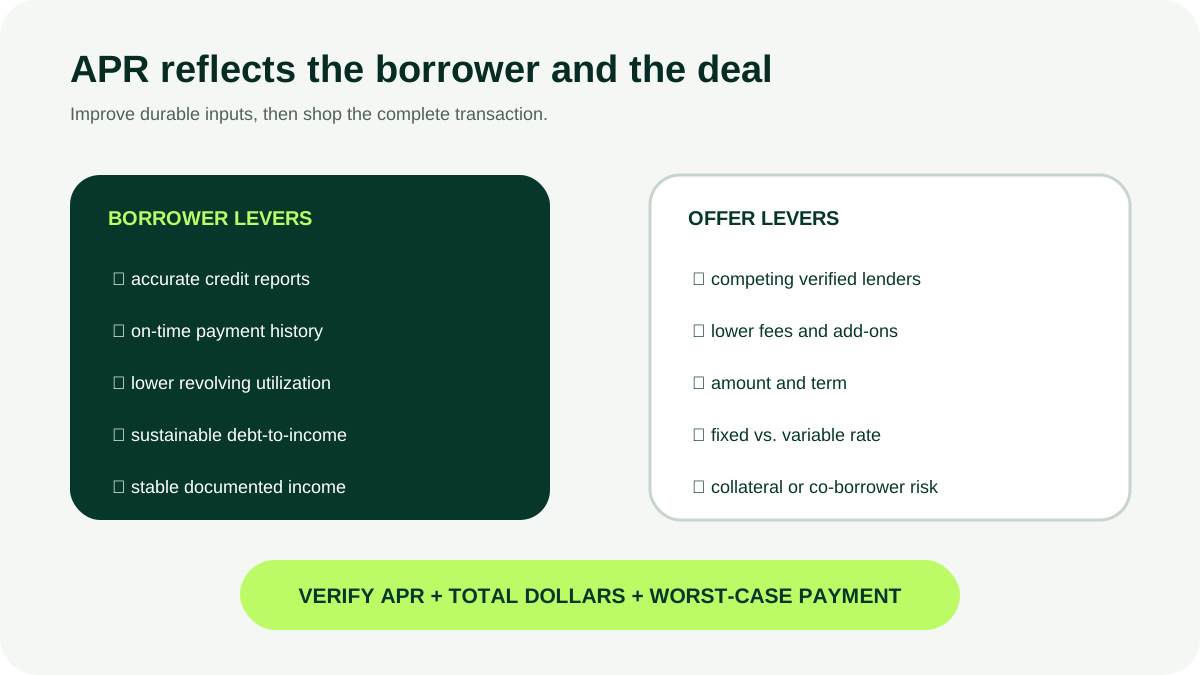
APR is a yearly measure of borrowing cost that incorporates the interest rate and certain finance charges. You cannot directly edit the APR a lender assigns, but you can improve the information and risk factors used in underwriting, compare more lenders, reduce fees, adjust the loan structure, and apply when finances are stronger. This guide separates durable credit work from quick claims and shows how to compare the final offer.
Key takeaways
- APR is not the same as the note rate or monthly payment; compare it with total dollars paid and the same loan term.
- Correcting supported credit-report errors, paying on time, lowering revolving utilization, and limiting unnecessary applications can strengthen a profile over time.
- Shopping matters because lenders use different score models, policies, fees, and pricing—not because every inquiry is harmless.
- A larger down payment, smaller amount, shorter term, qualified co-borrower, or collateral can change pricing but also changes cash use and risk.
- Never pay a credit-repair company to remove accurate, timely negative information or promise a guaranteed score increase.
Understand what APR measures
The CFPB describes APR as the interest rate plus certain additional loan fees, expressed as a percentage. Regulation Z defines it as a yearly measure relating the amount and timing of credit received to the amount and timing of payments.
APR is useful for comparing like-for-like offers, but it does not replace the payment schedule, total of payments, or contract. A longer loan can show a lower APR and still collect more interest dollars.
Obtain all credit reports before optimizing a score
Request reports through AnnualCreditReport.com and review all three nationwide companies. Scores are calculated from report data, and different lenders can use different reports and models.
Check identity, account ownership, balances, limits, payment status, collections, public records, and inquiries. Dispute an error with evidence to both the reporting company and the furnisher. Keep copies and results. Do not dispute accurate information merely because it is unfavorable.
Identity theft, mixed files, a wrong limit, or a payment reported late in error can affect underwriting. Start early; disputes and lender updates are not instantaneous.
Build payment history that can be verified
Pay every account by its due date. Use autopay for at least the minimum with alerts and an account buffer, then make intentional extra payments. Check that autopay survived a replaced bank account or card.
If a payment may be missed, contact the creditor before the due date and ask about a written hardship or due-date option. A promise by phone does not change reporting unless confirmed.
Past accurate late payments generally cannot be erased by a credit-repair service. Their influence may change over time, but only truthful correction and sustained current behavior create a defensible file.
Lower revolving utilization deliberately
Credit utilization compares reported revolving balances with limits. CFPB warns that moving balances onto one card or closing accounts can increase the percentage used.
Reduce balances without creating new debt elsewhere. Learn when each issuer reports—often near statement closing, not necessarily the due date. A payment before reporting can lower the balance a lender sees, but avoid draining the emergency reserve for a cosmetic one-month change.
Do not assume requesting a higher limit is free of consequences. Ask whether it creates a credit inquiry and control spending if approved.
Improve debt-to-income and cash stability
Lenders also evaluate income and recurring obligations. A borrower can have a high score and still fail affordability rules.
Before applying:
- pay down obligations that meaningfully reduce required monthly debt;
- avoid financing a vehicle or opening cards unnecessarily;
- document stable eligible income accurately;
- keep tax returns, pay records, and bank statements consistent;
- avoid unexplained large transfers;
- choose a loan amount the budget supports.
Never inflate income or omit debt. Fraud creates far greater risk than a higher APR.
Limit applications without avoiding comparison
A lender request for a credit report is an inquiry. CFPB says a single lender inquiry usually has little effect, and some scoring models group rate-shopping inquiries for certain loan types within a limited window. Treatment varies by model, product, and timing.
Ask whether prequalification is a soft inquiry. Compare verified lenders in a focused period and submit full applications only when terms are plausible. Credit-card and personal-loan applications may not receive the same shopping treatment as mortgages or auto loans.
Shop lenders and negotiate fees
Different lenders can offer different APRs to the same borrower. Compare the same amount, purpose, rate type, and term on the same day when possible.
Record:
| Offer field | Why it can change the result |
|---|---|
| Note rate | Determines interest accrual under the contract |
| APR | Adds certain finance charges to a yearly measure |
| Origination or lender fees | Can raise APR and reduce proceeds |
| Points | Upfront cost can buy a lower mortgage rate |
| Term | Changes payment and total interest |
| Fixed or variable | Determines whether future rate can change |
| Add-ons | Optional insurance or membership can increase cost |
| Prepayment rule | Affects the value of paying early or refinancing |
Ask a preferred lender to match a documented competing offer, but verify that one fee was not lowered while another rose.
Change loan structure only when the tradeoff is sound
A smaller loan or larger down payment can lower lender exposure. A shorter term may receive a lower rate and reduces time for interest, but raises the payment. Collateral or a qualified co-borrower can improve terms while exposing property or another person.
Do not pledge a home, vehicle, deposit, or family member solely for a headline APR. Quantify the worst-case loss and legal obligation. A co-borrower is responsible for the debt, not merely a character reference.
For a variable rate, identify the index, margin, adjustment dates, caps, floors, and maximum payment. A low initial APR is not a permanent rate unless the contract says so.
Time the application around real improvements
Useful reasons to wait include a corrected report, lower reported card balances, completed probationary employment period, paid-off installment obligation, or documented income season. Waiting only because someone promises a market-rate prediction is speculation.
Check offer expirations. Mortgage and auto pricing can change with market conditions even if the credit profile improves.
Avoid false shortcuts
Warning signs include:
- a guaranteed exact score increase;
- a new “credit identity” or instruction to use an EIN instead of a Social Security number;
- disputing every accurate negative item;
- advance payment for guaranteed approval;
- pressure to add tradelines whose ownership is misleading;
- advice to lie on an application.
Consumers can dispute errors themselves for free. The FTC and CFPB accept complaints about deceptive services and lenders.
Measure progress with facts, not daily score movement
Create a monthly record of statement balances, limits, on-time payments, required debt payments, report disputes, and application dates. A score can move because a balance reports on a different day, an account ages, or a lender uses another model. The objective is a stronger credit and cash-flow profile, not a particular number in one app.
Before applying again, verify that the intended improvement has actually reached the relevant credit report. Save the corrected report, creditor confirmation, or lower-balance statement. Do not pay for rapid-rescore claims unless a verified mortgage professional explains the legitimate process, cost, and evidence; consumers cannot force accurate data to disappear.
If the goal is refinancing existing debt, include exit cost from the old loan and entry cost to the new one. Calculate the break-even point: upfront refinancing costs divided by expected monthly savings. If the debt will be repaid or the property sold before that point, a lower APR may not create net savings.
Also test whether the new term resets the clock. Refinancing a three-year remaining balance into a new five-year loan can reduce the payment while increasing total interest. Compare the new loan against continuing the current amortization and against making the same higher payment on the new balance.
Verify the final APR and dollars
After underwriting, compare the final disclosure with the saved quote. Confirm amount, net proceeds, APR, rate, fees, payment, number of payments, total of payments, collateral, and optional products.
Use total-cost scenarios. If early payoff is likely, calculate the actual fees and interest through that date. If the payment is variable, model the contractual maximum, not only the initial amount.
Bottom line
Improving APR is not one credit-score trick. Build accurate reports and reliable payments, reduce revolving and monthly debt without exhausting reserves, document income, limit unnecessary applications, and shop comparable offers. Then test fees, term, collateral, and total dollars so a lower advertised APR does not create a worse loan.
Related content
Frequently asked questions
Sources
Related content
More from DollarScout on this topic.
