Many products on this page are from partners who compensate us. This doesn't influence our ratings. Our opinions are our own.
Common Tax Deductions
By Sophie Brown, Senior Finance Editor · Updated Jul 2026 · Fact-checked Jul 18, 2026
A tax deduction generally reduces income subject to tax; it is not a dollar-for-dollar refund. The right deduction depends on the tax year, filing status, income, activity, ownership, payment, and documentation. This guide organizes common federal individual deductions into adjustments to income, standard versus itemized deductions, and business deductions, with a record-first process that avoids double claims and outdated internet lists.
Key takeaways
- Separate deductions from credits and estimate tax savings at the applicable marginal rate—not the amount spent.
- Compare the standard deduction with allowable itemized deductions using the instructions for the return’s tax year.
- Some deductions can be claimed without itemizing, while business expenses belong on the form for the underlying activity.
- Eligibility limits, phaseouts, and documentation rules can change annually; save the exact form instructions used.
- A payment is not deductible merely because it feels necessary, and an expense cannot normally be deducted twice.
Understand what a deduction changes
The IRS distinguishes credits from deductions. A deduction generally reduces taxable income; a credit generally reduces tax. If a $1,000 deduction reduces income taxed at a 22% marginal rate, the federal income-tax effect may be roughly $220—not $1,000—before other interactions. A refundable credit can behave differently.
The result depends on where the deduction appears, income limitations, filing status, alternative tax rules, and whether the taxpayer already receives the standard deduction. Calculate with the complete return rather than multiplying every receipt by one rate.
Use the instructions for the correct tax year
Federal amounts, limits, forms, and eligibility can change. Identify the calendar year in which the income was earned or expense paid, then use that year’s Form 1040 instructions, schedules, publications, and state return rules.
Do not rely on a search snippet or an article that says “this year” without a date. IRS news releases can explain a filing season but may not be updated after publication. Current topic pages and the form instructions are stronger starting points.
Record the source URL or PDF, revision date, eligibility rule, calculation, and documents. Tax software is a calculation and filing tool; the taxpayer remains responsible for accurate inputs.
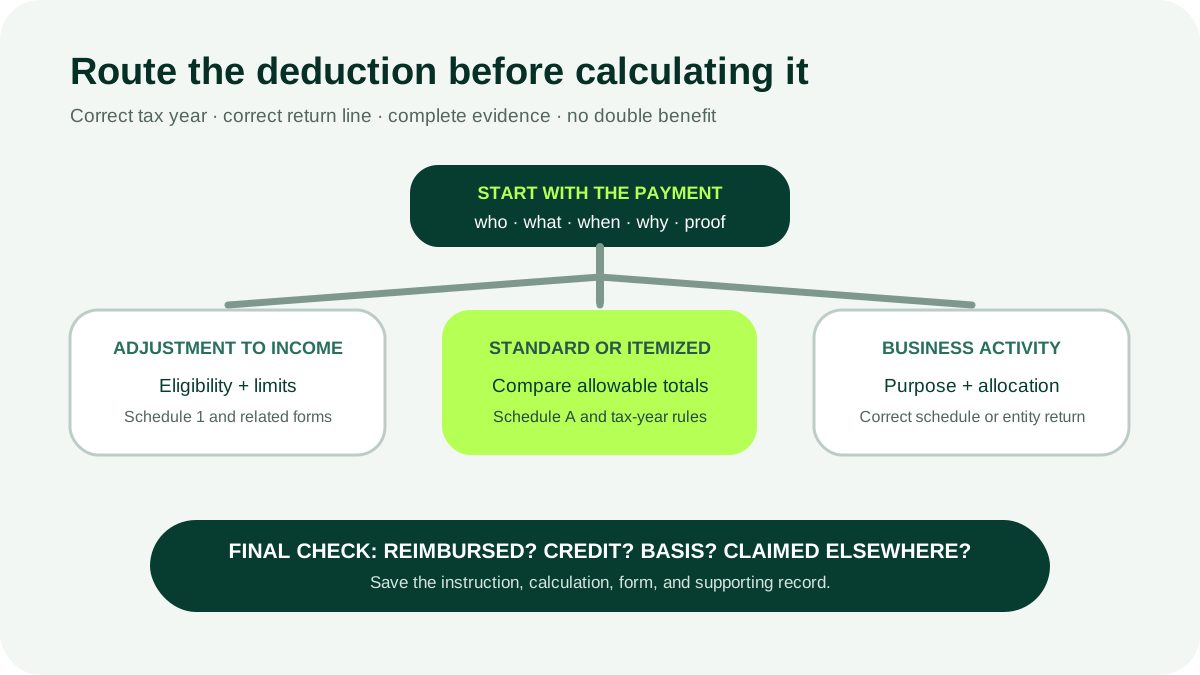
Sort deductions into three paths
Adjustments to income
Some deductions can reduce gross income in calculating adjusted gross income without using Schedule A. Depending on eligibility and the tax year, examples may include deductible contributions to certain retirement accounts, qualifying health savings account contributions, certain self-employed deductions, student loan interest, and other items listed on Schedule 1.
Each has its own limits and interactions. An employer retirement plan can affect IRA deductibility. Education expenses can interact with credits. Health savings account contributions require eligible coverage and cannot be duplicated through payroll or reimbursement.
Standard or itemized deduction
Most individual filers choose between the standard deduction and itemizing on Schedule A. IRS Topic 501 says itemizing generally makes sense when allowable itemized deductions exceed the standard deduction, although some taxpayers must itemize or cannot use the standard deduction.
Business or activity deductions
Expenses connected with self-employment, rental, farming, or another income-producing activity normally belong on the schedule or form for that activity, not Schedule A merely because an individual paid them. The classification affects self-employment tax, loss limits, basis, and recordkeeping.
Compare standard and itemized deductions
Create a Schedule A estimate before deciding. Common categories can include:
- qualified medical and dental expenses above the applicable threshold;
- specified state and local taxes subject to current rules and limitations;
- qualifying home mortgage interest and points;
- qualifying charitable contributions;
- casualty and theft losses allowed under current disaster rules;
- certain other deductions listed in the schedule instructions.
| Category | Evidence to gather | Common error |
|---|---|---|
| Medical | Bills, payment proof, insurance reimbursements, mileage log | Counting reimbursed costs or ignoring the income threshold |
| State and local tax | Forms, property-tax bills, payment dates | Claiming the wrong year or exceeding current limitations |
| Mortgage interest | Form 1098, loan history, use of proceeds | Assuming all home-equity interest is deductible |
| Charity | Receipts, acknowledgments, qualified-organization check | Gifts to individuals or unsupported property value |
| Disaster loss | Declaration, basis, insurance claim, appraisal | Applying rules for a nonqualifying event |
Compare total allowable itemized deductions—not gross receipts—with the standard deduction for the filing status. Married filing separately can require coordination if one spouse itemizes. Dependents, nonresident status, age, blindness, and partial-year returns can alter the standard deduction.
Review charitable contributions carefully
IRS Topic 506 says gifts must generally go to qualified organizations, not individuals. If the donor receives goods or services, only the amount above their fair market value may qualify. Documentation changes with the type and value of the gift.
For cash, retain the bank record or written communication. For contributions meeting the acknowledgment threshold, obtain a contemporaneous written acknowledgment. Noncash contributions can require Form 8283 and a qualified appraisal at specified levels. Donated time is not deductible, although certain unreimbursed out-of-pocket costs may qualify under the rules.
The tax treatment of charitable contributions for non-itemizers can change by tax year. Confirm the current Form 1040 and Schedule A instructions rather than assuming the rule from an earlier filing season continues.
Check medical expenses after reimbursement
Qualified unreimbursed medical expenses may be itemized only above the applicable adjusted-gross-income threshold. Include only eligible expenses for the taxpayer, spouse, or qualifying dependent under the rules.
Reconcile insurance, health reimbursement arrangements, flexible spending accounts, and health savings accounts. A cost reimbursed or paid with tax-advantaged funds generally cannot be deducted again. Track the date paid, not merely the date of service, and separate medical care from general health or personal spending.
Verify mortgage interest and home expenses
Form 1098 is a starting document, not proof that every amount is deductible. Eligibility can depend on when debt was incurred, principal limits, points, refinancing, and how proceeds were used. Home-equity loan interest is not automatically deductible because a home secures the loan.
Property tax, mortgage interest, home office expense, energy credits, and basis improvements are different items. A capital improvement may increase basis for a later sale rather than create a current deduction. Keep closing disclosures and improvement records for as long as they affect basis.
Capture eligible adjustments to income
Review Schedule 1 and the return instructions for the tax year. Potential adjustments can have specific forms and income limits:
- deductible traditional IRA contributions;
- health savings account contributions;
- deductible part of self-employment tax;
- self-employed health insurance;
- eligible self-employed retirement contributions;
- student loan interest;
- educator or military-related expenses where current law allows.
Do not infer eligibility from receiving a year-end form. For example, a contribution can be reportable but nondeductible. Maintain Form 8606 and basis records when after-tax IRA amounts are involved.
Deduct business expenses on the business record
IRS recordkeeping guidance says records must clearly show income and expenses and support return entries. A self-employed expense generally needs a business purpose and adequate proof. Mixed costs such as vehicle, phone, internet, travel, meals, and home use require allocation and sometimes enhanced logs.
Separate current expenses from inventory, capital assets, startup costs, and personal spending. A laptop may be depreciated, expensed under an election, or allocated between business and personal use depending on facts and law. Reimbursements reduce the amount borne by the taxpayer.
Employees generally cannot move an unreimbursed work cost onto Schedule C unless they separately operate a genuine trade or business. Worker classification follows the facts, not the preferred deduction.
Avoid double benefits
Check whether the same cost was:
- reimbursed by an employer, insurer, account, or grant;
- paid with pre-tax payroll money;
- used for a tax credit;
- capitalized into property basis;
- deducted by a business or another taxpayer;
- included in a state deduction with different rules.
Some laws allow coordinated benefits, but the calculation is explicit. Never assume a receipt can support every available line.
Build a documentation ledger
For each claimed deduction, record:
- tax year and return line;
- legal eligibility and current instruction source;
- payee, date, amount, and purpose;
- payment proof;
- required form, acknowledgment, appraisal, or log;
- reimbursement and business-use allocation;
- calculation and limitation;
- retention date.
Digital copies are useful when readable, complete, and backed up. Preserve original documents when a rule, appraisal, title, or basis record makes them important. Keep records as long as needed to support the return; property basis and carryovers often outlive the normal return file.
Review deductions before filing
Compare the return with Forms W-2, 1098, 1099, prior-year carryovers, and IRS transcripts. Confirm names, Social Security numbers, filing status, dependency, account ownership, and payment dates. Review whether the standard or itemized choice is actually used by the software.
For material, unusual, multi-state, foreign, entity, rental, casualty, or business issues, consider an enrolled agent, CPA, or tax attorney with relevant experience. Ask for the rule and assumptions, not a promise of a larger refund.
Bottom line
The deductions worth claiming are the ones allowed for the correct tax year and supported by complete records. Classify each item, compare standard and itemized deductions, coordinate adjustments, credits, reimbursements, and business forms, and save the calculation. A defensible return is more valuable than an unsupported “missed deduction” list.
Related content
Frequently asked questions
Sources
Related content
More from DollarScout on this topic.
