
Zacks Premium at a glance
Zacks Premium is the paid research layer built around the Zacks Rank, earnings-estimate revisions, Style Scores, analyst reports, screens, and portfolio monitoring. The current product page lists $249 per year and a 30-day trial. Signup material says the card is not charged during the trial and advertises a 90-day satisfaction guarantee after conversion. The exact checkout terms should be saved because Zacks sells many other services with different prices, trials, and guarantees.
The product is best understood as a repeatable stock-research process. The Zacks Rank sorts stocks from #1 Strong Buy to #5 Strong Sell based mainly on changes in earnings expectations. Premium unlocks the full #1 and #5 lists, daily Rank information, Style Scores, industry ranks, equity research, the Focus List, predefined and custom screens, the Earnings ESP filter, and portfolio alerts.
| Review question | DollarScout finding |
|---|---|
| Best for | Investors screening stocks around earnings-estimate revisions |
| Poor fit for | Passive fund investors or anyone expecting a low-turnover model portfolio |
| Standard price checked | $249 per year |
| Trial checked | 30 days |
| Main limitation | A strong signal still needs valuation, risk, and implementation controls |
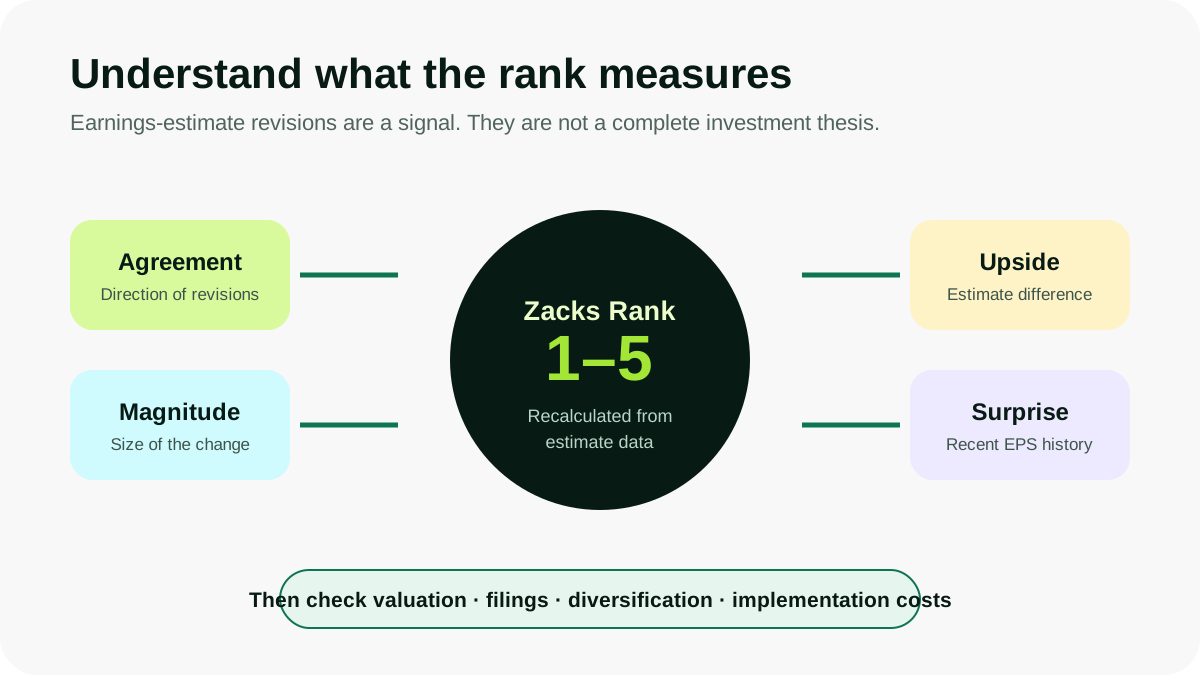
How the Zacks Rank works
Zacks describes four main inputs: Agreement, Magnitude, Upside, and Surprise. Agreement measures how broadly analysts revise estimates in the same direction. Magnitude measures the size of recent changes to consensus estimates. Upside compares Zacks’ most accurate estimate with consensus. Surprise incorporates recent earnings surprises. Raw scores are recalculated and combined to place stocks into five Rank groups.
The economic idea is understandable. Analysts update estimates as new information arrives; broad upward revisions can indicate that the market’s earnings expectations are improving. Because institutional estimate changes may arrive incrementally, revisions can carry information beyond one earnings announcement. The Rank creates a consistent way to observe that process across many stocks.
It is not a complete company valuation. A stock can receive favorable revisions and still trade at an excessive multiple, face balance-sheet risk, or sit inside an overconcentrated portfolio. The Rank’s stated short-term horizon—often described as one to three months—can also conflict with a household’s tax and turnover preferences. Use it as one evidence layer, not an automatic order instruction.
Rank versus Recommendation and Style Scores
Zacks distinguishes the quantitative Rank from its longer-horizon Recommendation. The Rank focuses on short-term earnings-revision signals. The Recommendation incorporates a six-to-twelve-month outlook and can include analyst judgment. Style Scores grade Value, Growth, and Momentum from A through F, with a combined VGM score.
Combining Rank and Style Scores can make a screen more relevant to an investor’s thesis, but it also creates more opportunities to data-mine. A user who tests dozens of combinations and reports only the best historical result is likely measuring selection luck. Define a rule before reviewing performance and test it across regimes, sectors, and realistic costs.
What Premium includes
The official products page lists daily Rank updates, full access to the #1 Rank list, equity research reports, the Focus List of 50 longer-term stocks, and more than 45 predefined Premium screens. The Premium tour adds Industry Rank, the #5 Rank list, Earnings ESP, custom screening, and a portfolio tracker that can monitor Rank, Style Score, estimate revisions, broker recommendation changes, and earnings surprises.
Coverage scores 4.4/5. The membership supports several linked workflows: discover a stock through Rank or screen, inspect the industry and Style Scores, read a research report, and monitor changes. Zacks also publishes research on ETFs and mutual funds. The deduction reflects uneven depth by security and the fact that many separately priced Zacks newsletters and portfolios are outside Premium.
That last distinction matters. The Zacks site markets Ultimate, investor collections, strategy newsletters, Research Wizard, and other products near Premium. A buyer should compare the exact entitlement list rather than assuming every portfolio or buy/sell alert advertised by Zacks is included in the $249 membership.
Research reports and data quality
Zacks Equity Research reports explain the drivers behind a rating, summarize fundamentals and estimates, and disclose analytical and investment-banking conflicts. The standard report format can make cross-company review efficient. Estimate revisions, consensus history, earnings surprise, Style Scores, and industry context are particularly useful around earnings season.
Data Quality earns 4.4/5. The Rank has a clear, documented factor logic; reports expose current estimates and supporting context; and the performance page provides substantially more implementation detail than a bare marketing claim. The score remains below excellent because estimates can be wrong, analyst coverage varies, Rank changes can be frequent, and the service’s own terms do not guarantee timeliness, accuracy, or completeness.
Always check the report date and data footnotes. A research report can contain a recent price but an older narrative or target. Consensus figures can change after publication. Open the issuer’s current 10-Q, 10-K, or 8-K to confirm reported results, debt, share count, cash flow, and risk factors. Treat the Zacks report as analysis layered over disclosure, not a replacement for disclosure.
What the performance disclosure changes
Zacks reports that its #1 Rank hypothetical portfolio has outperformed the S&P 500 over a period beginning in 1988. The current performance disclosure is essential because it explains how the number is constructed. The portfolio is equally weighted, historically rebalanced monthly and later weekly, and uses the group of #1 stocks available at the beginning of each period.
Zacks explicitly states that these returns are not achievable with actual portfolios at the displayed level. The calculation excludes commissions, bid-ask spreads, market impact, and some timing effects. It also does not represent one investor’s taxable account, position limits, liquidity requirements, or inability to own every selected stock in equal weight.
That disclosure does not make the signal useless. It changes the question from “did this historical hypothetical beat the index?” to “can I implement a constrained version after costs and taxes?” A subscriber should estimate turnover, spreads, tax consequences, position count, sector exposure, and the effect of missing trades. If the process requires weekly attention the user will not provide, the back history is irrelevant to their likely outcome.
Screening without overfitting
Premium screens can be an efficient research queue. A disciplined user begins with an investment hypothesis—such as favorable revisions combined with reasonable valuation and adequate liquidity—then selects only filters that implement that hypothesis. The screen should be tested over a period not used to invent it and compared with a simple benchmark.
More filters do not guarantee a better signal. Requiring Rank #1, VGM A, a top industry, a recent surprise, a narrow valuation band, and several growth thresholds may leave a small set that looks excellent historically because the rule was tailored to past data. It can fail when market leadership changes. Keep the rule interpretable and record changes rather than rewriting history.
The Earnings ESP filter is similarly contextual. A positive difference between the most accurate estimate and consensus may increase the chance of a surprise under Zacks’ research, but an earnings beat can coincide with weak guidance, poor cash flow, or a price decline. A probability signal is not an outcome guarantee.
Ease of use and site experience
Ease of Use scores 3.9/5. Rank numbers, Style Score letters, predefined screens, and portfolio alerts make the core signal easy to recognize. The Premium onboarding tour provides direct links to the main tools and explains what each is for.
The website is dense, dated in places, and highly promotional. Articles, free tools, Premium entitlements, and separately sold services can appear in the same journey. Calls to start trials or upgrade recur across pages. New users may struggle to tell whether a link opens included research, a free page, or another paid offer.
The best remedy is a narrow dashboard. Bookmark the Premium home, Rank lists, chosen screens, reports, and portfolio tracker. Unsubscribe from promotional messages that do not support the process. A research subscription should reduce noise, not add a second market feed to react to.
Price, trial, and value
Zacks Premium costs $249 per year according to the live products page. The 30-day trial is long enough to test the full workflow across at least one earnings cycle for some holdings, build screens, inspect report coverage, and set up a tracker. Current trial material says no charge is due during the trial and advertises a 90-day refund guarantee after conversion; save the specific signup terms because promotions and guarantees can change.
Value earns 4.0/5. The price is reasonable for a serious user combining screening, estimate data, reports, alerts, and a repeatable revisions process. It is weak value if the user only wants the visible Rank for a handful of stocks, follows a passive portfolio, or will pay for a second Zacks strategy service immediately after joining.
Before conversion, list the included features actually used and compare them with free brokerage research, SEC filings, and other subscriptions. Do not credit Zacks Premium with the value of separate products shown in cross-sells.
Support and cancellation
Zacks publishes telephone and email support for Premium, with weekday hours stated in the product tour. The signup page says a trial can be cancelled before conversion without owing the annual fee. Terms describe the service as informational and allow termination, but offer-specific billing and refund language remains the most relevant document for a purchase.
Customer Service scores 3.9/5. Direct phone and email channels and a structured onboarding tour are positives. The score is capped because DollarScout did not submit a case or measure response quality and because the site’s multiple products can complicate billing questions. Keep the receipt and identify the exact service name when contacting support.
Alternatives
Choose Morningstar Investor for fund, ETF, and portfolio construction research with a longer-term fundamental orientation. Choose Seeking Alpha Premium for a broad library of competing articles, transcripts, and quant factor grades. Choose Simply Wall St for visual global-company analysis and documented valuation models. Choose Motley Fool Stock Advisor when curated long-horizon stock ideas are more useful than a rules-based screen.
Zacks is the strongest fit when the user can explain why estimate revisions matter and has an implementation rule. It is less suitable when the user simply wants a list of stocks labeled Strong Buy.
Who should subscribe
Zacks Premium is a good fit for:
- Investors who deliberately monitor earnings estimates and surprises.
- Screen-based researchers who want consistent Rank and Style Score inputs.
- Users who will read reports and filings before acting on a signal.
- Portfolios that can manage turnover, diversification, and taxes explicitly.
It is easier to skip for:
- Long-term index investors who rarely select individual stocks.
- Users likely to chase every Rank change without a written process.
- Anyone treating hypothetical performance as a realizable return forecast.
- Investors who need a modern, calm interface more than a dense research toolkit.
Bottom line
Zacks Premium earns 4.2/5. Its Rank methodology, estimate-revision data, Style Scores, reports, screens, and portfolio monitoring form a coherent system, and the company discloses important limitations in its historical performance calculation. Data Quality and Coverage lead the score.
The subscription is not a shortcut around due diligence. Price it at $249, test the exact workflow during the 30-day trial, quantify implementation costs, and read the issuer’s current filings. The Rank is most valuable when it narrows a research universe; it is most dangerous when it becomes the entire thesis.