Many products on this page are from partners who compensate us. This doesn't influence our ratings. Our opinions are our own.
Seeking Alpha vs Zacks: 2026 Stock Research Comparison
By Sophie Brown, Senior Finance Editor · Updated Jul 2026 · Fact-checked Jul 19, 2026
Seeking Alpha wins narrowly at 4.3/5 versus Zacks at 4.2/5. Its $299 annual Premium plan combines competing contributor theses, Quant Ratings, factor grades, screeners, transcripts, financials, portfolio tools, and alerts. Zacks Premium costs $249 annually after its current 30-day trial and is the more focused choice for investors who deliberately use earnings-estimate revisions, the Zacks Rank, Style Scores, screens, and equity reports. Zacks wins Data Quality; Seeking Alpha wins Ease of Use and Coverage; Value and Customer Service are ties.
Head-to-head
| Feature | Seeking Alpha | Zacks |
|---|---|---|
| DollarScout Rating | 4.3/5 ★ | 4.2/5 ★ |
| Pricing | $299/year plus applicable taxes or VAT | $249/year for Zacks Premium |
| Trial | Trial eligibility varies; cancel before the stated end date to avoid automatic renewal | 30-day free trial; current signup material also advertises a 90-day satisfaction guarantee after conversion |
| Coverage | Stock and ETF analysis, Quant Ratings, screeners, transcripts, financials, alerts, and portfolio tools | Zacks Rank lists, Style Scores, equity reports, earnings-estimate data, Premium screens, Focus List, and portfolio monitoring |


Category-by-category breakdown
Data Quality
Ease of Use
Coverage
Value
Customer Service
Detailed analysis
The short answer
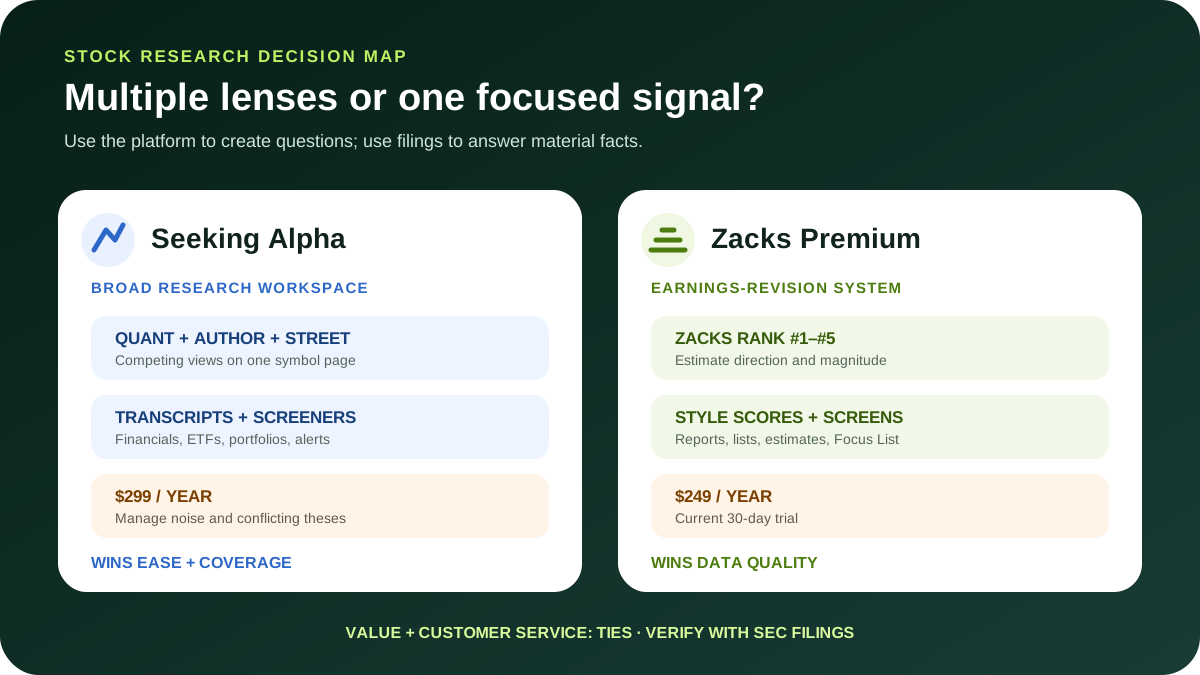
Seeking Alpha is the better broad research workspace; Zacks is the better focused earnings-revision system. DollarScout rates Seeking Alpha 4.3/5 and Zacks 4.2/5. Zacks wins Data Quality. Seeking Alpha wins Ease of Use and Coverage. Value and Customer Service are ties.
| Decision factor | Seeking Alpha Premium | Zacks Premium |
|---|---|---|
| Best fit | Comparing bull, bear, quant, and sell-side views | Applying a repeatable estimate-revision workflow |
| Standard price | $299/year plus applicable tax or VAT | $249/year |
| Trial | Eligibility and offer vary; renewal rules shown at signup | Current 30-day free trial |
| Primary signal | Daily Quant Rating plus five sector-relative Factor Grades | Zacks Rank driven primarily by earnings-estimate revisions |
| Research surface | Contributor articles, transcripts, financials, screeners, ratings, portfolios | Rank lists, Style Scores, equity reports, screens, Focus List, estimates |
| Main risk | Volume and conflicting opinions create noise | Promotional presentation can turn one signal into a trading instruction |
The methodological difference
Seeking Alpha deliberately puts several frameworks on the same symbol page. A stock can have a Quant Rating, five Factor Grades, a consensus from Seeking Alpha authors, sell-side ratings, competing articles, financial statements, earnings transcripts, dividend grades, and alerts. The investor's job is to resolve disagreement.
Zacks organizes the experience around earnings-estimate revisions. Its Rank attempts to identify the direction and magnitude of analyst-estimate changes and related surprise factors. Style Scores for Value, Growth, and Momentum complement the Rank, while screens and equity reports help turn it into a repeatable process.
The choice is therefore not “opinions versus data.” Seeking Alpha has a substantial quantitative system, and Zacks provides analyst research. The difference is which layer anchors the workflow: a multi-view research page or an estimate-revision ranking system.
Price and subscription terms
Seeking Alpha says Premium is currently $299 per year plus applicable taxes or VAT. Trials and introductory offers vary by eligibility and signup route. Its cancellation policy says subscriptions renew automatically unless canceled and describes refund eligibility and account procedures. The live checkout controls the precise trial and renewal date.
Zacks lists Premium at $249 per year with a 30-day trial. Current signup material also advertises a satisfaction guarantee after conversion, subject to its terms. Zacks sells many other services and bundles at different prices; a Premium membership should not be confused with Ultimate, Investor Collection, a recommendation portfolio, or a screening software product.
The $50 annual difference is about $4.17 per month. It matters only if the cheaper product supports the actual process. Paying $249 for unused rank lists is worse value than paying $299 for a research workspace used every week.
Value is a tie: Seeking Alpha 4.1/5, Zacks 4.0/5. The score gap is below DollarScout's threshold for a meaningful category winner.
Data Quality: Zacks wins
Zacks scores 4.4/5 versus Seeking Alpha's 4.2/5. Its estimate-revision framework has a clear economic input, a defined five-level Rank, and a long operating history. Premium exposes the #1 Rank list, equity reports, Style Scores, earnings data, Focus List, and predefined screens in a relatively consistent research vocabulary.
Seeking Alpha's underlying financial, price, and estimate data support sophisticated ratings, but the editorial layer varies by author. A well-supported contributor article can be excellent; another can use an aggressive valuation, omit a risk, or become stale after the thesis changes. The site displays author history and separate rating systems, which helps readers judge rather than homogenize those opinions.
Zacks wins because its primary framework is more standardized. It does not follow that every Rank change is correct or that Zacks has more accurate raw data in every field. Verify earnings estimates, dates, share counts, adjusted measures, and corporate actions before a material decision.
Seeking Alpha Quant Ratings
Seeking Alpha describes Quant Ratings as daily evaluations using more than 100 metrics drawn from financial statements, price performance, and analysts' future revenue and earnings estimates. Stocks receive Strong Buy through Strong Sell classifications and a numeric score from 1.0 to 5.0.
Factor Grades compare Value, Growth, Profitability, Momentum, and EPS Revisions with other companies in the same sector. Sector-relative comparison avoids treating a bank's margins or a utility's growth as directly equivalent to software. It can still hide differences in business quality, accounting, balance-sheet risk, and cycle.
The overall Quant Rating is not a simple average of the five displayed grades. Seeking Alpha documents weighting, risk and size inputs, and disqualifying grades. A user should not reverse-engineer it by averaging letters.
Ratings update daily before the market opens under the current FAQ. That makes historical screenshots stale quickly. Record the observation date and the underlying factor change when a rating enters an investment memo.
Zacks Rank and Style Scores
The Zacks Rank ranges from #1 Strong Buy through #5 Strong Sell. Zacks describes earnings-estimate revisions as the central driver: changes in consensus expectations and agreement among analysts can contain information not yet fully reflected in price.
Style Scores grade Value, Growth, Momentum, and a combined VGM profile from A through F. Zacks presents them as complements to Rank, not substitutes. A high Value score with a weak Rank describes a different setup from a strong Rank with weak valuation characteristics.
Estimate revisions have limitations. Analyst coverage can be sparse, the consensus can follow management guidance, and a stock can rise before the estimates change. One-time items, acquisitions, foreign exchange, accounting reclassification, and non-GAAP measures can distort comparisons. A Rank is a signal to investigate, not a complete investment thesis.
Performance claims require an implementation test
Zacks publishes a detailed performance disclosure explaining hypothetical portfolios, Rank histories, benchmark comparisons, and limitations. A model that buys every qualifying stock at assumed prices is not the same as an investor account. Turnover, bid-ask spread, market impact, tax lots, position limits, cash, and inability to trade at the modeled price reduce replicability.
Seeking Alpha also presents performance associated with its Quant system and rated groups. The same implementation questions apply: universe, start date, survivorship, rebalancing frequency, weighting, delistings, dividends, transaction costs, capacity, and benchmark.
Do not compare two headline return percentages unless the periods, portfolio rules, and assumptions match. Reconstruct the approach with investable constraints or use the rating only as a prioritization signal.
Ease of Use: Seeking Alpha wins
Seeking Alpha scores 4.2/5 to Zacks at 3.9/5. Its current symbol pages integrate ratings, financials, transcripts, articles, news, dividends, valuation, and portfolio context. The screener supports approximately 100 criteria, saved screens, ratings, factor grades, trading, dividend, and earnings filters.
Zacks is functionally rich but visually promotional. Multiple products, free reports, email captures, portfolios, and recommendation services can obscure what Premium includes. A disciplined user can bookmark Rank, Style Scores, screens, reports, and portfolio pages, but the first session requires more navigation work.
Seeking Alpha's ease can become information overload. The feed rewards continued reading, and opposing articles do not resolve themselves. Use a written checklist and a stopping rule instead of treating volume as diligence.
Ease-of-use winner: Seeking Alpha. It is easier to move from a ticker to a multi-angle research packet; Zacks is easier only after a customer internalizes its specific system.
Coverage: Seeking Alpha wins
Seeking Alpha scores 4.7/5 versus Zacks at 4.4/5. Premium includes analysis across thousands of stocks and ETFs, unlimited transcripts, ten years of financials, stock and ETF comparisons, screeners, dividend tools, portfolio linking, and alerts. Its contributor network can cover niche securities and events that a standardized desk may not emphasize.
Seeking Alpha says the Quant system currently covers roughly 5,600 stocks but excludes securities without sell-side analyst coverage because estimates are necessary inputs. Its articles and transcripts can cover a different universe from the Quant ratings. Do not assume every visible ticker has every feature.
Zacks provides Rank coverage, research reports on widely followed companies, estimates, industries, ETFs, mutual-fund tools, screens, and Premium lists. The product is broad, but its most distinctive value remains U.S.-equity earnings research.
Coverage winner: Seeking Alpha. A larger content surface is useful only when the investor filters it to eligible securities.
Contributor research versus house research
Seeking Alpha articles are written by independent contributors with different styles, horizons, incentives, and expertise. The same company can have bullish and bearish cases published close together. That plurality is valuable when the reader compares assumptions rather than counting recommendations.
Check an author's disclosure, rating history, update cadence, valuation basis, and treatment of contrary evidence. Follow links to filings and reconcile quoted measures. An eloquent thesis can be wrong because of a single share-count, debt, margin, or terminal-value assumption.
Zacks equity reports offer a more standardized house presentation around estimates, valuation, industry, and Rank. That consistency makes cross-company review faster but can provide less qualitative debate about management, competitive position, product risk, or capital allocation.
The strongest workflow can combine them: use a standardized screen to find a candidate, read opposing qualitative cases, then verify both against primary materials.
Earnings transcripts and event research
Seeking Alpha Premium includes unlimited earnings-call and event transcripts and supports searching them for themes and keywords. Transcripts accelerate review of management commentary, analyst questions, guidance, and changing language.
Transcripts are secondary records. Speaker labels, numbers, punctuation, and inaudible passages can contain errors. Use the company's investor-relations audio, presentation, earnings release, and SEC filing when exact wording or a material figure matters.
Zacks provides earnings calendars, estimates, surprises, and reports, which are excellent for seeing expectation changes. It is less centered on a searchable transcript library. Seeking Alpha wins this use case clearly.
Screeners and false precision
Seeking Alpha screens can filter by Quant Rating, Factor Grades, author or Wall Street ratings, valuation, growth, profitability, momentum, EPS revisions, dividend data, and other fields. Zacks Premium includes predefined screens and tools tied to Rank, Style Scores, earnings, and industry data.
A screen is a query over data, not a strategy. The result changes with point-in-time availability, restatements, estimates, and market price. Adding many filters can overfit a story and produce a tiny, concentrated list.
Write the economic reason for each filter, define rebalance and exit rules, and inspect excluded securities. Export or record the screen date and criteria so a result can be reproduced.
Portfolio tools and alerts
Seeking Alpha supports portfolios, broker linking, custom views, aggregate health measures, rating and price alerts, and updates tied to followed symbols. Zacks Premium supports portfolio monitoring, Rank changes, research access, and lists.
Linked brokerage data increases convenience and data exposure. Read the connector's permissions, use read-only access, and remove stale links. Neither platform is a broker merely because it can display holdings.
Too many alerts create reactive trading. Limit notifications to a thesis-changing event, filing, estimate revision, rating threshold, or risk limit that has a prewritten response.
Verify with SEC filings
EDGAR should anchor material U.S. company facts. Use the latest 10-K, 10-Q, 8-K, proxy, registration statement, and exhibits to verify revenue recognition, segments, debt, dilution, stock compensation, related parties, legal proceedings, and risk factors.
Adjusted figures and trailing ratios can differ among research vendors because definitions and update timing differ. Reconcile the numerator, denominator, fiscal period, currency, and share basis before concluding one service has an error.
Neither a contributor article nor an automated report replaces the filing. The research platform should reduce discovery time, not become the final source of record.
Customer Service: a tie
Both score 3.9/5. Seeking Alpha publishes subscription help, cancellation policies, feature documentation, and support contacts. Zacks publishes member support and terms, but its many services can make entitlement or email questions more complex.
Before a trial converts, verify the product name, annual price, tax, renewal date, cancellation route, refund policy, and saved research access after cancellation. Take a timestamped screenshot of the order summary and cancellation confirmation.
Customer service cannot resolve a disagreement with a model output as if it were a data-entry ticket. Distinguish account support, data correction, methodology explanation, and investment judgment.
Who should choose Seeking Alpha?
Choose Seeking Alpha Premium when the process benefits from competing bull and bear cases, Quant and factor ratings, screeners, transcripts, ten-year financials, ETF tools, and portfolio alerts in one interface. It is the better default for an investor who reads critically and wants several lenses.
Do not choose it for an effortless buy list. The volume and disagreement require a research protocol.
Who should choose Zacks?
Choose Zacks Premium when the investor wants a focused, repeatable framework based on earnings-estimate revisions, Rank, Style Scores, screens, and standardized equity reports. Its $249 annual price is lower and the current 30-day trial supports a real process test.
Do not treat Rank #1 as an instruction to buy every stock or a guarantee of outperformance. Portfolio and implementation rules remain the investor's responsibility.
Final verdict
Seeking Alpha wins narrowly because its interface and research breadth solve more use cases. Zacks provides the more standardized primary signal and wins Data Quality. Select the platform that fits a written research process, then verify every candidate against filings and investable constraints.
Which one is right for you?
- Best for Comparing bull, bear, quant, and sell-side views: Seeking AlphaView Premium Plans
- Best for Earnings transcripts and broad research workflow: Seeking AlphaView Premium Plans
- Best for Focused earnings-estimate revision system: ZacksView Zacks Premium
- Best for Zacks Rank and Style Score screens: ZacksView Zacks Premium
Final verdict
Seeking Alpha wins 4.3/5 to 4.2/5 for easier navigation and broader coverage across contributor research, Quant Ratings, screeners, transcripts, financials, and portfolios. Zacks is the stronger specialist for standardized earnings-revision research and wins Data Quality. Value and Customer Service are ties; neither platform replaces filings or a portfolio process.
Frequently asked questions
Sources and verification
Scores and product facts come from the underlying DollarScout reviews and were checked against these primary sources.
- Seeking Alpha Premium overview and price
- Seeking Alpha Premium feature list
- Seeking Alpha Quant Ratings FAQ
- Seeking Alpha stock screener documentation
- Seeking Alpha analyst ratings documentation
- Seeking Alpha Wall Street ratings documentation
- Seeking Alpha cancellation and refund policy
- Zacks product catalog and Premium price
- Zacks Premium features and onboarding
- Zacks Premium trial and guarantee
- Zacks Rank methodology explanation
- Zacks performance disclosure
- Zacks terms of service
- Zacks company and research background
- SEC EDGAR company filings search
Related content
More from DollarScout on this topic.
