
Seeking Alpha Premium at a glance
Seeking Alpha Premium is a paid research platform built around three different kinds of investment opinion: articles and ratings from Seeking Alpha contributors, aggregated ratings from Wall Street analysts, and Seeking Alpha’s proprietary Quant Ratings. It adds screeners, financial statements, earnings-call transcripts, comparison tools, alerts, and portfolio monitoring to that rating framework. The result is broader and more debate-driven than a traditional single-house research service.
The standard price verified for this review is $299 per year, plus applicable taxes or VAT. Promotional first-year prices may appear, but the current offer and renewal disclosure at checkout control what a subscriber will actually pay. Seeking Alpha’s support policy says subscriptions renew automatically unless canceled and that fees are generally non-refundable unless a written offer states otherwise. Trial eligibility also varies by service and account history.
| Review question | DollarScout finding |
|---|---|
| Best for | Active, self-directed stock and ETF investors comparing multiple viewpoints |
| Poor fit for | Passive investors, occasional readers, or anyone expecting personalized advice |
| Standard price checked | $299 per year plus applicable taxes or VAT |
| Main strength | Contributor analysis, Quant data, transcripts, and screening in one workflow |
| Main limitation | High information volume and uneven contributor quality require verification |
What Premium includes
Premium removes the article limits applied to free readers and opens Seeking Alpha’s wider stock and ETF research workflow. The official feature list includes unlimited articles and transcripts, three rating perspectives on symbol pages, factor grades, top-rated lists, stock and ETF screeners, side-by-side comparisons, ten years of company financials, price and rating alerts, customizable portfolio views, and optional broker linking.
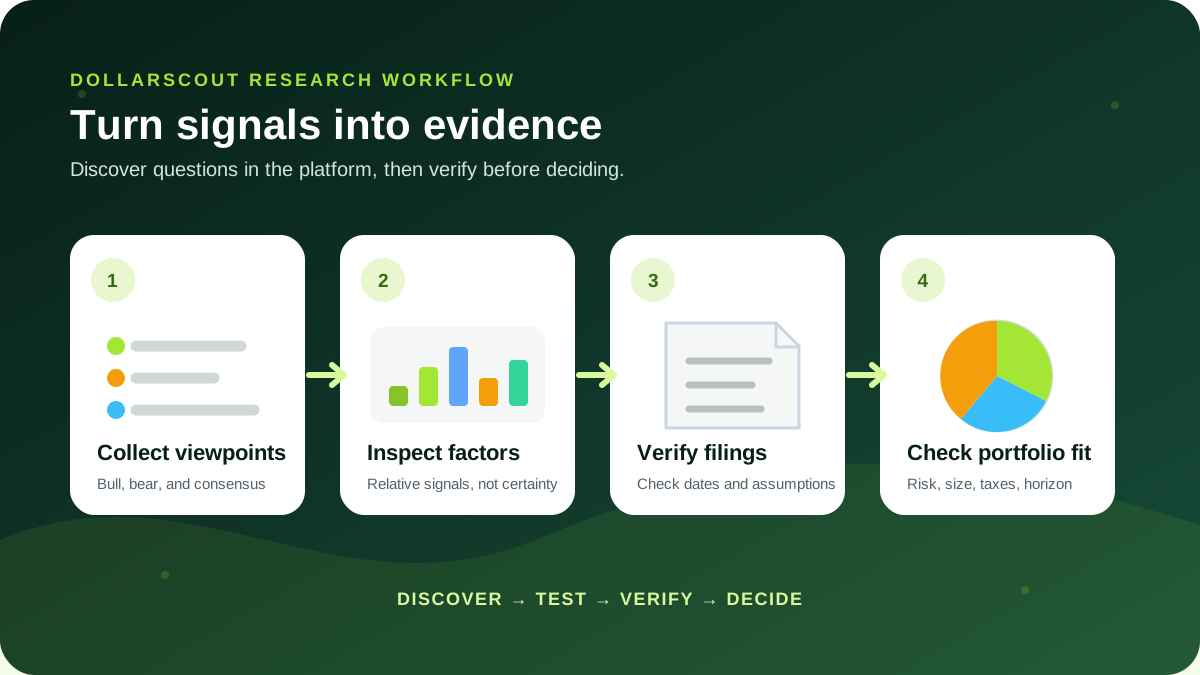
The platform’s appeal is not any one feature in isolation. An investor can begin with a screen, open a company page, compare Quant, contributor, and sell-side ratings, read bullish and bearish articles, search an earnings-call transcript, inspect historical financials, and then add the security to a monitored portfolio. That connected path is more useful than buying Premium solely to unlock an occasional article.
Seeking Alpha’s current help material also describes AI-powered Virtual Analyst Reports and Earnings Call Insights. These tools can reduce the time required to locate themes, estimates, and management commentary. They should be treated as navigation and summarization aids. A generated summary can omit context, and a transcript-based insight does not replace reading the relevant exchange or the company’s filed results.
Premium is separate from products such as Alpha Picks, Investing Groups, and higher-tier services. A subscriber should not assume that every recommendation product advertised within Seeking Alpha is included in the $299 plan. Review the plan comparison and checkout page for inclusions, first-year discounts, renewal price, taxes, and trial conditions before payment.
Quant Ratings and Factor Grades
Quant Ratings are the platform’s most distinctive structured research feature. Seeking Alpha documents more than 100 metrics used to compare a stock or ETF with peers in its sector or asset class. The visible Factor Grades cover Value, Growth, Profitability, Momentum, and EPS Revisions, while the overall Quant Rating runs from Strong Sell to Strong Buy on a 1.0-to-5.0 scale.
The overall rating is not a simple average of the five grades. Seeking Alpha says the model weights inputs differently, applies disqualifying thresholds to particularly weak factors, and also accounts for size and risk. Ratings are recalculated daily before the market opens. A rating can therefore change because of estimate revisions, price momentum, a threshold crossing, or changes among sector peers even when the company has issued no new filing.
This relative design is both useful and easy to misread. A strong Value grade means the security compares favorably with relevant peers under the model’s metrics; it does not necessarily mean the security is inexpensive in absolute terms or below a defensible intrinsic value. Momentum and EPS Revisions also introduce timing information into what might otherwise look like a purely fundamental score.
Seeking Alpha’s documentation gives different counts for different parts of the product: its Premium overview describes analysis on more than 4,000 stocks and ETFs, while the Quant FAQ describes ratings coverage of about 5,600 stocks. Those figures refer to different scopes and can change. The Quant FAQ also states that securities without sell-side analyst coverage and stocks trading directly on foreign exchanges may be excluded. Check the actual symbol page instead of extrapolating platform-wide coverage to a specific security.
Why the Data Quality score is 4.2/5
The score recognizes the documented factor framework, daily refresh, financial statements, estimates, transcripts, rating histories, and peer comparisons. It stops below the top tier because a user must distinguish provider data, quantitative outputs, contributor judgments, Wall Street consensus, and AI summaries. Contributor articles can contain different assumptions and standards of evidence; breadth does not make every conclusion equally reliable.
Contributor analysis and rating context
Seeking Alpha’s contributor network is a major point of difference. A symbol page can contain conflicting long and short theses, and those disagreements can expose assumptions that a single research house might not emphasize. Authors generally attach a directional rating to covered securities, and Seeking Alpha aggregates recent contributor ratings into an overall analyst view.
More opinions do not automatically produce a better answer. Some contributors specialize deeply in an industry, while others publish across broader themes. Articles can use different valuation dates, forecasts, risk tolerances, or time horizons. A bullish article written before an earnings release and a bearish article written afterward are not directly comparable even when both remain visible on the same page.
A disciplined reader checks the publication date, author history, disclosure, cited documents, assumptions, and later updates. Comments may surface useful counterarguments, but they are not a quality-control system. The most productive use of the contributor library is to build a question list: What must be true for the thesis to work? Which filing supports the claim? What evidence would invalidate it? How does the author’s horizon compare with the investor’s own?
Wall Street Analyst ratings are a third, separate input. Seeking Alpha explains that these represent third-party sell-side recommendations aggregated by the platform, not Seeking Alpha contributor ratings. The three rating columns should be read as different evidence streams rather than votes in one homogeneous poll.
Screeners, comparisons, and financials
Premium’s stock screener can filter by ratings, Quant fields, trading data, dividend grades, earnings information, company attributes, country, sector, and industry. Seeking Alpha’s current screener documentation describes roughly 100 criteria and the ability to save custom screens. Predefined screens and top-rated lists offer a faster entry point.
Screening is discovery, not due diligence. A filter for high profitability and positive revisions may surface candidates but can also concentrate results in one sector, market-cap range, or market regime. Before acting, inspect liquidity, debt, dilution, valuation, recent filings, earnings quality, and whether the relevant metric is trailing, forward, GAAP, or non-GAAP.
The comparison tool can place up to six stocks or six ETFs side by side and export results. Premium also documents ten years of income statements, balance sheets, and cash-flow statements. These tools are useful for establishing a consistent peer table, but standardized rows cannot explain every accounting difference. Acquisitions, discontinued operations, restatements, and company-specific adjustments may require returning to the 10-K, 10-Q, 8-K, or fund documents.
Why the Coverage score is 4.7/5
Coverage is the strongest category because Premium combines articles, transcripts, ratings, factor grades, financial statements, estimates, screeners, comparisons, news, and portfolio alerts across a broad U.S.-oriented stock and ETF universe. The deduction reflects documented Quant exclusions, uneven depth across securities, and the fact that Premium is not a comprehensive terminal for every global exchange, fixed-income instrument, derivative, or private asset.
Portfolio tools and alerts
Users can create portfolios manually, import data, or link supported brokerage accounts. Seeking Alpha says linked holdings can update daily and feed ratings, factor grades, news, and alerts into portfolio views. That can turn the site from a discovery feed into a monitoring workspace.
Broker linking adds convenience but deserves a privacy and operational review. The help center notes limitations involving supported brokers, geography, multi-factor authentication, update timing, and USD display. Verify imported holdings and avoid treating a research portfolio as the brokerage’s authoritative account record.
Alerts are most useful when they identify a reason to review a thesis, not when they trigger an automatic reaction. A Quant downgrade, analyst-rating change, earnings headline, or price move may justify opening new evidence. It does not, by itself, account for taxes, position size, diversification, or the investor’s objectives.
Ease of use
Seeking Alpha organizes a large amount of information around symbols, portfolios, feeds, and screeners. Existing users of market-news sites will recognize the quote-page pattern, and the separation among Quant, SA Authors, and Wall Street ratings is useful once understood. Saved screens, watchlists, alerts, and customized portfolio columns can reduce repetitive work.
The learning curve comes from density and product boundaries. Premium articles, Investing Groups, Alpha Picks, PRO, community comments, AI summaries, news, and promotional messages can appear within the same ecosystem. New subscribers need to learn which features are included, which ratings are independent, and which pages present opinion rather than standardized data.
The 4.2/5 Ease of Use score reflects a coherent research path with unavoidable information overload. It is not a timed usability score. DollarScout did not maintain a logged-in Premium account in this review cycle, so the assessment relies on current documentation, public interfaces, and the complexity of the documented workflow.
Pricing and value
At $299 per year, Premium costs about $24.92 per month when annualized. Value depends less on the number of articles consumed than on whether the subscriber uses several paid functions repeatedly. Someone who screens stocks, checks Quant changes, reads transcripts, compares peer financials, and monitors a portfolio can replace multiple scattered research steps. Someone buying one index fund or checking occasional quotes probably cannot.
The 4.1/5 Value score recognizes the breadth of the bundle while accounting for the high annual commitment, promotional pricing, automatic renewal, and overlap with free filings, issuer investor-relations pages, broker research, and public market data. A discounted first year should be evaluated against the standard renewal amount, not treated as the permanent cost.
Premium should also be compared with the right alternative. Morningstar Investor is generally stronger for integrated mutual-fund, ETF, and portfolio-allocation research. Seeking Alpha is stronger for a continuous stream of stock opinions, transcripts, Quant signals, and competing theses. Free SEC filings remain the authoritative source for company disclosures, regardless of which interface an investor prefers.
Customer service and cancellation
Seeking Alpha’s support center documents account management, subscription help, and a contact email. Its policy states that subscriptions can be canceled at any time, cancellation generally takes effect at the end of the current billing period, and subscriptions automatically renew unless canceled. It also says fees are normally non-refundable unless a specific written offer provides otherwise.
Trial rules vary. The policy distinguishes free trials, paid trials, and limited guarantees attached to some Investing Group subscriptions. It also says a free trial may be limited to one per service per lifetime. Save the exact checkout terms when subscribing because a general support article cannot override a specific written offer.
The 3.9/5 Customer Service score reflects the documented help center and account channels, balanced against firm renewal and refund terms. DollarScout did not submit support tickets or measure response times, so the score should not be read as a promise about speed or resolution quality.
Who should subscribe?
Seeking Alpha Premium is a strong fit if:
- You research individual stocks or ETFs every month.
- You want bullish and bearish contributor theses in the same workspace.
- You will use Quant Ratings as a discovery and monitoring input.
- Transcripts, screeners, peer comparisons, and alerts are recurring tasks.
- You are comfortable checking claims against filings and primary data.
It is a weak fit if:
- You primarily hold a few broad index funds and rarely research securities.
- You want a managed portfolio, trade execution, or personalized planning.
- A high-volume news and opinion feed encourages unnecessary trading.
- You expect every article or automated rating to meet one uniform standard.
- You are unlikely to use the paid tools enough to justify $299 per year.
Bottom line
Seeking Alpha Premium earns 4.3/5 because it combines broad qualitative debate with structured Quant research, transcripts, financials, screeners, comparisons, and portfolio monitoring. Coverage leads the rating. Data Quality and Ease of Use are strong but acknowledge that multiple evidence types and high content volume demand careful interpretation. Value is compelling for a recurring stock-research workflow, not for occasional reading.
The right way to use Seeking Alpha is as an evidence-discovery system. Start with a screen, rating change, or article; identify the assumptions; compare opposing views; then verify material claims in the company’s latest filings and investor disclosures. That process can make Premium worth the fee. Treating a Strong Buy label, popular article, or AI summary as a self-contained decision cannot.