
Morningstar Investor at a glance
Morningstar Investor is a paid investment-research service for people who want more than market quotes and a news feed. It combines security pages, proprietary ratings, analyst reports, customizable screeners, side-by-side comparisons, watchlists, portfolio analysis, and research-driven investment lists. The service covers stocks, mutual funds, and exchange-traded funds, but its clearest advantage is fund research: Morningstar’s category system, Style Box, star ratings, Medalist Ratings, fee data, and analyst commentary are designed to work together.
The standard price verified for this review is $249 per year or $34.95 per month. Paying monthly for 12 months would cost $419.40, so the annual plan saves $170.40 and works out to $20.75 per month. Morningstar advertises a trial for eligible new subscribers and separate discounts for some verified groups, but eligibility and promotional terms can change. Check the final checkout page rather than treating any introductory offer as permanent.
| Review question | DollarScout finding |
|---|---|
| Best for | Long-term investors researching funds, ETFs, stocks, and portfolio overlap |
| Poor fit for | Quote checking, short-term trade execution, or investors satisfied with free fund documents |
| Standard price checked | $249 annually or $34.95 monthly |
| Main strength | A connected fund-research and portfolio-analysis workflow |
| Main limitation | Premium price and a dense interface with specialized terminology |
What Morningstar Investor is—and is not
The product is best understood as a research workspace. It can help an investor discover securities, compare candidates, read Morningstar’s analysis, organize watchlists, and examine an existing portfolio. It does not open a brokerage account, hold cash or securities, place orders, rebalance a portfolio automatically, or act as a fiduciary adviser. That distinction matters because a subscription fee is not a commission and the costs shown for a mutual fund are not Morningstar’s own charges.
Morningstar also publishes a large amount of free editorial material, quotes, and basic security information. Investor is the paid layer. Morningstar’s help center says there is no continuing free tier for Investor: after cancellation, a subscriber loses access to tools such as Screener, Watchlists, Portfolio, proprietary metrics, full reports, and paid analysis. Someone who needs only prospectuses, shareholder reports, or occasional quote checks may be able to build a satisfactory process with free issuer, SEC, and FINRA resources instead.
The strongest use case is repeated research. A household comparing several funds, monitoring a diversified portfolio, or evaluating overlapping ETF holdings can reuse the same screens, watchlists, reports, and portfolio views throughout the year. A person making one simple index-fund decision may receive much less value from the same feature set.
Research quality and ratings
Morningstar’s data is not a single score pasted onto a quote page. Fund research may include category placement, historical risk-adjusted performance, fees, portfolio holdings, style characteristics, sustainability data, and forward-looking research. Stock pages add valuation work, economic-moat analysis, analyst notes, financial statements, and company reports where coverage is available. Unabridged company reports are reserved for Investor subscribers, according to Morningstar’s help center.
Two ratings are easy to confuse. The familiar Morningstar Rating for funds—the star rating—is based on historical, risk-adjusted performance relative to peers. The Medalist Rating is forward-looking. Morningstar updated the Medalist methodology globally in April 2026: the framework still examines People, Process, and Parent, while a separate price assessment reflects whether fees help or hurt a strategy’s prospects relative to its category. Analyst coverage is not universal; some ratings can include algorithmic inputs. The label and the methodology therefore deserve inspection before an investor treats a medal as a complete recommendation.
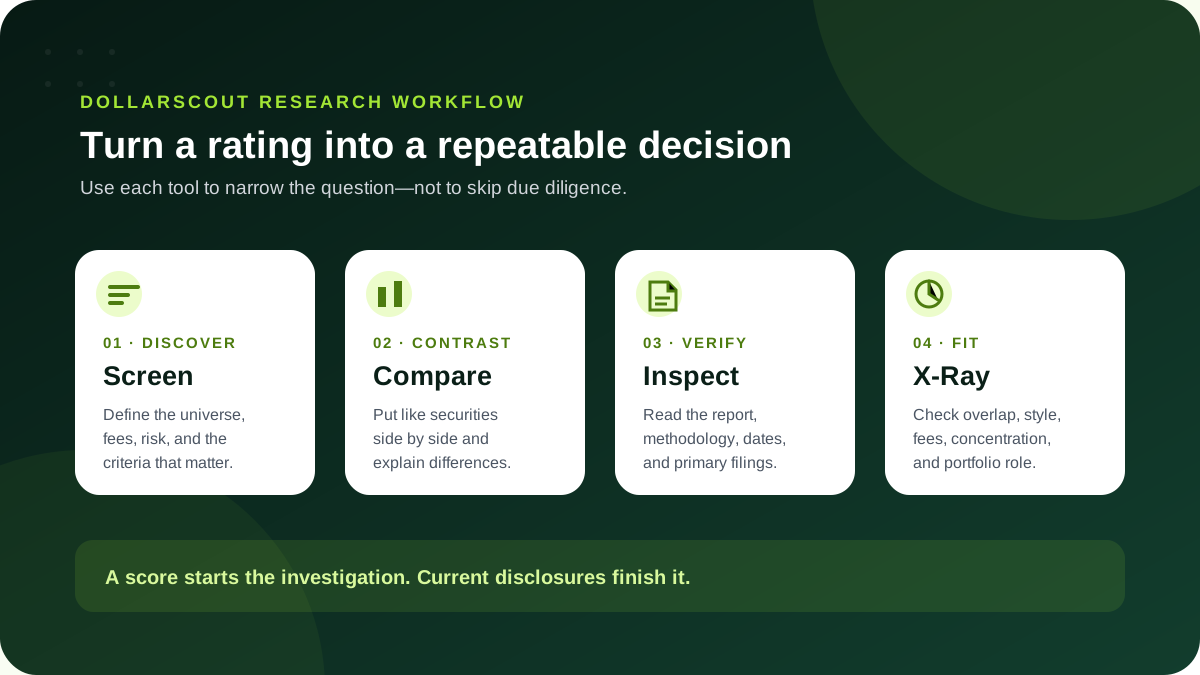
Morningstar’s ratings can organize due diligence, but they cannot remove investment risk. The SEC notes that past fund performance does not predict future returns and recommends reading a fund’s prospectus and latest shareholder report. A sound workflow uses Morningstar to find questions and compare evidence, then checks the issuer’s current disclosures. That is especially important after a manager change, strategy change, fee waiver, share-class change, or material portfolio shift.
Why the Data Quality score is 4.9/5
The high score reflects the breadth and consistency of the documented fund and equity research framework, the linkage between data and methodology, and the presence of analyst reports and portfolio-level diagnostics. It is not a claim that every security has an analyst-written report or that every data point updates in real time. Investors should check each data point’s as-of date and distinguish analyst-assigned work from quantitatively generated coverage.
Screening and idea discovery
Screener is one of the clearest reasons to pay. Morningstar documents support for stocks, mutual funds, ETFs, closed-end funds, and semiliquid funds, with available filters changing by investment type. Users can begin with a predefined view or build a custom screen from valuation, performance, risk, fee, portfolio, and Morningstar-specific data points. Results can be moved into a watchlist for continuing review.
The current Screener also includes optional AI Quick Filters. A user can describe a screen in plain English and review the filters Morningstar applies. Morningstar explicitly warns that the AI can make mistakes and tells users to confirm the resulting criteria. We view that as a useful starting aid, not a substitute for understanding the selected filters. A screen for “low-cost funds,” for example, still requires the investor to inspect share class, expense-ratio date, load, transaction fee, and account availability.
Morningstar’s predefined “Best Investments” lists can accelerate discovery, but they are filtered research lists rather than model portfolios. The useful next step is to open the list in Screener, add criteria that reflect the investor’s own objective, and then compare the survivors. Treating a list title as a buy signal would skip most of the product’s actual value.
Comparing funds, ETFs, and stocks
The Compare tool supports up to five securities side by side. Morningstar’s fund help documentation describes five related routes: screen for securities, use Compare, inspect comparables on a fund report, compare within a fund family, and read the analyst report. That sequence is more valuable than selecting the highest-rated option because it exposes differences in fees, category, strategy, risk, and portfolio construction.
The limitation is that standardized comparisons can make unlike products look deceptively similar. Two funds can share a category while using different indexes, derivatives, currency policies, distribution schedules, or tax structures. Investors should confirm the prospectus and the exact share class or ticker before acting. FINRA’s Fund Analyzer is a useful independent companion when the main question is how fund-level and account-level fees compound over a chosen holding period.
Why the Coverage score is 4.8/5
Coverage is excellent for a household researching mainstream U.S. stocks, mutual funds, and ETFs, and the tools connect those asset types to portfolio views. The score stops short of 5 because depth is not identical across every security, exchange, or specialty asset. Morningstar Investor is also not designed as an execution terminal for options, futures, foreign exchange, or intraday order-flow research.
Portfolio analysis and X-Ray
Portfolio X-Ray is the feature most likely to reveal something an investor missed while evaluating positions one by one. Morningstar documents breakdowns for asset class, stock sector, world region, fees and expenses, equity style, fixed-income style, and security-level contributions. Stock Intersection can reveal when several funds own the same companies, while portfolio views can show concentration that is not obvious from the number of tickers alone.
A practical workflow is to enter or import the current portfolio, choose an appropriate benchmark, inspect the largest deviations, and then investigate why they exist. A sector overweight may be intentional; a duplicate position may be harmless; a higher weighted expense ratio may pay for a deliberate strategy. X-Ray surfaces the condition but does not decide whether it fits the investor’s goals, taxes, time horizon, or risk tolerance.
The tool is most useful when the holdings data is complete and current. Missing accounts, stale quantities, untracked cash, or a security Morningstar cannot classify can distort the picture. Portfolio diagnostics should therefore be treated as a model of the entered holdings, not an audit of the investor’s entire financial life.
Ease of use
Morningstar Investor earns 4.2/5 for Ease of Use. The documented workflow is coherent: a user can move from a list or screen to a security page, compare candidates, save them, and evaluate portfolio fit. The help center is unusually detailed and explains both individual tools and broader tasks.
The learning curve comes from information density. Star Rating, Medalist Rating, Moat Rating, fair value, category, style box, price-to-fair-value, analyst coverage, and quantitative coverage answer different questions. New users may initially read them as variations of a single recommendation. Dense tables and customizable columns also reward a desktop-sized screen more than a quick mobile visit.
We did not score usability from a brief marketing-page impression. The 4.2 rating combines the documented task flow, breadth of help material, and consistency between tools, then deducts for terminology, density, and the amount of context required to interpret proprietary metrics correctly.
Pricing and value
The annual subscription is substantially cheaper than paying month to month for a full year, but $249 remains a meaningful recurring expense. Value depends on usage, not portfolio size alone. An investor who runs screens, reads reports, evaluates fund fees, checks overlap, and monitors several watchlists can spread the cost across many decisions. Someone who opens the site twice a year may be paying for depth they do not use.
Morningstar receives 4.1/5 for Value. It scores well because several specialized research functions sit in one subscription and the annual price is transparent. It loses points because capable free alternatives exist for narrower tasks: issuer documents and SEC filings for primary disclosure, FINRA’s Fund Analyzer for cost scenarios, and free broker or finance sites for quotes and basic screening. The right comparison is not “paid research versus no research”; it is whether Morningstar saves enough time or improves enough repeated decisions to justify $20.75 per month on the annual plan.
Use the trial period, if the checkout page offers one, to perform actual tasks. Build the same screen you expect to reuse, find reports for the securities you own, import or enter a realistic portfolio, and test whether X-Ray answers a question you could not answer easily elsewhere. Cancel before the trial ends if the workflow does not earn a permanent place in your process.
Support and cancellation
Morningstar’s published agreement lists online account cancellation, email cancellation, and telephone cancellation for subscriptions purchased directly from Morningstar. It also publishes email and phone support channels and support hours. Subscriptions originally purchased through Apple can be subject to Apple’s cancellation process. A cancelled paid plan generally remains available until the end of the applicable paid term, while cancelling during an eligible trial avoids the subscription charge under the stated terms.
Customer Service receives 4.0/5. Multiple documented contact and cancellation channels are positive, and the help center covers the core product workflows in depth. We cap the score because DollarScout did not submit and time support cases during this review cycle. The score evaluates documented access and self-service resources; it should not be read as a measured promise about resolution speed or outcome.
Morningstar Investor alternatives
Choose Seeking Alpha when the priority is a high volume of competing investment theses, earnings transcripts, contributor discussion, and a more feed-driven idea workflow. Choose Zacks Premium when the main attraction is rank-driven stock screening and earnings-estimate signals. Morningstar is the stronger fit when fund analysis, proprietary manager research, standardized comparisons, and portfolio composition are central.
Free resources may be sufficient for a disciplined index investor. A fund prospectus, shareholder report, issuer holdings page, SEC filings, and FINRA’s Fund Analyzer can answer many essential questions without another subscription. The tradeoff is fragmentation: the investor must assemble and maintain the workflow instead of using Morningstar’s connected data model.
Who should subscribe
Morningstar Investor is best suited to:
- Long-term investors comparing multiple mutual funds or ETFs within a category.
- Households that want to detect portfolio overlap, style drift, concentration, or fee exposure.
- Investors who will read analyst reports and methodology notes rather than relying on a badge.
- People replacing a collection of disconnected screeners, spreadsheets, and research tabs.
It is easier to skip when:
- You only need quotes, charts, or a small watchlist.
- Your portfolio uses a few broad index funds that you rarely reconsider.
- You want brokerage execution, real-time trading tools, or personalized financial planning.
- You are unlikely to use Screener, Compare, reports, and X-Ray more than occasionally.
Bottom line
Morningstar Investor earns 4.5/5 because it turns a large body of fund, stock, and portfolio research into a repeatable decision process. Data Quality and Coverage lead the score. Ease of Use remains strong but reflects a real learning curve, while Value depends on choosing the annual plan and using the tools repeatedly. Customer Service is supported by documented channels rather than response-time testing.
The subscription is worth considering for an investor who can name the recurring tasks it will replace: screening a fund universe, comparing candidates, reading full research, checking portfolio overlap, or monitoring a structured watchlist. It is not worth buying merely to see a rating or confirm a quote. Use Morningstar’s analysis as one layer of due diligence, verify current fund documents and costs, and remember that neither a star nor a medal can predict the investor’s eventual return.