Many products on this page are from partners who compensate us. This doesn't influence our ratings. Our opinions are our own.
Morningstar vs Seeking Alpha: 2026 Comparison
By Sophie Brown, Senior Finance Editor · Updated Jul 2026 · Fact-checked Jul 18, 2026
Morningstar Investor is the better fit for mutual-fund and ETF due diligence, portfolio allocation, and a consistent in-house analyst framework. Seeking Alpha Premium is better for stock investors who want competing contributor opinions, daily Quant signals, earnings transcripts, and a faster idea feed. Morningstar costs $249 annually; Seeking Alpha Premium costs $299 annually. Neither service executes trades or replaces primary filings.
Head-to-head
| Feature | Morningstar | Seeking Alpha |
|---|---|---|
| DollarScout Rating | 4.5/5 ★ | 4.3/5 ★ |
| Pricing | $249/year or $34.95/month | $299/year plus applicable taxes or VAT |
| Trial | Free trial for eligible new subscribers; terms can vary by offer | Trial eligibility varies; cancel before the stated end date to avoid automatic renewal |
| Coverage | Stocks, mutual funds, ETFs, portfolios, analyst reports, ratings, and screeners | Stock and ETF analysis, Quant Ratings, screeners, transcripts, financials, alerts, and portfolio tools |


Category-by-category breakdown
Data Quality
Ease of Use
Coverage
Value
Customer Service
Detailed analysis
The bottom line
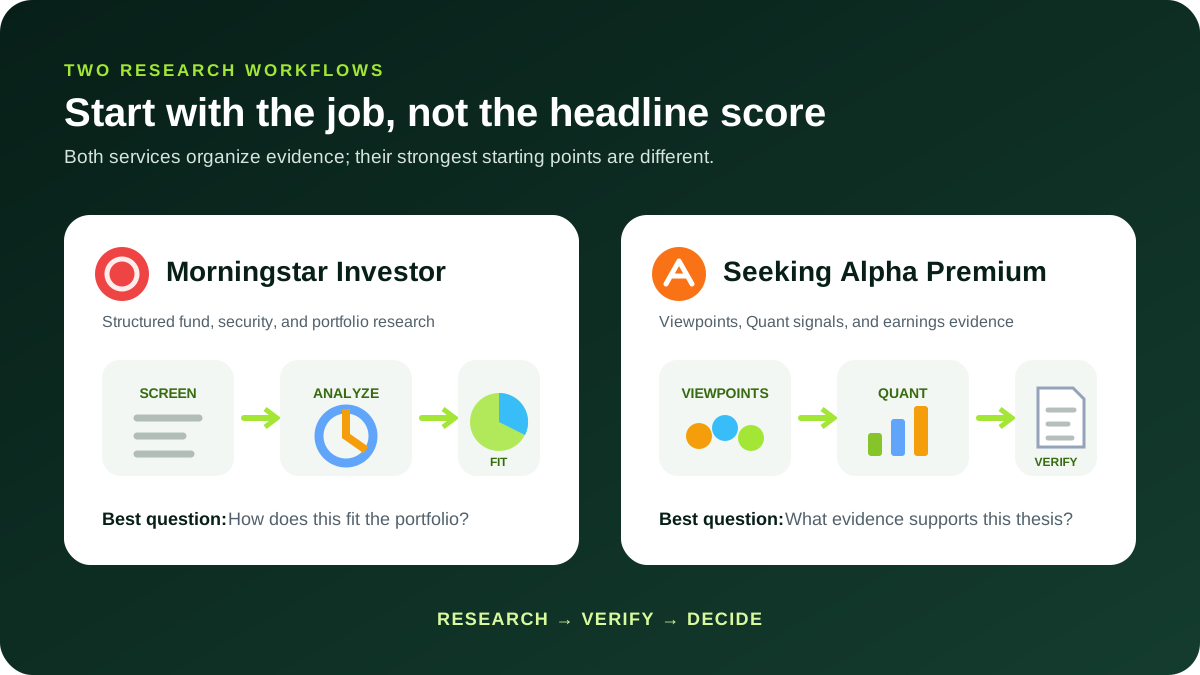
Morningstar Investor and Seeking Alpha Premium both sell investment research, but they organize evidence differently. Morningstar is a structured research library: proprietary fund ratings, analyst reports, security comparisons, screeners, fair-value work, and Portfolio X-Ray operate inside one house methodology. Seeking Alpha is an evidence marketplace: contributor articles, Wall Street consensus, daily Quant Ratings, transcripts, financial statements, screeners, alerts, and portfolio feeds bring several viewpoints into the same symbol page.
Choose Morningstar Investor when the recurring job is comparing mutual funds or ETFs, checking portfolio overlap, studying fees and categories, or following one consistent analyst framework. Choose Seeking Alpha Premium when the recurring job is researching individual stocks, comparing bullish and bearish theses, monitoring earnings, and using factor-driven screens or rating changes to generate ideas.
The annual list prices checked for this comparison are $249 for Morningstar Investor and $299 for Seeking Alpha Premium, a $50 difference before any applicable tax or temporary promotion. Price alone should not decide the matchup. Paying less for the wrong workflow wastes more money than paying $50 extra for tools used every week.
| Decision factor | Morningstar Investor | Seeking Alpha Premium |
|---|---|---|
| Best use case | Fund, ETF, stock, and portfolio due diligence | Stock and ETF idea discovery and monitoring |
| Standard annual price checked | $249 | $299 plus applicable taxes or VAT |
| Research model | In-house and quantitative Morningstar frameworks | Contributors, Wall Street consensus, and Quant Ratings |
| Standout tool | Portfolio X-Ray and fund research | Quant Ratings, transcripts, and competing theses |
| Main limitation | Dense interface and premium price for occasional use | High content volume and uneven contributor quality |
Price, trial, and renewal terms
Morningstar’s official pricing material lists Investor at $249 per year or $34.95 per month. Twelve monthly payments total $419.40, so the annual option saves $170.40 and effectively costs $20.75 per month. Morningstar advertises trials for eligible new subscribers, but promotions and eligibility can change.
Seeking Alpha’s official Premium overview lists $299 per year plus applicable taxes or VAT, or about $24.92 per month when annualized. Promotional first-year pricing may be lower. Seeking Alpha’s support policy says subscriptions renew automatically unless canceled, fees are generally non-refundable unless a written offer says otherwise, and trial conditions vary by service and account history.
For a clean comparison, use the standard annual prices rather than comparing one service’s promotion with the other’s list price. Save the checkout terms, note the renewal date, and verify whether the quoted amount includes tax. Morningstar is the lower-priced service under the standard prices checked, but its advantage is only $4.17 per month on an annualized basis.
Pricing edge: Morningstar. The difference is real but not large enough to outweigh a major workflow mismatch.
Research philosophy: one framework or many viewpoints
Morningstar’s research is built around connected proprietary frameworks. Fund pages can combine category data, historical star ratings, forward-looking Medalist Ratings, fees, risk, holdings, style, analyst commentary, and reports. Stock coverage can add economic-moat analysis, fair-value estimates, analyst notes, financial statements, and company reports. The benefit is consistency: users can learn the definitions and apply them across a portfolio.
Seeking Alpha intentionally exposes disagreement. A stock page can show a Quant Rating, an aggregated Seeking Alpha contributor rating, an aggregated Wall Street rating, bullish and bearish articles, news, financial data, and earnings material. That breadth can reveal assumptions a single-house report might not emphasize. It also places more responsibility on the reader to separate dates, methodologies, incentives, time horizons, and standards of evidence.
Morningstar’s familiar fund star rating is backward-looking and based on historical risk-adjusted performance relative to peers. The Medalist Rating is forward-looking and evaluates People, Process, Parent, and price. Seeking Alpha’s Quant model compares more than 100 metrics with sector or asset-class peers, shows Factor Grades for Value, Growth, Profitability, Momentum, and EPS Revisions, and recalculates ratings daily before the market opens.
Neither provider’s headline score is a complete recommendation. Morningstar ratings can simplify a large fund universe but cannot predict returns. Seeking Alpha’s factor grades are relative, meaning a favorable Value grade does not necessarily indicate absolute cheapness. In both products, the label should open an investigation rather than end one.
Consistency edge: Morningstar. Viewpoint diversity edge: Seeking Alpha.
Funds and ETFs
Morningstar has the clearer advantage for mutual funds. Its category system, Style Box, expense data, holdings analysis, star ratings, Medalist framework, analyst reports, and fund comparison workflows are core parts of the product. Portfolio X-Ray can also show how several funds combine at household level, including asset allocation, region, sector, style, fees, and stock overlap.
Seeking Alpha covers ETFs and documents an ETF screener, Quant Ratings, contributor articles, comparisons, expenses, performance, and related metrics. That is useful for discovering or monitoring ETFs, especially when the investor wants market commentary and factor signals alongside fund data. It is not the same depth of mutual-fund taxonomy and portfolio construction that defines Morningstar’s strongest use case.
An index investor with a few broad funds may need neither subscription. Issuer pages, prospectuses, shareholder reports, SEC resources, and FINRA’s Fund Analyzer can answer many core questions. A paid service becomes easier to justify when the portfolio contains many funds, overlapping strategies, active managers, several accounts, or recurring manager and fee reviews.
Fund-research edge: Morningstar.
Individual-stock research
Morningstar offers substantial equity research where coverage is available, including analyst reports, fair-value work, moat ratings, financial statements, and screeners. Its approach is attractive to investors who want a valuation-oriented framework and a smaller number of clearly defined research concepts.
Seeking Alpha has the stronger stock-research feed. Premium documents unlimited articles and transcripts, ten years of financials, stock comparisons, roughly 100 screener criteria, rating histories, alerts, and three parallel rating perspectives. A user can move quickly from an earnings transcript to opposing articles, peer factors, estimates, and portfolio alerts.
The tradeoff is quality control. Seeking Alpha contributors do not all use the same assumptions or research process. Article dates, disclosures, author histories, cited filings, and thesis updates matter. Popularity and comment volume are not substitutes for verification. Morningstar’s more centralized framework reduces that variation, although analyst-written depth is not identical for every covered security.
Stock idea and earnings-workflow edge: Seeking Alpha. Equity-framework consistency edge: Morningstar.
Screeners and comparisons
Both services can begin a research funnel. Morningstar documents screeners for stocks, mutual funds, ETFs, closed-end funds, and semiliquid funds, with filters that change by investment type. Its Compare tool supports up to five securities. The workflow fits investors who move from a broad fund or stock universe into detailed reports and portfolio analysis.
Seeking Alpha’s Premium screener emphasizes ratings, Quant fields, dividend grades, earnings data, trading data, company attributes, and sector filters. Its documentation describes roughly 100 criteria. The comparison feature can place up to six stocks or ETFs side by side and export the results.
Seeking Alpha is more natural for a factor-and-signal screen. Morningstar is more natural when the screen leads into fund categories, analyst frameworks, and portfolio construction. Neither screen proves suitability. Investors still need to check liquidity, fees, share class, accounting definitions, recent filings, and whether a metric is trailing or forward.
Stock-screening edge: Seeking Alpha. Multi-asset research workflow edge: Morningstar.
Portfolio monitoring
Morningstar Portfolio X-Ray is designed to analyze how holdings interact. It can reveal stock overlap between funds, concentration, style exposure, asset mix, regional allocation, and weighted expenses. This is a diagnostic model of the holdings supplied, not an automated recommendation or complete financial plan.
Seeking Alpha portfolios are oriented more toward monitoring. Users can organize holdings, customize columns, receive news and rating alerts, and optionally link supported brokerages for daily updates. Quant and article signals can then be viewed in portfolio context. That is helpful for following active stock positions but does not replace the brokerage’s official records or account-level tax information.
Investors asking “What do I own beneath these funds?” will usually prefer Morningstar. Investors asking “What changed today across the stocks I follow?” will usually prefer Seeking Alpha.
Allocation and overlap edge: Morningstar. News and rating-monitoring edge: Seeking Alpha.
Ease of use and information density
Neither service is truly simple. Morningstar asks users to learn star ratings, Medalist Ratings, categories, Style Boxes, moat ratings, fair values, and portfolio diagnostics. Seeking Alpha asks users to separate Quant, contributor, and Wall Street ratings while navigating articles, comments, news, transcripts, AI summaries, portfolios, and several separately sold subscription products.
Morningstar feels more like a research database. Seeking Alpha feels more like an investing publication layered over a data and ratings platform. The better interface depends on whether a reader prefers structured reports or an active feed. Both reward desktop use for dense tables and comparisons.
DollarScout scores Ease of Use at 4.2/5 for both. That tie is deliberate: the products are coherent once learned, but each has a meaningful learning curve. We did not run timed tasks in paid accounts, so this is an evidence-based editorial assessment rather than a laboratory usability result.
Ease-of-use result: tie.
Data quality, coverage, value, and service scores
Morningstar leads Data Quality 4.9 to 4.2 because its documented fund and equity frameworks, analyst reports, rating methodologies, and portfolio diagnostics form a more consistent evidence system. Seeking Alpha’s underlying data and Quant documentation are strong, but the overall platform also includes contributor opinions and AI summaries with variable evidentiary quality.
Coverage is effectively a tie: Morningstar scores 4.8 and Seeking Alpha 4.7. Morningstar’s breadth across funds, ETFs, stocks, and portfolios offsets Seeking Alpha’s larger flow of stock opinions, transcripts, screening, ratings, and alerts. The difference is below DollarScout’s 0.15-point threshold for declaring a category winner.
Value is tied at 4.1. Morningstar costs less and offers an unusually coherent fund-and-portfolio workflow. Seeking Alpha costs $50 more per year but may deliver more recurring value to an active stock researcher. The value calculation changes with usage, not merely price.
Customer Service is also treated as a tie: Morningstar scores 4.0 and Seeking Alpha 3.9. Both publish support and subscription information. Seeking Alpha’s policy explicitly highlights automatic renewal and generally non-refundable fees. DollarScout did not time support responses for either service, so a tenth-point difference is not enough to manufacture a winner.
Which one should you choose?
Choose Morningstar Investor if most of these statements are true:
- Mutual funds and ETFs are central to your portfolio.
- You want analyst reports and one consistent rating vocabulary.
- Portfolio overlap, asset allocation, and weighted expenses matter.
- You prefer a structured research library to a high-volume opinion feed.
- You will use the tools often enough to justify $249 per year.
Choose Seeking Alpha Premium if most of these statements are true:
- You research individual stocks or ETFs every month.
- You want competing bullish and bearish theses.
- Quant screens, daily ratings, transcripts, and earnings monitoring matter.
- You are comfortable checking contributor claims against filings.
- You will use enough of the workflow to justify $299 per year.
Choose neither if you need trade execution, fiduciary advice, automatic portfolio management, or only occasional quotes. A brokerage, registered adviser, robo-adviser, issuer documents, SEC filings, or free fund tools may be the more appropriate solution.
Final verdict
Morningstar wins this comparison for fund research, portfolio diagnostics, methodological consistency, and standard annual price. Seeking Alpha wins for stock idea discovery, contributor debate, Quant-driven monitoring, transcripts, and the volume of earnings-oriented research. The overall ratings—4.5/5 for Morningstar and 4.3/5 for Seeking Alpha—summarize those tradeoffs but do not make Morningstar the automatic choice for every investor.
The best purchase is the service whose workflow will be repeated. List the actual tasks you expect to perform each month, map them to the features above, and compare the standard renewal prices. If the list contains fund comparison and portfolio overlap, Morningstar is the stronger answer. If it contains stock screens, transcript review, opposing theses, and rating alerts, Seeking Alpha is the stronger answer.
Which one is right for you?
- Best for Mutual-fund and ETF due diligence: MorningstarStart Free Trial
- Best for Portfolio allocation and overlap analysis: MorningstarStart Free Trial
- Best for Individual-stock idea discovery: Seeking AlphaView Premium Plans
- Best for Earnings transcripts and rating alerts: Seeking AlphaView Premium Plans
Final verdict
Morningstar Investor is the stronger choice for mutual-fund and ETF research, portfolio overlap, and a consistent analyst framework. Seeking Alpha Premium is stronger for stock idea discovery, competing contributor views, daily Quant signals, transcripts, and earnings monitoring. Choose based on the workflow you will repeat; neither service executes trades or replaces primary filings.
Frequently asked questions
Sources and verification
Scores and product facts come from the underlying DollarScout reviews and were checked against these primary sources.
- Morningstar Investor product and trial page
- Morningstar Investor standard pricing
- Morningstar Portfolio X-Ray documentation
- Morningstar fund comparison workflow
- Seeking Alpha Premium overview and standard price
- Seeking Alpha Premium feature list
- Seeking Alpha Quant Ratings and Factor Grades FAQ
- Seeking Alpha cancellation and refund policy
- FINRA Fund Analyzer overview
- SEC EDGAR company filings search
Related content
More from DollarScout on this topic.
