
Stock Advisor at a glance
Motley Fool Stock Advisor is a paid stock-recommendation and education service, not a market-data terminal. The current public product page lists a $199 standard annual price, two new recommendations per month, updated monthly rankings, portfolio strategies, stock reports, watchlist and portfolio-tracking tools, partial Fool IQ access, and a large library of editorial material. The same page displayed a $99 introductory first-year promotion for eligible new members when DollarScout checked it on July 18, 2026. The disclosure states that renewal occurs at the then-current list price, so a subscriber should budget from the standard price rather than the promotional headline.
The service is designed around a long holding period. Its product page separates recommendations between Hidden Gems and Rule Breakers teams, publishes an updated Top 10 list, and suggests a portfolio size above $25,000. That suggested size is marketing guidance, not an account minimum: Stock Advisor does not hold money, open a brokerage account, or place orders. The practical question is whether a reader wants a recurring stream of concentrated stock ideas and is prepared to do the portfolio work the newsletter cannot do for them.
| Review question | DollarScout finding |
|---|---|
| Best for | Patient DIY investors who want a small number of named stock ideas |
| Poor fit for | Index-only investors, short-term traders, or anyone expecting personalized advice |
| Standard price checked | $199 per year |
| Recommendation cadence | Two new recommendations per month plus updated rankings |
| Main risk | Treating a persuasive thesis as a complete portfolio plan |
What the membership includes
The public feature list is more substantial than “two picks in an email.” Stock Advisor includes two scheduled monthly recommendations, updated monthly rankings, foundational-stock lists, watchlist and portfolio tracking, analyst coverage, news and reports, portfolio approaches labeled cautious, moderate, and aggressive, GamePlan planning content, and partial access to Fool IQ. Stock reports and updates give members a place to revisit the original business case after earnings or material news.
The format is intentionally opinionated. A screener asks the user to define filters and search a universe; Stock Advisor starts with the research team’s conviction and explains why a specific company may compound over a long period. That can save discovery time and teach business analysis through examples. It also narrows coverage. Investors who need comprehensive mutual-fund data, bond research, intraday analytics, or the ability to examine any ticker through the same standardized template will find more breadth in a general research platform.
Coverage earns 3.8/5. The score recognizes meaningful depth around the recommended companies and a useful supporting library, but the product is not trying to cover every security or every asset class. “More ideas” is not automatically better; the narrower scope works when a subscriber wants curation and becomes a limitation when the subscriber wants a neutral research database.
Recommendation process and data quality
The service’s central output is a forward-looking editorial thesis. That is different from an audited fact, a consensus estimate, or a rules-based quantitative rank. Good stock research connects a competitive advantage, addressable market, management decisions, financial performance, valuation, and risks. The public page shows the product’s long-term orientation but does not expose every internal assumption behind current member recommendations to nonmembers.
Data Quality receives 4.0/5. The score reflects a long-running editorial process, company reports, ongoing coverage, and a documented disclosure framework. It stops well short of perfect because a recommendation remains a judgment about an uncertain future. The Fool’s terms state that techniques, information, and sources believed reliable cannot guarantee accuracy or results. Writers or the company may own discussed securities, which is why the disclosure attached to each article or recommendation matters.
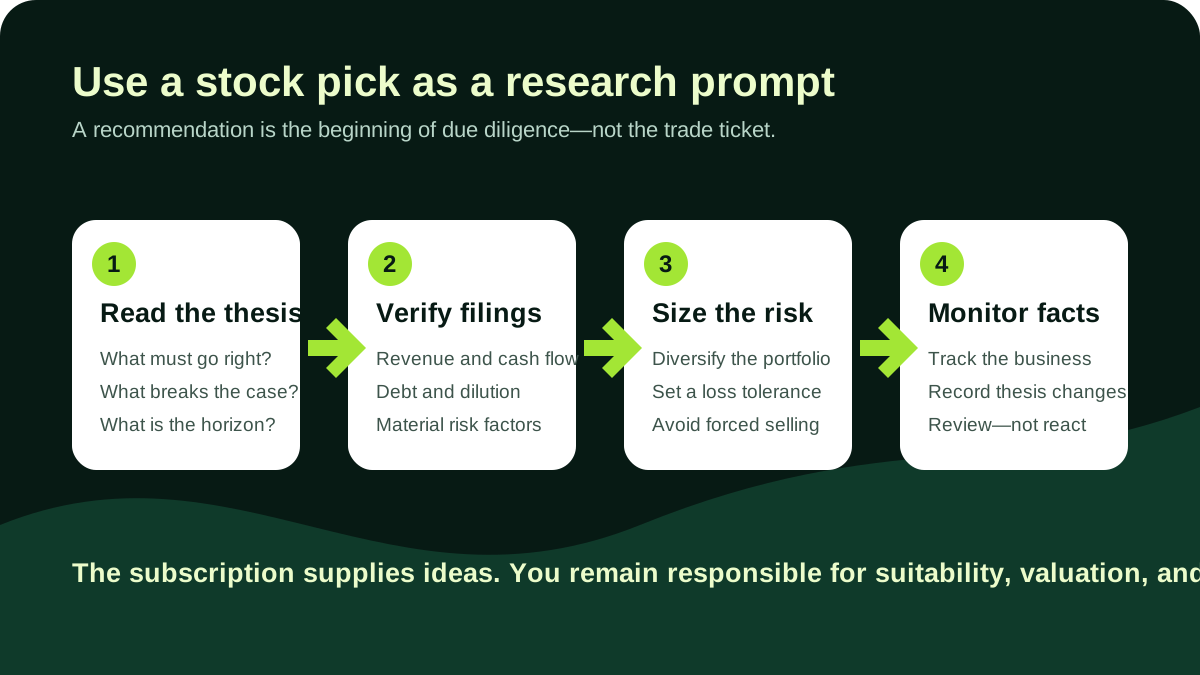
The most important quality control happens outside the newsletter. Open the company’s latest 10-K, 10-Q, and material 8-K filings in SEC EDGAR. Reconcile the thesis with revenue, margins, free cash flow, debt, dilution, customer concentration, and management’s stated risks. Note which claims come from the issuer, which are the analyst’s interpretation, and which depend on forecasts. If the thesis cannot be expressed as testable statements, it is difficult to monitor.
How to read performance claims
The public Stock Advisor page reports a large cumulative return relative to the S&P 500 and lists extraordinary early recommendations. Those are provider-reported figures. They are useful for understanding the service’s history but insufficient for forecasting a new subscriber’s outcome. A cumulative average can be lifted by rare, extremely successful stocks; it does not show that every pick won, that a member bought every recommendation, or that the member held each position through years of volatility.
A fair evaluation asks for the measurement period, treatment of dividends, recommendation price, weighting, closed positions, transaction costs, taxes, and benchmark convention. It also asks whether the displayed average resembles the experience of a diversified member portfolio. DollarScout does not convert marketing performance into an assumed return and does not award extra rating points based only on a headline percentage.
Building a portfolio from the ideas
Stock Advisor is not a model portfolio tailored to a subscriber’s age, income, tax situation, existing holdings, or risk capacity. Buying every new idea in equal dollars can produce unintended sector, factor, or company concentration. Buying only the most exciting story creates selection bias. Following a recommendation after a price jump may create a very different valuation from the research team’s entry context.
A more controlled workflow starts with an allocation policy. Decide how much of the household portfolio, if any, belongs in individual stocks. Set a maximum initial position and a maximum exposure after appreciation. Check overlap with funds and workplace accounts. Keep emergency savings and near-term spending outside volatile equities. Record the thesis, valuation assumptions, risks, and review triggers before placing an order.
The Fool’s long-horizon philosophy can reduce unproductive reaction to daily noise, but “hold for years” is not the same as “never reassess.” A business can issue shares, lose a competitive advantage, take on excessive debt, face regulation, or simply become priced for unrealistic growth. Review business evidence on a schedule and after material filings; do not let either a falling price or an old recommendation substitute for current analysis.
Ease of use
Ease of Use scores 4.4/5. The proposition is straightforward: read a manageable number of recommendations and supporting updates instead of configuring a professional research system. The public schedule makes the cadence predictable, and reports translate company analysis into readable narratives. This can be less intimidating than starting with hundreds of ratios or an empty screener.
The deduction reflects information and marketing friction. The Motley Fool sells several increasingly expensive services, and the public pages promote upgrades such as Epic and Epic Plus. A member must distinguish the Stock Advisor entitlement from features shown for other packages. Email volume and cross-selling can also compete with the research itself. Before subscribing, confirm which databases, rankings, portfolio tools, podcasts, or scorecards belong to the chosen tier.
We did not score the private interface from a temporary trial or claim hands-on access we did not have. The usability judgment is based on the documented workflow, product hierarchy, public feature comparison, and support resources.
Price, promotion, and renewal
At the time of review, the standard price was $199 per year. The product page also disclosed a $99 introductory first-year promotion for eligible new members and stated that the membership renews at the then-current list price. That difference is material: evaluating value at $99 while ignoring the likely renewal economics would overstate the long-run bargain.
The current product page advertises a 30-day membership-fee-back guarantee. The February 2026 Stock Advisor terms are more precise: cancellation is available at any time, refunds depend on the offer, monthly memberships do not receive refunds, and any annual guarantee is limited by the specific purchase terms and cannot exceed 30 days. Save the checkout screen and confirmation email. They establish the price, term, guarantee, and renewal disclosure that apply to the actual purchase.
Value earns 3.9/5. At $199, the service can be reasonable for someone who will research and monitor the ideas, particularly when the alternative is buying several narrower newsletters. It is poor value for someone who wants one hot tip, already follows a low-cost index strategy, or will not verify the work. A subscription only needs to prevent one weak decision to pay for itself, but that counterfactual cannot be measured in advance.
Support, cancellation, and conflicts
The Fool publishes a support center and account channels, while the Stock Advisor terms explain renewal, cancellation, guarantees, credit transfers, and service changes. Customer Service scores 3.8/5 because the policy material is available but offer-specific exceptions create work for the buyer. DollarScout did not open support tickets or measure resolution time, so the score is not a claim about response speed.
Disclosure deserves its own check. The terms prohibit employees and contractors from trading on unpublished Stock Advisor recommendations and impose a waiting rule after publication. They also note that writers or the company may own mentioned stocks and that an affiliated asset manager may hold securities discussed in publications. Those rules reduce some conflicts but do not make the analysis objective fact. Read the security-specific disclosure and decide whether the thesis survives without the author’s conviction.
Alternatives
Choose Morningstar Investor when standardized fund, ETF, stock, and portfolio research matters more than a curated stream of picks. Choose Seeking Alpha Premium when you want competing bull and bear opinions, transcripts, and quantitative ratings around a much larger ticker universe. Choose Zacks Premium when earnings-estimate revisions and repeatable screens are the primary workflow. A broad index fund plus issuer filings may be the better answer when the goal is a diversified portfolio without ongoing stock selection.
The right alternative depends on the bottleneck. Stock Advisor solves “give me a researched company to investigate.” It does not fully solve “is this security fairly valued today,” “how should it fit my household balance sheet,” or “how should I diversify across asset classes.”
Who should subscribe
Stock Advisor is a reasonable fit for investors who:
- Expect to hold selected companies for at least several years.
- Enjoy reading a business thesis and checking it against primary filings.
- Can diversify across many positions and tolerate significant drawdowns.
- Want curation more than a neutral database or advanced screener.
- Will track the renewal price and cancel if the workflow goes unused.
It is easier to skip for investors who:
- Prefer a simple index-fund portfolio.
- Need personalized asset allocation, tax planning, or fiduciary advice.
- Trade around short-term price action or need real-time execution tools.
- Are tempted to concentrate heavily in the newest or best-performing idea.
- Judge a service only by historical winners or promotional pricing.
Bottom line
Motley Fool Stock Advisor earns 4.0/5. Its greatest advantage is disciplined curation: two monthly ideas, rankings, readable theses, and continuing coverage can turn an overwhelming stock universe into a manageable research queue. Its largest weakness is the gap between an appealing recommendation and a complete investment process. The subscriber still owns valuation, diversification, trade timing, taxes, and risk.
Use the service if you want ideas and education, not certainty. Price the decision at the $199 standard annual rate, document the offer-specific refund terms, verify every thesis in current filings, and size each position so one persuasive story cannot derail the portfolio.