Many products on this page are from partners who compensate us. This doesn't influence our ratings. Our opinions are our own.
Freelancer Banking Setup
By Sophie Brown, Senior Finance Editor · Updated Jul 2026 · Fact-checked Jul 18, 2026
A freelancer needs more than a place for client payments. The banking setup should separate operating money, tax reserves, and personal pay; preserve evidence for every transaction; and keep payment interruptions from becoming household emergencies. This guide builds that system without pretending that one universal tax percentage or account count fits everyone.
Key takeaways
- Receive freelance income and pay business costs through a dedicated business checking account.
- Create separate, labeled reserves for estimated taxes and irregular business obligations instead of treating the current balance as spendable.
- Reconcile processor payouts to gross invoices, fees, refunds, and chargebacks rather than recording only the net deposit.
- Pay yourself with documented transfers and preserve receipts, invoices, statements, and the business purpose behind each cost.
- Design a backup path for payments and cash access before a bank, card, or processor interruption occurs.
Build the system around four jobs
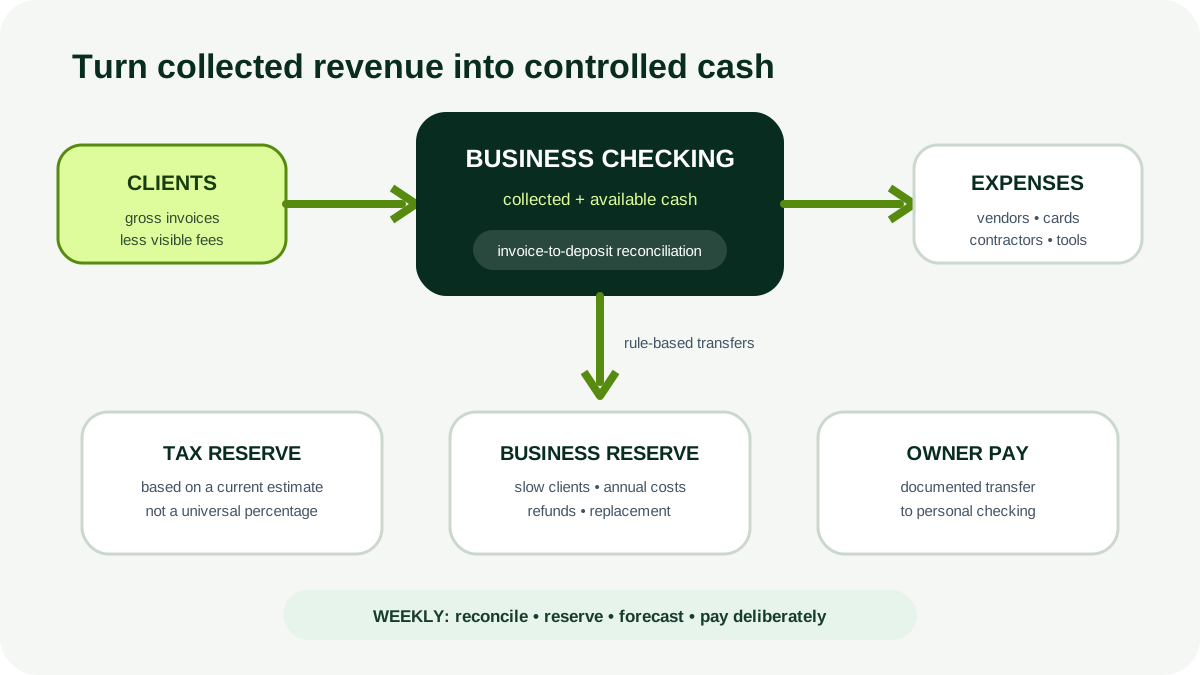
Freelance cash must do four different jobs: collect revenue, pay business costs, reserve money for obligations, and fund personal life. Keeping every dollar in one personal checking account makes the displayed balance misleading. It does not show which portion belongs to the next software renewal, an estimated tax payment, a client refund, or household spending.
The IRS says self-employed individuals generally file an annual return and pay estimated taxes quarterly, and that self-employment tax is separate from income tax. The exact obligation depends on income, deductions, other withholding, filing status, state and local rules, and current law. That is why a banking system should reserve money without embedding an unverified universal percentage.
The minimum viable account structure
Use three distinct functions, whether they are separate accounts or clearly controlled subaccounts:
| Function | Purpose | Normal activity |
|---|---|---|
| Business checking | Revenue collection and ordinary business payments | Client deposits, software, contractors, card payments, owner transfers |
| Tax reserve | Money expected to fund federal, state, and local obligations | Scheduled deposits and tax payments; no ordinary spending |
| Business reserve | Irregular costs and interruption buffer | Annual renewals, equipment replacement, refunds, slow-client periods |
Personal checking remains outside the business system. Transfer a deliberate owner-pay amount there. A separate business credit card can simplify purchases and provide a statement cycle, but it is not a substitute for cash reserves and should be paid from business checking.
More accounts are not automatically better. A freelancer with low volume can keep tax and business reserves in one interest-bearing business savings account if the ledger tracks the two balances. The structure succeeds only when the reserved amount is visible and cannot be spent accidentally.
Decide the legal and tax identity first
A freelancer may operate as a sole proprietor, single-member LLC, partnership, or corporation. The bank should reflect the actual legal owner and tax documentation. A trade name does not by itself form an entity. A single-member LLC may be disregarded for federal income-tax purposes while remaining an entity under state law.
The IRS says an EIN is free. A sole proprietor without employees may not need one for federal tax purposes, but can request one for banking or state-tax purposes. An LLC should be formed with the state before applying for its EIN. Do not buy an EIN from a commercial lookalike site.
Common bank-opening records include identification, SSN or EIN as appropriate, formation documents, ownership agreement, assumed-name filing, and business license. Requirements vary by institution, activity, ownership, and state.
Route client income cleanly
Put the business account on invoices and payment-platform settlement instructions. Do not give clients personal login credentials or accept a request to “verify” the account through an unfamiliar link. Use the bank's official routing information and a secure invoicing or payment process.
Record income at the correct level. If a platform processes a $2,000 invoice, withholds a $60 fee, and deposits $1,940, the books normally need to preserve the $2,000 gross receipt and $60 fee rather than treating $1,940 as the entire sale. Refunds, chargebacks, reserves, and currency conversion should also reconcile from the invoice to the net bank deposit.
Use an invoice-to-cash table:
| Field | Example |
|---|---|
| Invoice ID and issue date | DS-1042, July 2 |
| Client and gross amount | Client A, $2,000 |
| Processor or bank receipt date | July 16 |
| Fee and withholding | $60 fee |
| Net deposit | $1,940 |
| Difference status | Reconciled |
An unpaid invoice is not cash. Base owner pay and transfers on collected, available funds after known obligations, not on revenue promised in a contract.
Create a tax-reserve rule from a real estimate
Start with Form 1040-ES, current IRS guidance, prior returns, projected net profit, other household income, and advice from a qualified tax professional. Include state and local obligations where applicable. Set a reserve percentage or fixed transfer from that calculation and revisit it when profit changes materially.
Transfer the reserve when revenue clears, not at quarter-end when the money may already be spent. Label the ledger by obligation and due period. The IRS lists standard estimated-tax due dates, with weekend and holiday adjustments; calendar the actual dates for the current tax year and payment jurisdiction.
The reserve is not an expense at the moment of transfer between your accounts. It is restricted cash. When a tax payment occurs, record it according to the advice appropriate for the tax type and entity. Do not assume every tax paid by an owner is a deductible business expense.
If employment withholding or a spouse's withholding is part of the plan, the required quarterly reserve may differ. The bank structure should implement the tax estimate, not replace it.
Pay yourself consistently
For a sole proprietor or a default-taxed single-member LLC, routine transfers to the owner are commonly tracked as draws rather than payroll expense. Other tax elections and entities can require different compensation treatment. Confirm the method before labeling transfers “salary.”
A stable owner-pay cadence reduces random business-account spending. Choose a weekly, twice-monthly, or monthly transfer after reviewing available cash, tax reserves, and upcoming obligations. In variable months, use a conservative base draw plus a deliberate periodic distribution rather than emptying the account after each client payment.
Document capital moving the other direction. If personal money funds a new laptop or covers a shortfall, record an owner contribution, loan, or reimbursement based on the actual arrangement. Preserve the purchase evidence and business purpose.
Use a 13-week cash view
A monthly budget can hide timing risk. Build a rolling 13-week forecast with beginning available cash, expected collected receipts, committed payments, tax transfers, owner pay, and ending cash. Weight uncertain invoices conservatively.
Separate three states:
- booked: the client accepted work or an invoice was issued;
- expected: payment has a credible date but has not arrived;
- available: the bank has made collected funds usable.
Only available cash can fund today's payment. If a client routinely pays late, change the forecast assumption rather than repeatedly borrowing from the tax reserve.
Control cards, ACH, and subscriptions
Use one business card for ordinary purchases and virtual cards or merchant-specific controls where useful. Turn on alerts for every transaction, low balances, external-link changes, and failed payments. Review recurring software quarterly; cancel abandoned trials and downgrade tools that no longer support revenue.
For ACH and wires, verify recipient instructions outside the email thread before a first or changed payment. Business-email-compromise scams often rely on a plausible invoice plus altered bank details. A known phone number or authenticated vendor portal is stronger than replying to the message that requested the change.
Do not let a bookkeeper, assistant, or contractor share the owner login. Use a separate user role with the minimum access required, and remove it promptly when the relationship ends.
Maintain evidence, not only categories
IRS Publication 583 explains that a bank statement can show payment but does not by itself establish entitlement to a deduction. Keep the invoice, receipt, contract, mileage record, or other support showing the expense and business purpose. Record transactions promptly and reconcile the business account monthly.
For every month, retain:
- Bank and card statements.
- Issued invoices and settlement reports.
- Vendor receipts and contracts.
- Processor fee, refund, and chargeback reports.
- Tax-payment confirmations.
- Owner contribution, draw, and reimbursement records.
- The reconciliation report and unresolved-item log.
Store records securely with a retention policy appropriate to the document and applicable law. Do not keep full bank credentials or authentication recovery codes inside a bookkeeping spreadsheet.
Design for interruption
A freelancer can lose access because of fraud review, a lost card, bank outage, processor reserve, or compromised credentials. Keep a second way to receive or move money, but do not scatter balances across unmonitored apps.
Document how to contact the bank, freeze cards, change invoice instructions, and notify clients securely. Maintain a business reserve sized from fixed costs, payment volatility, refund exposure, and replacement needs. Test an external transfer before relying on it.
Deposit insurance also matters. A sole-proprietorship balance is generally combined with the owner's other single-category deposits at the same FDIC-insured bank. Do not assume the word “business” gives a sole proprietor another $250,000 limit.
A weekly and monthly cadence
Each week, match receipts to invoices, review new transactions, transfer the calculated tax reserve, update the 13-week forecast, and follow up on overdue invoices. Before owner pay, confirm upcoming card, contractor, and subscription obligations.
Each month, reconcile every account, close unresolved differences, review profitability separately from cash flow, save statements, inspect user access, and compare reserves with updated tax and business forecasts. Each quarter, review estimated taxes with current figures and test whether the banking fees still fit transaction volume.
Bottom line
A freelancer banking setup should make the current balance harder to misread. Use dedicated business checking, visible tax and operating reserves, documented owner pay, gross-to-net payout reconciliation, and a short cash forecast. The system will not calculate taxes or prove deductions on its own, but it will preserve the evidence and cash boundaries needed to make those decisions well.
Related content
Frequently asked questions
Sources
Related content
More from DollarScout on this topic.
