Many products on this page are from partners who compensate us. This doesn't influence our ratings. Our opinions are our own.
Mercury vs Bluevine: 2026 Business Banking Comparison
By Sophie Brown, Senior Finance Editor · Updated Jul 2026 · Fact-checked Jul 18, 2026
Mercury and Bluevine both earn 4.4/5 overall, but Mercury is the better operating account for startups, distributed teams, free domestic wires, international payments, cards, permissions, and accounting integrations. Bluevine is better for a U.S. small business that wants deposit APY and can meet the activity conditions or justify a paid plan. Do not compare Bluevine checking APY with Mercury Treasury as if they were the same product: Bluevine interest is a bank-deposit feature, while Mercury Treasury is a securities product with advisory fees, investment risk, and no FDIC insurance.
Head-to-head
| Feature | Mercury | Bluevine |
|---|---|---|
| DollarScout Rating | 4.4/5 ★ | 4.4/5 ★ |
| Monthly Fee | Core banking $0; optional Plus starts at $35/month or $29.90/month equivalent with annual pricing; higher Pro workflow plan available | Standard $0; Plus $30; Premier $95. Paid-plan fees can be waived by meeting the published balance and card-spend requirements |
| Yield | No promoted checking APY; eligible Treasury portfolios currently show net yield up to 3.64%, but they are investments, not bank deposits | Standard 1.30% on up to $250,000 with qualifying activity; Plus 1.75% up to $250,000; Premier 3.00% with no stated interest balance cap |
| Deposit Insurance | Up to $5 million through Choice Financial Group, Column N.A., and their sweep networks, subject to pass-through conditions and program-bank placement | Up to $3 million in FDIC coverage through Coastal Community Bank and program banks, subject to pass-through and sweep-program conditions |


Category-by-category breakdown
Fees
Yield
Integrations
Onboarding
Customer Service
Detailed analysis
The short answer
Choose Mercury for startup operations and payments; choose Bluevine for yield on business checking. DollarScout rates both 4.4/5 overall. Mercury wins more operational categories in our rubric, while Bluevine has the clearer deposit-interest advantage.
Mercury's free business-banking tier combines checking, savings, domestic ACH, domestic wires, checks, cards, bill pay, invoicing, permissions, and accounting connections without a monthly subscription. Bluevine Standard also has no monthly fee and adds interest eligibility, subaccounts, checks, bill pay, invoicing, and access to Bluevine's broader small-business products.
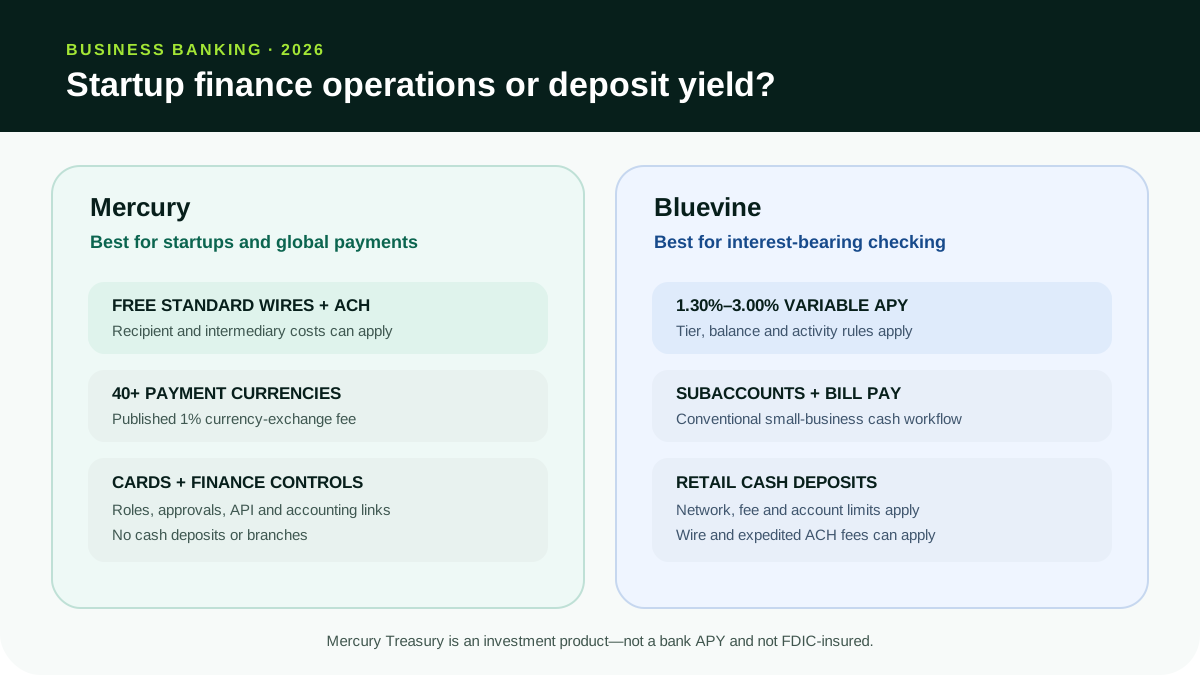
| Decision factor | Mercury | Bluevine |
|---|---|---|
| Core monthly fee | $0 for business banking | $0 for Standard |
| Deposit APY | Core checking and savings are not marketed with a standard deposit APY | Standard 1.30% up to $250,000 with qualifying activity; paid tiers publish higher rates |
| Domestic ACH and wires | Standard ACH and domestic USD wires advertised free | Standard ACH free; wire and expedited-payment fees can apply |
| International workflow | USD wires plus payments in 40+ currencies | International payments available, with published wire and FX fees |
| Cash deposits | Not supported | Supported through participating retail network, with fees and limits |
| Best fit | Startup, online company, distributed finance team | Established U.S. small business holding operating cash |
Account pricing and monthly fees
Mercury advertises its core business-banking account without a monthly fee, minimum balance, or overdraft fee. Standard domestic ACH, domestic USD wires, mailed checks, and ordinary banking tools are included. Mercury also sells Plus and Pro software plans, starting at a published $35 per month, for more advanced finance controls. A company does not need a paid plan merely to obtain the core checking and savings accounts.
Bluevine Standard has no monthly subscription. Plus costs $30 per month and Premier costs $95 per month under the current fee page. Bluevine describes conditions that can waive paid-plan fees; the live requirements should be checked for the selected billing period. Plus currently requires both a qualifying average balance and qualifying debit spend for its stated waiver, so satisfying only one should not be assumed sufficient.
The practical fee winner depends on transactions. Mercury is unusually economical for a company that regularly sends wires or mailed checks. Bluevine Standard is economical for a business using ordinary ACH and card payments, but wire, same-day ACH, check, cash-deposit, and non-network ATM fees can accumulate.
Bluevine checking APY and eligibility
Bluevine publishes variable rates effective March 12, 2026. Standard advertises 1.30% APY on eligible balances up to $250,000 when the business either spends at least $500 per month with the Bluevine debit or receives at least $2,500 per month in qualifying customer payments. A transfer from the owner's other bank is not necessarily a qualifying customer payment.
Plus publishes 1.75% APY on balances up to $250,000 without the Standard activity requirement. Premier publishes 3.00% APY on eligible balances with no stated balance cap or activity requirement. Those higher rates come with subscription costs unless waiver conditions are met.
Calculate net value rather than selecting the largest rate. At a constant 1.75%, $20,000 would earn roughly $350 over one year before tax. A $30 monthly subscription would cost $360 before any waiver, so APY alone would not justify Plus at that balance. At larger balances or when paid-plan payment discounts are useful, the result can change.
Mercury Treasury is not a bank APY
Mercury's ordinary business checking and savings accounts should not be described as automatically earning the yield shown for Mercury Treasury. Treasury is an investment-management product offered through Mercury Advisory, with custody through Apex under current disclosures. Its portfolios invest in securities, can lose value, and are not bank deposits or FDIC-insured.
Mercury currently illustrates a yield up to 3.61% using a May 31, 2026 30-day SEC yield and an assumed $20 million deposit relationship. That is a dated portfolio yield illustration, not a guaranteed APY for every account. Mercury also discloses an annualized advisory fee that varies by balance, generally 0.15% to 0.60%, which reduces the investor's return.
Treasury can still be useful for an eligible company with surplus cash, an understood investment policy, and sufficient liquidity. It should be evaluated against money-market funds, Treasury bills, and other securities accounts, including settlement timing, price risk, expenses, and board or investor restrictions.
ACH, wires, and checks
Mercury's strongest everyday advantage is payment economics. It advertises standard ACH, domestic USD wires, international USD wires sent with shared fees, and mailed checks without a Mercury fee. An international intermediary or recipient bank can still deduct charges. Mercury's optional “OUR” treatment, which attempts to cover recipient fees, currently costs $15.
Bluevine includes standard ACH without a fee, while same-day ACH currently costs $10 on Standard, $8 on Plus, and $5 on Premier. Outgoing wire pricing can reach $15 under the published schedule, and printed checks cost $1.50 on Standard after any applicable inclusions. These charges are not automatically unreasonable; they simply make transaction volume important.
Estimate monthly behavior: number of wires, expedited ACH transfers, checks, and international payments. A company sending ten domestic wires can see a larger economic difference than one holding a modest interest-bearing balance.
International payments
Mercury supports outgoing payments in more than 40 currencies and currently publishes a 1% currency-exchange fee. It also supports international USD wires, with the shared-fee and recipient-fee distinction noted above. This makes it the stronger choice for a U.S. startup paying overseas contractors, software vendors, or professional firms.
Bluevine supports international payments but publishes separate charges, including an international wire fee and a foreign-exchange markup that can reach 1.5% under current terms. Availability, destination, intermediary deductions, cutoff time, and recipient requirements still need to be verified for every payment corridor.
Neither product substitutes for foreign-currency accounts, local clearing in every country, currency hedging, or international tax advice. Send a low-value test payment before a critical invoice, and verify the exact amount the beneficiary must receive.
Cards, permissions, and finance-team controls
Mercury is designed for distributed operating teams. It supports physical and virtual cards, employee controls, role-based permissions, bill-pay approvals, accounting access, and workflow upgrades through paid plans. Founders can separate who prepares, approves, and views payments without sharing a single login.
Bluevine provides debit cards, virtual-card capabilities under current plan rules, multiple users, subaccounts, and payment controls appropriate for many small companies. Its structure is practical for an owner, office manager, and bookkeeper, but Mercury has the stronger startup-finance orientation and deeper emphasis on card and payment governance.
Permissions are only effective when configured. Give each person an individual identity, use the least access needed, require multifactor authentication, set card and payment limits, remove departed users immediately, and reconcile exceptions independently.
Accounting integrations and automation
Mercury connects directly with QuickBooks and Xero and promotes an API, webhooks, Slack notifications, and automation-friendly exports. These tools matter to companies that synchronize payment status with internal systems or want engineers and finance staff to reduce manual work.
Bluevine also integrates with major accounting platforms and offers transaction feeds, bill pay, invoicing, and subaccounts. That is sufficient for many service firms, local businesses, and ecommerce operators that need a conventional bookkeeping connection rather than an API-led finance stack.
An integration does not guarantee complete books. Confirm whether pending transactions, checks, fees, card users, and subaccounts map correctly. Review duplicate feeds after reconnecting, and preserve monthly statements as the authoritative bank record.
Subaccounts and cash organization
Bluevine lets customers create multiple subaccounts under the current product limits. A business can separate payroll, tax, operating expenses, and reserves while managing them within the same interface. Interest eligibility and account-level terms should be verified rather than assumed to apply identically to every subaccount.
Mercury provides checking and savings organization and supports company structures that need cards, payments, and treasury workflows. Its value is less about an envelope-style system and more about controlled movement across a startup's operating stack.
Do not confuse interface separation with legal or insurance separation. Several subaccounts at one insured bank in the same ownership category are normally aggregated for FDIC limits.
Cash deposits and ATM use
Mercury does not accept cash deposits. It has no branch network, and an ATM cannot turn physical business receipts into a Mercury balance. That is disqualifying for many restaurants, salons, trades, market sellers, and retail operators.
Bluevine supports cash deposits through participating retail networks. Fees, store limits, rolling account limits, and posting times apply. Non-MoneyPass ATM withdrawals currently carry a Bluevine fee of $2.50, and the ATM owner can impose another surcharge.
A cash-heavy business should compare Bluevine's per-deposit cost with a local bank's monthly fee and commercial cash allowance. A hybrid setup can use a branch account for cash intake and Bluevine for interest or digital payments, but extra transfers and reconciliation must be managed.
Onboarding and eligibility
Mercury is optimized for U.S. companies and is notably friendly to startup founders, including qualifying international founders with a U.S. entity. It requires business and owner documentation and excludes certain industries and activities. Approval is not guaranteed, and a polished application should clearly explain the business model, counterparties, expected transactions, and source of funds.
Bluevine is oriented toward U.S. small businesses and requests identity, entity, ownership, and operating information. It can be more intuitive for a conventional domestic business, particularly one interested in checking yield or Bluevine's credit products.
Do not close an existing bank immediately after approval. Fund the new account gradually, test incoming customer payments and outgoing vendor payments, add authorized users, and confirm mobile-deposit and transfer limits.
Customer support and operational resilience
DollarScout scores Mercury 4.2/5 and Bluevine 3.9/5 for Customer Service. That gives Mercury an edge, but neither has a national branch network where an owner can resolve a complex hold in person. Support experience can vary by issue and account history.
Every business should maintain a second payment method, securely export statements, document recurring debits, and avoid keeping payroll dependent on one debit card or login. A second bank is operational resilience, not an admission that the primary account is poor.
Before committing, ask support a product-specific question about an international wire, a card approval rule, a cash deposit, or a check limit. The clarity and audit trail of the response are more useful than a generic support-hours claim.
FDIC insurance and partner banks
Mercury is a fintech, not a bank. Banking services are provided through Choice Financial Group and Column N.A., Members FDIC, under current disclosures. Mercury advertises up to $5 million in potential FDIC coverage through its sweep network, subject to program terms, customer eligibility, bank availability, and proper records.
Bluevine is also a fintech. Its business checking is provided by Coastal Community Bank, Member FDIC, and eligible funds can be placed across program banks. Bluevine currently advertises potential coverage up to $3 million, subject to the sweep terms and FDIC rules.
Expanded coverage is not automatic insurance for every displayed dollar. Identify excluded banks, opt-outs, funds in transit, and money already held at a program bank through another relationship. Mercury Treasury securities are not part of the deposit-insurance program.
Which business should choose each account?
Choose Mercury for a software or internet company, a distributed team, frequent domestic or international payments, virtual cards, payment approvals, API access, or a founder who wants startup-oriented finance operations without paying a core monthly fee.
Choose Bluevine for a U.S. small business that can qualify for Standard interest, can economically justify Plus or Premier, wants yield inside checking, uses subaccounts, may need retail cash deposits, or values access to Bluevine's small-business credit ecosystem.
Choose a conventional commercial bank when branches, coin and currency service, cash pickup, complex lending, escrow, same-day official checks, or a dedicated relationship manager is essential. It can coexist with either digital platform.
Final verdict
The overall rating is tied, but the product choice is not ambiguous once the use case is known. Mercury is the stronger operating platform because its free wires, international capabilities, cards, permissions, integrations, and startup workflow remove recurring friction. Bluevine is the stronger interest-bearing deposit account because its checking tiers publish explicit APYs. Keep the comparison honest: Mercury Treasury may complement Mercury banking, but it is an investment product rather than a bank-rate answer to Bluevine.
Which one is right for you?
- Best for Startup payments, free domestic wires, and team controls: MercuryOpen a Business Account
- Best for International vendor payments and accounting automation: MercuryOpen a Business Account
- Best for Variable APY on an operating checking balance: BluevineOpen a Business Account
- Best for Retail cash deposits and conventional small-business workflow: BluevineOpen a Business Account
Final verdict
Mercury and Bluevine tie at 4.4/5 overall. Mercury is the better default for startups and online companies that need economical payments, wires, international reach, cards, approvals, and integrations. Bluevine is better for established U.S. small businesses that can meet its Standard activity rule or justify a paid tier to earn variable deposit APY. Mercury Treasury must be assessed separately as a non-FDIC-insured investment product.
Frequently asked questions
Sources and verification
Scores and product facts come from the underlying DollarScout reviews and were checked against these primary sources.
- Mercury business banking
- Mercury pricing
- Mercury business banking plan fees
- Mercury international USD wire recipient fees
- Mercury currency exchange
- Mercury sending money overview
- Mercury Treasury disclosures
- Bluevine business checking and current tiers
- Bluevine checking interest disclosures
- Bluevine interest eligibility help
- Bluevine business checking fee schedule
- Bluevine FDIC insurance information
- FDIC understanding deposit insurance
Related content
More from DollarScout on this topic.
