Many products on this page are from partners who compensate us. This doesn't influence our ratings. Our opinions are our own.
Mercury vs Novo: 2026 Business Banking Comparison
By Sophie Brown, Senior Finance Editor · Updated Jul 2026 · Fact-checked Jul 18, 2026
Mercury wins overall at 4.4/5 versus Novo at 4.2/5. Mercury is the stronger account for incorporated startups and growing online companies that need domestic and international wires, team permissions, virtual cards, accounting automation, and an optional investment-management path for surplus cash. Novo is the simpler choice for a freelancer, agency, or ecommerce operator who wants no monthly fee, Reserves, invoicing, and direct connections to tools such as Stripe and QuickBooks. Neither accepts cash deposits, and neither provides branch service.
Head-to-head
| Feature | Mercury | Novo |
|---|---|---|
| DollarScout Rating | 4.4/5 ★ | 4.2/5 ★ |
| Monthly Fee | Core banking $0; optional Plus starts at $35/month or $29.90/month equivalent with annual pricing; higher Pro workflow plan available | $0 monthly service charge and $0 minimum balance; optional express transfers and outgoing wires carry fees |
| Yield | No promoted checking APY; eligible Treasury portfolios currently show net yield up to 3.64%, but they are investments, not bank deposits | 0% APY on the business checking account and Reserves |
| Deposit Insurance | Up to $5 million through Choice Financial Group, Column N.A., and their sweep networks, subject to pass-through conditions and program-bank placement | Up to $250,000 through Middlesex Federal Savings, F.A., Member FDIC, subject to standard ownership-category rules |


Category-by-category breakdown
Fees
Yield
Integrations
Onboarding
Customer Service
Detailed analysis
The short answer
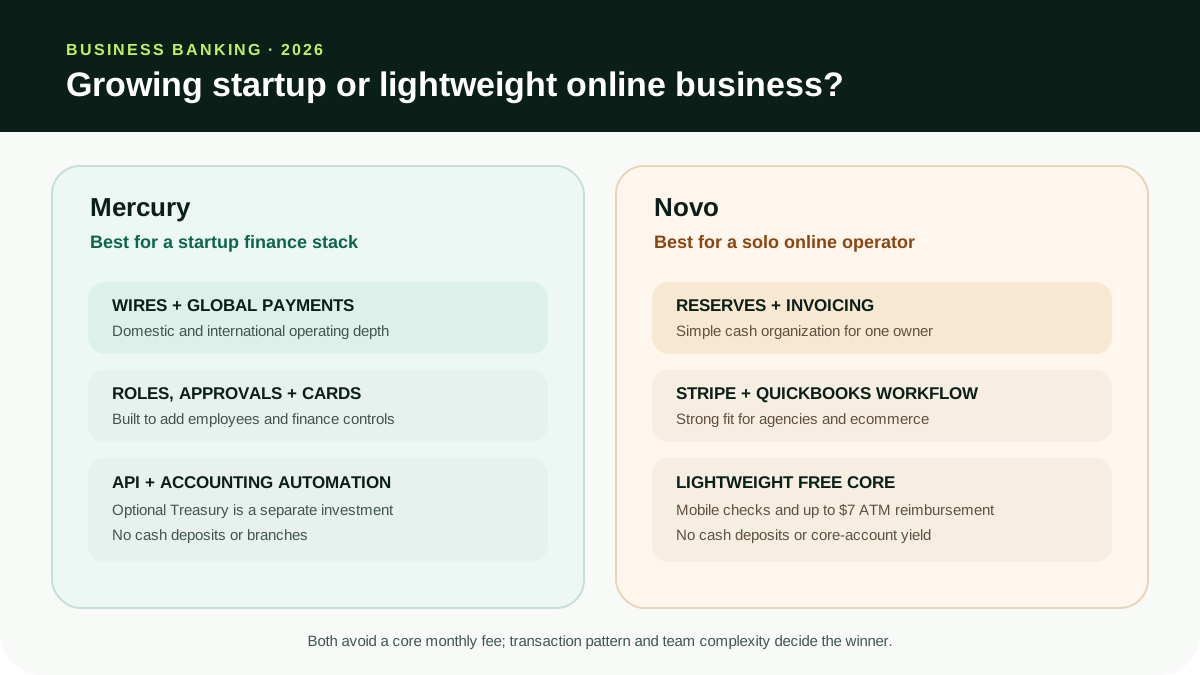
Mercury is better for a growing startup; Novo is better for a solo or very small online business. DollarScout rates Mercury 4.4/5 and Novo 4.2/5. Both remove the monthly subscription from core business checking and both integrate with modern software, but their operating depth is different.
Mercury combines checking, savings, ACH, wires, checks, cards, bill pay, invoicing, role-based access, and accounting connections in a system designed for startup finance teams. Novo emphasizes a lighter workflow: business checking, Reserves, invoices, card access, mobile check deposit, and integrations for owners who receive revenue through software platforms.
| Decision factor | Mercury | Novo |
|---|---|---|
| Core monthly fee | $0 | $0 |
| Minimum balance | No published core minimum | No published minimum |
| Standard ACH | $0 | $0 |
| Wires | Domestic and shared-fee international USD wires advertised without a Mercury fee | Incoming domestic wire $0; outgoing wire charges can apply under the fee schedule |
| Deposit yield | Core account is not the same as Mercury Treasury | Core checking is not positioned as an interest account |
| Cash deposits | Not accepted | Not accepted |
| Best fit | Startup with payments, cards, approvals, and global vendors | Freelancer, agency, or ecommerce owner wanting a simple app stack |
Monthly fees and basic account cost
Mercury and Novo both advertise core business checking without a monthly maintenance fee or minimum balance. Neither charges an overdraft fee under its current positioning. That makes either easier to budget than an account that requires a recurring deposit or balance merely to avoid a subscription.
Mercury sells optional Plus and Pro software plans, beginning at a published $35 per month, for companies that want additional controls and finance automation. Core banking does not require that upgrade. Novo's included feature set covers standard ACH, a physical and virtual card, mobile check deposit, mailed checks, unlimited invoices, Reserves, and supported integrations.
“No monthly fee” is not the same as “every service is free.” Novo's current fee schedule governs Express ACH, Express Check Deposit, wires, and other nonstandard services. Mercury has separate pricing for paid plans, accelerated or specialized services, currency exchange, and recipient-fee handling on international wires.
ACH, wires, and mailed checks
Mercury has the stronger payment package. It advertises standard ACH, domestic USD wires, shared-fee international USD wires, and mailed checks without a Mercury fee. Banks between Mercury and an international recipient can still deduct charges. Mercury's optional OUR treatment, intended to cover recipient fees, currently costs $15.
Novo includes standard ACH and mailed checks. Its fee materials list free incoming domestic wires while outgoing wire pricing and availability follow the current schedule. Express ACH currently carries percentage pricing with a published minimum and maximum, and expedited check-deposit access can cost extra. An owner who rarely accelerates money may pay nothing for those features; one who uses them weekly should calculate the total.
Create a transaction profile before choosing: monthly ACH count, domestic wires, foreign payments, paper checks, and instances when funds must arrive the same day. Mercury's wire advantage is more valuable to a startup paying investors, legal firms, manufacturers, or international contractors than to a consultant paying three local bills by ACH.
International payments
Mercury supports international USD wires and payments in more than 40 currencies. It currently publishes a 1% currency-exchange fee for non-USD payments. Country, beneficiary, compliance, intermediary, and cutoff rules still apply, but the product is designed for companies with cross-border vendors.
Novo highlights its Wise integration for international transfers rather than presenting a comparably broad native international-payments system. That can work well for an occasional foreign contractor, but the owner must understand which company executes the transfer, where fees and exchange rates are displayed, and which support team owns a delayed payment.
Mercury therefore wins for recurring international operations. For either platform, send a small test payment, confirm the beneficiary receives the correct amount and currency, and preserve the invoice and transfer confirmation for accounting and tax records.
Cards and team permissions
Mercury supports physical and virtual cards, individual users, spending controls, role-based permissions, bill-pay approvals, and accounting access. These controls help a startup separate payment preparation from approval and give a bookkeeper visibility without granting ownership-level authority.
Novo provides a physical debit card and virtual-card access and is practical for an owner-led business. Its native team and approval depth is lighter than Mercury's. That simplicity is attractive to a solo operator but can become a constraint when several employees purchase software, travel, or pay vendors.
Never share one owner login. Give each user an individual account where supported, require multifactor authentication, limit cards to their business purpose, review declined and unusual transactions, and revoke access the day a role ends.
Integrations and ecommerce workflow
Novo's clearest advantage is its approachable integration set. It connects with platforms such as Stripe, Wise, and QuickBooks and promotes workflows for freelancers, agencies, and ecommerce operators. Revenue arriving through Stripe can be viewed alongside invoices and categorized transactions without forcing the owner into a complex treasury interface.
Mercury connects with QuickBooks and Xero and adds an API, webhooks, Slack notifications, exports, and startup-oriented automation. That is stronger when engineers or finance staff want bank events to trigger internal workflows, or when payment controls must scale across a larger team.
DollarScout treats integrations as a tie because both are excellent within their intended market. Novo is more approachable for a small software stack; Mercury is more extensible for a company building finance operations. Verify the exact sync direction, fields, latency, and supported account types before assuming a logo on an integrations page will solve reconciliation.
Reserves and cash-flow organization
Novo Reserves let an owner earmark money for purposes such as taxes, payroll, profit, or equipment. The feature is useful for a simple envelope method and reduces the temptation to treat the entire checking balance as spendable.
Mercury provides checking and savings organization and a broader set of payment and card controls. It is a better environment when cash allocation is tied to several users, approvals, and entities rather than one owner's mental budget.
Reserves and interface labels do not create additional FDIC insurance categories. They also do not replace accounting entries. Record the legal purpose of transfers, reconcile total cash to the general ledger, and maintain enough unrestricted operating money for near-term obligations.
Invoicing and customer payments
Novo includes unlimited invoicing under its current feature description. It is suitable for straightforward service invoices and gives a freelancer or small agency a clean route from billing to bank activity. Payment-processing terms, settlement time, disputes, and any instant-access charge still need separate review.
Mercury also offers invoicing and accounts-receivable tools within its banking platform. Its advantage appears when incoming payments connect to bill pay, cards, accounting, permissions, and finance-team workflows.
Neither is a full replacement for a specialized billing platform when the business needs subscriptions, complex sales tax, partial fulfillment, usage billing, purchase orders, multicurrency receivables, or advanced collections. Preserve invoice records outside the bank and reconcile processor fees separately from revenue.
Savings yield and Mercury Treasury
Novo business checking is not positioned as an interest-bearing account. Mercury's ordinary checking and savings should not be assigned the yield advertised for Mercury Treasury. A comparison that places “0% Novo APY” beside a Mercury Treasury yield without explaining product risk would be misleading.
Mercury Treasury is an investment-management account offered through Mercury Advisory with custody through Apex under current disclosures. Mercury currently illustrates yield up to 3.61% using a May 31, 2026 30-day SEC yield and an assumed $20 million relationship. The advisory fee varies by balance, generally from 0.15% to 0.60% annualized. Securities can lose value and are not FDIC-insured.
An eligible company with surplus cash may value that optional path, which is why Mercury has the category edge. The decision should follow a documented liquidity and investment policy. Payroll, taxes, chargebacks, and near-term vendor money should not be invested merely to chase a displayed yield.
ATM access, reimbursements, and cash deposits
Novo says it does not charge a fee for ATM withdrawals and currently reimburses third-party ATM charges up to $7 per month. The ATM owner can charge more than the reimbursement cap, and international or card-network conversion rules may add other costs.
Mercury cards can be used for ATM withdrawals under its terms, but Mercury is not designed as a cash-access account. More importantly, neither Mercury nor Novo accepts cash deposits. An owner cannot walk into a branch or use an ordinary ATM to convert business cash into the account.
A business receiving cash should keep a local commercial account or select a fintech with a supported retail cash network. Do not deposit business cash into a personal account merely for convenience; that weakens records and can violate account terms.
Mobile check deposits and funds availability
Novo supports mobile check deposit, subject to eligibility, image standards, limits, holds, and return risk. It also offers an expedited access option under published pricing. Mercury provides check-deposit functionality for eligible accounts with its own limits and availability rules.
A displayed deposit does not guarantee final collection. Keep the original check until the retention period passes, avoid spending against a suspicious payment, and never return “excess” money to a sender before the bank confirms final settlement. New accounts can have lower limits or longer holds.
Businesses receiving many checks should compare remote-deposit limits, endorsement requirements, batch reporting, and duplicate detection with a conventional commercial bank.
Onboarding and business eligibility
Novo's focused application is generally a good match for a U.S. freelancer, agency, or small online operator. It requests business and owner identity information, and approval remains subject to compliance review. DollarScout gives Novo a narrow onboarding edge for this simpler target profile.
Mercury is built for U.S. companies and supports many qualifying international founders who have a U.S. entity. Its review can require more context about formation, ownership, funding, customers, and expected international activity. Certain industries and business models are ineligible.
Prepare formation documents, EIN confirmation, beneficial-owner information, business address, website or product evidence, expected transaction volume, and source-of-funds records. Complete information reduces avoidable back-and-forth but does not guarantee acceptance.
Customer support and resilience
DollarScout scores Mercury 4.2/5 and Novo 3.9/5 for Customer Service. Mercury has the edge, though neither offers a national branch network. The support experience for a card replacement may differ sharply from an account review, check hold, or international payment trace.
Test secure messaging before the account is mission-critical. Document recurring debits, export statements, retain invoices, and establish a backup bank or card. Payroll should never depend on a single app, device, or payment rail.
If an account is restricted, respond through the official channel and keep communications factual. Public social-media messages are not an appropriate place to disclose account or identity data.
FDIC insurance and fintech structure
Mercury and Novo are fintech companies, not chartered banks. Mercury currently provides banking services through Choice Financial Group and Column N.A., Members FDIC, and advertises an optional sweep structure that can provide up to $5 million of potential pass-through coverage under program conditions.
Novo identifies Middlesex Federal Savings, F.A., Member FDIC, as its banking partner. Eligible deposits can receive pass-through coverage when legal and recordkeeping requirements are satisfied. The general FDIC limit is $250,000 per depositor, per insured bank, per ownership category.
Check whether the business already has money at the same partner or program bank, how funds in transit are treated, and how the account is titled. Mercury Treasury investments are outside deposit insurance. Novo Reserves do not multiply the standard insurance limit.
Which account should you choose?
Choose Mercury for an incorporated startup, distributed team, international vendor base, frequent wires, virtual-card program, payment approvals, API automation, or a company that may later evaluate an investment account for surplus cash.
Choose Novo for a freelancer, consultant, creative agency, or ecommerce operator who wants a simple no-monthly-fee account, Reserves, unlimited invoices, mobile check deposit, and direct connections with the software already collecting revenue.
Choose a branch business bank when cash deposits, change orders, in-person service, complex lending, same-day official checks, or a long-term commercial-banking relationship is important. Either digital account can be secondary rather than the only institution.
Final verdict
Mercury wins because it can support a company through more stages. Free wires, international payments, cards, roles, approvals, accounting connections, and automation give a growing startup room to add financial controls. Novo remains the more approachable specialist for a solo or very small online business. Its Reserves, invoicing, card, check-deposit, and integration workflow is useful precisely because it does not ask that owner to operate a finance-team platform.
Which one is right for you?
- Best for Growing startup with wires, cards, approvals, and global vendors: MercuryOpen a Business Account
- Best for Finance automation and optional surplus-cash investing: MercuryOpen a Business Account
- Best for Freelancer or agency wanting simple Reserves and invoicing: NovoOpen a Business Account
- Best for Small ecommerce operator using Stripe and QuickBooks: NovoOpen a Business Account
Final verdict
Mercury wins 4.4/5 to 4.2/5 because its payments, wires, international reach, cards, permissions, and automation support a growing startup more completely. Novo is the better lightweight choice for a freelancer, agency, or ecommerce operator that prioritizes Reserves, invoicing, mobile deposits, and familiar integrations. Neither accepts cash deposits, and Mercury Treasury is an investment—not a checking APY.
Frequently asked questions
Sources and verification
Scores and product facts come from the underlying DollarScout reviews and were checked against these primary sources.
- Mercury business banking
- Mercury pricing
- Mercury pricing plan details
- Mercury international wire recipient fees
- Mercury currency exchange
- Mercury sending money overview
- Mercury Treasury and investment disclosures
- Novo legal and current disclosure index
- Novo account differences and core fees
- Novo included account features
- Novo company and partner-bank explanation
- Novo ATM fee reimbursement
- Novo online business checking and cash-deposit limitation
- Novo current fee schedule
- FDIC understanding deposit insurance
Related content
More from DollarScout on this topic.
