Many products on this page are from partners who compensate us. This doesn't influence our ratings. Our opinions are our own.
Robinhood vs E*TRADE: 2026 Brokerage Comparison
By Sophie Brown, Senior Finance Editor · Updated Jul 2026 · Fact-checked Jul 19, 2026
E*TRADE wins overall, 4.5/5 to Robinhood's 4.3/5, because it offers broader investments and account types, deeper Morgan Stanley research, stronger service routes, and an optional managed portfolio. Robinhood remains better for ease of use and fees, especially for $1 fractional purchases, eligible IRA matching, and stock or ETF options without a standard per-contract charge. Choose by portfolio complexity, not brand popularity.
Head-to-head
| Feature | Robinhood | E*TRADE |
|---|---|---|
| DollarScout Rating | 4.3/5 ★ | 4.5/5 ★ |
| Account Minimum | $0 for a self-directed brokerage account; eligible fractional stock and ETF orders can start at $1, while Robinhood Strategies requires $50 | $0 to open a standard self-directed brokerage or eligible IRA; Core Portfolios requires $500, and direct fractional buys require at least $5 in eligible Reg-NMS securities |
| Commissions | $0 commission on eligible U.S. stocks, ETFs, and stock/ETF options; regulatory fees apply, index options add a $0.50 contract fee or $0.35 with Gold plus exchange fees, and other products have separate schedules | $0 online eligible U.S.-listed stock, ETF, mutual-fund, and options commissions; options are $0.65 per contract or $0.50 with 30+ qualifying quarterly trades, while OTC, bonds, futures, crypto, broker assistance, and other services have separate prices |
| Product Type | Mobile-first self-directed brokerage with IRAs, joint and custodial accounts, separate crypto and futures products, Robinhood Legend, Gold, and optional Robinhood Strategies managed portfolios | Full-service self-directed and managed brokerage from Morgan Stanley with taxable, retirement, custodial, business, futures, banking, and advisory account choices |

Category-by-category breakdown
Fees & Commissions
Ease of Use
Investment Selection
Research & Tools
Customer Service
Detailed analysis
The short answer
Choose Robinhood for a simple, low-friction self-directed account; choose E*TRADE for a more complete brokerage relationship. DollarScout rates ETRADE 4.5/5 overall and Robinhood 4.3/5. Robinhood wins Fees and Ease of Use. ETRADE wins Investment Selection, Research & Tools, and Customer Service.
| Decision factor | Robinhood | E*TRADE from Morgan Stanley |
|---|---|---|
| Best starting use | Simple stocks, ETFs, options, and IRAs | Broad self-directed and managed investing |
| Standard self-directed minimum | $0 | $0 for brokerage and IRA accounts |
| Fractional-share minimum | $1 for eligible stocks and ETFs | $5 for eligible Reg NMS stocks and ETFs |
| Eligible online U.S.-listed stock/ETF commission | $0 | $0 |
| Standard equity option contract fee | $0; regulatory and exchange charges can apply | $0.65, or $0.50 with 30+ qualifying trades per quarter |
| Standout strength | Simplicity and eligible IRA match | Product breadth, research, retirement, and support |
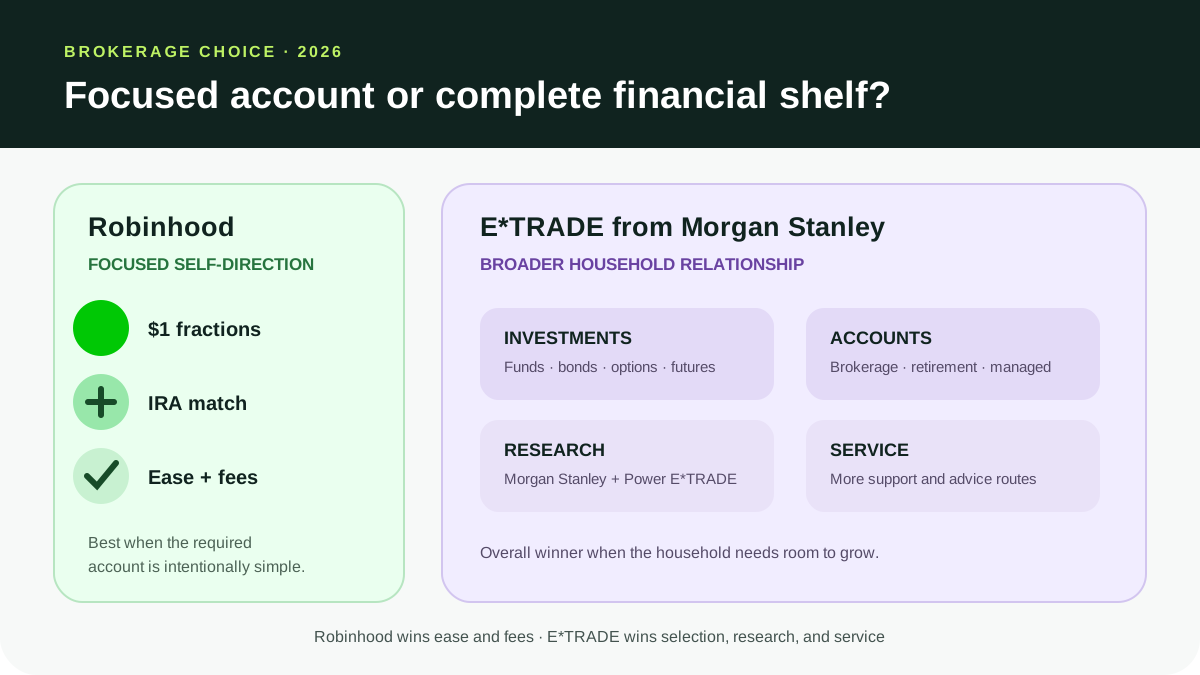
Overall winner: E*TRADE
E*TRADE's overall lead comes from breadth rather than from beating Robinhood at its specialty. It supports a full brokerage catalog with self-directed accounts, retirement accounts, mutual funds, bonds, options, futures, fractional shares, managed portfolios, and access to Morgan Stanley research and services. That makes it easier for a household to keep several investing needs inside one institution.
Robinhood is intentionally narrower. Its self-directed brokerage, IRA, options, recurring investment, fractional-share, Legend, and separate managed or alternative product experiences cover many retail needs without making the main interface feel like a financial supermarket. That narrower focus earns the higher ease score and contributes to its fees advantage.
The category results are decisive: Robinhood leads Fees 4.7 to 4.3 and Ease of Use 4.8 to 4.2. E*TRADE leads Investment Selection 4.9 to 4.1, Research & Tools 4.8 to 4.0, and Customer Service 4.4 to 3.9.
Fees: Robinhood wins
Both firms charge $0 commissions for eligible online U.S.-listed stock and ETF trades. The difference becomes clearer for options. Robinhood states that stock and ETF options have no base, per-contract, exercise, or assignment fee, although regulatory and exchange charges apply and index options have a contract fee. E*TRADE lists a standard $0.65 per options contract, reduced to $0.50 after at least 30 qualifying stock, ETF, and options trades in a quarter.
E*TRADE also lists $6.95 for online OTC stock trades, or $4.95 for qualifying active traders; $1.50 per futures contract per side; and $1 per bond for online secondary trades, with a $10 minimum and $250 maximum. Broker-assisted trades generally add $25. Those are legitimate services, but they show why “$0 trades” is not a complete price comparison.
Robinhood can still charge for index options, regulatory and exchange activity, Gold, margin, wires, statements, transfers, and other services. Robinhood Gold is $5 per month under the checked terms. Calculate whether its IRA match, eligible cash, margin, and premium benefits exceed the $60 annual subscription cost for the expected balance and behavior.
Fees winner: Robinhood, 4.7 to 4.3.
Ease of use: Robinhood wins
Robinhood is designed around a short path from funding to a dollar-based purchase. Eligible stocks and ETFs can be bought fractionally from $1 during regular market hours, and recurring investing can turn a contribution schedule into a repeatable routine. Account, watchlist, position, and order information are presented with relatively little setup.
ETRADE has a greater information and navigation burden because it supports more products. A user may choose between its standard web or mobile experience, Power ETRADE, screeners, mutual-fund tools, fixed income, futures, Core Portfolios, retirement resources, and Morgan Stanley services. That breadth is valuable once the user knows the goal, but it creates more paths and terminology.
An easy interface is not a substitute for suitability. Options, margin, crypto exposure, concentrated positions, and frequent trading remain risky on either platform. Robinhood wins because it reduces interface friction for the core use case, not because it removes investing risk.
Ease-of-use winner: Robinhood, 4.8 to 4.2.
Fractional shares: different minimums and mechanics
Robinhood supports eligible NMS-listed stocks and ETFs from $1. Fractional orders can be placed in dollar or share amounts during regular market hours, subject to eligibility. Fractions are not transferable in kind; a full account transfer generally liquidates them, while a partial transfer can leave them at Robinhood.
E*TRADE's current fractional-share program allows eligible listed Reg NMS securities, with a minimum notional amount of $5 and quantities entered to three decimal places. Direct fractional purchases of OTC and non-NMS-listed securities are not supported. The rollout and eligibility set can change, and dollar-notional order support was still described as forthcoming in the checked documentation.
Robinhood therefore has the more mature small-dollar workflow. E*TRADE's addition closes an important gap, but an investor who wants to split $20 among several exact dollar targets will find Robinhood more natural. Neither program changes the underlying risk or guarantees diversification.
Investment selection: E*TRADE wins clearly
E*TRADE supports U.S. stocks, ETFs, options, mutual funds, bonds and CDs, futures, fractional shares, retirement accounts, custodial and education routes, and managed portfolios. Not every product is commission-free or available in every account, but the catalog supports more stages of a household's financial life.
Robinhood supports stocks, ETFs, options, IRAs, fractional and recurring investments, margin for eligible customers, Legend, managed Strategies, and separate crypto and derivatives offerings. It does not match E*TRADE's mutual-fund, fixed-income, account-registration, and full-service breadth.
The right selection is the one the investment policy requires. A three-fund ETF investor may gain nothing from thousands of mutual funds or a bond desk. A household managing inherited securities, a rollover, education savings, individual bonds, and an active options allocation can outgrow a narrower platform.
Investment-selection winner: E*TRADE, 4.9 to 4.1.
Research and tools: E*TRADE wins
ETRADE combines screeners, market news, analyst material, educational resources, portfolio views, Power ETRADE, options analytics, retirement tools, and Morgan Stanley research. The stronger research score reflects the depth available across asset types and experience levels, not a claim that every tool predicts returns.
Power E*TRADE is designed for more active stock and options workflows, while the standard platform serves broader investing. A user can begin with an idea, screen alternatives, inspect fundamentals and technicals, analyze an option strategy, and place an order without leaving the brokerage ecosystem.
Robinhood provides company data, lists, news, recurring controls, option tools, and its Legend desktop experience. Legend materially improves the active-trading proposition. Gold also includes premium features, but the scheduled removal of Morningstar reports on August 10, 2026 means that benefit should not be counted as a durable research advantage.
Research quantity is not research quality. Verify material claims in issuer filings, prospectuses, and primary disclosures. Analyst ratings, screeners, charts, and model portfolios are inputs, not outcomes.
Research-and-tools winner: E*TRADE, 4.8 to 4.0.
Retirement accounts and IRA incentives
Both brokers support traditional and Roth IRA routes. E*TRADE's retirement offering is part of a larger account catalog and pairs with rollover guidance, beneficiary tools, retirement education, self-directed investments, and eligible managed solutions. This can suit a household that expects its retirement needs to become more complex.
Robinhood's differentiator is its eligible IRA match: currently 1% for non-Gold customers and 3% for eligible Gold members. The promotion has retention requirements. Gold customers must keep the subscription for the specified period, and matched money generally needs to remain for five years to avoid a possible Early IRA Match Removal Fee. Rates and terms can change.
Calculate the net benefit. A person contributing $1,000 to receive an additional two percentage points through Gold would gain $20 of incremental match while paying up to $60 annually for Gold, before counting other used benefits. A higher contribution can change the math. Do not let a bonus determine the asset allocation or cause an ineligible contribution.
Managed investing: E*TRADE offers the clearer option
E*TRADE Core Portfolios is an automated advisory program with a $500 minimum and an annual advisory fee of 0.30%, described as as low as $1.50 at the minimum balance. It builds and monitors an ETF portfolio based on goals, time horizon, liquidity needs, risk tolerance, and restrictions. The underlying funds have expenses in addition to the advisory fee.
Robinhood Strategies is a managed account with its own minimum, advisory terms, eligibility, and Gold fee cap. It expands Robinhood beyond pure self-direction, but E*TRADE's Core Portfolios experience sits inside a broader advice and service ecosystem.
Neither program supplies comprehensive financial planning merely by rebalancing an ETF portfolio. Taxes, insurance, debt, estate planning, employer benefits, and withdrawal strategy may require separate advice. Review the Form ADV and program brochure before enrolling.
Customer service: E*TRADE wins
DollarScout scores ETRADE 4.4 and Robinhood 3.9 for Customer Service. ETRADE's advantage is the number of support and relationship routes available across self-directed brokerage, retirement, managed accounts, branches, phone support, and Morgan Stanley services. The specific channel and availability depend on the account and issue.
Robinhood offers in-app and online support and extensive documentation. Its model is more digitally centered, which can work well for routine tasks but feel limiting during an unusual transfer, estate, restriction, tax-lot, or corporate-action issue.
Service scores do not guarantee a response time. Before consolidating a large or complicated household portfolio, ask both firms a precise question and document the answer. Confirm how each handles beneficiaries, powers of attorney, inherited accounts, cost-basis corrections, restricted securities, and transfer residuals.
Customer-service winner: E*TRADE, 4.4 to 3.9.
Cash, banking, and custody are not the same thing
E*TRADE connects brokerage with banking products from Morgan Stanley Private Bank, while Robinhood offers cash features through its own programs and partner-bank arrangements. A brokerage cash sweep, money market fund, bank deposit, and interest-bearing cash feature can have different yields, insurance, liquidity, and conditions.
Read the cash program disclosure rather than comparing a single APY. Rates change; promotional rates expire; eligibility and deposit networks matter. FDIC insurance applies to eligible bank deposits under its rules, while SIPC addresses missing cash and securities at a failed member brokerage. SIPC does not protect market losses and is not a guarantee of investment value.
Transfers and switching costs
Before moving an account, compare outbound transfer charges, fractional-share treatment, proprietary funds, options positions, cost basis, pending dividends, margin, and residual sweeps. Fractions generally cannot transfer in kind and may be sold, creating a taxable event in a taxable account.
Do not close the old account until the transfer is complete, residual dividends arrive, tax documents are available, and cost basis has been verified. Save statements from both firms. Transfer bonuses can have holding periods or clawbacks, so read terms before using the bonus to offset a transfer fee.
Which investors should choose Robinhood?
Choose Robinhood for straightforward self-directed stock and ETF investing, small fixed-dollar recurring purchases, eligible IRA contributions where the net match is worthwhile, and approved stock or ETF options trading where the contract-fee advantage matters. It is especially suitable when a compact interface will help maintain a disciplined routine.
Robinhood is less suitable for a household that needs mutual funds, a deep fixed-income catalog, unusual account registrations, extensive research, or higher-touch service.
Which investors should choose E*TRADE?
Choose E*TRADE for broader assets and account types, Morgan Stanley research, Power E*TRADE, retirement and rollover depth, individual bonds or mutual funds, optional Core Portfolios, and more service routes. It is the stronger choice when the brokerage needs to support a growing household rather than a single simple account.
E*TRADE is not automatically better for a small ETF routine. Its options contract charges and additional complexity can be unnecessary when Robinhood already supports every required task.
Final verdict
E*TRADE wins overall because its selection, research, and service advantages outweigh Robinhood's leads in fees and ease of use. Robinhood remains the sharper tool for the narrower job of simple, low-friction self-directed investing. Map the next five years of account types and assets—not just today's first trade—before choosing.
Which one is right for you?
- Best for Simple fixed-dollar stock and ETF investing: RobinhoodOpen Brokerage Account
- Best for Eligible IRA matching and low-cost stock/ETF options: RobinhoodOpen Brokerage Account
- Best for Mutual funds, bonds, futures, and broader account types: E*TRADEOpen Brokerage Account
- Best for Deep research, managed portfolios, and service routes: E*TRADEOpen Brokerage Account
Final verdict
E*TRADE wins 4.5/5 to 4.3/5 for broader investments, account types, research, managed options, and service. Robinhood is better for simplicity, $1 fractional investing, eligible IRA matching, and lower stock or ETF options contract costs. A simple investor can rationally choose Robinhood; a complex household will usually get more room to grow at E*TRADE.
Frequently asked questions
Sources and verification
Scores and product facts come from the underlying DollarScout reviews and were checked against these primary sources.
- Robinhood fractional shares
- Robinhood options investing
- Robinhood Gold overview
- Robinhood IRA match FAQ
- Robinhood investments supported
- Robinhood transfers and rollovers
- Robinhood Strategies FAQ
- E*TRADE pricing and rates
- E*TRADE fractional shares
- E*TRADE investment choices
- E*TRADE account comparison
- E*TRADE Core Portfolios
- E*TRADE Core Portfolios FAQ
- E*TRADE Power E*TRADE platform
- SIPC investor protection overview
Related content
More from DollarScout on this topic.
