Webull at a glance
Webull is a self-directed brokerage built for investors who want more charts, order controls, watchlists, screeners, and simulated trading than a minimalist app provides. It runs across mobile, browser, and downloadable desktop platforms. The same ecosystem now spans U.S. stocks, ETFs, options, bonds, IRAs, joint and custodial accounts, plus separate futures, crypto, event-contract, and advisory products.
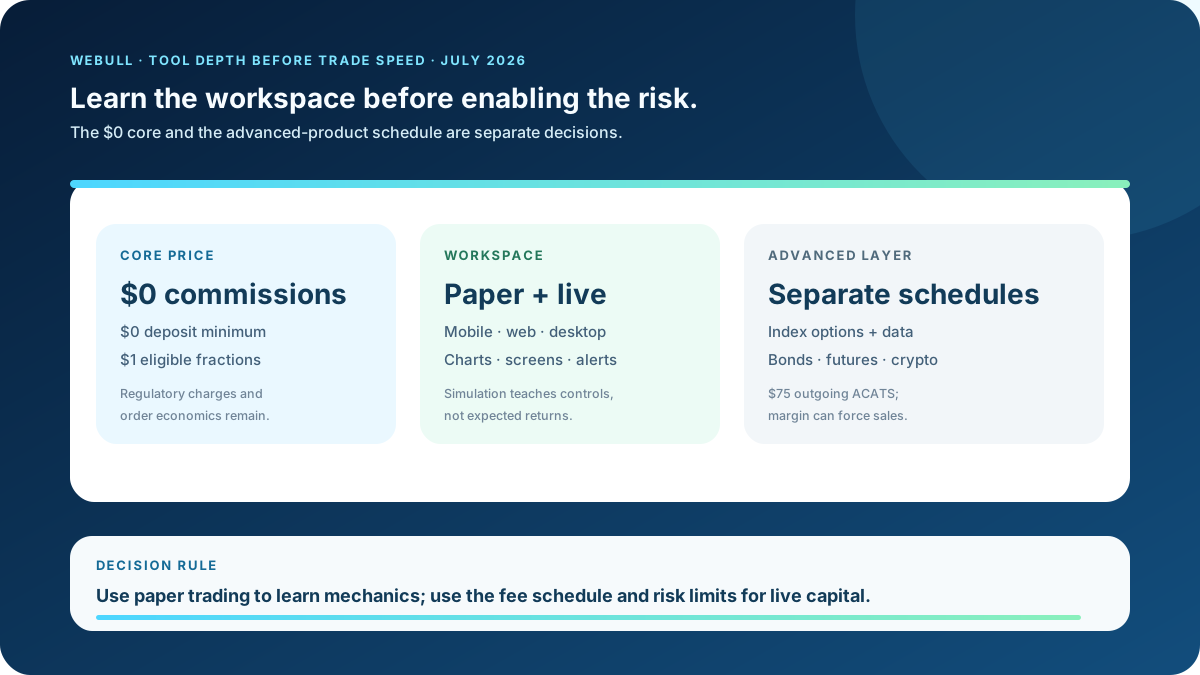
Webull says the standard brokerage has no deposit minimum. Eligible fractional stock and ETF buys can start at $1 during regular market hours. U.S.-listed stocks, ETFs, and standard options carry no Webull commission, but index options, very large option orders, regulatory charges, market data, margin, transfers, bonds, futures, and crypto follow separate schedules.
| Review question | DollarScout finding |
|---|---|
| Best for | Active learners who value charts, screeners, order controls, and paper trading |
| Opening minimum | $0 deposit minimum; eligible fractional buys from $1 |
| Core pricing | $0 commission on eligible U.S. stocks, ETFs, and standard options |
| Platform access | Mobile, web, desktop, and paper trading |
| Main limitation | Dense interface and product-specific costs outside the commission-free core |
Fees and commissions
Fees & Commissions scores 4.6/5. Webull lists $0 commissions for U.S.-listed stocks, ETFs, and standard options in eligible self-directed accounts. Regulatory agencies and exchanges can still assess fees, and Webull’s current table passes through specific transaction charges. A zero ticket commission should therefore be read as one cost component, not a zero-dollar trade.
Certain index options cost $0.50 per contract. Webull also discloses a $0.10 per-contract fee for oversized option orders. OTC and foreign-settlement transactions can trigger share-based, principal-based, or per-trade charges. Equity algorithmic order types are priced separately. The fee schedule—not a product card—is the authoritative source for the planned security and order type.
An outgoing stock transfer through ACATS costs $75. Fractional shares do not transfer and are liquidated in a full outgoing transfer. Market data subscriptions, Webull Premium, margin interest, futures exchange fees, crypto transaction pricing, bond economics, wire and returned-payment events, corporate actions, and paper documents can add cost.
Webull explains that it earns from stock lending, interest on free credit balances, margin interest, and payment for order flow. Those revenue sources create economic incentives an investor should understand. Compare execution price, spread, fill probability, and price improvement—not only the explicit commission.
Fractional shares and recurring investing
Eligible fractional purchases support selected U.S. stocks and ETFs marked in the platform. The current minimum buy is $1 and more than 0.00001 shares; the sell minimum is $0.01 and more than 0.00001 shares. Fractional trading is limited to regular market hours and is not available in extended sessions.
Market fractional orders can use a dollar or share amount, while fractional limit orders use shares. Fractional orders cannot be modified after submission, although a pending order can be cancelled and replaced. The positions cannot transfer to another brokerage as fractions and may be liquidated during a full transfer.
Recurring deposits and investments can support a long-term process, but Webull’s interface also surfaces frequent trading opportunities. Investors should separate an automated diversified allocation from a tactical account. A $1 minimum reduces an access barrier; it does not make a speculative security suitable.
Platform and ease of use
Ease of Use scores 4.1/5. Webull provides a consistent family of mobile, WebTrade, and desktop experiences, with customizable watchlists, chart layouts, multiple order tickets, news, company data, screeners, community features, and account views. An experienced user can arrange a productive workspace without paying for a professional terminal.
The same density creates a real learning curve. Quotes, technical indicators, options chains, multiple sessions, margin metrics, Level 2 data, alerts, and social activity compete for attention. A new investor can reach an order ticket before understanding settlement, buying power, order duration, spread, or the consequences of margin.
Start with a cash account and the simulator. Build a watchlist, learn market and limit orders, inspect bid and ask, and define position size before enabling options or margin. Turn off notifications that encourage action without improving the investment thesis.
Research, charts, and paper trading
Research & Tools scores 4.6/5. Webull’s strongest differentiator is the trading toolkit: interactive charts, technical indicators, screeners, customizable layouts, order-flow and market-data options, extended sessions, alerts, an API surface, and paper trading across supported platforms.
Paper trading currently supports stocks, ETFs, options, and futures. Webull documents a subset of option strategies, position and order limits, supported order types, and separate simulated hours. Data can reset after long inactivity or a platform update. That makes the simulator useful for learning the interface and documenting a rule set—not for estimating real-world profitability.
Extended-hours trading provides access outside 9:30 a.m.–4 p.m. ET, but participation and protections differ. Webull warns about reduced liquidity, wider volatility, limited security availability, and limit-order-only requirements in extended sessions. Fractional shares do not trade there. An order that looks small can receive a poor price in a thin market.
Research is more technical and market-oriented than full financial planning. Webull can help identify a setup or inspect a company, but retirement income, tax location, fund comparison, bond-ladder design, estate considerations, and comprehensive planning require a different workflow.
Investment and account selection
Investment Selection scores 4.4/5. Standard accounts can trade U.S.-listed stocks, ETFs, options, selected OTC securities, Treasuries, and corporate bonds. Account types include individual cash and margin, Traditional, Roth, and Rollover IRAs, joint, custodial, entity, advisory, futures, crypto, and event accounts, subject to eligibility.
Webull now supports U.S. Treasury and corporate bond trading through mobile, desktop, and WebTrade, using limit orders. Bond transaction pricing and yields must be evaluated together. A quoted yield can be reduced by markup, fee, spread, call risk, default risk, and the price obtained on an early sale.
Futures span indices, rates, currencies, agriculture, metals, energy, and cryptocurrency-related contracts. They trade in a separate account with margin requirements, exchange hours, and delivery controls. Crypto trading is provided through Webull Pay and is available 24/7 apart from applicable maintenance periods and location restrictions. Neither product should be evaluated with SIPC brokerage assumptions.
Traditional, Roth, and Rollover IRAs are available. Webull says self-directed IRAs can hold U.S. exchange-listed stocks, ETFs, ADRs, selected OTC securities, and approved Level 2 options; margin and short selling are unavailable. Managed IRAs use Webull Advisors and a different service relationship.
The platform is not a leading mutual-fund supermarket. Investors committed to specific mutual funds, branch advice, or a deeply integrated retirement-plan ecosystem may prefer E*TRADE, Fidelity, or Schwab.
Margin and active-trading risk
Margin increases buying power and the possibility of losses beyond the initial cash. Webull can raise house requirements, issue margin calls, and liquidate assets when equity is insufficient. Interest rates vary by balance and can change. A strategy’s expected return must exceed borrowing cost and still survive adverse moves.
Options add expiration, assignment, volatility, liquidity, and multi-leg execution risks. A commission-free contract can expire worthless; a short contract can create an obligation far larger than the premium received. Index options have different settlement and fee details from stock options.
Futures use leverage and near-continuous sessions. The platform’s availability does not mean a customer is financially or psychologically prepared. Establish maximum loss, liquidation rules, and funding separation before enabling the account.
Protection and cash treatment
Webull Financial is a FINRA member broker-dealer and SIPC member. Webull documents standard SIPC protection up to applicable limits and excess SIPC insurance with an aggregate policy limit. SIPC addresses missing assets after broker failure; it does not protect market value, unsuitable decisions, crypto, futures, or every contractual claim.
Cash-management and sweep products can use partner banks or money market funds with different protections. FDIC eligibility applies to deposits at participating banks under program rules and ownership limits. Money market funds are securities and are not bank deposits. Confirm where uninvested cash sits and what rate, fee, and protection apply.
Customer service
Customer Service scores 3.8/5. Webull publishes in-app help and a telephone support number, and its help center is detailed enough to resolve many product questions. The platform also exposes rules for account types, trading, transfers, protection, and product availability.
There is no branch network or assigned adviser in the standard self-directed account. Complex restrictions, transfers, corporate actions, tax lots, options assignments, and fraud cases can require escalation. DollarScout did not time a support case, so the score reflects documented access—not a measured resolution promise.
Save statements, confirmations, tax documents, transfer records, and chat transcripts. Use multifactor authentication and only official in-app or domain-based support channels. Never send credentials or verification codes to a person who contacted you unexpectedly.
Webull versus alternatives
Choose Robinhood for a simpler mobile experience, $1 fractional access, recurring purchases, and a less technical first screen. Choose E*TRADE for mutual funds, fixed-income depth, broader retirement infrastructure, managed portfolios, and Power E*TRADE under a long-established full-service umbrella.
Choose Public for an app-oriented mix of bonds, Treasuries, options, crypto, direct indexing, and AI research. Choose M1 for long-term target allocations and dynamic deposit rebalancing rather than intraday control.
Who Webull is best for
Webull fits customers who:
- Want to learn a chart-rich platform in paper trading before risking cash.
- Need mobile, browser, and desktop access under one account.
- Trade stocks, ETFs, or approved options and understand order mechanics.
- Value extended sessions, screeners, alerts, and customizable layouts.
- Can keep tactical trading separate from retirement assets.
It is weaker for someone seeking the simplest first app, a mutual-fund-heavy portfolio, branch support, or comprehensive financial advice.
Bottom line
Webull earns 4.3/5. Research & Tools and low core commissions are the strongest categories. Selection has expanded into bonds and multiple specialized accounts, while the $1 fractional minimum keeps access broad.
The deductions are the mirror image of those strengths: complexity, product-specific costs, and risk-heavy features. Use paper trading to learn mechanics, but validate every strategy with realistic costs and constraints. Read the fee and disclosure page for the exact account, security, session, and order before trading.