Many products on this page are from partners who compensate us. This doesn't influence our ratings. Our opinions are our own.
Robinhood vs Webull: 2026 Brokerage Comparison
By Sophie Brown, Senior Finance Editor · Updated Jul 2026 · Fact-checked Jul 19, 2026
Robinhood and Webull both earn 4.3/5 overall, but they serve different investors. Robinhood is better for a first brokerage account, $1 fractional investing, straightforward recurring purchases, and eligible IRA matching. Webull is better for charting, screeners, paper trading, extended-hours controls, and a more technical trading workspace. Fees and customer service are ties; Robinhood wins ease of use, while Webull wins investment selection and research.
Head-to-head
| Feature | Robinhood | Webull |
|---|---|---|
| DollarScout Rating | 4.3/5 ★ | 4.3/5 ★ |
| Account Minimum | $0 for a self-directed brokerage account; eligible fractional stock and ETF orders can start at $1, while Robinhood Strategies requires $50 | $0 brokerage deposit minimum; eligible fractional stocks and ETFs have a $1 buy minimum and trade only in regular market hours |
| Commissions | $0 commission on eligible U.S. stocks, ETFs, and stock/ETF options; regulatory fees apply, index options add a $0.50 contract fee or $0.35 with Gold plus exchange fees, and other products have separate schedules | $0 commission on U.S.-listed stocks, ETFs, and standard options; certain index options cost $0.50 per contract, oversized option orders can cost $0.10 per contract, and regulatory, exchange, data, futures, crypto, bond, margin, and transfer charges vary |
| Product Type | Mobile-first self-directed brokerage with IRAs, joint and custodial accounts, separate crypto and futures products, Robinhood Legend, Gold, and optional Robinhood Strategies managed portfolios | Self-directed multi-platform brokerage with stocks, ETFs, options, bonds, IRAs, joint and custodial accounts, paper trading, plus separate futures, crypto, event, and managed-advisory accounts |


Category-by-category breakdown
Fees & Commissions
Ease of Use
Investment Selection
Research & Tools
Customer Service
Detailed analysis
The short answer
Choose Robinhood for a simpler investing workflow and eligible IRA incentives; choose Webull for a more technical self-directed trading workspace. DollarScout rates both brokers 4.3/5 overall. The tie does not mean the products are interchangeable: Robinhood wins Ease of Use, Webull wins Investment Selection and Research & Tools, and Fees and Customer Service are ties under DollarScout's 0.15-point comparison threshold.
| Decision factor | Robinhood | Webull |
|---|---|---|
| Best starting use | Simple stock, ETF, option, and IRA investing | Research-heavy stock, ETF, and options trading |
| Fractional-share minimum | $1 for eligible stocks and ETFs | $1 for eligible stocks and ETFs |
| Standard eligible stock/ETF commission | $0 online | $0 online |
| Standout workflow | Mobile simplicity, recurring investing, IRA match | Charts, screeners, desktop tools, paper trading |
| Extended-hours emphasis | Available, with product and order restrictions | 4 a.m.–8 p.m. ET sessions with limit-order restrictions |
| Main tradeoff | Less depth for technical analysis | More controls and a steeper learning curve |
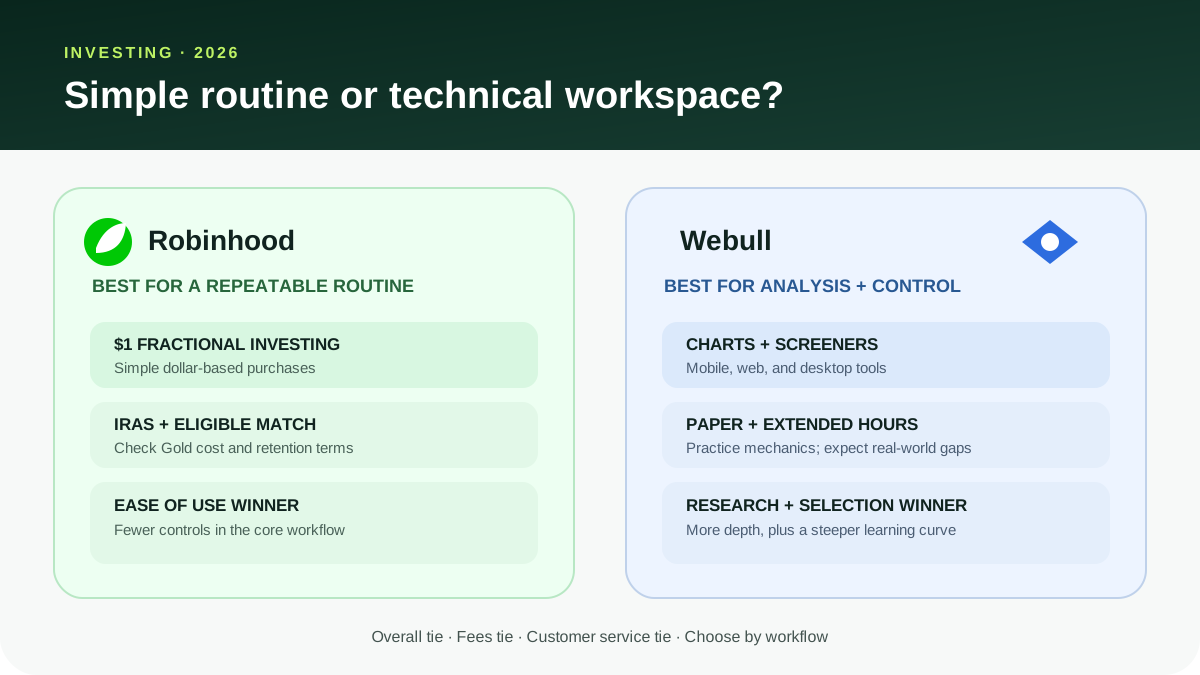
Overall score: a tie with different strengths
Robinhood and Webull each score 4.3/5 overall in DollarScout's investing rubric. Robinhood scores 4.7 for Fees, 4.8 for Ease of Use, 4.1 for Investment Selection, 4.0 for Research & Tools, and 3.9 for Customer Service. Webull scores 4.6, 4.1, 4.4, 4.6, and 3.8 in the same categories.
The 0.1-point gaps in Fees and Customer Service are recorded as ties, not manufactured wins. Webull's 0.3-point lead in Investment Selection and 0.6-point lead in Research are material. Robinhood's 0.7-point Ease of Use lead is also material. The result is a useful split: Robinhood is easier to begin and maintain; Webull provides more depth for active analysis.
These scores compare documented products as of July 19, 2026. They do not predict investment performance, order execution on a particular trade, support response time, or account approval.
Fees: an effective tie
Both brokers advertise $0 commissions for eligible online U.S.-listed stock and ETF trades. Robinhood also states that stock and ETF options have no base, exercise, assignment, or per-contract fee; index options have a separate contract fee. Webull lists $0 commissions for eligible stocks, ETFs, and standard options, while index options, regulatory charges, exchange fees, market data, transfers, and other products can cost extra.
That makes the headline price similar for a basic stock or ETF investor. The real comparison begins with the activity: option type and volume, margin balance, live-data needs, wire use, paper statements, ACATS transfer plans, and whether a premium subscription is required for a desired feature.
Robinhood Gold costs $5 per month under the terms checked. It adds eligible cash benefits, margin and IRA features, and other premium tools, but Morningstar research reports are scheduled to leave Gold on August 10, 2026. A feature with an announced end date should not be treated as permanent value. Webull's optional data and product charges likewise need to be priced from the current account and market-data pages.
Fees result: tie. Robinhood's numerical score is 0.1 higher, below the rubric's threshold for a category win.
Ease of use: Robinhood wins
Robinhood's strongest advantage is a focused account experience. A new investor can fund an account, find an eligible stock or ETF, buy by dollars, schedule recurring investments, and monitor a compact portfolio without first configuring a trading layout. Fractional shares can begin at $1 during regular market hours, which makes precise recurring contributions practical.
Webull is coherent, but it presents more controls: chart layouts, indicators, watchlists, screeners, order tickets, simulated trading, desktop modules, and extended-hours settings. Those controls are an advantage for someone who understands them and friction for someone who does not. A first-time investor can confuse a useful feature with a required step.
Simplicity does not make Robinhood risk-free. Options, margin, concentrated positions, frequent trading, and speculative assets remain complex even inside a polished interface. An easy order ticket can reduce interface friction without reducing economic risk.
Ease-of-use winner: Robinhood, 4.8 to 4.1.
Fractional shares and recurring investing
Both platforms support eligible fractional shares from $1, but the operating details matter. Robinhood supports most eligible NMS-listed stocks and ETFs and executes qualifying fractional orders in real time during regular market hours. Fractions cannot transfer in kind; a full transfer generally sells the fractional remainder, while a partial transfer leaves it behind.
Webull supports selected U.S. stocks and ETFs. Its current help documentation allows supported fractional orders on mobile, desktop, and web, subject to platform and order limitations. Fractional trading is restricted to regular market hours and fractions generally cannot move in kind to another broker.
Neither program turns a small position into diversification by itself. Owning five $1 slices of highly correlated technology stocks is still concentrated. Evaluate the underlying companies or funds, expense ratios, spread, tax consequences, and portfolio weights. Fractional capability is a funding tool—not an investment thesis.
Robinhood has the cleaner routine for a beginner who wants fixed-dollar recurring purchases. Webull is entirely workable for fractions, but its stronger reason to exist is the analysis surrounding the order.
Investment selection: Webull wins
Webull's platform spans stocks, ETFs, options, OTC securities subject to restrictions, bonds, futures, advisory offerings, and other product-specific experiences. Availability, entity, approval, and fee schedules vary, and some products sit in separate accounts or apps. Its selection score reflects the wider set of self-directed routes and trading-oriented instruments.
Robinhood supports stocks, ETFs, options, IRAs, cash and margin brokerage configurations, Legend, managed Strategies, and separate crypto and derivatives products where eligible. It covers the core needs of many retail investors, but it is not a full mutual-fund and fixed-income supermarket. Investors building portfolios around traditional mutual funds, a broad bond inventory, or specialized account types should verify support before opening.
Breadth is not automatically better. Futures and options introduce leverage and can produce losses faster than long-only investing. OTC securities can have limited information and liquidity. Choose the broker that holds the assets in the plan, not the broker with the longest product menu.
Investment-selection winner: Webull, 4.4 to 4.1.
Research and tools: Webull wins
Webull's clearest advantage is its working environment. It documents mobile, web, and desktop platforms, technical charts, indicators, screeners, watchlists, alerts, paper trading, and customizable modules. Paper trading is available across mobile, desktop, and web; simulated stocks and ETFs can operate from 4 a.m. to 8 p.m. ET, while simulated options follow regular hours. Simulation uses simplified assumptions and cannot reproduce queue position, slippage, partial fills, emotion, taxes, or real liquidity.
Robinhood supplies company information, news, lists, alerts, recurring-investment controls, options tools, and the Legend desktop platform. Legend narrows the historical gap for active traders, but the mainstream experience still prioritizes clarity over a dense research workstation. Gold's current research bundle should be evaluated carefully because the announced Morningstar report removal changes its durable value.
Webull is better for an investor who begins with a chart, scans a universe, tests an order workflow, and monitors technical conditions. Robinhood is better for someone whose research happens elsewhere and who wants a clean execution and portfolio interface.
Research-and-tools winner: Webull, 4.6 to 4.0.
Extended-hours trading
Webull places extended hours near the center of its value proposition. Its documented sessions run from 4:00 a.m. to 9:30 a.m. ET, 9:30 a.m. to 4:00 p.m., and 4:00 p.m. to 8:00 p.m. Only limit orders are accepted in the premarket and after-hours sessions, and not every security or order type is eligible.
The longer clock is not automatically better execution. Webull warns that extended sessions can have lower participation, wider spreads, higher volatility, and no Regulation NMS order-protection requirement. A limit order controls the worst acceptable price but does not guarantee a fill.
Robinhood also offers extended and overnight trading for eligible securities and accounts, with its own session, venue, and order restrictions. Compare the exact security and order ticket instead of treating “24-hour market” as universal access. Investors who do not need to respond outside regular hours should not let the feature dictate the broker choice.
IRAs and long-term investing: Robinhood has the edge
Robinhood offers traditional and Roth IRAs and advertises a match on eligible contributions: 1% for non-Gold customers and 3% for eligible Gold customers under current terms. Gold members must remain subscribed for the required period, and matched contributions generally need to stay in the account for five years to avoid a potential removal fee. Match rates and eligibility can change.
That incentive can be meaningful, but it should be calculated net of the $5 monthly Gold cost and any effect on asset choice. A $60 annual subscription requires enough eligible contributions and other used benefits to justify it. The tax rules and annual contribution limit come from federal law, not the app, and the investor remains responsible for eligibility and excess-contribution corrections.
Webull offers retirement accounts and recurring tools, but Robinhood's documented matching program gives it the clearer long-term acquisition benefit. Neither platform supplies a complete retirement plan. Asset allocation, emergency savings, taxes, time horizon, withdrawal rules, and behavior matter more than an account-opening bonus.
Customer service and account safety: a tie
DollarScout scores Robinhood 3.9 and Webull 3.8 for Customer Service, a tie under the rubric. Both publish digital help centers and support routes. Neither small numerical difference is evidence that a specific issue will be resolved faster.
Before transferring a large account, test the support channel with a concrete question about beneficiaries, options approval, cost-basis correction, an outbound transfer, or a restricted security. Save confirmations and monthly statements. Turn on multifactor authentication, use a unique password, verify official domains, and distrust unsolicited “support” messages asking for credentials or remote access.
Both brokerage firms describe SIPC membership for applicable securities accounts. SIPC can help restore missing securities and cash when a member brokerage fails, subject to legal limits of $500,000 including $250,000 for cash claims. It does not insure market losses, bad investment advice, declining securities, or every crypto or futures position.
Order execution matters beyond commission
A $0 commission does not prove that two brokers deliver identical executions. Market orders prioritize execution over price; limit orders control price but may not fill. Spread, liquidity, order size, venue, timing, price improvement, and the broker's routing practices affect outcomes.
Review each firm's Regulation NMS Rule 606 reports and best-execution disclosures if execution quality is central to the decision. Payment for order flow is a conflict to understand, not a shortcut that proves good or bad execution by itself. For a long-term investor making occasional liquid ETF purchases, disciplined contributions may dominate small routing differences. For a high-volume trader, fractions of a cent can compound.
Which investors should choose Robinhood?
Choose Robinhood for a first self-directed brokerage account, fixed-dollar recurring stock or ETF investing, eligible IRA contributions where the match terms add net value, or a customer who values a compact mobile experience. It is also attractive for approved stock and ETF options traders who understand the risks and value the absence of a standard per-contract fee.
Do not choose it solely for a promotion, a temporary premium feature, or an easy interface. Confirm the required securities, account type, transfer policy, margin terms, and total fees first.
Which investors should choose Webull?
Choose Webull for technical charts, screening, desktop layouts, simulated practice, extended-hours controls, and a broader active-trading workflow. It better fits an investor who wants to analyze and execute in the same environment and is comfortable configuring the platform.
Do not choose it merely because more tools appear on screen. If the plan is a small automated ETF portfolio, unused complexity is not value. Review optional market-data, product, transfer, and margin charges before funding.
Final verdict
This comparison is an overall tie, not a product tie. Robinhood is the better beginner and IRA-oriented experience; Webull is the stronger research and active-trading workstation. Fees and customer service are too close to call under the published rubric. The durable decision is whether the account routine begins with a contribution and a simple purchase, or with analysis, charts, and order control.
Which one is right for you?
- Best for First brokerage account and simple recurring investing: RobinhoodOpen Brokerage Account
- Best for Eligible IRA contributions and match evaluation: RobinhoodOpen Brokerage Account
- Best for Technical charting, screening, and paper trading: WebullOpen Brokerage Account
- Best for Extended-hours and active self-directed workflow: WebullOpen Brokerage Account
Final verdict
Robinhood and Webull tie at 4.3/5 overall. Choose Robinhood for simplicity, $1 fractional recurring investing, and eligible IRA matching. Choose Webull for technical research, desktop tools, paper trading, extended-hours controls, and broader self-directed selection. Compare the complete fee schedules and account terms, not only the $0 commission headline.
Frequently asked questions
Sources and verification
Scores and product facts come from the underlying DollarScout reviews and were checked against these primary sources.
- Robinhood fractional shares
- Robinhood options investing
- Robinhood Gold overview
- Robinhood IRA match FAQ
- Robinhood trading fees
- Robinhood investments supported
- Robinhood fee schedule
- Webull pricing
- Webull fractional shares
- Webull extended-hours sessions
- Webull OTC securities
- Webull paper trading
- Webull trading platforms
- SIPC investor protection overview
- SIPC protection limits and exclusions
Related content
More from DollarScout on this topic.
