E*TRADE at a glance
ETRADE from Morgan Stanley combines a traditional full-service brokerage menu with two modern self-directed interfaces: the main ETRADE web and mobile experience and Power E*TRADE for active trading. Customers can hold stocks, ETFs, mutual funds, options, bonds, Treasuries, CDs, futures, eligible fractional shares, and crypto, subject to product and account rules. Account choices span taxable brokerage, IRAs, custodial and education accounts, small-business retirement, managed portfolios, futures, and bank products.
The standard self-directed brokerage has a $0 opening minimum. Online eligible U.S.-listed stock, ETF, mutual-fund, and options trades have a $0 commission, but options contract fees and many product-specific charges remain. That combination—broad selection plus serious research and trading tools—is E*TRADE’s advantage over an app whose entire pitch is a short order ticket.
| Review question | DollarScout finding |
|---|---|
| Best for | Households consolidating taxable, retirement, fund, bond, and active-trading needs |
| Standard brokerage minimum | $0 |
| Options pricing | $0.65 per contract; $0.50 with 30+ qualifying trades per quarter |
| Managed option | Core Portfolios: $500 minimum and 0.30% annual advisory fee |
| Main limitation | Dense product surface and separate schedules for options, bonds, OTC, futures, crypto, and service events |
Fees and commissions
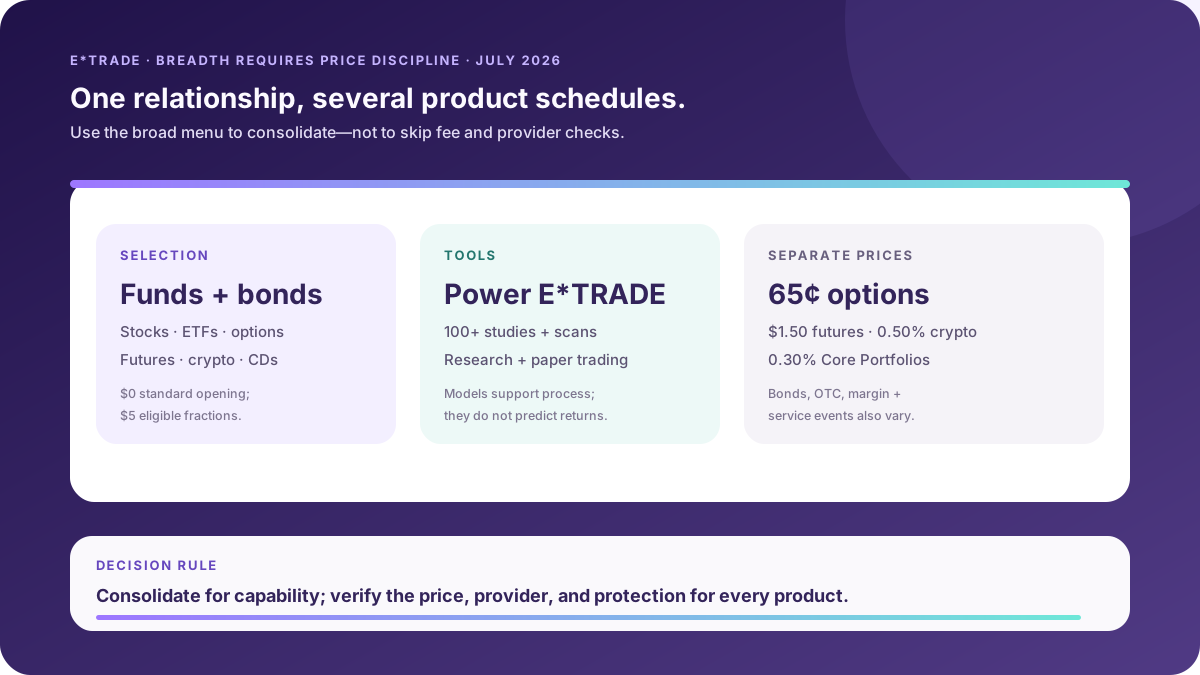
Fees & Commissions scores 4.3/5. E*TRADE charges $0 commission for eligible online U.S.-listed stocks, ETFs, mutual funds, and options. Options still cost $0.65 per contract, reduced to $0.50 for customers who execute at least 30 stock, ETF, and options trades per quarter. Exercise and assignment are listed at $0, while regulatory and exchange fees can apply.
Online OTC stock trades cost $6.95, or $4.95 at the 30-trade quarterly level. Futures cost $1.50 per contract per side plus exchange and NFA fees; some crypto-related futures cost more. Most online secondary bond and CD agency trades cost $1 per bond, with a $10 minimum and $250 maximum. Treasury auctions and online Treasury secondary trades are listed at $0 commission, although spread, price, and yield still determine economics.
Crypto trading is currently priced at 0.50% of notional trade value through Zero Hash, and E*TRADE says it receives a portion of that commission. Broker-assisted trades generally add $25. Margin rates vary by debit tier and can change. Directed orders, foreign securities, stock plans, wires, transfers, corporate actions, paper delivery, and other events have separate terms.
This is competitive for a broad broker, not universally cheapest. A $0 mutual-fund transaction does not remove a fund’s expense ratio, sales load, redemption condition, or tax cost. A $1 bond commission does not show markup or spread. Compare the complete confirmation and current schedule for the exact investment.
Fractional shares and recurring access
E*TRADE now offers direct fractional purchases in eligible listed Reg-NMS securities. Orders can use decimal quantities to three places with a $5 minimum notional amount. Availability began with a pilot group and is expanding; BRK.A, Morgan Stanley common and preferred stock, OTC securities, and other restricted names can be ineligible.
Fractional shares can also arise through dividend reinvestment. Fractions can receive proportionate dividends and, in many cases, voting or mandatory corporate-action treatment, but voluntary events and transfers can differ. Eligibility may change and a fraction generally cannot move between brokers as an identical fractional position.
The feature closes an important gap with mobile-first brokers, but it does not turn every stock into a suitable small-dollar holding. A $5 purchase of a concentrated company remains concentrated. Use fractional access to implement a deliberate allocation—not merely to collect more tickers.
Investment selection
Investment Selection scores 4.9/5. E*TRADE supports stocks, ETFs, mutual funds, options, Treasuries, municipal and corporate bonds, CDs, futures, fractional shares, and cryptocurrency. It also provides IPO access where eligible and a wide range of account registrations.
Mutual-fund and fixed-income access are decisive advantages over Robinhood and M1. A retirement investor can compare active and index mutual funds, exchange-traded funds, bonds, and CDs without opening a separate specialist account. Prospectus expenses, transaction conditions, minimums, liquidity, and call features still require analysis.
E*TRADE promotes 24x5 trading in a selected group of widely traded ETFs. Overnight access can involve reduced liquidity, wider spreads, volatility, and different venues. Selection is limited; it does not make the underlying fund trade continuously on its primary exchange. Use eligible limit orders and inspect the spread.
Account breadth includes individual and joint brokerage, Traditional, Roth, Rollover, Beneficiary and SEP IRAs, custodial and education savings, small-business retirement, Core Portfolios, other managed relationships, futures, and bank products. Eligibility, minimums, taxes, and legal providers vary.
Power E*TRADE and research
Research & Tools scores 4.8/5. The main ETRADE experience supports research, idea generation, screeners, portfolio views, education, fund and fixed-income tools, quotes, news, and ordinary order entry. Power ETRADE adds an active-trading workspace across web and mobile.
ETRADE documents interactive charts, more than 100 technical studies, preset scans, risk and probability tools, options analysis, paper trading, customizable layouts, and learning events. Power ETRADE Pro is succeeding the legacy E*TRADE Pro desktop workflow with a modern downloadable platform and ongoing feature additions.
Paper trading is useful for learning controls and option mechanics but cannot reproduce live fills, slippage, assignment, borrowing cost, taxes, or emotion. Probability tools depend on models and assumptions; they do not predict a contract’s outcome. Use them to compare scenarios, not to convert risk into certainty.
Morgan Stanley research and education deepen the experience beyond technical charts. The practical benefit is one workflow from long-term fund research to an active options chain. The cost is density: a new investor must learn which interface and data source answer the question.
Ease of use
Ease of Use scores 4.2/5. ETRADE organizes account, banking, investing, and trading features within a unified relationship. The standard app is capable for ordinary portfolio management; Power ETRADE handles more demanding trading. That separation prevents every user from landing on the densest screen.
Navigation is still more complex than Robinhood or Public. A household can encounter multiple cash balances, sweep or bank products, platforms, account types, research modules, fee tiers, and provider disclosures. The breadth that supports consolidation also creates more opportunities to select the wrong account or assume a feature applies universally.
Start with the main interface, a cash account, and a small number of tasks. Learn statements, positions, cash availability, cost basis, beneficiaries, and basic order duration before opening Power E*TRADE. Enable options, futures, margin, or crypto only when the product has a defined portfolio role and maximum loss.
Core Portfolios
Core Portfolios is E*TRADE’s automated managed program. The documented minimum is $500 and the annual advisory fee is 0.30%, charged monthly based on account assets. Underlying ETF expenses remain. Eligible taxable and retirement registrations can participate.
The program builds and monitors an ETF portfolio using the customer’s goals, horizon, liquidity needs, and risk tolerance. It can offer tax-sensitive, socially responsible, or smart-beta customization subject to availability. Accounts can receive tax-loss harvesting, but wash-sale interactions with securities held elsewhere can reduce the intended benefit.
Core Portfolios is appropriate for someone who wants delegation and a support team at a low minimum. It does not assign an individual financial adviser or provide comprehensive planning. Compare 0.30% plus fund costs with a simple self-directed ETF allocation and other robo-advisers.
Bonds, CDs, and cash
ETRADE’s bond and CD tools allow direct maturity and issuer analysis that bond ETFs cannot replicate. Treasury auctions and online secondary Treasuries are listed without commission, while other online secondary agency trades commonly use the $1-per-bond schedule. When ETRADE acts as principal, a markup or markdown can be embedded in price.
Compare yield to worst, call schedule, maturity, credit quality, accrued interest, quantity, spread, and the price available on an early sale. A high coupon is not the same as a high yield, and neither is a guarantee of repayment.
Morgan Stanley Private Bank products include checking, savings, and CDs under their own rate sheets and FDIC terms. Promotional APYs can expire and standard APYs can change. Do not paste a limited promotional rate into a permanent brokerage review.
Customer service and protection
Customer Service scores 4.4/5. E*TRADE publishes telephone and digital support, specialized trading and retirement resources, education events, extensive FAQs, and integrated Morgan Stanley service pathways. That is stronger documented access than a mobile-only callback model.
DollarScout did not submit and time a service case, so the score does not promise wait time or resolution. Complex transfers, inherited accounts, corporate actions, futures, options, and managed relationships can route to specialized teams. Record case numbers and confirm material instructions in writing.
Brokerage securities are provided by a SIPC-member broker-dealer. Futures, crypto, bank, and advisory arrangements differ. SIPC does not protect a decline in value; FDIC does not cover securities; crypto is not FDIC or SIPC insured. Read the provider name on the account agreement and confirmation.
E*TRADE versus alternatives
Choose Robinhood when the priority is the shortest mobile path, $1 fractional orders, and recurring ETF or stock purchases. Choose Webull for a chart-first active environment and broad paper trading with lower standard options contract pricing.
Choose Fidelity or Schwab when branch or adviser access and their particular mutual-fund or cash ecosystems are central. Choose M1 for target-allocation Pies and automatic deposit routing rather than unrestricted intraday execution. Choose Public for a newer multi-asset interface and AI-centered research.
Who E*TRADE is best for
E*TRADE fits customers who:
- Want taxable, retirement, fund, bond, and active-trading tools at one broker.
- Need mutual funds, individual fixed income, or CDs.
- Value deep research, education, screeners, and Power E*TRADE.
- Want an optional managed ETF portfolio with a $500 entry point.
- Can navigate product-specific fee and protection rules.
It is weaker for someone who wants the absolute simplest first app, the lowest options contract cost, or a relationship that automatically includes comprehensive human planning.
Bottom line
E*TRADE earns 4.5/5. Selection and Research & Tools are close to best in class. The $0 account minimum and online commission schedule keep basic access competitive, while fractional shares remove a former disadvantage.
Its complexity is real, and several products are not the cheapest. ETRADE is most valuable when a household uses the breadth to consolidate a deliberate portfolio. Price each security and service, choose the correct legal account, and use Power ETRADE’s sophistication to improve process—not trading frequency.