Many products on this page are from partners who compensate us. This doesn't influence our ratings. Our opinions are our own.
How to Choose a Business Bank Account
By Sophie Brown, Senior Finance Editor · Updated Jul 2026 · Fact-checked Jul 18, 2026
The best business bank account is the one that handles the company’s real payment volume, cash access, users, controls, and integrations at the lowest reliable total cost. A headline monthly fee is only one input. This guide turns the transaction profile into a scorecard, verifies the institution and documents, and tests the account before critical money moves.
Key takeaways
- Map a normal month and a peak month of transactions before comparing account prices.
- Verify the legal institution, federal deposit insurance, ownership title, and opening requirements.
- Model cash deposits, ACH, wires, checks, cards, users, integrations, minimums, and fraud controls—not just the monthly fee.
- Match permissions and approval workflows to the people who will actually move or review money.
- Pilot deposits, withdrawals, bill pay, alerts, and accounting feeds before moving payroll or the full operating balance.
Start with a transaction profile, not a best-of list
A consultant paid by ACH, a restaurant depositing cash, an ecommerce seller receiving processor payouts, and a property manager sending many vendor payments do not need the same account. A ranking can narrow candidates, but only the business's activity reveals the relevant fees and controls.
Build two profiles from statements or a realistic forecast: one normal month and one peak month. Include transaction count, dollar value, timing, and channel. The peak case matters because included allowances and daily limits often break when sales or payroll is highest.
Inventory every money movement
Record these monthly quantities:
| Channel | Volume questions | Operational questions |
|---|---|---|
| ACH | Credits, debits, batches, same-day needs | Limits, approval, cutoff, returns, templates |
| Wires | Domestic/international, incoming/outgoing | Fees, cutoff, callbacks, dual approval |
| Cash | Dollars, deposits, locations, frequency | Included allowance, branch or partner network, counting fees |
| Checks | Written, deposited, bill-pay checks | Positive pay, mobile limits, stop-payment cost |
| Cards | Cardholders, spend, merchant types | Limits, virtual cards, alerts, receipt controls |
| Processor payouts | Platforms, cadence, reserves | Gross-to-net reports, settlement delay, account-change security |
| Payroll and taxes | Frequency, provider, peak amount | Funding deadline, ACH limit, failed-payment process |
Also list expected balances, foreign-currency needs, branch visits, ATM use, remote-deposit capture, and whether customers will pay to a legal business name. A feature has value only if the workflow uses it.
Set non-negotiable gates
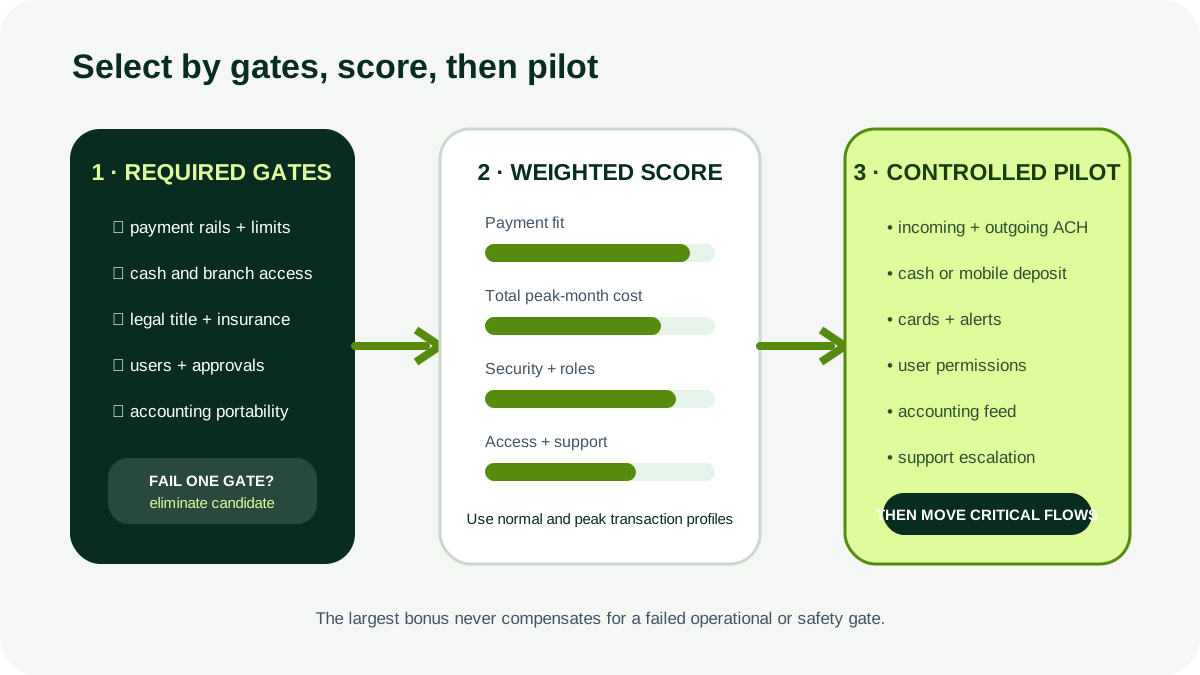
Before scoring price, eliminate candidates that cannot perform a critical job. Gates might include cash deposits within a reasonable distance, an ACH limit above payroll, two-person wire approval, QuickBooks or Xero feeds, multiple cardholders, international wires, or branch access for official checks.
Add safety gates:
- The legal bank appears in FDIC BankFind, or the credit union is federally insured through the NCUA.
- The account can be titled to the actual sole proprietor or entity.
- Opening and beneficial-owner requirements can be satisfied accurately.
- The bank supports required user roles without shared credentials.
- Fraud reporting, payment cutoffs, and support escalation are documented.
An attractive bonus should never override a failed gate.
Verify the institution behind the interface
Search the legal institution name in FDIC BankFind. A software platform may provide the interface while partner banks hold deposits. Identify those banks, when money reaches them, how customer records support pass-through coverage, and whether the business already has deposits at a partner bank.
FDIC coverage for a qualifying corporation, partnership, or unincorporated association is generally up to $250,000 at one insured bank in the business/organization category, regardless of the number of owners or signers. A sole-proprietorship deposit instead belongs to the owner's single-account category and is aggregated with the owner's other single deposits at that bank.
Multiple operating, payroll, and tax accounts owned by the same legal entity do not each create a separate insurance limit. If operating cash can exceed coverage, design a deliberate multi-bank or other risk-management policy rather than discovering the issue during a bank event.
Calculate total monthly cost
Create a price sheet from the current fee schedule. Include:
- monthly maintenance fee and waiver requirement;
- required minimum daily or average balance;
- included transactions and per-item overage;
- cash-deposit allowance and overage rate;
- incoming and outgoing ACH fees;
- domestic and international wire fees;
- check orders, bill pay, stop payments, and returned items;
- ATM, foreign transaction, and expedited-card fees;
- extra users, cards, subaccounts, accounting feeds, and treasury services;
- early closure or bonus clawback terms.
Then apply both transaction profiles. Example:
| Cost component | Account A | Account B |
|---|---|---|
| Monthly fee after realistic waiver | $0 | $20 |
| Cash overage in peak month | $48 | $0 |
| Four outgoing wires | $100 | $60 |
| Two extra users | $0 | $0 |
| Peak-month total | $148 | $80 |
The “free” account is more expensive for this hypothetical business. Use current bank pricing and your own volumes; do not treat the example as an offer.
Minimum balances also have an opportunity cost. If a fee waiver requires $25,000 that could safely earn more elsewhere, compare the foregone return with the fee. Never jeopardize payroll or tax liquidity merely to avoid a modest monthly charge.
Evaluate access and funds availability
Ask when check, ACH, card, wire, and cash deposits become available—not merely when they appear. Review the business funds-availability policy, new-account holds, mobile-deposit limits, and fraud-review procedures. A processor payout marked complete may still be pending at the bank.
Confirm daily and monthly outbound limits for ACH and wires. Some limits are configurable only after underwriting or account history. A business that discovers a low ACH ceiling on payroll day has selected the wrong account even if every fee is zero.
For cash, inspect the actual deposit path. Partner retail networks may impose per-deposit limits or fees. A branch may be far away or close before the day's receipts are ready. Include staff time and physical security in the decision.
Design user roles before adding users
List each person and the exact actions needed:
| Role | View balances | Create payment | Approve payment | Manage users |
|---|---|---|---|---|
| Owner/admin | Yes | Yes | Yes | Yes |
| Bookkeeper | Yes | Optional | No | No |
| AP specialist | Limited | Yes | No | No |
| Second approver | Limited | No | Yes | No |
| Cardholder | Card only | Card spend | No | No |
Prefer accounts that support separate identities, least privilege, approval thresholds, and audit logs. Never solve missing role support by sharing the administrator password or multifactor code.
For higher-risk payments, look for dual approval, new-recipient controls, callbacks, positive pay for checks, ACH debit blocks or filters, card limits, and instant alerts. Understand which controls are included and which require a treasury package.
Test integrations rather than checking a logo
“Integrates with accounting” can mean a stable direct feed, an aggregator connection, or only CSV export. Test how pending and posted transactions, check numbers, processor descriptors, and multiple subaccounts appear. Confirm how far history goes and what happens when credentials or tokens change.
For payroll and merchant services, verify that the account supports the provider's debit and credit flows and that funding deadlines match available cash. The SBA notes that merchant services and payment processors have their own discount rates, transaction fees, batch fees, and minimums; price the processor separately from the bank.
Keep portable records. Download statements and transaction exports even when an integration is working. A bank or software connection should not be the only copy of the books.
Prepare the opening file
The SBA lists an EIN—or SSN for some sole proprietorships—formation documents, ownership agreements, and business licenses among common requirements. Banks may also ask for assumed-name records, physical address, industry details, expected volume, responsible-party identification, and information about owners or controllers.
Form a legal entity with the state before applying for its EIN. Obtain the EIN directly from the IRS for free. Ensure names, addresses, and ownership details agree across the formation record, IRS confirmation, license, application, and processor account.
Current FinCEN guidance exempts U.S.-created entities from Corporate Transparency Act BOI reporting under the March 2025 interim final rule, but bank customer-identification and beneficial-owner requests are separate compliance processes. Answer the bank accurately rather than assuming one rule eliminates every ownership question.
Run a controlled pilot
Open with a limited amount and test:
- Incoming ACH and its availability date.
- Outgoing ACH, recipient setup, limit, and approval.
- A mobile check or cash deposit if relevant.
- Card activation, limits, alerts, and receipt process.
- Bill pay or one vendor payment.
- Accounting feed and statement export.
- User invitations and permission boundaries.
- Support response to a nonurgent question.
Only after the pilot passes should the business reroute processor payouts, payroll, taxes, and the full operating balance. Keep the old account funded during the migration until every critical flow settles successfully.
Score and document the decision
Weight the surviving candidates according to business priorities. One practical model might assign 30% to payment fit, 25% to total cost, 20% to security and roles, 15% to access and support, and 10% to integrations. Change the weights rather than pretending they are universal.
Write down why the winner was selected, the pricing date, known limits, and the trigger for review. Reassess after rapid growth, a new location, international expansion, payroll changes, or recurring service failures. A good account today can become a poor fit when the transaction profile changes.
Bottom line
Choose a business bank account by converting operations into gates, costs, and controls. Verify the institution and entity title, model a normal and peak month, inspect payment limits and availability, design roles, test integrations, and pilot the account. The best option is the lowest-risk complete fit—not the largest bonus or the lowest fee in isolation.
Related content
Frequently asked questions
Sources
Related content
More from DollarScout on this topic.
