Many products on this page are from partners who compensate us. This doesn't influence our ratings. Our opinions are our own.
Webull vs M1 Finance: 2026 Brokerage Comparison
By Sophie Brown, Senior Finance Editor · Updated Jul 2026 · Fact-checked Jul 19, 2026
Webull wins overall, 4.3/5 to M1 Finance's 3.9/5, for lower recurring platform cost, broader self-directed selection, and substantially stronger research and trading tools. M1 wins Ease of Use for long-term investors who want target-based Pies, recurring deposits, and Dynamic Rebalancing instead of intraday control. Customer Service is a tie. The decisive question is whether you want to place and analyze trades or automate an allocation.
Head-to-head
| Feature | Webull | M1 Finance |
|---|---|---|
| DollarScout Rating | 4.3/5 ★ | 3.9/5 ★ |
| Account Minimum | $0 brokerage deposit minimum; eligible fractional stocks and ETFs have a $1 buy minimum and trade only in regular market hours | $100 initial deposit for individual, joint, custodial, and crypto accounts; $500 for Traditional, Roth, and SEP IRAs; $5,000 for trust accounts; cash accounts have separate rules |
| Commissions | $0 commission on U.S.-listed stocks, ETFs, and standard options; certain index options cost $0.50 per contract, oversized option orders can cost $0.10 per contract, and regulatory, exchange, data, futures, crypto, bond, margin, and transfer charges vary | No trading commission on eligible stock and ETF trades, but a $3 monthly Platform or IRA Fee applies unless waived by $10,000 in total M1 assets or an active Personal Loan; regulatory, closure, transfer, ADR, crypto, borrowing, and other fees can apply |
| Product Type | Self-directed multi-platform brokerage with stocks, ETFs, options, bonds, IRAs, joint and custodial accounts, paper trading, plus separate futures, crypto, event, and managed-advisory accounts | Automated self-directed stock and ETF portfolio platform using customizable Pies, recurring deposits, Dynamic Rebalancing, and scheduled trade windows, with separate cash, crypto, and borrowing products |


Category-by-category breakdown
Fees & Commissions
Ease of Use
Investment Selection
Research & Tools
Customer Service
Detailed analysis
The short answer
Choose Webull to research and place trades; choose M1 Finance to maintain a target portfolio with fewer day-to-day decisions. DollarScout rates Webull 4.3/5 overall and M1 3.9/5. Webull wins Fees, Investment Selection, and Research & Tools. M1 wins Ease of Use because its Pies, recurring deposits, Auto-Invest, and Dynamic Rebalancing fit a repeatable long-term allocation. Customer Service is a tie.
| Decision factor | Webull | M1 Finance |
|---|---|---|
| Primary workflow | Self-directed research and trading | Target-based portfolio automation |
| Eligible stock/ETF commission | $0 online | $0 self-directed commission; other fees apply |
| Recurring platform charge | No general $3 brokerage platform fee | $3/month Platform or IRA Fee unless waived |
| Trade timing | Real-time plus eligible extended hours | Scheduled trade windows, generally once or twice daily |
| Portfolio structure | Individual positions, watchlists, orders | Pies and percentage-based Slices |
| Standout tool | Charts, screeners, alerts, and paper trading | Auto-Invest and Dynamic Rebalancing |
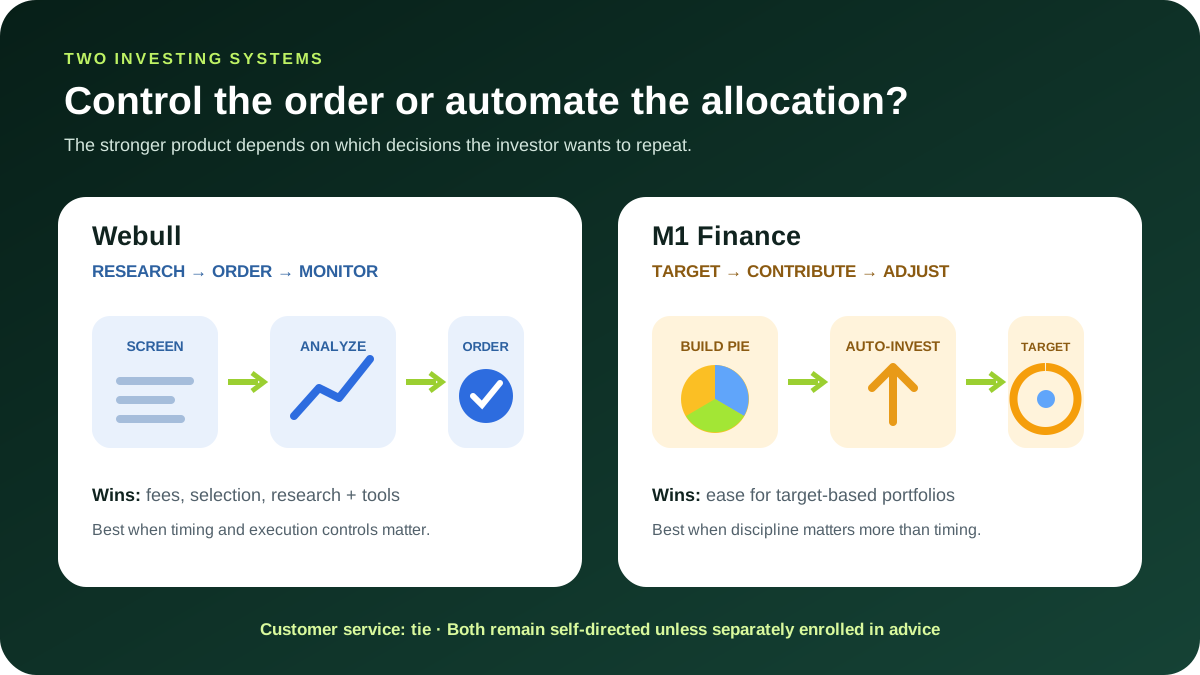
These brokers solve different problems
Webull is a trading platform. Its mobile, web, and desktop products emphasize quotes, charts, indicators, screeners, watchlists, alerts, order types, extended hours, and simulation. The customer selects a security, decides timing and price controls, and submits the order.
M1 is a portfolio automation platform. The customer builds a Pie, assigns percentage targets to Slices, funds the account, and lets scheduled trade windows allocate eligible cash. New deposits go toward underweight Slices; withdrawals generally begin with overweight Slices. The platform is designed around maintaining a plan rather than choosing an exact execution moment.
This distinction matters more than the 0.4-point overall score gap. An active trader will experience M1's scheduled windows as a limitation. A long-term investor who wants to stop reacting to every quote may experience those same windows as useful guardrails.
Fees: Webull wins
Webull lists $0 commissions for eligible online U.S. stocks, ETFs, and standard options. Index options, regulatory and exchange charges, margin interest, market-data subscriptions, transfers, and other products or services can cost extra. “Commission-free” is the correct description of eligible trades, not of the entire account.
M1 states that it does not charge commission, trading, or management fees for self-directed brokerage accounts. It does, however, charge a $3 monthly Platform Fee or a $3 monthly IRA Fee when the customer does not meet a waiver. Only one of the two fees is charged in a month. The current disclosure says the fee can be waived by maintaining at least $10,000 in total M1 assets or having an active M1 Personal Loan, subject to the detailed program rules.
If the selected account lacks $3 in cash, M1 may sell securities to collect the fee. Its fee schedule also lists an outgoing direct account transfer at $100 and an IRA termination event at $100, plus regulatory, ADR, paper, and other service charges. A $3 monthly fee is $36 annually: 3.6% of a $1,000 portfolio before fund expenses or market performance, but only 0.036% of $100,000.
Fees winner: Webull, 4.6 to 4.0. M1's fee can become immaterial or waived at a larger balance, but it weighs heavily on a small account.
Ease of use: M1 wins for its intended workflow
M1's interface asks the investor to make the important allocation decision first. A Pie can hold stocks and ETFs as percentage-based Slices. Once targets, recurring deposits, and Auto-Invest are configured, new money can flow toward underweight positions without a separate decision for every purchase.
Webull presents more information and more control. That is helpful for an investor who wants to compare charts, study indicators, screen a market, select an order type, and include or exclude extended hours. It is unnecessary cognitive load for someone who only wants to contribute to a long-term allocation every payday.
M1's simplicity has rules that must be learned. Removing a Slice can trigger liquidation even when Auto-Invest is off. Manual orders receive priority over automated trades. A full rebalance must be requested and can create taxable sales. Trades occur in windows, not at a user-selected second.
Ease-of-use winner: M1, 4.4 to 4.1. The win applies to target-based investing; Webull is easier for an investor whose task is placing a specific real-time order.
M1 Pies, Auto-Invest, and Dynamic Rebalancing
A Pie is an allocation template. The investor assigns target percentages, and each holding becomes a Slice. On the first eligible deposit, M1 can invest according to those targets. Future deposits use Dynamic Rebalancing, directing cash toward underweight Slices. Withdrawals generally source money from overweight positions first.
This is not the same as automatically selling every position back to target. M1's current documentation says it never performs a full rebalance without the customer's instruction. Auto-Invest uses buys to move gradually toward targets; it triggers only when cash exceeds the selected minimum by at least $25. A manual rebalance places buys and sells during the next trade window and may realize taxable gains or losses.
That distinction is a strength when the goal is tax-aware drift correction with new contributions. It can be a limitation when an investor expects immediate or exact target restoration. Review every Pie edit before confirming it, especially when removing a Slice.
Webull research, charts, and paper trading
Webull's strongest category is Research & Tools. It offers mobile, web, and desktop workspaces with customizable charts, indicators, screening, watchlists, alerts, news, and order tickets. A user can begin with a universe of securities, narrow it with data, inspect a chart, and move into an order in the same environment.
Paper trading is available across the mobile, desktop, and web platforms. Current documentation allows simulated stock and ETF trading from 4:00 a.m. to 8:00 p.m. ET and simulated options during regular market hours. The simulator has position and order limits and fills from simplified market data.
Simulation is useful for learning platform mechanics and testing whether rules are explicit. It cannot model a live order's queue position, price impact, liquidity, partial fills, borrow availability, emotional pressure, taxes, or every corporate action. A strategy that works in a simulator is not validated merely because a chart shows a profit.
Research-and-tools winner: Webull, 4.6 to 3.5.
Trade timing: real-time control vs windows
Webull supports regular-market trading and eligible premarket and after-hours sessions. Its documented extended sessions run from 4:00 a.m. to 9:30 a.m. ET and from 4:00 p.m. to 8:00 p.m. Only limit orders are accepted in those sessions, and not every security or order type is eligible. Lower liquidity, wider spreads, volatility, and weaker price protection can make more hours worse rather than better.
M1's morning trade window begins around 9:30 a.m. ET and its afternoon window around 3:00 p.m. Eligible accounts with at least $25,000 in invested assets per account can use both windows in one day; smaller accounts select one. Orders are aggregated and considered “not held,” giving M1 time and price discretion within its process.
M1's windows are poorly suited to news-driven trading, intraday risk control, or an investor who requires a particular limit price. They are reasonable for periodic contributions where the investment horizon is years and the goal is allocation discipline. Do not use a long-term automation platform for a task that depends on intraday timing.
Investment selection: Webull wins
Webull's product ecosystem includes stocks, ETFs, options, OTC securities subject to restrictions, bonds, futures, and separate advisory or product experiences. Eligibility, legal entity, approvals, fees, and platform availability vary. That breadth earns the higher Investment Selection score.
M1 Invest is centered on eligible stocks and ETFs inside individual, joint, custodial, trust, and retirement structures, with separate product experiences for cash, borrowing, and crypto. It does not aim to be an active options, futures, mutual-fund, or bond-trading workstation.
M1's smaller menu can be an advantage when the plan requires only diversified ETFs and a few stocks. Webull's broader menu is an advantage only when the investor understands and needs the additional instrument. Options and futures can create leverage and losses beyond a simple long-only contribution plan.
Investment-selection winner: Webull, 4.4 to 3.7.
Fractional shares and small portfolios
Webull supports eligible fractional U.S. stocks and ETFs from $1 during regular market hours. Fractions are not eligible in every security or platform context and generally cannot transfer in kind. Limit and dollar-order behavior depends on the supported ticket and current rules.
M1's percentage-based Pies naturally rely on fractional capability to allocate deposits across Slices. Its account-opening minimums and product eligibility vary: current editorial profile data lists $100 for individual, joint, custodial, and crypto accounts; $500 for IRAs; and $5,000 for trusts. Confirm the live application because minimums can change.
For a small portfolio, M1's $36 annual platform fee is the more important difference. A $100 account can be organized elegantly and still face a large fee percentage. Webull's lack of the same general monthly platform fee makes it more economical at very low balances, even if its automation is less allocation-centered.
Rebalancing and taxes
M1's Dynamic Rebalancing can direct new deposits toward underweight Slices without selling, which generally avoids creating a taxable sale from the allocation adjustment. A requested full rebalance does sell overweight positions and can realize gains or losses in a taxable account. Removing a Slice also triggers liquidation and reinvestment.
Webull leaves allocation and rebalancing decisions to the investor or to a separately selected advisory product. That provides more control over lots, timing, and limit prices, but it also requires a written process. A spreadsheet target that is never reviewed is not an allocation system.
Neither broker provides personal tax advice. Review holding periods, cost basis, wash-sale interactions across all accounts, and estimated taxes before selling. Retirement accounts can avoid current capital-gain realization but have their own contribution and withdrawal rules.
Customer service and protection: a tie
Webull scores 3.8 and M1 3.8 for Customer Service. Both rely heavily on digital support and published documentation. A tie is more honest than inferring support quality from a marketing page or isolated anecdote.
Test the support route before consolidating assets. Ask about a real issue: beneficiary registration, cost-basis correction, an outbound transfer, a restricted security, a failed bank link, or the fee-waiver calculation. Save responses and account statements.
Both brokerage firms describe FINRA registration and SIPC membership for applicable brokerage accounts. SIPC protection can help restore missing cash and securities at a failed member brokerage, up to $500,000 including $250,000 for cash claims under current law. It does not protect market losses, performance promises, or every futures, commodity, or digital-asset position.
Which investors should choose Webull?
Choose Webull when the recurring task involves charting, screening, researching, paper trading, placing limit orders, using eligible extended hours, or managing a broader set of self-directed trading products. It is also the more economical choice for a very small balance that would not qualify for M1's $3 monthly fee waiver.
Webull is less suitable when more data encourages reactive trading or when the only needed workflow is an automated long-term ETF allocation. Disable unused alerts and avoid treating platform activity as investment progress.
Which investors should choose M1 Finance?
Choose M1 Finance when the recurring task is contributing to a target allocation, using Pies and Slices, directing new cash toward underweights, and accepting scheduled windows. It can be especially useful for a long-horizon investor who benefits from fewer opportunities to time the market.
M1 is less suitable for intraday trading, precise limit-price control, active options, or a very small unwaived account where $36 per year is a meaningful percentage. Read the platform-fee and trade-window disclosures before funding.
Final verdict
Webull wins overall because its lower recurring cost, broader selection, and deeper research tools outweigh M1's ease advantage. M1 still wins its defined use case: target-based, contribution-driven portfolio automation. Choose Webull when the investor should control the order; choose M1 when the system should control the routine.
Which one is right for you?
- Best for Technical research, screening, and paper trading: WebullOpen Brokerage Account
- Best for Real-time and eligible extended-hours order control: WebullOpen Brokerage Account
- Best for Target-based Pies and recurring contributions: M1 FinanceView M1
- Best for Dynamic Rebalancing with fewer daily decisions: M1 FinanceView M1
Final verdict
Webull wins 4.3/5 to 3.9/5 for lower recurring platform cost, broader selection, and superior research and trading tools. M1 Finance is better for target-based Pies, recurring deposits, and Dynamic Rebalancing through scheduled windows. Customer Service is a tie. The choice should follow the workflow: active order control or long-term allocation automation.
Frequently asked questions
Sources and verification
Scores and product facts come from the underlying DollarScout reviews and were checked against these primary sources.
- Webull pricing
- Webull fractional shares
- Webull extended-hours sessions
- Webull OTC securities
- Webull paper trading
- Webull trading platforms
- M1 platform fee disclosure
- M1 miscellaneous fee schedule
- M1 trading process
- M1 trade windows
- M1 portfolio rebalancing
- M1 disclosure library
- M1 product overview
- SIPC investor protection overview
- SIPC protection limits and exclusions
Related content
More from DollarScout on this topic.
