Many products on this page are from partners who compensate us. This doesn't influence our ratings. Our opinions are our own.
Investing · Rankings
Best Stock Trading Apps of 2026
By Sophie Brown, Senior Finance Editor
Updated Jul 19, 2026
Fact-checked Jul 19, 2026
15 min read
Robinhood ranks first among the five stock trading apps in DollarScout's 2026 comparison for the clearest complete mobile workflow: a $0-minimum self-directed account, eligible $1 fractional orders, recurring investments, understandable stock and ETF tickets, expanding account types, and a free advanced web companion in Robinhood Legend. Webull ranks second for deeper mobile trading and chart tools, Public is third for research-led multi-asset investing, E*TRADE is fourth because its breadth is excellent but split across a more complex app family, and M1 is fifth as a scheduled long-term automation app rather than a real-time trading app.
This page compares the five apps attached to DollarScout's current catalog. It does not claim that they are the only or universally best choices. Fidelity, Charles Schwab, Interactive Brokers, SoFi, Merrill Edge, tastytrade, and other apps can be stronger for particular accounts or workflows. DollarScout reviewed current official app, account, pricing, order, fractional, authentication, transfer, execution, and disclosure material on July 19, 2026. We did not install the apps, create accounts, authenticate with biometrics, place orders, measure fills, contact support, or test an outage.
$0 for a self-directed brokerage account; eligible fractional stock and ETF orders can start at $1, while Robinhood Strategies requires $50
$0 brokerage deposit minimum; eligible fractional stocks and ETFs have a $1 buy minimum and trade only in regular market hours
$0 brokerage account minimum; eligible fractional stock buys require $5, Treasury recurring purchases can start at $100 through the applicable Jiko account, and Direct Indexing starts at $1,000 subject to portfolio composition
$0 to open a standard self-directed brokerage or eligible IRA; Core Portfolios requires $500, and direct fractional buys require at least $5 in eligible Reg-NMS securities
$100 initial deposit for individual, joint, custodial, and crypto accounts; $500 for Traditional, Roth, and SEP IRAs; $5,000 for trust accounts; cash accounts have separate rules
Commissions
$0 commission on eligible U.S. stocks, ETFs, and stock/ETF options; regulatory fees apply, index options add a $0.50 contract fee or $0.35 with Gold plus exchange fees, and other products have separate schedules
$0 commission on U.S.-listed stocks, ETFs, and standard options; certain index options cost $0.50 per contract, oversized option orders can cost $0.10 per contract, and regulatory, exchange, data, futures, crypto, bond, margin, and transfer charges vary
$0 regular-hours eligible U.S. stock and ETF commissions; non-Premium extended-hours and OTC trades cost $2.99, while Plans, bonds, index options, crypto, margin, routing choices, transfers, and other services follow separate schedules
$0 online eligible U.S.-listed stock, ETF, mutual-fund, and options commissions; options are $0.65 per contract or $0.50 with 30+ qualifying quarterly trades, while OTC, bonds, futures, crypto, broker assistance, and other services have separate prices
No trading commission on eligible stock and ETF trades, but a $3 monthly Platform or IRA Fee applies unless waived by $10,000 in total M1 assets or an active Personal Loan; regulatory, closure, transfer, ADR, crypto, borrowing, and other fees can apply
Product Type
Mobile-first self-directed brokerage with IRAs, joint and custodial accounts, separate crypto and futures products, Robinhood Legend, Gold, and optional Robinhood Strategies managed portfolios
Self-directed multi-platform brokerage with stocks, ETFs, options, bonds, IRAs, joint and custodial accounts, paper trading, plus separate futures, crypto, event, and managed-advisory accounts
Multi-asset self-directed investing platform with stocks, ETFs, OTC, options, bonds, Treasuries, margin, IRAs, crypto, Direct Indexing, Investment Plans, AI research, and cash products across several providers
Full-service self-directed and managed brokerage from Morgan Stanley with taxable, retirement, custodial, business, futures, banking, and advisory account choices
Automated self-directed stock and ETF portfolio platform using customizable Pies, recurring deposits, Dynamic Rebalancing, and scheduled trade windows, with separate cash, crypto, and borrowing products
Standout feature
$0 account minimum and eligible $1 fractional orders
Advanced cross-device charts, screeners, alerts, and paper trading
Research-focused interface with broad asset coverage
Broadest account registrations and investment menu in this group
Target-weight Pies and recurring allocation automation
Detailed reviews
In-depth look at every product on our list.
Best Overall · Editor's Choice
1
Ranked #1
Robinhood
★★★★⯨4.3/54.3
DollarScout rating
ROB
Robinhood
Best overall mobile stock workflow
Robinhood provides the clearest complete mobile path in this group: a $0-minimum self-directed account, eligible $1 fractional orders, recurring investing, several account types, understandable tickets, and the free Legend web companion. Its simplicity is valuable, but brokerage, crypto, derivatives, and advisory entities require separation, while the current $100 outgoing ACATS fee makes the exit expensive for a small account.
$0 for a self-directed brokerage account; eligible fractional stock and ETF orders can start at $1, while Robinhood Strategies requires $50
Commissions
$0 commission on eligible U.S. stocks, ETFs, and stock/ETF options; regulatory fees apply, index options add a $0.50 contract fee or $0.35 with Gold plus exchange fees, and other products have separate schedules
Product Type
Mobile-first self-directed brokerage with IRAs, joint and custodial accounts, separate crypto and futures products, Robinhood Legend, Gold, and optional Robinhood Strategies managed portfolios
Standout features
$0 account minimum and eligible $1 fractional orders
Clear mobile recurring-investment and stock order workflow
Free Robinhood Legend companion for advanced web layouts
DollarScout's take
Robinhood provides the clearest complete mobile path in this group: a $0-minimum self-directed account, eligible $1 fractional orders, recurring investing, several account types, understandable tickets, and the free Legend web companion. Its simplicity is valuable, but brokerage, crypto, derivatives, and advisory entities require separation, while the current $100 outgoing ACATS fee makes the exit expensive for a small account.
Pros
✓$0 account minimum and eligible $1 fractional orders
✓Clear mobile recurring-investment and stock order workflow
✓Free Robinhood Legend companion for advanced web layouts
Cons
✗$100 outgoing ACATS fee and fractions generally cannot transfer
✗Several products under one brand use distinct entities and protections
Webull offers the deepest mobile active-trading surface here, with charts, screeners, alerts, paper trading, extended hours, options tools, and companion web and desktop platforms. A $0 brokerage deposit minimum and eligible $1 fractional orders keep entry low. The density can encourage activity, products span several entities, and certain tiny dormant taxable accounts face a published $5 quarterly inactivity fee beginning August 2026 unless exempt.
$0 brokerage deposit minimum; eligible fractional stocks and ETFs have a $1 buy minimum and trade only in regular market hours
Commissions
$0 commission on U.S.-listed stocks, ETFs, and standard options; certain index options cost $0.50 per contract, oversized option orders can cost $0.10 per contract, and regulatory, exchange, data, futures, crypto, bond, margin, and transfer charges vary
Product Type
Self-directed multi-platform brokerage with stocks, ETFs, options, bonds, IRAs, joint and custodial accounts, paper trading, plus separate futures, crypto, event, and managed-advisory accounts
Standout features
Advanced cross-device charts, screeners, alerts, and paper trading
$0 brokerage deposit minimum and $1 eligible fractional orders
Strong options and active-order controls for an app-first broker
DollarScout's take
Webull offers the deepest mobile active-trading surface here, with charts, screeners, alerts, paper trading, extended hours, options tools, and companion web and desktop platforms. A $0 brokerage deposit minimum and eligible $1 fractional orders keep entry low. The density can encourage activity, products span several entities, and certain tiny dormant taxable accounts face a published $5 quarterly inactivity fee beginning August 2026 unless exempt.
Pros
✓Advanced cross-device charts, screeners, alerts, and paper trading
✓$0 brokerage deposit minimum and $1 eligible fractional orders
✓Strong options and active-order controls for an app-first broker
Cons
✗Dense interface can turn market activity into distraction
✗Upcoming inactivity fee may affect certain tiny dormant taxable accounts
Public places financials, news, analyst context, and AI-assisted exploration beside stocks, ETFs, options, bonds, Treasuries, Plans, IRAs, and separate crypto access. Eligible regular-hours stock and ETF orders are commission-free and fractional stock buys start at $5. AI is not advice or a primary source, and the app’s product breadth requires careful attention to providers, protection, and fee-specific terms.
$0 brokerage account minimum; eligible fractional stock buys require $5, Treasury recurring purchases can start at $100 through the applicable Jiko account, and Direct Indexing starts at $1,000 subject to portfolio composition
Commissions
$0 regular-hours eligible U.S. stock and ETF commissions; non-Premium extended-hours and OTC trades cost $2.99, while Plans, bonds, index options, crypto, margin, routing choices, transfers, and other services follow separate schedules
Product Type
Multi-asset self-directed investing platform with stocks, ETFs, OTC, options, bonds, Treasuries, margin, IRAs, crypto, Direct Indexing, Investment Plans, AI research, and cash products across several providers
Standout features
Research-focused interface with broad asset coverage
$0 brokerage account minimum and eligible $5 fractional buys
Detailed fee, options rebate, and product disclosures
DollarScout's take
Public places financials, news, analyst context, and AI-assisted exploration beside stocks, ETFs, options, bonds, Treasuries, Plans, IRAs, and separate crypto access. Eligible regular-hours stock and ETF orders are commission-free and fractional stock buys start at $5. AI is not advice or a primary source, and the app’s product breadth requires careful attention to providers, protection, and fee-specific terms.
Pros
✓Research-focused interface with broad asset coverage
✓$0 brokerage account minimum and eligible $5 fractional buys
✓Detailed fee, options rebate, and product disclosures
Cons
✗AI output requires verification against filings and official sources
✗Different products use separate entities, agreements, and protection rules
Our pick for best mobile app family for account breadth
4
Ranked #4
E*TRADE
★★★★⯨4.5/54.5
DollarScout rating
ETR
E*TRADE
Best mobile app family for account breadth
E*TRADE has the broadest household brokerage capability in this set, spanning many account registrations, mutual funds, bonds, stocks, ETFs, eligible fractional purchases, options, futures, research, and managed portfolios. Its main app and Power E*TRADE cover different long-term and active needs. That split and the richer product menu make it less cohesive as a pure stock app, while offering far more room for complex accounts.
$0 to open a standard self-directed brokerage or eligible IRA; Core Portfolios requires $500, and direct fractional buys require at least $5 in eligible Reg-NMS securities
Commissions
$0 online eligible U.S.-listed stock, ETF, mutual-fund, and options commissions; options are $0.65 per contract or $0.50 with 30+ qualifying quarterly trades, while OTC, bonds, futures, crypto, broker assistance, and other services have separate prices
Product Type
Full-service self-directed and managed brokerage from Morgan Stanley with taxable, retirement, custodial, business, futures, banking, and advisory account choices
Standout features
Broadest account registrations and investment menu in this group
Main E*TRADE app plus advanced Power E*TRADE workflow
$0 eligible account opening and $5 eligible direct fractional buys
DollarScout's take
E*TRADE has the broadest household brokerage capability in this set, spanning many account registrations, mutual funds, bonds, stocks, ETFs, eligible fractional purchases, options, futures, research, and managed portfolios. Its main app and Power E*TRADE cover different long-term and active needs. That split and the richer product menu make it less cohesive as a pure stock app, while offering far more room for complex accounts.
Pros
✓Broadest account registrations and investment menu in this group
✓Main E*TRADE app plus advanced Power E*TRADE workflow
✓$0 eligible account opening and $5 eligible direct fractional buys
Cons
✗Multiple apps and platforms increase feature-discovery effort
✗Options, futures, OTC, fixed income, and services can add fees
M1 is a target-allocation app, not a conventional real-time trading app. Pies, recurring transfers, Auto-Invest, and dynamic allocation can maintain a customer-designed stock-and-ETF portfolio with fewer manual orders. Scheduled trade windows, no options, account-specific deposit minimums, and a $3 monthly platform or IRA fee unless current waiver conditions are satisfied place it last for trading but make it compelling for disciplined long-term automation.
$100 initial deposit for individual, joint, custodial, and crypto accounts; $500 for Traditional, Roth, and SEP IRAs; $5,000 for trust accounts; cash accounts have separate rules
Commissions
No trading commission on eligible stock and ETF trades, but a $3 monthly Platform or IRA Fee applies unless waived by $10,000 in total M1 assets or an active Personal Loan; regulatory, closure, transfer, ADR, crypto, borrowing, and other fees can apply
Product Type
Automated self-directed stock and ETF portfolio platform using customizable Pies, recurring deposits, Dynamic Rebalancing, and scheduled trade windows, with separate cash, crypto, and borrowing products
Standout features
Target-weight Pies and recurring allocation automation
Contribution-based rebalancing can reduce manual portfolio work
M1 is a target-allocation app, not a conventional real-time trading app. Pies, recurring transfers, Auto-Invest, and dynamic allocation can maintain a customer-designed stock-and-ETF portfolio with fewer manual orders. Scheduled trade windows, no options, account-specific deposit minimums, and a $3 monthly platform or IRA fee unless current waiver conditions are satisfied place it last for trading but make it compelling for disciplined long-term automation.
Pros
✓Target-weight Pies and recurring allocation automation
✓Contribution-based rebalancing can reduce manual portfolio work
Prices, methodology, tradeoffs, and the workflow each service actually supports.
How we ranked stock trading apps
The model weights Mobile Order and Portfolio Workflow at 25%, All-In Cost at 20%, Research and Decision Guardrails at 20%, Account and Investment Fit at 20%, and Security, Support, and Exit at 15%. Download counts and app-store star ratings are excluded because they can change rapidly and do not establish execution, suitability, or service quality.
An app receives credit for making a deliberate long-term plan easy and an accidental trade difficult. We examined order previews, limit-order access, fraction and recurring rules, position and tax information, alerts, research provenance, product/entity boundaries, authentication, statements, and the ability to leave. We do not reward confetti, trading streaks, leverage prompts, or more notifications.
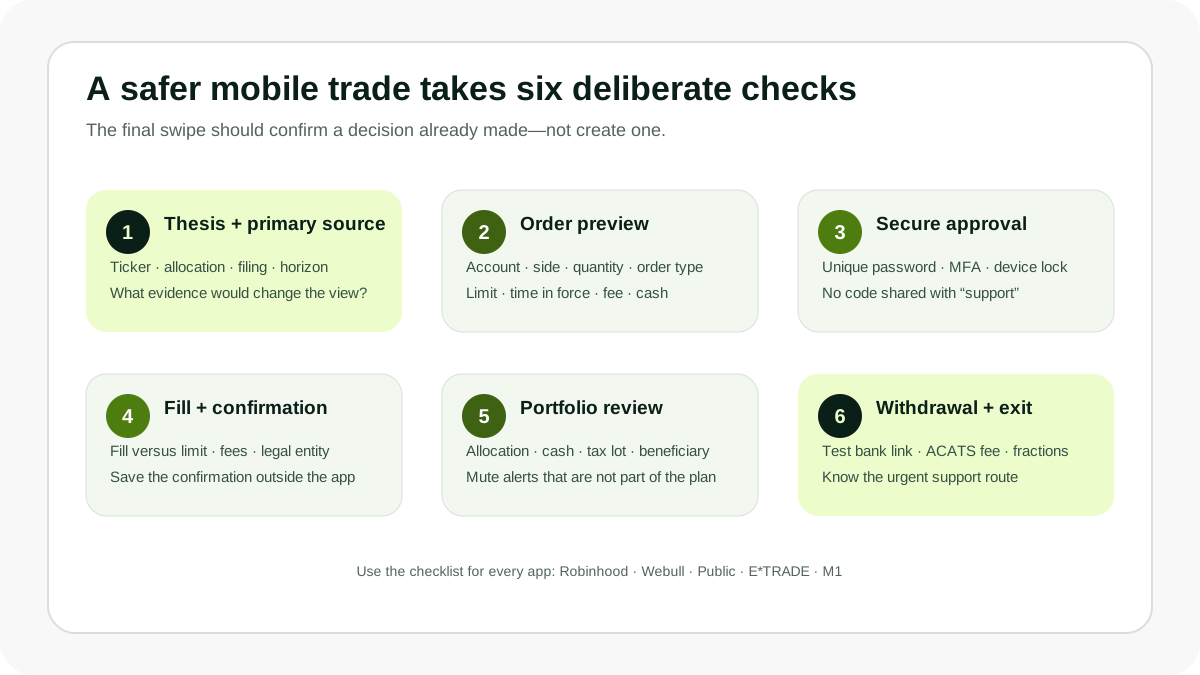
A good app supports a repeatable decision: verify the security and account, use the right order, inspect total cost, save the confirmation, monitor the portfolio, and preserve an exit path.
1. Robinhood — best overall mobile stock workflow
Robinhood wins because its app still has the lowest cognitive overhead for a basic stock or ETF portfolio while offering more account depth than its early reputation suggests. A standard self-directed brokerage account has no opening minimum. Eligible stocks and ETFs support fractional purchases from $1, recurring investments, and dividend reinvestment. Individual, joint, custodial, and retirement brokerage accounts are available subject to current eligibility.
Eligible U.S. stock and ETF trades have no commission, but regulatory, options, index, margin, subscription, transfer, and other charges can apply. The order preview must remain the source for the specific transaction. Robinhood receives payment for order flow on certain activity; the SEC explains that order routing is part of a broker's best-execution duty, so customers should judge confirmations and required disclosures rather than treating either “free” or “PFOF” as a complete execution conclusion.
For a beginner, the app makes dollar orders, recurring schedules, lists, news, earnings information, and basic charts easy to find. More experienced users can use limit and stop orders where supported and move to Robinhood Legend for customizable browser layouts, multiple widgets, deeper charts, lists, and direct order entry. Legend is a companion, not a reason to trade more.
Robinhood Gold costs $5 monthly or $50 annually under current terms and can add research, margin eligibility, cash and retirement benefits, and other features. A $50 subscription equals 5% of a $1,000 portfolio before any investment result. Price the exact benefit at the expected balance; do not subscribe because the app frames it as an upgrade.
Product boundaries are the main risk. Brokerage securities, crypto, futures, event contracts, cash, and managed Strategies accounts can appear in the same brand experience while different entities, protections, agreements, and tax forms apply. SIPC does not protect crypto. Read the entity named on every confirmation.
The exit is expensive: Robinhood currently lists a $100 outgoing ACATS fee, and fractional shares generally cannot transfer in kind. That cost prevents a perfect score. Robinhood ranks first for the mobile workflow, not because leaving is easy or every product belongs in one portfolio.
2. Webull — best advanced mobile trading app
Webull ranks second for users who need more charting and trading information on a phone. The app, web platform, and desktop system share advanced charts, technical indicators, screeners, news, alerts, Level II or other data subject to terms, options chains, extended-hours support, and paper trading. A position can therefore move between devices without abandoning the same broker.
The brokerage has a $0 deposit minimum, and eligible fractional U.S. stocks and ETFs can be purchased from $1 during regular market hours. Eligible U.S.-listed stock and ETF trades carry no commission. The detailed schedule adds possible costs for OTC securities, bonds, options exceptions, regulatory activity, market data, margin, wires, transfers, crypto, futures, and other products.
Webull is better than Robinhood for technical charting and active-order monitoring. That density is also its weakness. A small screen filled with indicators, movers, comments, promotions, and alerts can make activity feel like analysis. Technical indicators describe past price and volume; they do not establish a company's value or guarantee a future move.
Paper trading is useful for learning tickets and order types, but simulated fills omit important real-market conditions. A user should practice cancel/replace, partial-fill, stop-limit, and extended-hours behavior, then begin live with small, liquid orders. Extended hours can have wider spreads, lower liquidity, and more volatile prices.
Webull's published schedule says that beginning August 1, 2026, certain taxable brokerage accounts under $100 with no qualifying activity can incur a $5 quarterly inactivity fee, subject to detailed exemptions. This is especially relevant to someone installing the app, depositing a token amount, and forgetting it. Verify the current rule and account status.
Webull ranks behind Robinhood because the app's density makes a simple long-term plan less calm, and the expanding set of brokerage, futures, crypto, advisory, and event products requires more boundary checking. It ranks above Public for active mobile control and above E*TRADE for a more unified modern trading surface.
3. Public — best research-led trading app
Public ranks third because its interface places company and asset research beside the order workflow. Current products include stocks, ETFs, OTC securities, options, bonds, Treasuries, IRAs, Investment Plans, margin, Direct Indexing, cash features, and separate crypto access. Public's Alpha research surface can bring financials, earnings, analyst information, news, and AI-assisted exploration into one app.
The brokerage account has no stated opening minimum, and eligible fractional stock purchases start at $5. Regular-hours eligible U.S. stock and ETF orders have no commission. Non-Premium extended-hours stock and ETF trades and OTC trades generally cost $2.99 under the current fee schedule; options, index products, margin, bonds, crypto, Plans, Premium, routing choices, transfers, and specialized services follow separate terms.
AI is a research aid, not a primary source or personalized recommendation. It can omit a filing, misunderstand a one-time charge, use stale data, or express uncertainty poorly. Follow material claims to the issuer's SEC filing, earnings release, or official product document. Public's disclosures say its Plans are self-directed, even when a theme or automated allocation looks advice-like.
Public's multi-asset breadth is useful but increases legal complexity. Treasury purchases may involve a separate Jiko relationship; Direct Indexing is an advisory product; crypto uses separate custody and protection; options have approval and their own fee/rebate structure. A single login does not make every balance SIPC- or FDIC-protected.
Public ranks third for a user who wants to research before trading and will audit the sources. It falls behind Webull for advanced active controls and behind Robinhood for a minimal recurring-stock workflow. Its design is most valuable when the customer treats research as a reason to slow down, not as a stream of trade prompts.
4. E*TRADE — best mobile app family for account breadth
E*TRADE ranks fourth even though it is the broadest broker in this set. Its mobile experience spans the main E*TRADE app and Power E*TRADE, reflecting different long-term and active workflows. Customers can access taxable, joint, custodial, retirement, education, business, trust, managed, and other supported accounts, plus stocks, ETFs, eligible fractional purchases, mutual funds, options, bonds, CDs, futures, and portfolio services.
Standard self-directed brokerage accounts and eligible IRAs can open with $0, and direct fractional purchases of eligible Reg NMS stocks and ETFs now begin at $5. Eligible online U.S.-listed stock and ETF trades have no commission. Options contract, futures, OTC, fixed-income, broker-assisted, regulatory, and other fees apply according to the schedule.
The main app supports portfolio, watchlist, quote, research, order, deposit, bill-pay or banking-related, and document workflows. Power E*TRADE adds advanced charts, options analysis, paper trading, scanners, and more active tickets. The combination is powerful but creates a discovery cost: a user may need to learn which app contains a particular tool or account view.
E*TRADE is the strongest app family for a household that needs mutual funds, bonds, several registrations, research, and a path from simple investing to advanced tools. It ranks fourth specifically as a stock trading app because Robinhood and Webull provide more cohesive mobile-first workflows, while Public creates a more focused research narrative.
The surrounding institution and Morgan Stanley brand do not eliminate ordinary precautions. Verify cash treatment, beneficiaries, trusted contact, tax lots, order preview, and transfer rules. A broad product catalog can create choice overload and fees when the simplest portfolio needed only one low-cost fund.
5. M1 Finance — best scheduled portfolio app, not real-time trading
M1 ranks fifth because its app is designed around maintaining target allocations, not choosing an exact execution moment. Users build stock and ETF Pies, assign target percentages, automate transfers, and use Auto-Invest so new cash generally favors underweight slices. The result can reduce repetitive decisions for a long-term portfolio.
Initial deposit minimums currently vary: generally $100 for individual, joint, custodial, and crypto accounts, $500 for Traditional, Roth, and SEP IRAs, and $5,000 for trusts. M1 may charge a $3 monthly platform or IRA fee unless current $10,000 total-asset or active Personal Loan waiver conditions are satisfied. Other regulatory, ADR, transfer, closure, borrowing, and product fees remain possible.
Trades execute in scheduled windows, generally once or twice daily depending on account and eligibility. M1 explicitly calls itself a long-term platform, not a trading platform. A user cannot rely on the precise quote visible when an allocation change is submitted. Orders are aggregated and treated under the platform's execution process.
That design can be healthy for recurring long-term investing. It is unsuitable for day trading, exact limit control, rapid news response, or options—M1 does not currently offer options. A Pie also remains self-directed. Automation does not assess whether a 20-stock portfolio is diversified, tax-efficient, or appropriate.
M1 ranks fifth for the search phrase “stock trading app” but can rank first for a narrower question: “Which app will maintain my chosen stock-and-ETF target weights with minimal manual trading?” The user must accept windows, fee conditions, and responsibility for the portfolio.
Stock trading app comparison
App
Eligible fractional entry
Mobile identity
Best use
Critical limitation
Robinhood
$1
Clean mobile core plus free Legend web companion
Simple recurring stocks/ETFs with room for more tools
$100 outgoing ACATS and several product/entity boundaries
Webull
$1
Dense advanced mobile, web, and desktop ecosystem
Charts, active orders, screeners, paper practice
Complexity and possible upcoming small dormant-account fee
Public
$5
Research-led multi-asset app
Researching issuers and several asset types
AI and product integrations require source and entity checks
E*TRADE
$5 eligible direct fraction
Main app plus Power E*TRADE
Broad account and investment needs
More complex app family and specialized fees
M1
Account-specific initial minimum
Pie and target-allocation automation
Scheduled long-term portfolio maintenance
No real-time order timing or options; platform fee conditions
Use a pre-trade mobile checklist
Before touching the order button, write the thesis, target allocation, maximum position size, evidence that would invalidate the idea, and intended holding period. Then verify the security's legal name and ticker. Similar tickers and reverse splits can cause avoidable errors.
At preview, check account, buy or sell, dollar or share quantity, order type, limit or stop, time in force, estimated total, fee, and remaining cash. A stop order becomes a market order when triggered and can fill far from the stop in a gap. A stop-limit controls price but may not execute. Fractional orders can support fewer order types or hours.
Separate investing from notifications
Disable alerts that do not correspond to the written plan. A price move, analyst headline, social post, or “most active” list is not a thesis. Use calendar alerts for deposits, quarterly review, earnings, filings, and tax documents instead of minute-by-minute prompts.
If the app makes it difficult to wait, remove it from the home screen and use scheduled desktop reviews. Convenience should reduce administrative work, not shorten the investment horizon.
Mobile security is an operating process
Use a unique password, the strongest available multi-factor authentication, device lock, operating-system updates, and a carrier account PIN. Protect the email account used for password recovery. Never approve an unexpected login or move money in response to an inbound support message.
Brokerage support should not ask for a password or one-time authentication code. Navigate through the official app or typed domain rather than a search ad or message link. Save monthly statements and trade confirmations outside the phone so a lost device or locked account does not remove the record.
Judge research by provenance
For any revenue, margin, debt, share-count, or guidance claim, open the issuer filing or earnings release. Analyst ratings can be useful context but are opinions with methods, time horizons, and potential conflicts. App news can be duplicated, delayed, or stripped of context.
AI summaries require the same discipline. Ask which document and date support the answer, then read the source. Never let generated text calculate a tax lot, interpret an options agreement, or decide suitability without independent verification.
Measure execution and cash treatment
The SEC notes that online orders route through a broker and do not execute instantaneously. Record the quote, order type, limit, submission time, and fill for a sample of trades. Prefer liquid market hours when appropriate and understand the higher spread and volatility risks of extended sessions.
Check what happens to uninvested cash. Brokerage balances may use a bank sweep, a free-credit balance, a money market fund, or another program. Yield, access, FDIC eligibility, SIPC treatment, and program limits vary. A low cash yield can outweigh a small trading-fee difference on a large balance.
Plan the app exit before funding
Price a full and partial ACATS transfer. Determine whether fractions are sold, which products cannot transfer, whether crypto requires a separate path, and how open options or pending orders affect timing. Preserve cost basis and statements.
Test a small withdrawal and beneficiary workflow. Add a trusted contact where supported. An app deserves a lower ranking if the customer can trade in seconds but cannot understand how assets reach another broker or heir.
Frequently asked questions
Which stock trading app is easiest for a beginner?
Robinhood is the clearest low-entry app in this set, with eligible $1 fractional orders and recurring investments. Ease does not replace a written allocation, source verification, strong authentication, or attention to the $100 outgoing transfer fee.
Which app has the best charts?
Webull has the strongest advanced mobile charting and active-tool environment among these five. E*TRADE's Power app family provides deeper full-service analysis, and Robinhood Legend adds a capable free web companion. Charts do not predict returns.
Is M1 a trading app?
It is an investing app, but M1 explicitly operates as a long-term scheduled platform rather than a real-time trading system. It is appropriate for target-weight Pies and automation, not exact execution timing, day trading, or options.
Are fractional shares transferable?
Generally not through standard ACATS. Brokers often liquidate fractions or leave them behind, which can create taxes and delay. Confirm each broker's current process before transferring.
Does Face ID make a brokerage account fully secure?
No. Device biometrics help, but email compromise, SIM swapping, reused passwords, social engineering, malicious apps, and recovery-channel weaknesses remain. Use layered security and verify every unexpected contact through the official channel.
Our methodology
How we scored every product on this list
Weighted Mobile Workflow 25%, All-In Cost 20%, Research and Guardrails 20%, Account and Investment Fit 20%, and Security, Support, and Exit 15%. We reviewed documents but did not install apps, open accounts, authenticate, trade, contact support, or test outages.
This review cycle used official product documentation, published methodology, current plan terms, and regulatory sources. Any hands-on or support-response testing is stated explicitly when performed. Read our fullmethodologyfor the complete scoring rubric.
DollarScout uses a privacy-friendly, cookie-less analytics script (Ahrefs) to understand traffic in aggregate. We don't sell your personal information and don't run ad trackers. You can review our Privacy Policy or opt out of data sharing any time.