
M1 at a glance
M1 is a self-directed investing platform organized around Pies. Each Pie contains stocks, ETFs, or nested Pies with target percentages. Deposits can flow automatically toward underweight slices, recurring transfers can fund the account, and a manual rebalance can return the portfolio to its stated targets during the next trading window.
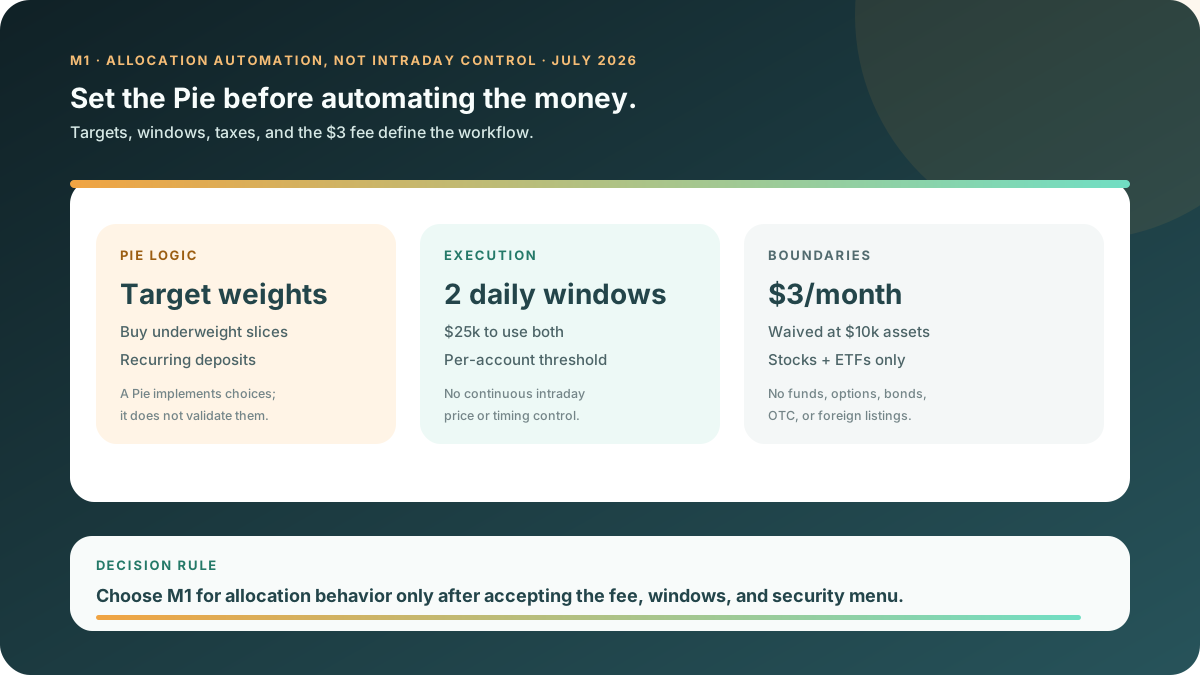
This is not a conventional order-by-order brokerage experience. M1 batches activity into morning and afternoon windows. An account below $25,000 in invested assets chooses one window for a given day; an account with at least $25,000 can be eligible for both. The design favors allocation discipline over exact intraday timing.
| Review question | DollarScout finding |
|---|---|
| Best for | Long-term DIY investors automating a stock and ETF target allocation |
| Initial minimum | $100 taxable/joint/custodial/crypto; $500 IRA; $5,000 trust |
| Monthly platform price | $3 unless waived by $10,000 total M1 assets or an active Personal Loan |
| Trading cadence | Scheduled morning and afternoon windows, with a $25,000 threshold to use both daily |
| Main limitation | No mutual funds, options, direct bonds, OTC, or unrestricted intraday execution |
Platform and IRA fees
Fees & Commissions scores 4.0/5. M1 does not charge a traditional trading commission for eligible stock and ETF transactions. However, clients can owe a $3 monthly Platform Fee or $3 monthly IRA Fee. M1 says the fee is automatically waived when the household maintains at least $10,000 in total M1 assets or has an active M1 Personal Loan. A customer will not be charged both fees in the same month.
The distinction matters for small accounts. A $3 monthly fee is $36 annually. On a $1,000 portfolio, that equals 3.6% before fund expenses, spreads, or market movement; on $5,000 it equals 0.72%. An account just above $10,000 can avoid the fee while eligible, but asset values can change. Do not maintain an unsuitable loan merely to obtain a $3 waiver.
M1 can sell investments when insufficient cash exists to collect the platform fee. Other charges can include regulatory fees, account closure, IRA termination, outgoing transfers, ADRs, directly registered holdings, wire or document services, and product-specific costs. Review the current fee schedule before transferring an existing portfolio.
M1 earns from securities lending, cash arrangements, borrowing, card and loan products, and other relationships. Commission-free trading is one economic component, not a statement that every platform incentive aligns perfectly with the investor.
Account minimums
The current initial deposit minimum is $100 for individual, joint, custodial, and crypto accounts. Traditional, Roth, and SEP IRAs require $500. Trust accounts require $5,000. After the first deposit, ordinary additional deposits can start at $10, while Auto-invest needs at least $25 above the selected cash threshold to trigger.
Cash-account minimums and linked-account requirements differ. An individual High-Yield Cash account requires an open individual brokerage relationship, while joint cash follows its own setup. Minimums are operational entry points, not suggested portfolio sizes.
An IRA customer should not select M1 solely because $500 is attainable. Compare investment eligibility, transfer treatment, monthly fee, beneficiary support, tax documents, and how an eventual rollover or distribution will work.
Pies and Dynamic Rebalancing
Ease of Use scores 4.4/5. Pies make target allocation visually explicit. A Pie can contain individual stocks, ETFs, and additional Pies as slices. When Auto-invest is enabled, new deposits generally flow toward underweight slices to move the portfolio closer to target weights. M1 calls this Dynamic Rebalancing.
Deposit-based balancing is tax-aware in one limited sense: buying underweight positions can reduce drift without selling appreciated holdings. It is not tax-loss harvesting and does not guarantee that the allocation returns exactly to target with every deposit. Withdrawals can sell overweight positions, and removing a slice can liquidate it in the next window and reinvest proceeds.
M1 says it never performs a full portfolio rebalance automatically without the customer’s instruction. A manual rebalance compares actual and target weights, sells overweight securities, and buys underweight ones. Those sales can create taxable gains, losses, wash-sale interactions, and short-term holding consequences.
The visual model is excellent for a written allocation. It becomes dangerous when a user keeps adding thematic Pies until the underlying holdings overlap or target percentages no longer describe a coherent strategy. Inspect every nested holding and weighted expense ratio.
Trade windows and execution control
All M1 Invest trades occur in scheduled windows. The morning window begins around 9:30 a.m. ET and the afternoon window around 3 p.m. ET. Accounts below $25,000 in invested assets choose either the morning or afternoon window for a day; eligible accounts with at least $25,000 can use both.
Orders submitted after a window begins roll into the next available window. M1 controls the timing and aggregation within the window. The customer does not receive the same continuous limit-order control as at Robinhood, Webull, E*TRADE, or a conventional broker.
For a long-term recurring ETF plan, that limitation can be acceptable. For a thin security, fast market, tax-lot sale, event-driven trade, or intraday strategy, it can be decisive. A scheduled window also means a Pie edit or deleted slice can execute later at an unknown market price.
The $25,000 threshold applies per account, not to combined M1 holdings. A customer with $40,000 across several smaller accounts might not qualify every account for both windows. Eligibility and market conditions can affect processing.
Investment selection
Investment Selection scores 3.7/5. M1 supports more than 6,000 U.S.-listed stocks and ETFs on major exchanges and a curated set of cryptocurrencies through a separate crypto account. The stock-and-ETF universe is adequate for many diversified portfolios.
M1 does not support mutual funds, options, direct bonds, Treasury securities, OTC securities, or foreign-exchange listings. Transfers also exclude many unsupported holdings: fractional shares, options, bonds, Treasuries, cryptocurrencies, and foreign securities generally cannot move in kind. Mutual funds may remain behind or be liquidated depending on registration and transfer process.
An ETF can provide bond or international exposure, but it does not reproduce an individual bond’s maturity or direct foreign-market access. Someone building a Treasury ladder, holding a specific mutual fund, trading options, or consolidating a complex legacy portfolio needs a broader broker.
Crypto operates in a separate M1 Crypto Account with its own Pie, custody relationship, trading rules, availability, fees, and protection. Crypto cannot sit inside a standard stock-and-ETF Pie. It is not SIPC insured.
Research and tools
Research & Tools scores 3.5/5. M1’s best tool is portfolio construction itself: target weights, nested Pies, performance views, recurring deposits, cash controls, and allocation-aware purchasing. Those tools are useful for implementing a plan.
Security research is more limited than E*TRADE, Webull, Morningstar, or a full-service broker. M1 provides stock and fund browsing, data, filters, and news, but it is not designed as a deep fundamental or technical terminal. There is no conventional options analysis, bond screener, mutual-fund center, or intraday execution suite because those products do not fit the platform.
That can be a virtue for an investor who researches elsewhere and wants execution automation. It is a weakness for someone expecting one provider to supply independent research, planning, and allocation decisions. A Pie is an implementation container, not an investment recommendation.
Borrow, cash, and product boundaries
Eligible taxable brokerage accounts can use an M1 Margin Loan when requirements are met. M1’s current overview describes borrowing against a portfolio once more than $2,000 is invested and a variable rate. Borrowing can amplify losses and trigger forced sales if collateral falls. The rate and available percentage can change.
High-Yield Cash, Personal Loans, card products, and other services have separate providers, eligibility, rates, and disclosures. The platform-fee waiver for an active Personal Loan should never be treated as a reason to borrow. Compare the annual interest cost with the $36 maximum annual platform charge.
Cash protection depends on whether funds are at participating banks or in brokerage cash. SIPC and FDIC solve different failure risks and neither protects a stock, ETF, or crypto position from losing value.
Customer service and records
Customer Service scores 3.8/5. M1 publishes a help center, in-app support, and contact paths for client issues. The documentation around Pies, trade windows, minimums, fees, and transfers is relatively detailed.
There is no traditional branch network or assigned financial adviser in the self-directed relationship. A transfer involving unsupported assets, an IRA distribution, trust paperwork, tax-lot correction, fraud issue, or forced liquidation can require careful escalation. DollarScout did not time support responses.
Export statements, confirmations, tax forms, cost basis, Pie targets, and transfer records. A platform built around automation should still have a manual record of what the investor intended and what actually executed.
M1 versus alternatives
Choose Robinhood for unrestricted market-hours self-directed orders, $1 fractional access, options, and a simpler mobile workflow. Choose Webull for charts, paper trading, alerts, options, and active execution across mobile and desktop.
Choose E*TRADE for mutual funds, direct bonds, futures, broad research, and full-service retirement choices. Choose Public for bonds, Treasuries, options, direct indexing, and multi-asset research. M1 is the better fit when target allocation and automatic deposit routing matter more than product breadth or execution timing.
Who M1 is best for
M1 fits customers who:
- Have a written long-term stock and ETF allocation.
- Want recurring deposits to target underweight holdings automatically.
- Do not need intraday price or order timing control.
- Can maintain the $10,000 fee waiver or justify $3 monthly.
- Understand that manual rebalancing can create taxes.
It is weaker for traders, mutual-fund investors, direct-bond buyers, options users, branch-service customers, or anyone transferring a portfolio full of unsupported assets.
Bottom line
M1 earns 3.9/5. Its Pies and Dynamic Rebalancing are genuinely differentiated and can make a long-term allocation easier to maintain. Ease scores well when the customer’s needs match the platform.
Fees for smaller accounts, scheduled execution, a narrower investment menu, and limited research reduce the rating. M1 should be chosen because its allocation model is the desired behavior—not because “commission-free” sounds universal. Map the Pie, model the $3 fee, review the trade window, and audit every transferred security before funding.