Many products on this page are from partners who compensate us. This doesn't influence our ratings. Our opinions are our own.
Coinbase vs Kraken: 2026 Crypto Exchange Comparison
By Sophie Brown, Senior Finance Editor · Updated Jul 2026 · Fact-checked Jul 19, 2026
Kraken wins overall, 4.4/5 to Coinbase's 4.3/5, through stronger published security controls, recurring proof-of-reserves reporting, transparent Kraken Pro entry pricing, and higher-rated support. Coinbase wins Ease of Use and remains the better first on-ramp for many U.S. buyers. Asset Selection is a tie because the 0.1-point difference is not decision-grade. Select the interface before comparing costs: simple purchase and Pro or Advanced trading have different economics.
Head-to-head
| Feature | Coinbase | Kraken |
|---|---|---|
| DollarScout Rating | 4.3/5 ★ | 4.4/5 ★ |
| Trading Fees | Simple orders disclose a fee and spread in the quote; Advanced uses maker/taker tiers based on trailing 30-day volume, with the complete current table shown after sign-in | Kraken Pro spot starts at 0.40% maker and 0.80% taker at the public entry tier; the next $2,500+ qualifying tier is 0.30%/0.60%, with lower rates at higher tiers |
| Asset Selection | Broad exchange selection that varies by product, jurisdiction, trading pair, and supported blockchain network; verify the live Tradable asset list | Extensive spot asset and network list, updated July 1, 2026; availability and deposit or withdrawal networks vary by country |
| Custody | Coinbase exchange is custodial; Base app and legacy Coinbase Wallet are separate self-custody products where the user controls recovery credentials | Custodial exchange with FIDO2/passkey controls, Global Settings Lock, withdrawal confirmations, security certifications, and recurring proof-of-reserves snapshots |


Category-by-category breakdown
Trading Fees
Ease of Use
Asset Selection
Security
Customer Service
Detailed analysis
The short answer
Choose Coinbase for the smoother first-purchase workflow; choose Kraken for stronger security tooling and a more transparent Pro trading path. DollarScout rates Kraken 4.4/5 overall and Coinbase 4.3/5. Kraken wins Trading Fees, Security, and Customer Service. Coinbase wins Ease of Use. Asset Selection is a tie.
| Decision factor | Coinbase | Kraken |
|---|---|---|
| Best fit | First-time U.S. buyer | Security-conscious or active user |
| Simple purchase | Fee and spread in preview | 1% instant/recurring or 1.5% custom-order fee, plus spread; payment fees can apply |
| Advanced entry tier | Complete maker/taker table after sign-in | 0.40% maker and 0.80% taker at Tier 1 |
| Advanced interface | Coinbase Advanced | Kraken Pro and Kraken Desktop |
| Security distinction | Mature 2FA and account controls | Passkeys, Global Settings Lock, withdrawal confirmations, proof of reserves |
| Asset breadth | Broad; product and network eligibility varies | Broad; jurisdiction and supported network vary |
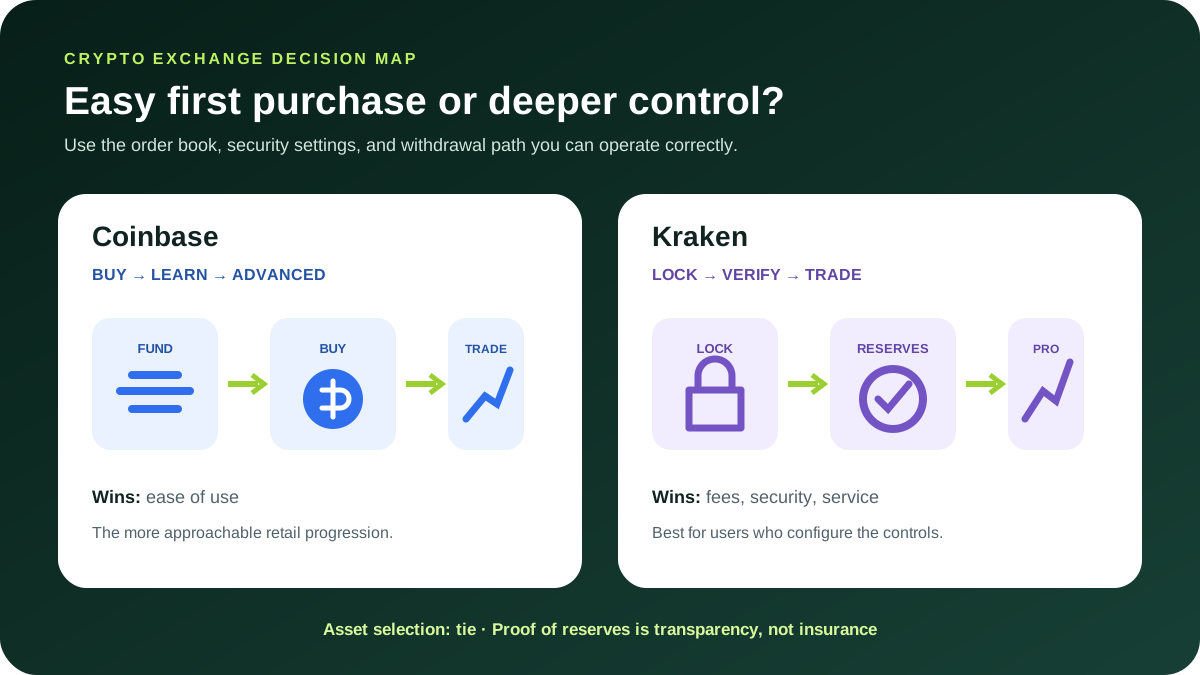
Compare four interfaces, not two logos
Coinbase's retail buy flow and Coinbase Advanced serve different jobs. A simple purchase emphasizes speed and a quoted delivered amount. Advanced exposes an order book, maker/taker treatment, limit orders, charts, and volume-based tiers. Coinbase Wallet and the newer Base app are separate self-custody experiences; assets there do not share exchange recovery or custody.
Kraken similarly separates Instant Buy/Sell from Kraken Pro. Instant and recurring purchases currently have a 1% trading fee, custom orders a 1.5% fee, plus a variable spread and possible payment charges. Kraken Pro applies its public maker/taker table. Kraken+ can waive certain instant trading fees within its limits, but spreads and card processing charges remain and the benefit does not apply to Kraken Pro spot, futures, API, or OTC trades.
The cost comparison must therefore be Coinbase simple versus Kraken instant, or Coinbase Advanced versus Kraken Pro. Mixing the convenient interface on one platform with the order book on the other predetermines the result.
Trading fees: Kraken wins
Kraken Pro publishes a Tier 1 spot rate of 0.40% maker and 0.80% taker. The next qualifying tier begins at $2,500 of spot volume and lists 0.30% maker and 0.60% taker. Kraken now determines a cross-platform tier from the most favorable eligible measure among spot volume, futures volume, and assets on platform; Instant Buy does not build the same 30-day volume incentive.
At the entry tier, a fully executed $1,000 Kraken Pro taker order has an $8 trading fee, while a maker execution has a $4 fee, before funding or withdrawal charges. That arithmetic is transparent, but it does not guarantee a better total fill. The spread and order-book depth still matter.
Coinbase Advanced also uses maker/taker tiers based on trailing 30-day volume, recalculated hourly. Its public help documentation explains the method but requires sign-in to see the complete current fee structure. Coinbase simple orders include a disclosed fee and spread in the quote. Without the signed-in table and transaction preview, a precise universal cost claim would be false.
Trading-fees winner: Kraken, 3.6 to 3.4. The advantage is modest and driven partly by public price transparency. Compare the live fee, spread, funding method, and network withdrawal charge for the intended order.
Ease of use: Coinbase wins
Coinbase provides the cleaner transition from identity verification and bank linking to a first purchase. Common tasks are surfaced in a retail vocabulary, and a customer can later enter Advanced from the same account. Its help center has focused guidance for tradability, networks, cash treatment, two-step verification, and unsupported deposits.
Kraken's app can also support a straightforward buy, but the ecosystem exposes more decisions: Instant versus Pro, web versus desktop, optional Kraken+, cross-platform fee tiers, asset-specific networks, and jurisdiction-dependent products. Those choices are valuable for a deliberate user and extra cognitive load for a beginner.
Ease-of-use winner: Coinbase, 4.8 to 4.2. A cleaner interface does not justify skipping fee previews or withdrawal tests.
Asset selection: a tie
Kraken scores 4.7 and Coinbase 4.6 for Asset Selection. Under DollarScout's comparison rule, a difference below 0.15 points is a tie rather than a manufactured winner. Both maintain broad catalogs, and both apply asset, pair, jurisdiction, product, and network restrictions.
The meaningful question is not “How many coins?” It is whether the desired asset can be bought with the intended quote currency, through the intended order type, and withdrawn on the exact blockchain network the customer needs. A supported ticker does not imply every wrapped version, token contract, or network is supported.
Check each exchange's live asset and network page on the day of deposit. When moving crypto, confirm the destination address, memo or tag, minimum, fee, and maintenance status. Unsupported deposits can be difficult or impossible to recover.
Security: Kraken wins
Coinbase earns a strong 4.6/5. It supports multiple two-step verification methods, publishes extensive account-security and network guidance, and operates with public-company reporting. Customers should prefer phishing-resistant security keys over SMS where available and protect the associated email account with equal care.
Kraken earns 4.8/5 for a particularly deep set of customer-facing controls. Its security page documents FIDO2-compatible passkeys, no phone/SMS account recovery, granular API-key permissions, email confirmation for new withdrawal addresses, PGP-signed email, configurable session timeout, and a Global Settings Lock that can delay sensitive account changes.
Kraken also publishes recurring proof-of-reserves reviews. The March 31, 2026 snapshot reports reserve ratios above 100% for listed in-scope assets and lets eligible customers verify balance inclusion. That is useful transparency. It does not prove every liability, asset quality, corporate obligation, or condition after the snapshot, and Kraken itself states there are no formally accepted universal proof-of-reserves procedures.
Configure security before depositing
A feature that remains disabled provides no protection. Create a unique password, secure the email account, enroll a hardware-backed passkey or security key, and store recovery material offline. At Kraken, consider a Master Key and Global Settings Lock after understanding their recovery implications. At Coinbase, review the strongest available two-step method and withdrawal settings.
Use address allowlisting or saved-address controls where supported, then make a small withdrawal test. Restrict API keys to the minimum permissions and IP ranges required; a trading bot generally does not need withdrawal permission. Never install remote-access software or share a verification code with someone claiming to be support.
Custody, cash, and insurance
Exchange balances are custodial. Coinbase and Kraken control the private keys for assets held in the standard exchange account, while customers hold contractual entitlements. Custody reduces the chance that a customer loses a seed phrase but adds dependency on the operator's controls, solvency, availability, and legal process.
Coinbase states that eligible U.S. dollar cash can be held in pooled FDIC- or NCUSIF-insured accounts or certain liquid investments. Pass-through treatment is conditional, Coinbase is not a bank, and digital assets are not insured deposits. Kraken's terms and product availability depend on the customer's legal entity and jurisdiction. Do not assume a cash protection statement covers crypto, staking, futures, margin collateral, or a self-custody wallet.
If long-term self-custody is appropriate, learn it with a small amount first. Verify backups and inheritance access before moving a material balance. Self-custody eliminates exchange counterparty custody but replaces it with irreversible key-management and transaction-signing risk.
Trading tools: Kraken has the deeper specialist surface
Coinbase Advanced supplies the tools many retail spot traders need: order books, limit and stop controls, TradingView-powered charts, and APIs. It is a meaningful step beyond the simple purchase flow without forcing a new account.
Kraken Pro, Kraken Desktop, and its APIs create a broader specialist environment across spot and eligible derivatives or margin products. Eligibility varies, especially for U.S. margin. More leverage and more instruments are not automatically an advantage. They are beneficial only when the user has a documented risk limit, liquidation plan, and reason to use them.
Low maker/taker rates do not compensate for overtrading. Measure implementation shortfall: the fee, bid-ask spread, slippage, funding cost, and movement between the decision price and fill.
Funding and withdrawal workflow
Before depositing, compare ACH, wire, debit-card, and existing-balance options. Payment fees, settlement holds, daily limits, bank rejections, and withdrawal availability can dominate a small transaction. Keep enough cash outside the exchange to avoid selling solely because a bank transfer is delayed.
For an on-chain withdrawal, confirm the asset and network at both ends. Copy the address from the receiving wallet, verify it on the hardware display if applicable, include any required memo, and send a test. Malware can replace clipboard addresses; visual verification matters.
Network fees change with congestion and asset-specific policies. A Pro trading advantage can disappear if the intended withdrawal route has a high minimum or fee.
Staking, rewards, and margin are separate decisions
Both providers may offer staking for eligible assets and jurisdictions. Reward rates can change, commissions reduce the gross protocol reward, and unstaking can involve delays or market exposure. Staked assets are not a savings account.
Kraken's fee page documents product-specific staking commissions, while Coinbase supplies asset-specific disclosures inside its staking experience. Compare net estimated reward, lock or bonding period, slashing allocation, liquidity, tax treatment, and who controls the validator relationship.
Margin and derivatives add liquidation and financing risk. Kraken's U.S. margin eligibility is restricted, and Coinbase product availability also depends on jurisdiction and legal entity. Never infer eligibility from a marketing page displayed in another country.
Customer service: Kraken wins
Kraken scores 4.3 to Coinbase's 3.8. Kraken publishes 24/7 live chat and email support for urgent concerns on its security page, while Coinbase maintains support and account-recovery channels within a larger retail operation. The category score reflects documented access, security escalation, and help quality—not a guarantee that every case will be fast.
Test support before a major transfer. Ask about the exact network, withdrawal hold, recovery process, or business-account requirement. Bookmark official support pages and initiate contact from the authenticated app. Search ads, unsolicited calls, and direct messages are common impersonation routes.
Taxes and transaction history
U.S. tax obligations can arise from sales, exchanges, spending, staking rewards, and other transactions. A transfer between wallets controlled by the same taxpayer is not the same as a sale, but the transfer fee and missing basis history still require records.
Export fills, deposits, withdrawals, fees, and rewards regularly from either platform. Keep transaction hashes and reconcile transfers between accounts so software does not mistake them for disposals. The exchange may not know the original basis of crypto deposited from elsewhere. Consult IRS digital-assets guidance and a qualified tax professional for personal advice.
Who should choose Coinbase?
Choose Coinbase for a first U.S. crypto purchase, recurring purchases in a familiar retail flow, or a broad asset catalog with a clear route into Advanced trading. It can also fit a user who values public-company disclosures and extensive help documentation.
Coinbase is less suitable when the sign-in-only Advanced fee table prevents adequate pre-account cost comparison or when Kraken's security controls and proof-of-reserves verification are decisive. Always compare the Advanced ticket before accepting simple-buy pricing.
Who should choose Kraken?
Choose Kraken when the customer will configure passkeys, Global Settings Lock, withdrawal controls, and granular APIs; wants public Pro fee tiers; or values recurring proof-of-reserves reporting. It is the stronger fit for a security-conscious active spot user.
Kraken is less suitable when product complexity creates mistakes or when the desired service is unavailable in the customer's jurisdiction. An occasional buyer should compare Kraken's instant fee and spread with Kraken Pro rather than assuming the same economics.
Final verdict
Kraken wins narrowly because its security controls, proof-of-reserves program, public Pro pricing, and support score outweigh Coinbase's ease advantage. Coinbase remains the more approachable first on-ramp, and Asset Selection is a tie. Decide from the exact transaction path and security practices the customer will actually use.
Which one is right for you?
- Best for First-time U.S. crypto purchases: CoinbaseOpen Coinbase
- Best for Simple path from retail buy to advanced spot orders: CoinbaseOpen Coinbase
- Best for Security controls and proof-of-reserves verification: KrakenOpen Kraken
- Best for Active spot trading with public fee tiers: KrakenOpen Kraken
Final verdict
Kraken wins 4.4/5 to 4.3/5 for deeper security controls, proof-of-reserves transparency, public Pro pricing, and stronger-rated support. Coinbase wins Ease of Use and remains the better first on-ramp for many U.S. buyers. Asset Selection is a tie. Compare the correct interfaces and exact withdrawal network before funding.
Frequently asked questions
Sources and verification
Scores and product facts come from the underlying DollarScout reviews and were checked against these primary sources.
- Coinbase Advanced fee methodology
- Coinbase asset and tradability guidance
- Coinbase treatment of U.S. customer cash
- Coinbase two-step verification
- Coinbase unsupported-deposit recovery limits
- Coinbase U.S. user agreement
- Kraken current fee schedule
- Kraken maker and taker fee definitions
- Kraken fees by product
- Kraken supported assets and networks
- Kraken security controls
- Kraken proof of reserves
- Kraken margin eligibility
- Kraken legal disclosures
- IRS digital-assets guidance
Related content
More from DollarScout on this topic.
