Many products on this page are from partners who compensate us. This doesn't influence our ratings. Our opinions are our own.
Kraken vs Binance.US: 2026 Crypto Exchange Comparison
By Sophie Brown, Senior Finance Editor · Updated Jul 2026 · Fact-checked Jul 19, 2026
Kraken wins overall, 4.4/5 to Binance.US's 4.3/5, because stronger security controls, recurring proof-of-reserves reporting, better-rated support, and broader geographic usability outweigh Binance.US's exceptional spot fee advantage. Binance.US wins Trading Fees with 0% maker and 0.01% taker pricing on Tier 0 Advanced pairs. Asset Selection is a tie. Check state eligibility first: Binance.US currently excludes multiple jurisdictions and limits Kansas and Wisconsin to crypto-only service.
Head-to-head
| Feature | Kraken | Binance.US |
|---|---|---|
| DollarScout Rating | 4.4/5 ★ | 4.3/5 ★ |
| Trading Fees | Kraken Pro spot starts at 0.40% maker and 0.80% taker at the public entry tier; the next $2,500+ qualifying tier is 0.30%/0.60%, with lower rates at higher tiers | Advanced Tier 0 pairs: 0% maker/0.01% taker; Tier 1 pairs: 0% maker/0.02% taker, before the optional 5% BNB fee discount |
| Asset Selection | Extensive spot asset and network list, updated July 1, 2026; availability and deposit or withdrawal networks vary by country | 190+ supported cryptocurrencies advertised; 16 listed jurisdictions unsupported and Kansas plus Wisconsin crypto-only as of June 3, 2026 |
| Custody | Custodial exchange with FIDO2/passkey controls, Global Settings Lock, withdrawal confirmations, security certifications, and recurring proof-of-reserves snapshots | Custodial U.S. exchange using omnibus hot and cold wallets; crypto and fiat balances are not FDIC- or SIPC-insured under the current terms |


Category-by-category breakdown
Trading Fees
Ease of Use
Asset Selection
Security
Customer Service
Detailed analysis
The short answer
Choose Kraken for the stronger all-around security and support profile; choose Binance.US when eligible Advanced spot pairs and minimum trading cost dominate the decision. DollarScout rates Kraken 4.4/5 overall and Binance.US 4.3/5. Binance.US wins Trading Fees. Kraken wins Ease of Use, Security, and Customer Service. Asset Selection is a tie.
| Decision factor | Kraken | Binance.US |
|---|---|---|
| Best fit | Security-conscious active user | Fee-sensitive eligible U.S. spot trader |
| Advanced entry pricing | 0.40% maker and 0.80% taker | Tier 0: 0% maker and 0.01% taker |
| Simple purchase | Fee plus spread and possible payment cost | Fee and spread shown in preview; method varies |
| Security distinction | Passkeys, Global Settings Lock, proof of reserves | 2FA, cold/hot-wallet controls, trust program |
| Geographic constraint | Product eligibility varies by jurisdiction | Multiple unsupported states; two crypto-only states |
| Asset breadth | Broad catalog with network limits | Broad U.S. catalog with network and state limits |
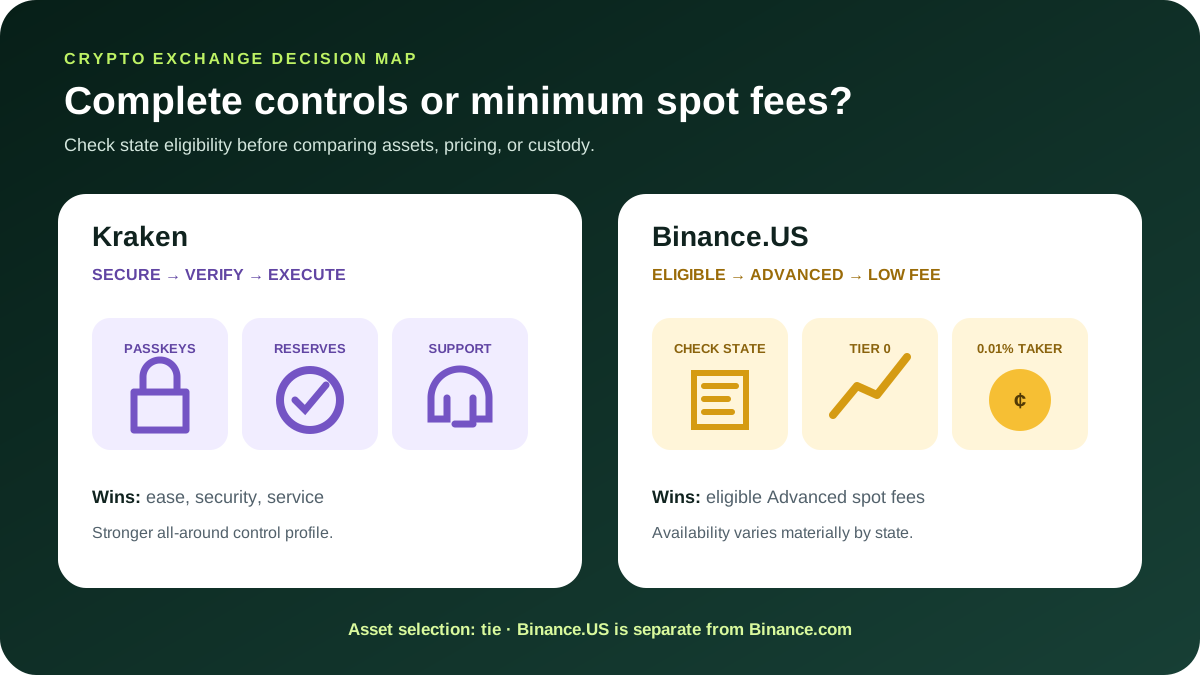
Eligibility can settle the comparison immediately
Binance.US's June 3, 2026 availability page lists 16 unsupported states and U.S. territories, including New York, Texas, Washington, Ohio, and Georgia. Kansas and Wisconsin are listed as crypto-only, meaning customers there cannot use USD services even though other crypto functions may remain available. The list can change, so a current residential-address check must precede every fee comparison.
Kraken also applies jurisdiction and product restrictions. Margin, derivatives, staking, and even individual assets can have different eligibility from ordinary spot trading. A customer who sees a feature on the global website should not assume it is available through the legal entity serving that address.
If one platform cannot legally onboard the customer or provide the needed fiat route, its nominal fee is irrelevant. Do not use a false address, VPN, or another person's identity to bypass restrictions; that can violate the terms and create account-freeze and withdrawal problems.
Trading fees: Binance.US wins by a wide margin
Binance.US currently advertises 0% maker and 0.01% taker fees on Tier 0 Advanced spot pairs, without a subscription or minimum trading-volume requirement. A fully executed $1,000 Tier 0 taker order therefore has a stated $0.10 trading fee before any withdrawal, funding, or other charge. Eligible Advanced fees can receive a 5% BNB payment discount, but holding another volatile asset solely for a small discount creates its own price and operational risk.
Kraken Pro publishes 0.40% maker and 0.80% taker at Tier 1, with the next volume tier at $2,500 listing 0.30% and 0.60%. On a $1,000 entry-tier taker order, the stated trading fee is $8. Kraken's cross-platform tier can use qualifying spot volume, futures volume, or assets on platform, but Instant Buy does not build the same Pro volume incentive.
The interfaces matter. Binance.US One Click Buy and Convert can include a spread and use preview pricing; funding and crypto withdrawals can add charges. Kraken Instant and recurring transactions currently have a 1% trading fee, custom orders a 1.5% fee, a variable spread, and possible payment fees. Neither convenient purchase flow shares the order-book economics above.
Trading-fees winner: Binance.US, 4.9 to 3.6. The result is clear for eligible Tier 0 Advanced trading, but total cost still includes spread, slippage, funding, withdrawal, and the cost of holding assets on an exchange.
Ease of use: Kraken wins narrowly
Kraken scores 4.2 and Binance.US 4.0. Kraken's product family is complex, yet the distinction between Kraken and Kraken Pro is well documented, and its support library explains fees, networks, security, margin eligibility, and proof of reserves in depth.
Binance.US offers a capable retail and Advanced interface, but state restrictions, crypto-only modes, separate One Click Buy economics, fee tiers, BNB discounts, staking commissions, and the necessary distinction from Binance.com add friction. A user can understand the trading ticket and still misunderstand which entity or service is available.
The better interface is the one that prevents an irreversible mistake. Before funding, a customer should be able to identify the legal entity, deposit hold, supported network, withdrawal address controls, and support path without relying on a search ad or social-media response.
Asset selection: a tie
Kraken scores 4.7 and Binance.US 4.6, a 0.1-point difference that DollarScout records as a tie. Both list a broad set of crypto assets and trading pairs. Neither supports every asset on every network, and listings can be paused, delisted, or restricted by region.
Raw asset count is a weak measure. A usable listing requires the desired quote currency, adequate liquidity, the correct blockchain network, enabled deposits and withdrawals, and a permitted customer location. A token ticker can represent different contracts or networks; sending to an unsupported implementation can cause permanent loss.
Check the live market and network pages immediately before a transfer. Confirm minimums, confirmations, memos or tags, and maintenance notices. Make a small test deposit or withdrawal even when an address has worked before.
Security: Kraken wins
Kraken earns 4.8/5 for a deep, public set of customer controls: FIDO2-compatible passkeys, no phone/SMS account recovery, email confirmation for new withdrawal addresses, granular API permissions, PGP-signed email, configurable session timeout, and Global Settings Lock. The lock can delay sensitive account changes and is particularly useful when a customer understands its recovery process.
Kraken also publishes recurring proof-of-reserves reviews. Its March 31, 2026 snapshot showed above-100% reserve ratios for the listed in-scope assets and offers customer balance-inclusion verification. The review is valuable but limited to scope and time; it is not deposit insurance or a guarantee of future solvency.
Binance.US earns 4.2/5. Its Trust materials describe identity controls, 2FA, organizational security, and custody using omnibus hot and cold wallets. Its terms explicitly state that crypto and fiat balances are not FDIC- or SIPC-insured. The platform's licensing and compliance materials provide useful legal context but do not substitute for a customer-verifiable reserve program equivalent to Kraken's current presentation.
An account-security checklist for either platform
Secure a dedicated email address with a unique password and phishing-resistant multi-factor authentication. Configure the strongest exchange login method available. Save recovery material offline and do not store it in the same cloud account as the password.
Restrict withdrawals to verified addresses where possible. At Kraken, consider the Global Settings Lock and a Master Key. On either platform, assign API keys only the permissions a bot requires; avoid withdrawal permission and restrict source IPs. Review active sessions and revoke old devices.
Treat unsolicited calls, messages, and search-engine support ads as hostile. A legitimate support agent does not need a seed phrase, remote-control session, or one-time authentication code. If the account may be compromised, navigate through the saved official app or URL rather than a link supplied in the message.
USD funding and withdrawal holds
Binance.US restored eligible USD deposit and withdrawal services in 2025, but access still depends on the customer's state and account. Its documentation explains ACH-related withdrawal holds and shows fees or limits in the applicable preview. Kansas and Wisconsin remain crypto-only under the current availability page.
Kraken provides several funding methods whose fees, settlement times, and availability depend on currency, bank partner, country, and verification level. Card, digital-wallet, ACH, and wire routes should not be treated as equivalent. A “free deposit” can still have a withdrawal hold or bank-side cost.
Test the complete cash cycle before relying on an exchange for liquidity: deposit a small amount, wait for settlement, place a small order through the intended interface, and withdraw both dollars and crypto if those are required workflows.
Custody and proof of reserves
Standard exchange accounts are custodial. The operator controls the wallet infrastructure while the customer sees an account balance. This enables trading and managed recovery but introduces dependency on internal records, security, legal process, and operational availability.
Proof of reserves can demonstrate that selected on-chain assets meet or exceed in-scope customer liabilities at a snapshot and can let a customer verify inclusion. It may not reveal every corporate liability, pledged asset, off-chain claim, token quality, or event after the snapshot. Read the accountant's scope and methodology, not just the reserve ratio.
Self-custody eliminates exchange custody for assets withdrawn but replaces it with key-management risk. Learn recovery, backups, transaction simulation, and inheritance access with a small balance before transferring significant value.
Advanced trading and execution quality
Binance.US's fee advantage is most relevant to frequent spot traders, but an extremely low fee does not guarantee low execution cost. Compare the bid-ask spread, displayed depth, order size, fill probability, and slippage. A poorly priced market order can lose far more than it saves in commission.
Kraken Pro offers order books, charting, APIs, and eligible margin or derivatives products. Binance.US Advanced provides order types and APIs for its U.S. market. More products and leverage should count as advantages only for customers who understand liquidation, financing, and operational risks.
Use limit orders deliberately. A limit order that crosses the spread and fills immediately is a taker order. Record the decision price, fill price, fee, and transfer cost so the comparison uses actual implementation rather than marketing rates.
Staking economics are not spot-trading economics
Both exchanges may offer staking for eligible assets. The gross network reward is not the customer return. Service commissions, validator performance, bonding or unbonding periods, slashing treatment, liquidity, asset-price movement, and taxes all matter.
Binance.US's fee page publishes service-fee ranges for staking and notes that the deduction is reflected in the estimated rewards rate. Kraken also documents product-specific staking commissions. Those terms can change by asset, so the live staking detail page and risk disclosure should be reviewed immediately before enrollment.
Do not move a portfolio to an exchange solely for an advertised annual percentage reward. First decide whether exchange custody and staking risk fit the portfolio; then compare the net reward.
Customer service: Kraken wins
Kraken scores 4.3 to Binance.US's 3.7. Kraken publishes 24/7 live chat and email support for urgent security concerns and maintains detailed task-based documentation. Binance.US provides a help center and support routes, but account eligibility and historic service changes create more cases where the customer may need precise assistance.
Test the route before transferring significant assets. Ask a concrete question about state eligibility, a withdrawal network, bank hold, or account recovery. Save the ticket. Bookmark official status and support pages, because exchange outages and impersonation scams often occur when markets are volatile.
Regulatory and legal-entity due diligence
Binance.US is operated by BAM Trading Services, not the global Binance.com exchange. Its Terms of Use, state license page, and supported-region list are the controlling starting points for a U.S. customer's service. A feature advertised globally may not exist on Binance.US.
Kraken likewise operates through jurisdiction-specific entities and disclosures. Margin and other products have explicit eligibility rules. “Registered” or “licensed” describes a legal status and set of obligations; it does not insure crypto value, guarantee liquidity, or approve every listed token.
Download current terms and statements when opening an account. Record which entity contracts with the customer and how complaints, arbitration, insolvency, and asset treatment are addressed.
Taxes and record portability
Crypto sales, exchanges, rewards, and spending can create U.S. tax consequences. Transfers between the same taxpayer's wallets require reconciliation so reporting software does not misclassify them. Exchange exports may lack the original cost basis of assets deposited from another platform.
Export fills, deposits, withdrawals, fees, staking rewards, and monthly statements on a schedule. Preserve transaction hashes and map each transfer to its destination. Complete the export before closing or losing access to an account. Consult current IRS digital-assets guidance and a qualified tax professional for the customer's circumstances.
Who should choose Kraken?
Choose Kraken when security controls, customer-verifiable proof-of-reserves reporting, published support access, and a capable Pro interface matter more than the absolute lowest spot commission. It is also the practical choice when Binance.US does not support the customer's state or USD workflow.
Kraken is less compelling for a fee-minimizing eligible trader who can use a liquid Binance.US Tier 0 pair safely. Avoid Kraken Instant pricing when the customer intends to trade through Kraken Pro and understands the order book.
Who should choose Binance.US?
Choose Binance.US when the customer resides in a fully supported jurisdiction, the desired asset and network are available, and Tier 0 Advanced spot fees materially benefit a disciplined trading strategy. The 0% maker and 0.01% taker schedule is difficult to beat on stated commission.
Binance.US is less suitable when state restrictions, crypto-only status, custody preferences, or support needs create friction. Confirm that the account is on Binance.US—not Binance.com—and examine the entire deposit-to-withdrawal path.
Final verdict
Kraken wins narrowly as the more complete exchange for security-conscious U.S. users. Binance.US is the decisive fee winner for eligible Advanced spot trading, and Asset Selection is a tie. Eligibility comes first; security configuration and total execution cost come next.
Which one is right for you?
- Best for Security controls and proof-of-reserves verification: KrakenOpen Kraken
- Best for Broader practical U.S. availability and support: KrakenOpen Kraken
- Best for Lowest stated fees on eligible Advanced spot pairs: Binance.USOpen Binance.US
- Best for High-frequency spot trading in a supported state: Binance.USOpen Binance.US
Final verdict
Kraken wins 4.4/5 to 4.3/5 for stronger security controls, recurring proof-of-reserves reporting, broader practical availability, and better-rated support. Binance.US is the clear fee winner for eligible Tier 0 Advanced spot pairs. Asset Selection is a tie. Confirm state eligibility and the entire funding-to-withdrawal workflow before opening an account.
Frequently asked questions
Sources and verification
Scores and product facts come from the underlying DollarScout reviews and were checked against these primary sources.
- Kraken current fee schedule
- Kraken maker and taker fee definitions
- Kraken fees by product
- Kraken supported assets and networks
- Kraken security controls
- Kraken proof of reserves
- Kraken margin eligibility
- Binance.US current fee schedule
- Binance.US explanation of trading fees
- Binance.US supported and unsupported jurisdictions
- Binance.US USD services guide
- Binance.US supported networks and pairs
- Binance.US terms and custody disclosures
- Binance.US licenses and insurance warning
- IRS digital-assets guidance
Related content
More from DollarScout on this topic.
