Many products on this page are from partners who compensate us. This doesn't influence our ratings. Our opinions are our own.
Coinbase vs Gemini: 2026 Crypto Exchange Comparison
By Sophie Brown, Senior Finance Editor · Updated Jul 2026 · Fact-checked Jul 19, 2026
Coinbase wins overall, 4.3/5 to Gemini's 3.9/5, because it combines a simpler retail on-ramp, broader asset coverage, and a stronger value score. Gemini remains a credible security-focused alternative for customers who specifically value its New York trust-company structure, institutional custody, required two-factor authentication, and public audit framework. Security is a tie and Customer Service is a tie. Compare the exact order interface, jurisdiction, supported network, and custody plan—not only the brand name.
Head-to-head
| Feature | Coinbase | Gemini |
|---|---|---|
| DollarScout Rating | 4.3/5 ★ | 3.9/5 ★ |
| Trading Fees | Simple orders disclose a fee and spread in the quote; Advanced uses maker/taker tiers based on trailing 30-day volume, with the complete current table shown after sign-in | ActiveTrader entry tier in the July 9, 2026 schedule: 0.600% maker/1.200% taker; Gemini Mode calculates a variable fee and includes spread in Instant, Recurring, and conversion quotes |
| Asset Selection | Broad exchange selection that varies by product, jurisdiction, trading pair, and supported blockchain network; verify the live Tradable asset list | ActiveTrader advertises 100+ trading pairs across 70+ cryptocurrencies and four currencies; exact availability varies by jurisdiction and product |
| Custody | Coinbase exchange is custodial; Base app and legacy Coinbase Wallet are separate self-custody products where the user controls recovery credentials | Custodial exchange operated under a New York fiduciary and qualified-custodian framework, with separate institutional custody services |


Category-by-category breakdown
Trading Fees
Ease of Use
Asset Selection
Security
Customer Service
Detailed analysis
The short answer
Coinbase is the better default for most U.S. retail buyers; Gemini is the more specialized regulation-and-custody choice. DollarScout rates Coinbase 4.3/5 overall and Gemini 3.9/5. Coinbase wins Trading Fees, Ease of Use, and Asset Selection. Security and Customer Service are ties.
| Decision factor | Coinbase | Gemini |
|---|---|---|
| Best fit | First purchase through active spot trading | Regulation- and custody-focused users |
| Simple purchase pricing | Fee and spread disclosed in the preview | Gemini Mode variable fee plus spread in the quote |
| Advanced entry tier | Maker/taker tier shown after sign-in | 0.600% maker and 1.200% taker |
| Advanced interface | Coinbase Advanced | ActiveTrader |
| Asset breadth | Broader, with product and network limits | 70+ cryptocurrencies and 100+ pairs advertised |
| Standout control | Mature account and network documentation | Required 2FA, address allowlisting, security keys |
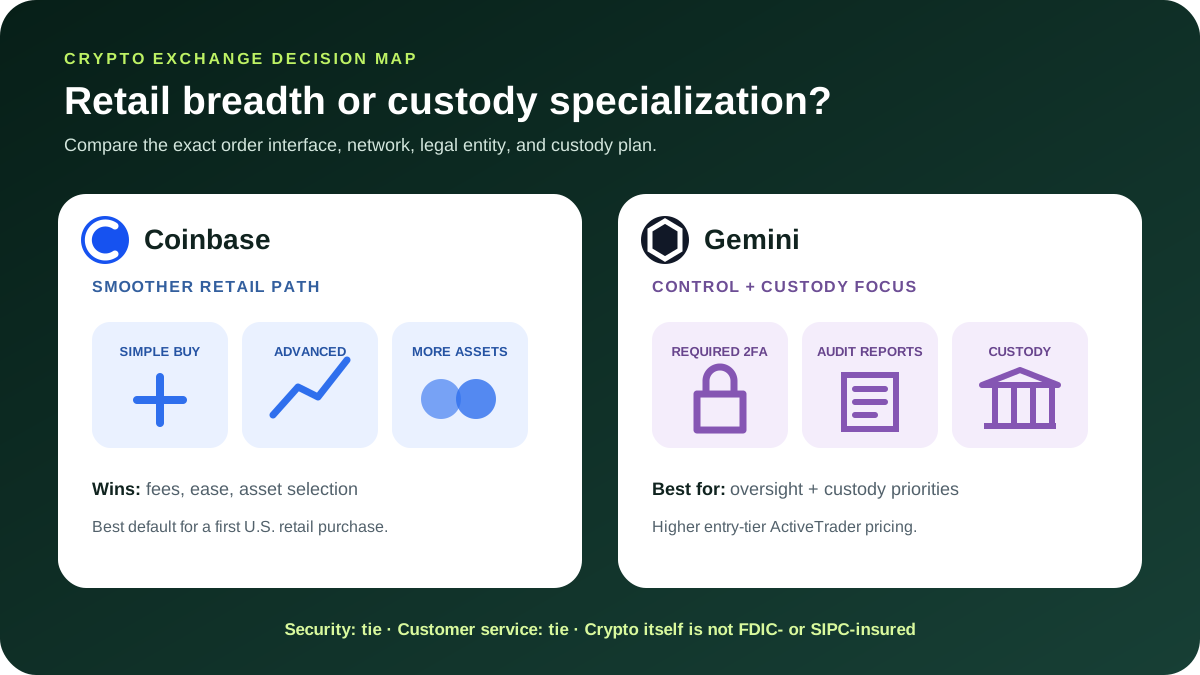
These are several products inside one login
The word “Coinbase” can refer to a simple buy flow, Coinbase Advanced, exchange custody, staking on eligible assets, recurring purchases, or a separate self-custody wallet product. Those services do not share one price or one risk model. A simple card purchase is not economically equivalent to a limit order funded from settled cash, and exchange custody is not self-custody.
Gemini has the same distinction. Gemini Mode covers Instant, Recurring, and conversion transactions with a quoted fee and spread. ActiveTrader is an order-book interface with maker/taker pricing. Gemini Custody is an institutional service with separate terms. Comparing “Coinbase fees” with “Gemini fees” without naming the interfaces produces a misleading answer.
Before opening either account, write down the intended action: deposit dollars, buy a specific asset on a supported network, trade an order book, withdraw to a verified wallet, or retain assets with a custodian. Then compare that exact path.
Trading fees: Coinbase wins, with an important disclosure gap
Gemini's ActiveTrader schedule dated July 9, 2026 publishes an entry tier of 0.600% maker and 1.200% taker for customers below the next volume or asset-balance threshold. At that tier, a fully executed $1,000 taker order has a $12 trading fee before any funding or withdrawal cost. The same schedule lowers rates as qualifying volume or balances rise. Selected stablecoin pairs follow separate pricing.
Gemini Mode does not use that table. It calculates a variable fee and includes a spread in Instant, Recurring, and conversion quotes. The preview is therefore the source of truth for a retail transaction. Convenience can be useful, but a customer should record both the fee and the delivered asset quantity before confirming.
Coinbase simple orders also disclose a fee and spread in the preview. Coinbase Advanced uses maker/taker tiers based on trailing 30-day volume, but its public help page directs customers to sign in for the complete current table. That makes a universal public dollar comparison impossible. The cost advantage in DollarScout's rubric reflects Coinbase's stronger overall value profile and Gemini's unusually high published ActiveTrader entry tier, not a promise that every Coinbase order is cheaper.
Trading-fees winner: Coinbase, 3.4 to 2.8. Preview the same asset, order type, size, funding method, and withdrawal network on both platforms before acting.
Ease of use: Coinbase wins
Coinbase's retail flow is designed around a first deposit and purchase. The same account can later expose Coinbase Advanced without requiring the customer to learn a completely separate brand. Its help center documents tradability, network selection, unsupported deposits, two-step verification, cash treatment, and Advanced order behavior in relatively clear task-based pages.
Gemini's core retail interface is also understandable, and required 2FA is a useful default. The product map is less forgiving economically: a new user who does not notice the difference between Gemini Mode and ActiveTrader can select a materially different pricing method. Gemini also advertises newer stocks, predictions, margin, and derivatives experiences, so a customer must confirm which legal entity, eligibility rules, and protections apply rather than assuming every tile is the same exchange service.
Ease-of-use winner: Coinbase, 4.8 to 4.2. Gemini is not difficult; Coinbase provides the smoother progression from first purchase to an advanced spot ticket.
Asset selection: Coinbase wins
Coinbase maintains a broad asset catalog, but the number alone is not a safe selection rule. Availability varies by jurisdiction, product, trading pair, and blockchain network. An asset that can be bought may not support the network a customer expects for deposits or withdrawals. Coinbase explicitly warns that unsupported deposits may not be recoverable.
Gemini advertises 100+ trading pairs across 70+ cryptocurrencies and four currencies on ActiveTrader. That covers many large assets but remains narrower than Coinbase's overall exchange surface. Gemini's asset listing hub and marketplace rules should be checked for the exact pair and region.
Asset-selection winner: Coinbase, 4.6 to 3.9. Count usable assets, not logos: the desired pair, fiat route, network, order type, and withdrawal status must all be available.
Security: a tie with different strengths
Coinbase scores 4.6 and Gemini 4.6. Coinbase offers multiple two-step verification methods, extensive account-security guidance, a large compliance operation, and detailed documentation for supported and unsupported networks. Its public-company status adds financial reporting, but it does not turn customer crypto into an insured bank deposit.
Gemini requires 2FA by default, supports hardware security keys, and offers withdrawal-address allowlisting. It describes SOC 1 Type 2 and SOC 2 Type 2 reporting, ISO 27001, and annual penetration testing. Gemini Trust Company operates under a New York fiduciary and qualified-custodian framework for applicable services.
Security architecture does not eliminate user-side failure. A compromised email inbox, reused password, malicious browser extension, SIM-swap exposure, fake support contact, or approved withdrawal to a scam address can defeat strong institutional controls. Use a unique password, phishing-resistant security key where supported, a dedicated email account, address allowlisting, and a small test withdrawal.
Custody and insurance require precise language
On both exchanges, the default exchange account is custodial: the operator controls the private keys and records the customer's entitlement on an internal ledger. That can simplify recovery and trading, but it introduces counterparty and operational dependency. A self-custody wallet reverses that tradeoff; losing the recovery secret or approving a malicious transaction can make recovery impossible.
Coinbase states that eligible U.S. customer cash may be held in pooled insured bank or credit-union accounts or in short-duration liquid investments. Pass-through insurance depends on recordkeeping, customer information, the receiving institution, and a regulator's determination. Coinbase itself is not an FDIC-insured bank, and digital assets are not FDIC- or SIPC-insured.
Gemini describes insurance for certain fiat or digital-asset circumstances subject to its terms and exclusions, not a blanket guarantee of every loss. Its institutional custody product is separate from a standard retail trading balance. Read the user agreement and insurance page for the specific account rather than converting “regulated” into “risk free.”
Gemini Earn remains relevant due diligence
Gemini Earn was not the same product as the Gemini exchange account: customers lent assets through a program involving Genesis. After Genesis entered bankruptcy, Gemini announced in 2024 that Earn users received 100% of digital assets owed in kind. The recovery was a significant outcome, but the episode remains a useful lesson.
Yield is not a security feature. A platform can maintain strong controls for exchange custody while a separate lending program introduces borrower, legal, liquidity, and bankruptcy risk. Whenever either provider offers staking, rewards, lending, margin, or another yield-bearing service, identify who holds the asset, who owes repayment, whether withdrawal can be delayed, and what happens in insolvency.
Funding and withdrawals can outweigh the headline fee
Total cost includes the deposit method, trading fee, spread, network withdrawal fee, and possible bank or card charge. A $5 card fee on a small order can matter more than a small difference in maker pricing. A cheap trade followed by an expensive or unsupported withdrawal path is not cheap end to end.
Use settled bank funds when appropriate, compare ACH and wire terms, and inspect holds before depositing. For crypto withdrawals, match the asset and network exactly. Send a small test amount to a newly allowlisted address and wait for final credit before moving the remainder. Never infer network compatibility from a ticker symbol alone.
Advanced trading: order behavior matters
Both Coinbase Advanced and Gemini ActiveTrader distinguish maker from taker executions. A limit order is not automatically a maker order: if it crosses the book and executes immediately, the filled portion can be charged as taker. A partially filled order can incur both treatments.
Advanced interfaces add limit and stop controls, charts, order books, and APIs, but they do not guarantee execution quality. A thin market can create slippage and poor fills even with a low stated fee. Review the bid-ask spread, book depth, minimum size, cancellation behavior, and actual fill report. Do not use market orders mechanically in an illiquid pair.
Customer service: a tie
Coinbase scores 3.8 and Gemini 3.7; the 0.1 difference is treated as a tie. Published contact routes, security escalation, and documentation matter more than isolated anecdotes. Gemini's security page states that it does not offer phone support and warns users to trust only valid Gemini email domains. That makes impersonation awareness essential.
Before consolidating assets, submit a low-stakes support question about a real workflow: withdrawal allowlisting, a supported network, tax-lot export, beneficiary handling, or account recovery. Save the case number and confirm how an account lock or suspected compromise should be reported.
Taxes and records do not stay inside one exchange
Selling, exchanging, or spending digital assets can create U.S. tax-reporting consequences. Transfers between the customer's own wallets are different from disposals, but fees and incomplete cost-basis history complicate records. Exchange tax documents may not contain the acquisition basis for assets transferred in from elsewhere.
Export transaction and fill history regularly. Record timestamps, asset quantities, USD values, fees, transaction hashes, wallet transfers, and the business purpose of any movement. Reconcile those records before closing an account. DollarScout does not provide personal tax advice; use the IRS digital-assets guidance and a qualified professional for the customer's facts.
Who should choose Coinbase?
Choose Coinbase when the priority is a straightforward U.S. fiat on-ramp, a broader set of tradable assets, a documented path from simple purchases to Advanced orders, or recurring purchases inside a mature retail account. It is also the better default when the required asset or network is unavailable at Gemini.
Coinbase is less compelling when the sign-in-only Advanced fee table prevents a clean pre-account comparison, or when a customer wants Gemini's specific qualified-custody structure. Do not pay simple-purchase convenience pricing without comparing the Advanced ticket.
Who should choose Gemini?
Choose Gemini when New York trust-company oversight, required 2FA, hardware-key support, address allowlisting, public control attestations, or institutional custody is central to the decision. It may suit an organization that values governance and operational controls more than the broadest retail catalog.
Gemini is less compelling for an entry-tier ActiveTrader customer sensitive to fees or for someone who needs an asset or network it does not support. Understand the distinction between exchange, custody, Gemini Mode, ActiveTrader, and any yield or margin product before funding.
Final verdict
Coinbase wins overall for usability, breadth, and value. Gemini remains a defensible specialist choice for regulation- and custody-focused customers. Security and support are ties, so the decision should turn on the exact asset, interface, jurisdiction, funding route, and custody plan—not a generalized claim that one exchange is “safer.”
Which one is right for you?
- Best for First-time U.S. crypto purchases: CoinbaseOpen Coinbase
- Best for Broader retail asset and network access: CoinbaseOpen Coinbase
- Best for New York trust-company custody framework: GeminiOpen Gemini
- Best for Institutions requiring separate custody controls: GeminiOpen Gemini
Final verdict
Coinbase wins 4.3/5 to 3.9/5 for a smoother retail workflow, broader asset coverage, and stronger value. Gemini is the specialist choice for users who prioritize its New York trust-company framework, required 2FA, security attestations, and institutional custody. Security and Customer Service are ties. Confirm the live quote, network, jurisdiction, and legal entity before funding.
Frequently asked questions
Sources and verification
Scores and product facts come from the underlying DollarScout reviews and were checked against these primary sources.
- Coinbase Advanced fee methodology
- Coinbase asset and tradability guidance
- Coinbase treatment of U.S. customer cash
- Coinbase two-step verification
- Coinbase unsupported-deposit recovery limits
- Coinbase U.S. user agreement
- Gemini ActiveTrader fee schedule
- Gemini Mode fee and spread schedule
- Gemini ActiveTrader product and asset coverage
- Gemini security controls
- Gemini Trust Center and audit reports
- Gemini insurance scope and limitations
- Gemini Earn final resolution
- Gemini institutional custody
- IRS digital-assets guidance
Related content
More from DollarScout on this topic.
