Many products on this page are from partners who compensate us. This doesn't influence our ratings. Our opinions are our own.
How Crypto Taxes Work
By Sophie Brown, Senior Finance Editor · Updated Jul 2026 · Fact-checked Jul 18, 2026
U.S. federal tax reporting for digital assets begins with what happened, not which app or token was involved. Buying, receiving, transferring, selling, exchanging, spending, gifting, and earning crypto can have different results. This guide builds a transaction-by-transaction workflow for classifying activity, calculating basis and proceeds, reconciling wallets and forms, and knowing when the facts require professional advice. It covers federal concepts for individual taxpayers and is not personalized tax advice.
Key takeaways
- Classify every event as an acquisition, receipt, transfer between your accounts, or disposition before calculating tax.
- Selling, exchanging, or spending a digital asset can create a capital gain or loss when the asset is held as a capital asset.
- Crypto received for services, mining, staking rewards under applicable facts, or other income is generally measured at fair market value when includible in income.
- A transfer between wallets you own is generally not a sale, but the records must connect both sides and separately account for assets used as fees.
- Broker forms and tax software can help, but taxpayers remain responsible for complete basis, proceeds, income, wallet, and transaction records.
Start with a tax map, not an account statement
The IRS treats digital assets as property for federal income-tax purposes. That means the tax result depends on the transaction and how the asset was held. A token name, wallet label, or exchange summary is not enough.
Organize activity into four categories:
- Acquisition: Buying an asset with U.S. dollars generally creates basis but not a gain or loss at purchase.
- Receipt: Receiving crypto for work, mining, staking, an airdrop, or another activity may create ordinary or other income when the taxpayer has the relevant control, depending on the facts.
- Transfer: Moving an asset between wallets or accounts owned by the same taxpayer is generally not a disposition, though a fee paid in crypto can require separate analysis.
- Disposition: Selling for dollars, exchanging for another digital asset, spending, or otherwise disposing of a capital asset can create a capital gain or loss.
Then identify exceptions: business inventory, dealer activity, gifts, donations, inherited property, retirement accounts, foreign reporting, derivatives, entity transactions, and complex DeFi arrangements can follow additional rules.
Understand capital gains and losses
When an individual holds digital assets for investment, they are generally capital assets. A disposition creates:
Amount realized − adjusted basis = capital gain or loss.
Amount realized generally includes the value received, adjusted for transaction costs under applicable rules. Basis generally begins with the amount paid in U.S. dollars plus qualifying acquisition costs. Basis can later change through specific events.
Suppose a taxpayer buys 0.010 unit of a digital asset for $400 and pays a $4 acquisition fee, making an illustrative basis of $404. Later, the taxpayer sells the entire unit for $530 and pays a $5 selling charge. If the applicable amount realized is $525, the illustrative gain is $121. This is a simplified example; it does not represent a live price, universal fee treatment, or a particular tax lot method.
Holding period matters. Property held for one year or less before disposition generally produces short-term gain or loss; property held for more than one year generally produces long-term gain or loss. The calendar dates and acquisition lot must be documented.
Capital-loss deductions and carryforwards are subject to federal rules and limits. Do not assume every economic loss is immediately deductible. Theft, abandonment, worthless assets, wash-sale questions, derivatives, and business losses require separate analysis under current law and facts.
Crypto-to-crypto trades are dispositions
Exchanging Bitcoin for Ether is not tax-deferred merely because no dollars reach a bank. Under the IRS digital-asset FAQ, the asset given up is disposed of, and the fair market value of the asset received is relevant to the transaction.
The same principle can apply when:
- swapping one token for another;
- using crypto to buy goods or services;
- converting into or out of a stablecoin;
- paying someone with digital assets;
- exchanging through a decentralized protocol.
The received asset generally begins with a new acquisition date and basis derived under applicable rules. One user action can therefore close one tax lot and open another.
Use a reasonable, consistently documented U.S.-dollar valuation at the transaction time. Record the pricing source, timestamp, time zone, units, fees, transaction hash, and both assets. Thin or fragmented markets may require judgment; preserve the method rather than choosing a favorable price after year-end.
Separate ordinary income from later gain or loss
Digital assets received as compensation or rewards can produce income before a later sale. The initial income and later price change are separate tax events.
Services and business receipts
Crypto received for employment is generally wages subject to employment-tax and reporting rules. Crypto received by an independent contractor or business for services is generally ordinary business income measured using fair market value when received under applicable rules. That amount commonly becomes the asset’s initial basis; a later disposition produces another gain or loss.
Report business activity in the correct business records and forms rather than combining it with investment sales. Self-employment tax, estimated payments, payroll, sales tax, and information-reporting duties may apply.
Mining
Mining rewards can be gross income when received, with business or hobby facts affecting the broader treatment. Equipment, electricity, pool fees, and operating activity require substantiation and may be subject to capitalization, depreciation, deduction, or limitation rules.
Staking
IRS Revenue Ruling 2023-14 concludes, for its stated facts, that a cash-method taxpayer who stakes cryptocurrency native to a proof-of-stake blockchain and receives additional units as validation rewards includes the fair market value in gross income in the tax year the taxpayer gains dominion and control over the rewards. Custodial restrictions, protocol mechanics, liquid-staking tokens, lockups, and other designs may require a facts-specific analysis.
Airdrops, forks, promotions, and rewards
The result can depend on whether the taxpayer actually received property and could transfer, sell, exchange, or otherwise control it. An unwanted token visible at an address is not automatically identical to a usable reward. Hard forks, airdrops, referral bonuses, learn-and-earn payments, and incentive tokens should be tracked separately with the governing facts and official records.
Do not interact with an unsolicited token merely to discover its value; it could be malicious. Tax recordkeeping does not require signing an unsafe contract.
Track basis by tax lot
A tax lot links asset units to an acquisition date, basis, and source. A person who bought the same asset at five times has five sets of facts even if a platform shows one balance.
Maintain:
- asset and exact units;
- acquisition date and time;
- wallet or custodial account;
- method of acquisition;
- U.S.-dollar value and valuation source;
- transaction costs;
- transaction hash or order ID;
- holding period;
- adjustments, if any;
- disposition date, proceeds, fees, and destination.
Tax-lot identification rules and broker-account rules are technical and have changed as digital-asset reporting develops. Do not assume a software default such as FIFO, LIFO, or highest-in-first-out is valid for every wallet, account, year, and fact pattern. Confirm the current identification requirements and preserve contemporaneous evidence of any lot selected.
Avoid changing methods merely to produce the lowest tax after seeing the outcome. Consistency does not cure a method that fails the rules, but inconsistent retrospective choices make substantiation harder.
Match transfers between your own wallets
Moving an asset from an exchange account to a self-custody wallet you own is generally not a sale. The original acquisition date and basis travel with the asset. A complete ledger should show the outbound and inbound records as one transfer.
Matching can be difficult because:
- the sent and received quantities differ due to network or platform fees;
- timestamps use different time zones;
- exchanges group withdrawals or use internal identifiers;
- bridges burn, lock, mint, or wrap representations;
- the destination account has no cost-basis history;
- one transaction contains multiple contract events.
Use transaction hashes, addresses, timestamps, quantities, and platform withdrawal records. Mark ownership of both endpoints. Preserve evidence that an address belonged to you, without ever storing the private key or seed phrase in a tax file.
Analyze fees separately. If digital assets are used to pay a network fee, those units may themselves be disposed of, and the tax treatment of the fee can depend on the purpose of the underlying transaction. Do not simply delete the difference between sent and received amounts.
Build a complete ledger before calculating
Start with every exchange, broker, wallet, payment app, mining pool, staking service, decentralized application, and blockchain address used during the year. Export files while the account is still accessible. Preserve original CSV, PDF, API, and blockchain data without overwriting them during cleanup.
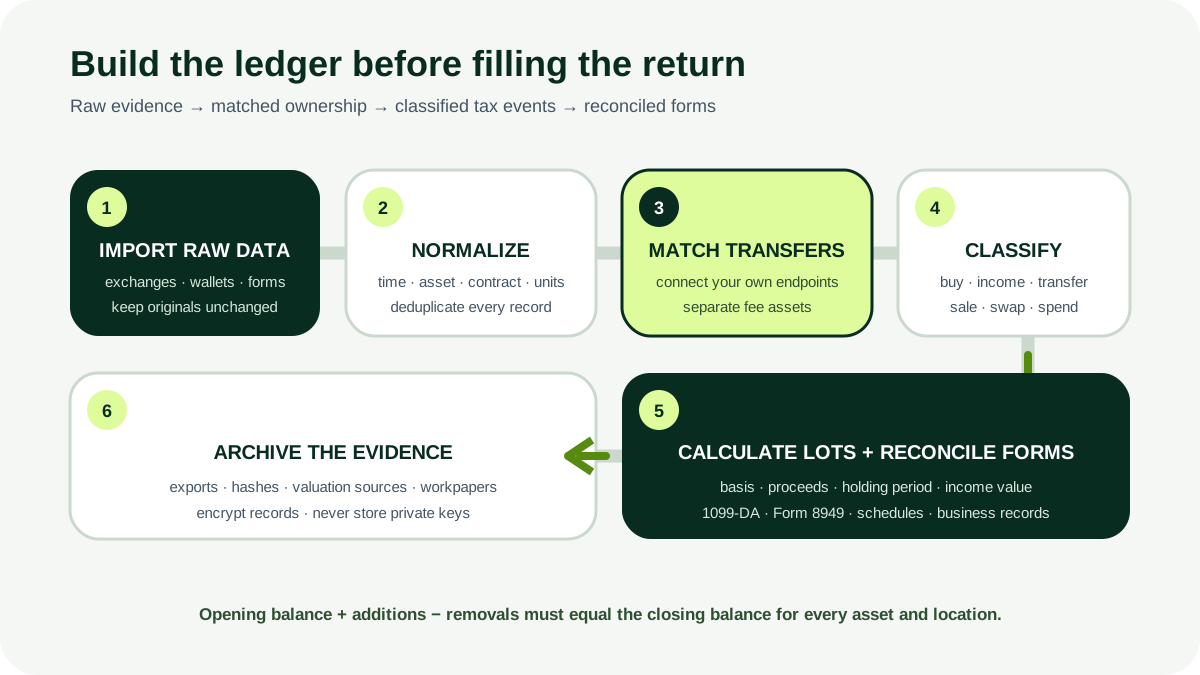
A robust workflow is:
- Normalize timestamps to one time zone while retaining the original.
- Normalize tickers carefully; identical symbols can represent different contracts.
- Deduplicate records imported from both a wallet and a platform.
- Match transfers between owned endpoints before treating withdrawals as sales.
- Split multi-action transactions into deposits, swaps, income, fees, and withdrawals.
- Attach U.S.-dollar values and their sources.
- Link every disposition to an allowable acquisition lot.
- Reconcile opening balance + additions − removals = closing balance for each asset and location.
Never upload seed phrases or private keys to tax software. Read-only public addresses, transaction exports, and restricted API credentials are safer inputs. Review an importer’s permissions and revoke keys after use when continued access is unnecessary.
Understand Form 1099-DA without relying on it completely
The IRS introduced Form 1099-DA for broker reporting of certain digital-asset proceeds. Reporting is being phased in. IRS instructions state that gross-proceeds reporting applies for covered transactions beginning in 2025, while mandatory basis reporting for brokers generally applies to certain covered digital assets acquired on or after January 1, 2026, in custodial accounts and held there until disposition, subject to the detailed rules and exceptions.
This creates practical gaps:
- an early form may report proceeds without basis;
- a broker may not know basis imported from another platform or self-custody wallet;
- decentralized transactions may have no reporting broker;
- a form can use an identifier or timestamp that differs from personal records;
- receiving a form does not mean it contains every transaction;
- not receiving a form does not remove the reporting obligation.
The IRS’s current 1099-DA instructions distinguish covered from noncovered securities and include special reporting rules and exceptions. Consult the instructions for the tax year being filed; do not apply one year’s form logic automatically to another.
Compare every form with the raw ledger. If a form appears wrong, contact the issuer promptly and preserve the correction request. Do not invent basis just to make a tax-software warning disappear.
Connect the ledger to the federal return
For an individual taxpayer, common destinations include:
| Activity | Common federal reporting path |
|---|---|
| Sale or exchange of a capital asset | Form 8949 and Schedule D |
| Rewards, staking, mining, or other income outside a business | Appropriate income schedule based on the facts, often Schedule 1 |
| Independent contractor or business receipts and expenses | Schedule C or the applicable entity return |
| Wages paid in crypto | Form W-2 and wage reporting |
| Gifts or donations | Gift-tax, charitable, and substantiation rules as applicable |
The correct form depends on the facts; the table is a starting point, not a universal classification. The federal individual return includes a digital-asset question. Read its instructions for the filing year and answer based on actual activity, even if the ultimate taxable amount is zero.
Reconcile totals between Form 8949, Schedule D, income schedules, business records, and information returns. A reward reported as income establishes data needed for its later disposition; failing to carry that basis forward can duplicate tax.
Handle gifts, donations, and inherited assets carefully
Giving digital assets is not the same as selling them. Donor basis, fair market value, gift tax, holding period, and later recipient gain or loss can interact. The recipient should receive records, not merely a transaction hash.
Charitable donations may require a qualified organization, contemporaneous acknowledgment, appraisal, and specific forms depending on asset type, value, holding period, and deduction claimed. Sending tokens to an address displayed on an unverified site creates both fraud and substantiation risk.
Inherited property follows different basis rules from a lifetime gift. Estate access, valuation, authority, and records should be coordinated with qualified legal and tax professionals. Never place a private key directly into a filed return or publicly accessible probate document.
Treat DeFi and cross-chain activity as high-complexity
A liquidity-pool deposit may exchange tokens for a pool token. A bridge may lock an asset and mint a representation. A vault may issue a receipt token and perform many underlying trades. Lending can create interest, incentives, collateral liquidations, or bad debt. Wrapping can change the legal or economic claim even when values are intended to track.
U.S. guidance does not reduce every design to one universal answer. Document:
- contracts called and assets transferred;
- legal and economic rights before and after;
- whether the user received a different token or claim;
- control, restrictions, and redemption mechanics;
- rewards, fees, liquidations, and debt;
- fair-market-value method;
- the position taken and professional authority relied on.
Software that labels every wallet outflow as a sale or every protocol receipt as income will often be wrong. Material, leveraged, cross-chain, derivative, or novel positions deserve review from a tax professional familiar with the specific protocol.
Plan for estimated taxes and cash flow
Income can arise in a digital asset even when no dollars are received. If the asset later falls, the taxpayer may still owe tax on the earlier income while holding something worth less. Consider selling enough, where appropriate, to cover estimated federal and state tax rather than assuming the asset will retain value.
Estimated-payment requirements and underpayment penalties depend on the taxpayer’s total facts. Employers, self-employed people, businesses, and investors have different cash-flow options. Build a tax reserve using conservative dollar values and revisit it after large rewards or dispositions.
State income tax, sales tax, franchise tax, information reporting, and sourcing rules can differ from federal rules. Moving states, operating a business, or transacting internationally increases complexity.
Review security and retention
Tax records can reveal balances, addresses, identity, and account relationships. Encrypt local records, restrict cloud sharing, use strong authentication, and remove seed phrases and private keys. A public address does not authorize spending, but it can expose an entire transaction history.
Retain source statements, exports, hashes, valuations, correspondence, forms, return workpapers, and method documentation for the period required under applicable tax rules. Longer retention may be prudent where basis carries forward for years, property remains held, amended returns are possible, or ownership and transfer history is complex.
Year-end reconciliation checklist
Before filing, confirm:
- every platform, wallet, address, and protocol is included;
- transfers between owned accounts are matched;
- fee assets and failed transactions are recorded;
- every disposition has proceeds, basis, date, and holding period;
- every income receipt has a date, value, source, and later basis;
- opening and closing quantities reconcile by asset and location;
- Forms 1099-DA and other information returns match or have documented differences;
- Form 8949, Schedule D, income schedules, and business records agree;
- the digital-asset question is answered for the correct tax year;
- state, foreign, gift, donation, estate, and estimated-tax issues were considered.
Bottom line
Crypto tax reporting is a data-reconciliation problem before it is a form-filling problem. Capture every location and transaction, match your own transfers, separate receipts from dispositions, preserve lot-level basis and valuation evidence, and reconcile broker forms rather than trusting them blindly. When a protocol changes the asset or legal rights in a way you cannot classify, document the facts and get qualified advice before filing.
Related content
Frequently asked questions
Sources
Related content
More from DollarScout on this topic.
