Chase Sapphire Preferred vs Capital One Venture: 2026 Comparison


Chase Sapphire Preferred wins at 4.6/5 versus Capital One Venture at 4.3/5 for most travelers. Both charge $95 and have no foreign transaction fee, but Chase adds a $100 annual eligible hotel credit, richer dining and travel categories, primary rental coverage, and broader documented trip protections. Venture is simpler: unlimited 2x miles on every purchase, 5x on specified Capital One Travel bookings, transfer partners, and up to $120 every four years for Global Entry or TSA PreCheck. Choose Chase for travel depth; choose Venture when 2x simplicity on uncategorized spend matters more.
Head-to-head
| Feature | Chase Sapphire Preferred | Capital One Venture |
|---|---|---|
| DollarScout Rating | 4.6/5 ★ | 4.3/5 ★ |
| Annual Fee | $95 | $95 |
| Rewards | 5x Chase Travel; 3x dining, gas, EV charging, select vacation homes, eligible streaming, and online grocery; 2x other travel; 1x other purchases | Unlimited 2x miles on every purchase; 5x on hotels, vacation rentals, and rental cars booked through Capital One Travel |
| Purchase APR | 19.24%–27.49% variable APR, based on creditworthiness | 19.49%–28.49% variable APR, based on creditworthiness |
Category-by-category breakdown
Rewards
Winner: Chase Sapphire PreferredFees
TieAPR
TieBenefits
Winner: Chase Sapphire PreferredCustomer Service
Winner: Chase Sapphire PreferredDetailed analysis
The short answer
Both cards charge $95, waive foreign transaction fees, earn transferable travel rewards, and offer higher portal rates. Chase Sapphire Preferred is the stronger travel card; Capital One Venture is the simpler everyday card. DollarScout rates them 4.6/5 and 4.3/5, respectively.
Chase earns 5x through Chase Travel, 3x in several everyday categories, 2x on other travel, and 1x elsewhere. Venture earns a flat 2x on ordinary purchases and 5x on specified Capital One Travel hotels, vacation rentals, and rental cars.
| Decision factor | Chase Sapphire Preferred | Capital One Venture |
|---|---|---|
| Annual fee | $95 | $95 |
| Base earning | 1x outside bonuses | Unlimited 2x miles |
| Major bonuses | 5x Chase Travel; 3x dining, gas, EV charging, select vacation homes, eligible streaming and online grocery; 2x other travel | 5x eligible Capital One Travel hotels, vacation rentals, and rental cars |
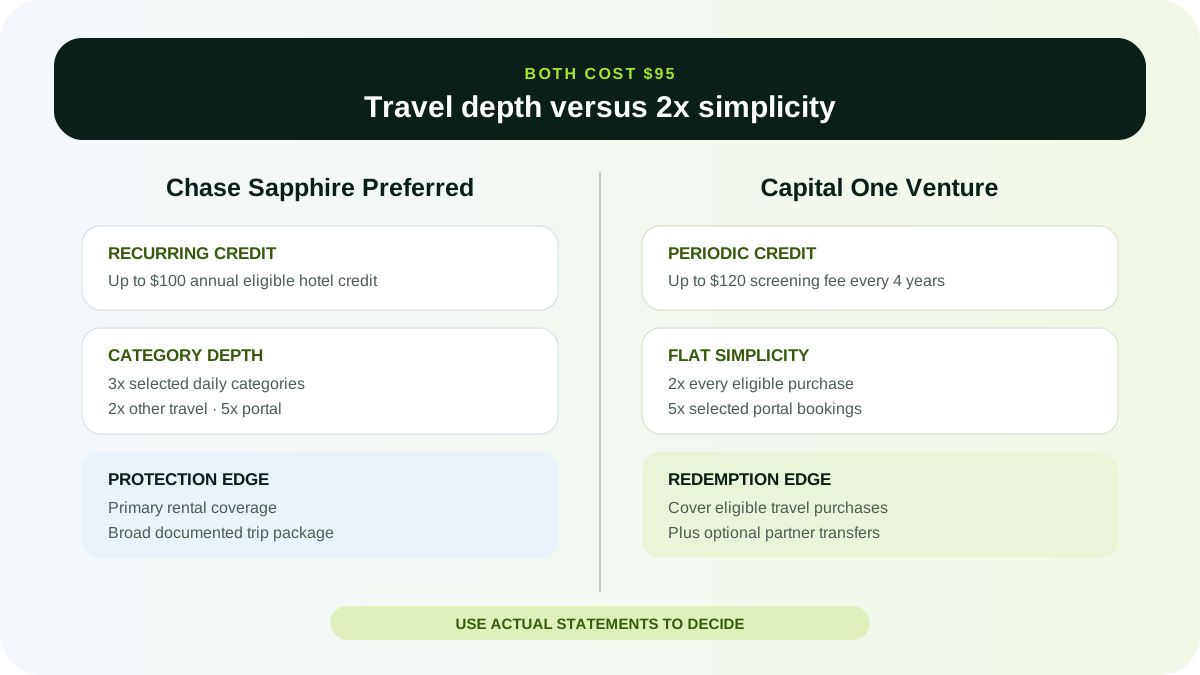
| Recurring credit | Up to $100 annual eligible Chase Travel hotel credit | Up to $120 Global Entry or TSA PreCheck credit every four years |
| Transfers | Airline and hotel partners; current ratios vary | Airline and hotel partners; current ratios vary |
| Key protection | Primary rental coverage and broad trip protections | Travel and purchase benefits under current account guide |
Same fee, different break-even
Because both cards charge $95, the comparison begins with recurring credits and spending patterns. Chase's annual hotel credit can reimburse up to $100 on an eligible booking through Chase Travel. Used naturally at a competitive price, it can offset the entire fee every year.
Venture's Global Entry or TSA PreCheck benefit reimburses up to $120 on an eligible application, generally once every four years. Its maximum annualized value is about $30, and it is worth zero when another card already pays the fee or the cardholder would not apply.
That gives Chase a recurring-credit advantage. Venture must recover the difference through extra 2x earning on purchases that would earn only 1x with Chase, through better transfer redemptions, or through benefits the cardholder actually uses.
Everyday reward math
Venture's strength is no category tracking. $30,000 of ordinary eligible purchases earns 60,000 miles. The same spend on Chase outside bonus categories earns 30,000 points.
Chase catches up quickly in its bonus categories. $10,000 of dining at 3x earns 30,000 points instead of Venture's 20,000 miles. $8,000 of broad direct travel at 2x ties Venture's base 2x, while eligible 5x portal bookings tie on the headline multiplier.
The June 2026 Chase refresh added 3x gas stations, EV charging, eligible streaming, online grocery, and select vacation-home purchases under current terms. Map twelve months of actual merchant-coded spend rather than estimating from a budget category name.
Travel category breadth
Chase's 2x travel category applies beyond portal hotels and rentals, subject to the rewards agreement. Eligible travel can include airlines, hotels, transit, tolls, parking, and other coded merchants. This helps a traveler who books directly or spends on trains and local transportation.
Venture earns 2x on all of those purchases because 2x is its base rate. That means it matches Chase on ordinary direct travel and beats Chase on uncategorized purchases, while Chase wins on dining and its 3x categories.
Neither card needs to dominate every transaction. A category-focused card can pair with a 2% or 2x base card, but additional cards create fee, account, and redemption complexity.
Portal bookings
Chase earns 5x on eligible Chase Travel purchases. Venture earns 5x on specified Capital One Travel hotels, vacation rentals, and rental cars. The scope is not identical; flights or other portal products can earn differently.
Before using either portal, compare the exact cash price, taxes, resort fees, room or fare class, cancellation rules, supplier loyalty credit, elite benefits, and support chain. A portal booking may not be controlled directly by the airline, hotel, or rental company when something changes.
Keep both confirmation numbers and verify the reservation with the supplier. The annual Chase hotel credit is valuable only after this comparison, not before it.
Transfer partners and Chase's Hyatt change
Both programs let eligible cardholders transfer rewards to airline and hotel partners. Transfer ratios, minimums, bonuses, partner lists, taxes, and availability can change.
Chase's June 2026 refresh changed Hyatt transfers to 4 Hyatt points for every 3 Ultimate Rewards points for affected Sapphire Preferred terms. That reduces a historically valuable route. It also removed the anniversary points bonus for new applicants under the announced transition. Verify the terms attached to the exact account.
Capital One has a broad group of airline and hotel partners, with ratios that vary by partner. Some transfers can unlock premium travel; others produce less than a simple travel-purchase redemption.
Search the award before transferring. Confirm the operating airline, cancellation rules, taxes, fuel surcharges, connection risk, and comparable cash price. Transfers are generally irreversible.
Redemption simplicity
Venture miles can cover eligible travel purchases after they post, book Capital One Travel, or transfer. Covering a recent travel purchase is a straightforward way to avoid award-search complexity, subject to the current rules and value.
Chase points can book through Chase Travel, use Points Boost on selected eligible offers, transfer, or redeem in other ways. Points Boost does not make every portal booking worth the same amount.
Cash and gift-card uses in either ecosystem can deliver different values. A point is not a cent by definition. Track actual value and avoid inflating it with travel you would not have purchased.
Rental-car coverage
Chase's Guide to Benefits documents primary rental collision damage coverage for eligible rentals when the requirements are met. Primary coverage can address covered damage before a personal auto insurer, reducing a major reason travelers pay the fee.
Coverage excludes certain vehicles, countries, rental lengths, losses, personal belongings, liability, injury, and violations of the agreement. Declining the rental company's collision waiver may be required, but liability coverage is a separate question.
Venture benefits depend on the network and account guide issued with the card. Do not assume identical primary coverage from a generic “travel benefits” label. Read the current guide and use the card whose policy fits the rental.
Trip delay, cancellation, and baggage
Chase has the stronger documented protection package in this matchup. Its current guide includes qualifying trip cancellation/interruption, trip delay, baggage delay, lost-luggage, purchase, warranty, and related protections with limits and exclusions.
Venture offers travel and purchase benefits under current issuer and network terms, but the package should be evaluated benefit by benefit. A higher rewards rate does not compensate for missing coverage on an expensive prepaid trip.
Pay the required portion with the card, retain receipts and carrier statements, notify the administrator promptly, and file within the deadline. Ordinary changes of mind, known events, and excluded causes are not covered.
International use
Both cards charge no foreign transaction fee. That prevents the common 3% surcharge on purchases processed outside the United States. Acceptance depends on the network attached to the actual account and merchant.
Carry a backup card from a different issuer and preferably a different network. Use local currency rather than dynamic currency conversion, secure the phone and email used for account access, and keep issuer contact methods available offline.
Rewards do not protect against a bad exchange choice. A merchant's conversion can add more cost than the reward earned.
APR and grace periods
Chase currently advertises 19.24% to 27.49% variable APR. Venture advertises 19.49% to 28.49% variable APR. A small difference in an applicant's assigned rate is far more important than a point multiplier when a balance revolves.
At 24% APR, carrying $4,000 for one month costs roughly $80 before compounding and payments. That can erase the incremental value from tens of thousands of dollars of reward spend.
Pay the full statement balance by the due date and preserve the grace period. If that is not realistic, use a lower-cost repayment product and ignore travel rewards until the debt is controlled.
Customer service and travel disruptions
Chase scores 4.4/5 and Venture 4.2/5 for Customer Service. Actual outcomes depend on whether the issue belongs to the issuer, travel portal, loyalty partner, supplier, or insurance administrator.
A portal schedule change can require the portal to reissue a ticket even when the airline operates the flight. A transfer cannot normally be reversed because an award disappears. A claim requires documentation rather than an ordinary card-service call.
Record case numbers, representative names, dates, documents, and promised actions. Escalate in writing when a deadline or material amount is involved.
Welcome offers and long-term value
Both issuers change bonuses, spending requirements, and eligibility rules. Compare the personalized or current public offer, but separate first-year value from the keep-or-cancel decision.
Required spend should come from ordinary purchases that can be paid in full. Check exclusions, return effects, bonus history, product-family rules, and the annual-fee posting date. Do not prepay unnecessary expenses or carry debt for points.
At the first anniversary, evaluate the next year's hotel credit, security-screening eligibility, transfer plans, protections, and actual spend. Past bonus value is sunk.
A practical break-even example
Assume $12,000 dining and Chase 3x categories, $8,000 direct travel, and $20,000 uncategorized spend. Chase earns 36,000 plus 16,000 plus 20,000 points, or 72,000. Venture earns 80,000 miles across the same $40,000.
Venture leads by 8,000 reward units, but Chase can add up to $100 through the hotel credit and has stronger protections. The winner depends on personal point values, whether the hotel credit is natural, and whether a rental or delayed trip invokes coverage.
Change the mix to mostly uncategorized spend and Venture improves. Increase dining, gas, online grocery, or eligible portal travel and Chase improves. Use real statements.
Which one should you choose?
Choose Chase Sapphire Preferred when the annual hotel credit is useful, dining and travel categories are material, primary rental coverage matters, and you value a broad trip-protection package. Recheck the 2026 transfer changes before assuming old valuations.
Choose Capital One Venture when you want one card earning 2x almost everywhere, spend heavily outside Chase categories, and prefer straightforward travel-purchase redemptions plus optional transfers. The Global Entry or TSA PreCheck credit adds periodic value.
Choose neither when a no-fee 2% card and separate trip insurance produce better total value, or when a balance will revolve.
Final verdict
Chase wins for the typical traveler because it provides more recurring and protective value at the same fee. Venture wins for the traveler whose spend is mostly uncategorized and who wants 2x simplicity. The decisive input is the statement, not the marketing multiplier.
Which one is right for you?
- Best for Annual hotel credit and broad travel protections: Chase Sapphire PreferredView Card Details
- Best for Dining, gas, online grocery, and direct-travel categories: Chase Sapphire PreferredView Card Details
- Best for Simple 2x earning on uncategorized purchases: Capital One VentureView Card Details
- Best for Travel-purchase redemption and security-screening credit: Capital One VentureView Card Details
Final verdict
Chase Sapphire Preferred is the better 2026 travel card at the shared $95 fee because its $100 eligible hotel credit, bonus categories, primary rental coverage, and broad trip protections are easier to monetize. Capital One Venture is better for uncategorized spend and one-card simplicity when its 2x miles are redeemed well. Verify current transfer ratios and pay in full.
Frequently asked questions
Sources and verification
Scores and product facts come from the underlying DollarScout reviews and were checked against official provider documentation and regulatory resources on Jul 18, 2026.
- 1Chase Sapphire Preferred current offer and rates (opens in a new tab)
- 2Chase Sapphire Preferred benefits (opens in a new tab)
- 3Chase June 2026 Sapphire Preferred refresh (opens in a new tab)
- 4Chase Sapphire Preferred Guide to Benefits (opens in a new tab)
- 5Chase Sapphire Preferred rewards agreement (opens in a new tab)
- 6Capital One Venture current offer and rates (opens in a new tab)
- 7Capital One rewards and benefits overview (opens in a new tab)
- 8Capital One Global Entry and TSA PreCheck rules (opens in a new tab)
- 9Capital One cardholder benefits (opens in a new tab)
- 10CFPB credit-card grace-period guidance (opens in a new tab)
- 11CFPB guidance on issuer term changes (opens in a new tab)
- 12CFPB card interest calculation (opens in a new tab)
Related content
More from DollarScout on this topic.
