Capital One Venture vs Citi Double Cash: 2026 Comparison

Capital One Venture and Citi Double Cash both earn 4.3/5, but Citi is the better default for domestic cash back: it has no annual fee and earns unlimited 2% on purchases, split as 1% when buying and 1% when eligible purchases are paid. Venture charges $95 for unlimited 2x miles, transfer partners, no foreign transaction fee, travel protections, and up to $120 every four years for Global Entry or TSA PreCheck. Choose Citi for certain no-fee cash value or its qualifying 18-month balance-transfer offer; choose Venture only when travel redemptions and international use reliably add more than $95.
Head-to-head
| Feature | Capital One Venture | Citi Double Cash |
|---|---|---|
| DollarScout Rating | 4.3/5 ★ | 4.3/5 ★ |
| Annual Fee | $95 | $0 annual fee; 3% foreign purchase fee |
| Rewards | Unlimited 2x miles on every purchase; 5x on hotels, vacation rentals, and rental cars booked through Capital One Travel | Unlimited 2% cash back: 1% when buying and 1% as eligible purchases are paid; 5% total on hotels, car rentals, and attractions booked through Citi Travel |
| Purchase APR | 19.49%–28.49% variable APR, based on creditworthiness | 17.49%–27.49% variable purchase APR; 0% for 18 months on balance transfers completed within four months, then the standard variable APR |
Category-by-category breakdown
Rewards
TieFees
Winner: Citi Double CashAPR
Winner: Capital One VentureBenefits
Winner: Capital One VentureCustomer Service
Winner: Capital One VentureDetailed analysis
The short answer
These cards look similar because both earn two rewards units per dollar on ordinary purchases. They are not economically identical. Citi Double Cash is a no-fee 2% cash-back card; Capital One Venture is a $95 travel-rewards card earning 2 miles per dollar.
DollarScout rates both 4.3/5. Citi wins Price, APR, and simple reward certainty. Venture wins Perks, international use, and travel-redemption flexibility. The decision is whether Venture miles and benefits create at least $95 more annual value than a no-fee 2% baseline.
| Decision factor | Capital One Venture | Citi Double Cash |
|---|---|---|
| Annual fee | $95 | $0 |
| Base earning | Unlimited 2x miles | Unlimited 2% cash back: 1% when buying and 1% as eligible purchases are paid |
| Portal earning | 5x hotels, vacation rentals, and rental cars through Capital One Travel | 5% total on eligible hotels, car rentals, and attractions through Citi Travel |
| International use | No foreign transaction fee | 3% foreign purchase fee |
| Transfers | Airline and hotel partners | ThankYou transfers depend on account and current program rules |
| Balance-transfer offer | Check applicant terms | 0% for 18 months on qualifying transfers completed within four months; fee applies |
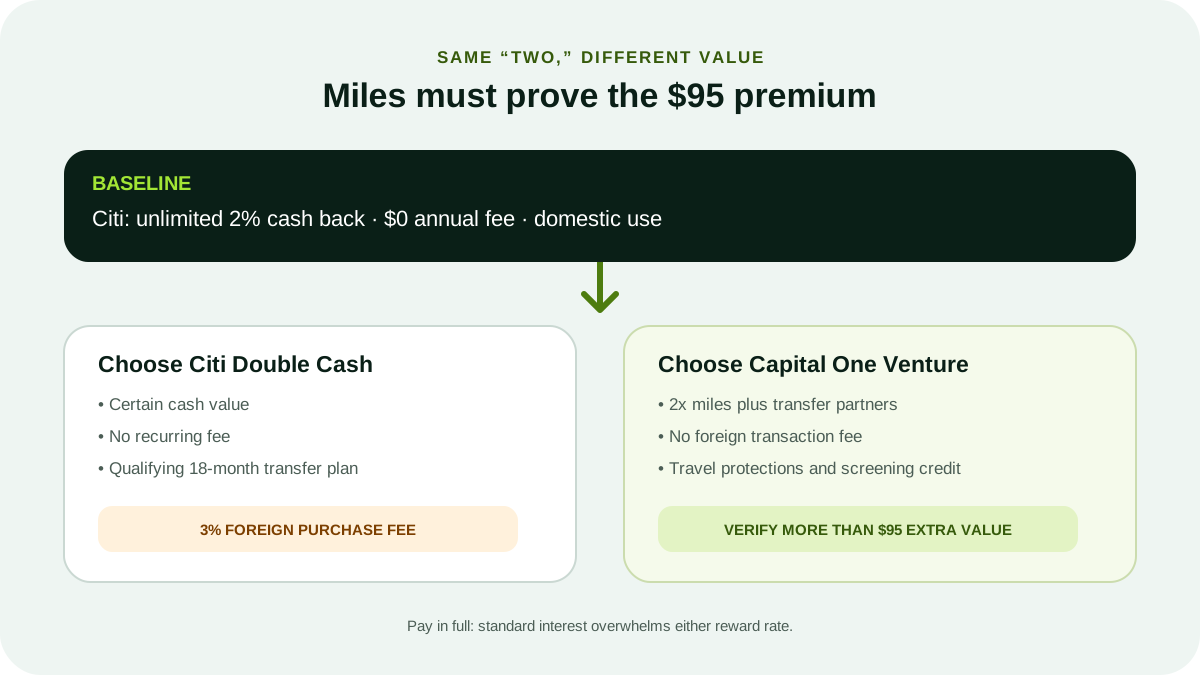
The $95 break-even test
Citi's no-fee 2% return is the benchmark. On $20,000 of eligible annual purchases, it produces $400 when the purchases are paid. Venture produces 40,000 miles and charges $95. To match Citi before other benefits, those miles must be worth $495 total, or about 1.24 cents each.
At $40,000 of spend, Citi produces $800 and Venture produces 80,000 miles minus the fee. Venture needs roughly 1.12 cents per mile to match. Higher spend dilutes the fixed annual fee, but putting spend on Venture can still displace category cards earning more than 2x.
Do not value a welcome offer as permanent break-even. Model the second year using ordinary spend, actual redemptions, foreign purchases, portal bookings, and the security-screening credit.
Citi Double Cash reward mechanics
Citi earns 1% when an eligible purchase posts and another 1% as the purchase is paid. Returns, credits, balance transfers, cash advances, fees, and other excluded transactions do not earn ordinary purchase rewards. Paying the statement balance preserves both the second 1% and the grace period.
Cash back is earned as ThankYou Points under current program rules and can be redeemed in eligible ways. The simple planning assumption is 2% cash value, but transfer access and ratios can depend on the account relationship and current ThankYou terms.
Citi also advertises 5% total on eligible hotels, car rentals, and attractions booked through Citi Travel. Compare portal pricing and conditions; a higher percentage on a marked-up or inflexible booking is not a win.
Capital One Venture miles
Venture earns unlimited 2 miles per dollar on ordinary purchases and 5x on hotels, vacation rentals, and rental cars booked through Capital One Travel. Miles can cover eligible travel purchases, book through the portal, transfer to airline or hotel partners, or be used for cash and gift-card options at different possible values.
Travel-purchase erasure is straightforward when eligible, while transfers can produce greater or lower value depending on award availability, ratio, fees, and itinerary. Cash redemptions can be weaker than travel uses under current terms.
Do not transfer speculatively. Search the award, confirm partner space and surcharges, verify that the loyalty account name matches, then move only the required miles. Transfers are generally irreversible.
Foreign transaction fees
Venture has no foreign transaction fee. Citi Double Cash charges 3% of the U.S.-dollar amount of each foreign purchase. On $4,000 spent abroad, Citi's gross 2% rewards are $80 while the foreign fee is $120, producing a negative $40 before exchange effects. Venture avoids that fee.
This alone can justify much of Venture's annual fee for a regular international traveler. Card-network acceptance, cash needs, and dynamic currency conversion still matter. Pay in local currency and let the network convert rather than accepting a merchant's conversion.
Citi remains useful domestically. A traveler can hold a separate no-foreign-fee card and use Double Cash only in the United States without paying an annual fee.
Transfer partners versus certain cash
Venture's main upside is the ability to transfer miles to partners. A well-timed airline redemption can exceed one cent per mile, while poor availability, surcharges, inconvenient routes, or orphan balances can reduce value.
Citi's 2% cash result is certain and fungible. It can pay a bill, reduce a statement, or be invested without searching award charts. Certainty has value, particularly for households that travel infrequently or cannot use flexible dates.
Use a personal realized-value log. Divide the comparable cash price minus unavoidable award taxes and fees by the points spent. Ignore inflated retail prices you would never have paid. Average completed redemptions over time.
Global Entry or TSA PreCheck credit
Venture provides up to a $120 statement credit when the card is used for an eligible Global Entry or TSA PreCheck application, generally once every four years under current terms. The benefit can offset more than one annual fee in the year it is used, but its annualized value is at most about $30 before utilization.
It has no value if the traveler already receives the benefit from another card, cannot qualify, or would not apply. Avoid double-counting the same application credit across several cards.
Citi Double Cash does not offer a comparable security-screening reimbursement. Its proposition is rewards without a fixed fee rather than a travel-benefit bundle.
Travel and purchase protections
Venture carries network and issuer benefits described in the current cardholder guides, potentially including travel assistance, rental coverage, extended warranty, purchase protections, and related services depending on the account version and event.
Citi Double Cash has a leaner protection profile. It is not designed as a primary trip-protection card, despite portal rewards. Pay travel purchases with the card whose Guide to Benefits covers the risk you care about and read the exclusions before booking.
Benefit names are not coverage decisions. Preserve receipts, proof of payment, carrier documents, and claim deadlines. A travel portal and an insurance administrator are different service channels.
Balance transfers
Citi currently advertises 0% for 18 months on qualifying balance transfers completed within four months of account opening. The introductory transfer fee is 3% with a $5 minimum during the qualifying window; later transfers carry a 5% fee with a $5 minimum under the published pricing.
A $10,000 transfer at 3% starts with a $300 fee. To clear it in 18 months, pay about $572 monthly before any additional charges. Set automatic payments and a payoff deadline before the promotional period ends.
New purchases can accrue interest while a promotional balance remains because the purchase grace period may not work as expected. Use another paid-in-full card for spending and treat Double Cash as a repayment instrument during the transfer.
Venture is not the better card for transferring debt. Its value proposition assumes travel rewards and full payment, not financing.
Purchase APR and interest
Venture currently advertises a 19.49% to 28.49% variable purchase APR. Citi advertises 17.49% to 27.49% variable purchase APR after any applicable promotion. Neither standard range is low enough to justify chasing rewards while carrying debt.
At 24% APR, one month of interest on a $5,000 balance is roughly $100 before compounding and payments. That equals the annual fee and wipes out the 2% reward on the entire balance.
Pay the statement balance in full and on time. If that is not realistic, compare a credit-union product, hardship plan, or structured transfer based on total cost rather than rewards.
Portal booking tradeoffs
Venture's 5x applies to specified Capital One Travel bookings. Citi's 5% total applies to specified Citi Travel hotels, rental cars, and attractions. Portal inventory, cash price, loyalty eligibility, cancellation rules, and post-booking support differ.
Before booking, compare the exact room or vehicle, taxes, resort fees, cancellation deadline, loyalty points, elite treatment, and direct price. A portal can be convenient and still be worse overall.
Keep confirmation numbers for both the portal and supplier. Verify the reservation directly with the hotel or rental company before travel, especially after a schedule or property change.
Welcome offers and approval
Capital One and Citi change welcome offers and eligibility rules. A bonus can make Venture's first year compelling, but it does not answer whether to keep the card. Check spending requirements, excluded transactions, bonus history rules, credit inquiry, and whether the planned spend is ordinary.
Preapproval or prequalification is not final approval and does not guarantee a limit or terms. Do not apply for several cards solely to manufacture rewards if utilization, inquiries, or new-account timing could harm a near-term mortgage or loan application.
Pairing instead of choosing
Some consumers can hold both: Double Cash for domestic purchases and Venture for international spend, travel protections, or transfers. But because both earn roughly two units on base purchases, the overlap is substantial.
A better pairing may use Double Cash as the no-fee base card and add a specialized no-foreign-fee travel card only when its benefits justify the fee. Alternatively, Venture can be the simple everyday and travel card while a no-fee category card handles food or fuel.
Every additional card adds account monitoring, fraud exposure, redemption complexity, and possible annual-fee decisions. Simplicity is a legitimate benefit.
Which one should you choose?
Choose Citi Double Cash when you want a reliable no-fee 2% domestic return, prefer cash to award travel, or have a disciplined plan for the qualifying 18-month balance-transfer offer. Avoid it abroad because of the 3% fee.
Choose Capital One Venture when you travel internationally, can realize more than the $95 fee through transfer partners and travel redemptions, need a Global Entry or TSA PreCheck credit, and value the card's travel-oriented protections.
Choose neither when a balance will revolve at the standard APR. Interest overwhelms both reward structures.
Final verdict
Citi Double Cash is the better default because 2% with no annual fee is difficult to beat. Venture is the better travel tool when no-foreign-fee use, transfers, protections, and the application credit produce verifiable incremental value. Make Venture prove the $95 premium with your actual trips.
Which one is right for you?
- Best for No-fee domestic 2% cash back: Citi Double CashView Card Details
- Best for Structured qualifying balance transfer: Citi Double CashView Card Details
- Best for International purchases without a foreign fee: Capital One VentureView Card Details
- Best for Travel transfers, protections, and security-screening credit: Capital One VentureView Card Details
Final verdict
Citi Double Cash is the stronger default for 2026 because its unlimited 2% cash back and $0 annual fee create certain domestic value. Capital One Venture is better for a traveler who uses transfers, spends abroad, values its protections, and can recover more than $95 without speculative redemptions. Do not use either standard APR to finance rewards purchases.
Frequently asked questions
Sources and verification
Scores and product facts come from the underlying DollarScout reviews and were checked against official provider documentation and regulatory resources on Jul 18, 2026.
- 1Capital One Venture current offer and rates (opens in a new tab)
- 2Capital One rewards and benefits overview (opens in a new tab)
- 3Capital One Global Entry and TSA PreCheck rules (opens in a new tab)
- 4Capital One cardholder benefits (opens in a new tab)
- 5Capital One balance-transfer guidance (opens in a new tab)
- 6Citi Double Cash rewards and terms (opens in a new tab)
- 7Citi Double Cash balance-transfer rates and fees (opens in a new tab)
- 8Citi Double Cash pricing information table (opens in a new tab)
- 9Citi Double Cash reward redemption guidance (opens in a new tab)
- 10CFPB guidance on purchases during balance transfers (opens in a new tab)
- 11CFPB credit-card grace-period guidance (opens in a new tab)
- 12CFPB credit-card interest explanation (opens in a new tab)
Related content
More from DollarScout on this topic.
