Many products on this page are from partners who compensate us. This doesn't influence our ratings. Our opinions are our own.
Ally Bank vs SoFi Bank: 2026 Comparison
By Sophie Brown, Senior Finance Editor · Updated Jul 2026 · Fact-checked Jul 18, 2026
Ally Bank narrowly wins overall at 4.6/5 versus SoFi Bank at 4.5/5. Ally is easier to keep optimized because its core savings rate does not depend on payroll, $5,000 of qualifying deposits every 31 days, or a paid membership; it also publishes 75,000+ no-fee ATMs, up to $10 in domestic out-of-network reimbursements per statement cycle, and 24/7 phone support. SoFi is stronger for an engaged ecosystem customer: checking earns 0.50% APY under its May 28, 2026 rate sheet, qualified savings earns 3.10%, and SoFi Plus can raise eligible savings tiers. Choose Ally for low-maintenance banking; choose SoFi when its qualification rules and broader financial app fit your routine.
Head-to-head
| Feature | Ally Bank | SoFi Bank |
|---|---|---|
| DollarScout Rating | 4.6/5 ★ | 4.5/5 ★ |
| Monthly Fee | $0 monthly maintenance fee and $0 minimum opening deposit for Ally Savings | $0 monthly, minimum-balance, and standard overdraft fees on SoFi Checking and Savings |
| APY | Competitive variable APY shown on Ally’s live rates page; no minimum balance to earn it | 3.10% qualified savings and 0.50% checking; 0.80% savings without qualifying activity; temporary new-account boost up to 3.80% |
| Deposit Insurance | Ally Bank deposits are FDIC-insured within ownership-category limits | Standard SoFi Bank coverage plus optional additional coverage up to $3 million through participating banks |


Category-by-category breakdown
Fees
APY
Digital Experience
Access & ATM Network
Customer Service
Detailed analysis
The short answer
Ally is the more predictable online bank; SoFi offers more upside with more conditions. DollarScout scores Ally 4.6/5 and SoFi Bank 4.5/5. Their fee and ease-of-use scores are close, but the path to the advertised savings yield is fundamentally different.
Ally publishes one variable Savings rate without a payroll or recurring-deposit qualification. SoFi's May 28, 2026 rate sheet separates customers by activity and membership: ordinary qualified customers earn one savings rate, unqualified customers earn a lower standard rate, and paid SoFi Plus members can receive a higher tiered rate subject to balance and account-ownership rules.
| Decision factor | Ally Bank | SoFi Bank |
|---|---|---|
| Account opening | Spending and Savings can be selected separately or together | Opening Checking also opens Savings; no savings-only or checking-only option |
| Monthly maintenance | None on core Spending and Savings | None on Checking and Savings |
| Core savings qualification | No payroll or deposit-activity condition for the published variable rate | Eligible direct deposit or $5,000 in qualifying deposits every rolling 31 days for the qualified rate |
| Checking APY | Tiered variable rate; verify live page | 0.50% on all balances under the May 28 rate sheet |
| ATM network | 75,000+ Allpoint and MoneyPass ATMs plus up to $10 domestic reimbursement per cycle | 55,000+ Allpoint ATMs; third-party fees can apply outside network |
| Standout tools | Savings and spending buckets, boosters, 24/7 phone support | Vaults, early pay, integrated lending/investing, optional SoFi Plus tiers |
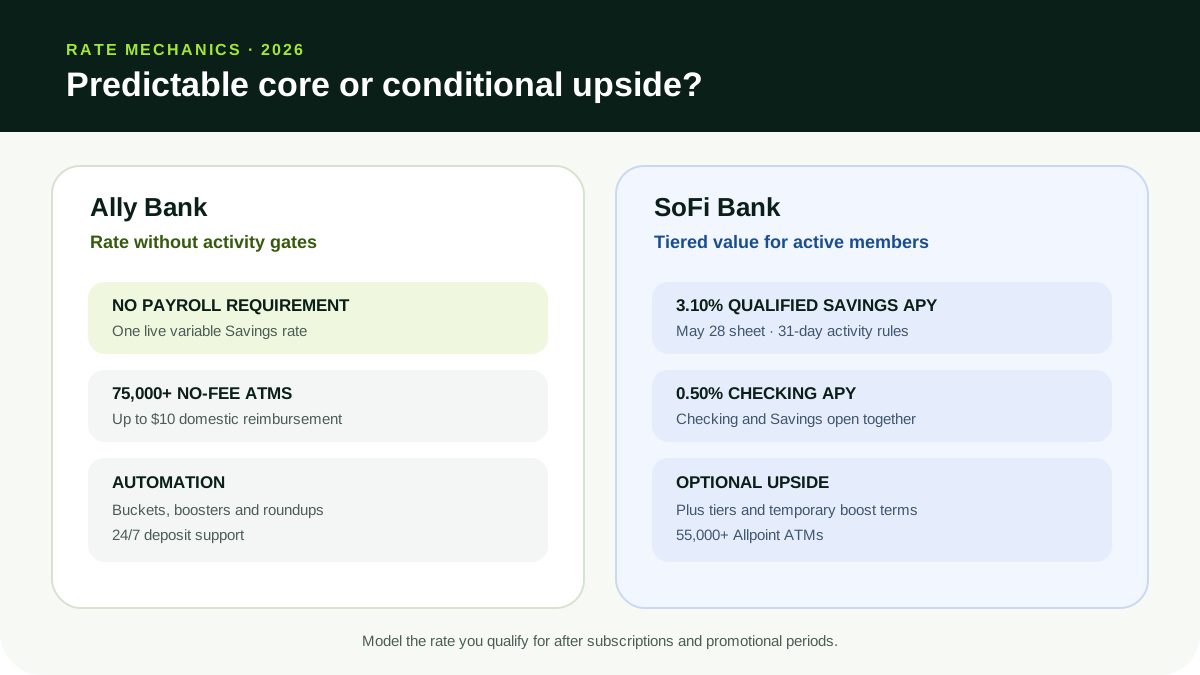
Savings APY: simple versus conditional
Ally Savings uses a variable APY across the balance and does not require a specific direct-deposit amount, monthly inflow, or paid plan to earn the rate shown on its live rate page. It also has no minimum opening deposit. That makes the account easy to model: current balance multiplied by the current APY approximates annual interest before tax.
SoFi's official rate sheet effective May 28, 2026 lists 3.10% APY on Savings for non-Plus customers who receive an eligible direct deposit or at least $5,000 in qualifying deposits every rolling 31 calendar days. Without eligible direct deposit, the qualifying inflow, or Plus membership, the sheet lists 0.80% APY. The difference is $230 a year on $10,000 before tax if those rates remained unchanged for a year.
The direct-deposit route has no published minimum amount for rate eligibility, but the deposit must be recurring income delivered through an eligible payroll, pension, benefits, or government source. A bank transfer, tax refund, peer-to-peer payment, or merchant payout is not automatically an eligible direct deposit. SoFi determines qualification and can request evidence.
The alternative is at least $5,000 in qualifying deposits every 31 days. That is a flow requirement, not a minimum balance. Moving the same money between a customer's own SoFi accounts does not qualify. Read the live APY Details screen because every new qualifying event resets the rolling period.
SoFi Plus and promotional rates
SoFi Plus adds another layer. Under the May 28 sheet, a paid Plus member with only an individual account can earn 4.50% APY on the portion of Savings at or below $20,000 and 3.10% on the portion above it. Joint-account and multiple-account scenarios have their own tables and thresholds. The resulting blended APY can be lower than the headline.
Separately, SoFi advertises a temporary 0.70-percentage-point boost for eligible new Checking and Savings customers, producing up to 3.80% on the underlying 3.10% rate for as long as six months under the published promotion. A temporary boost should be valued only for the qualifying months and only on the balance expected during that period.
Compare Plus subscription cost, the post-promotion rate, balance tiers, and any other Plus benefits you would genuinely buy. Paying for a rate can make sense on a sufficient balance, but the break-even calculation must use after-tax incremental interest rather than the headline APY.
Checking accounts
Ally's Spending Account has no monthly maintenance or overdraft fee and pays a tiered variable APY. It supports checks, bill pay, Zelle, early direct deposit, buckets for planned expenses, and roundups that can feed Savings.
SoFi Checking pays 0.50% APY on all balances under the current rate sheet, which is unusually clear for transaction money. Opening it automatically creates a Savings account. SoFi now provides physical checks at no cost through its app, plus bill payment, Zelle, early paycheck access, and card controls.
The paired-account rule is a real difference. Someone who wants only a standalone savings account may prefer Ally. Someone who wants checking, savings, lending, investing, credit, and member benefits in one interface may accept SoFi's bundled structure.
Fees and overdraft
Both core account sets have no monthly maintenance fee, no minimum-balance fee, and no bank overdraft fee. Other charges and partner fees can still apply. Read the fee sheet for wires, cash deposits, expedited services, returned items, and out-of-network ATMs.
SoFi's Overdraft Coverage is not universal. Its published checking terms limit the benefit to eligible debit-card purchases and require at least $1,000 in eligible direct deposits during the relevant 30-day evaluation period, subject to an account limit and repayment history. A declined item and an approved negative balance are different outcomes.
Ally offers CoverDraft and linked transfer options under its current terms. Neither program should replace a cash buffer. Turn on low-balance alerts, opt out of any coverage that encourages accidental spending, and understand which ACH or check transactions can still be returned.
ATM access
Ally publishes more than 75,000 no-fee Allpoint and MoneyPass ATMs in the United States and reimburses up to $10 per statement cycle for qualifying fees at other domestic ATMs. That is the stronger cash-withdrawal package for travelers who occasionally miss the network.
SoFi publishes more than 55,000 fee-free Allpoint ATMs. It does not promise the same recurring out-of-network reimbursement in its standard Checking terms; an ATM owner or another party can impose a fee outside the network.
Search actual locations before choosing. An ATM inside a pharmacy, warehouse club, or store can have access-hour or membership restrictions. Neither online bank substitutes for full teller service when large cash withdrawals, currency orders, medallion services, or immediate official checks are routine.
Cash and mobile deposits
Ally lets customers add cash to the Spending Account for free with an app barcode at participating Walmart Money Centers or service desks. Published limits apply, and cash cannot go directly into Savings, Money Market, or CDs through that workflow.
SoFi supports cash deposits through participating Green Dot retailers. Its help center says the partner can charge up to $4.95 per transaction. A person depositing $300 in cash twice a month could pay nearly $119 a year at the maximum fee, overwhelming a modest interest advantage.
Both support mobile check deposit subject to account eligibility, limits, holds, and endorsement rules. SoFi notes that some members may first need a qualifying deposit before mobile check deposit becomes available. Retain the original check until final credit and the bank's stated destruction date.
Savings organization
Ally allows up to 30 Savings buckets inside one account, plus recurring transfers, roundups, and Surprise Savings. Buckets are especially useful for an emergency fund, annual insurance premium, property tax, travel, and other irregular expenses. All bucket money earns the account rate.
SoFi uses Vaults for named savings goals. Its interface can automate transfers and show progress while keeping funds within Savings. The conceptual difference is small; Ally's implementation is more mature and its boosters make automation the center of the product.
Automation should remain visible. Review transfers, keep a checking buffer, and avoid letting an algorithm move money needed for taxes or scheduled bills. A high APY does not compensate for a returned payment.
Ecosystem and app design
SoFi's strongest non-rate advantage is its broader financial ecosystem. Banking sits beside personal and student lending, mortgages, investing, credit cards, insurance referrals, and member benefits. A customer who already uses several SoFi products may value a consolidated dashboard and faster internal movement.
The tradeoff is promotional density. Offers for other products can add friction, and investments are not bank deposits. FDIC insurance does not cover stocks, ETFs, crypto assets, or other securities merely because they appear in the same app.
Ally also offers auto lending, investing, credit cards, and mortgages, but its bank experience remains more clearly centered on deposits. Neither ecosystem is a reason to accept an unsuitable loan rate or investment product; compare each product independently.
FDIC insurance
Ally Bank and SoFi Bank are FDIC members. The ordinary federal limit is $250,000 per depositor, per insured bank, for each ownership category. Checking and savings owned by the same person in the same category at one bank are aggregated.
SoFi also offers an optional Insured Deposit Program that can sweep eligible funds to participating banks and advertises access to additional coverage up to $3 million, subject to program terms, allocation capacity, exclusions, and deposits the customer already holds at participating banks. Review the current bank list; outside deposits at the same receiving institution can reduce available coverage.
Use the FDIC EDIE tool for large, joint, trust, retirement, or multi-bank balances. “Up to” is not a personal coverage calculation.
Customer support
DollarScout scores Ally 4.5/5 for Customer Service and SoFi 4.2/5. Ally's deposit support line is available 24/7. SoFi offers phone and chat within published hours and integrates support into the app, but availability can depend on product and issue.
Test the support path before moving every bill. Ask a real question about ACH limits, beneficiaries, cash deposits, or mobile-check eligibility. Record case numbers and promised resolution dates when a transfer or fraud investigation is open.
Which bank should you choose?
Choose Ally Bank when you want a competitive variable savings rate without an activity gate, standalone account choice, stronger published ATM access, limited out-of-network reimbursement, mature savings automation, and 24/7 phone support.
Choose SoFi Bank when eligible direct deposit or $5,000 of qualifying 31-day inflows already happen, 0.50% checking interest matters, Vaults and early pay fit your routine, or the Plus and broader SoFi ecosystem produce enough verified value to offset their conditions.
Choose neither as the only bank when frequent teller service, large cash deposits, same-day wires, or branch problem-solving is essential. A local bank can handle physical transactions while one online bank holds savings.
Final verdict
Ally wins by being easier to keep optimized. Its core value does not disappear when payroll changes, and its ATM, reimbursement, automation, and support package is more forgiving. SoFi can beat it for a qualified, engaged member, but only after the exact rate table, rolling qualification window, subscription cost, cash-deposit fees, and balance tier are modeled correctly.
Which one is right for you?
- Best for Unconditional savings workflow and standalone account choice: Ally BankView Ally Accounts
- Best for Broader ATM access and limited domestic fee reimbursement: Ally BankView Ally Accounts
- Best for Qualified checking APY and integrated financial ecosystem: SoFi BankView SoFi Banking
- Best for Paid membership tiers or temporary new-customer rate boost: SoFi BankView SoFi Banking
Final verdict
Ally Bank is the better default because its core savings proposition is unconditional, its published ATM network is larger, it offers limited domestic out-of-network reimbursement, and its savings tools and 24/7 support reduce maintenance. SoFi Bank can be better for customers who reliably satisfy its rolling deposit rules or extract net value from SoFi Plus and the wider ecosystem.
Frequently asked questions
Sources and verification
Scores and product facts come from the underlying DollarScout reviews and were checked against these primary sources.
- Ally Bank current accounts and rates
- Ally Spending Account and ATM terms
- Ally Savings and Money Market FAQ
- Ally deposit and cash-addition FAQ
- Ally Bank Deposit Agreement
- SoFi Checking current features and disclosures
- SoFi Bank rate sheet
- SoFi high-yield Savings offer and promotion terms
- SoFi ATM network help
- SoFi cash-deposit help and partner fee
- SoFi Insured Deposit Program terms
- FDIC understanding deposit insurance
Related content
More from DollarScout on this topic.
