Many products on this page are from partners who compensate us. This doesn't influence our ratings. Our opinions are our own.
Ally Bank vs Discover Bank: 2026 Comparison
By Sophie Brown, Senior Finance Editor · Updated Jul 2026 · Fact-checked Jul 18, 2026
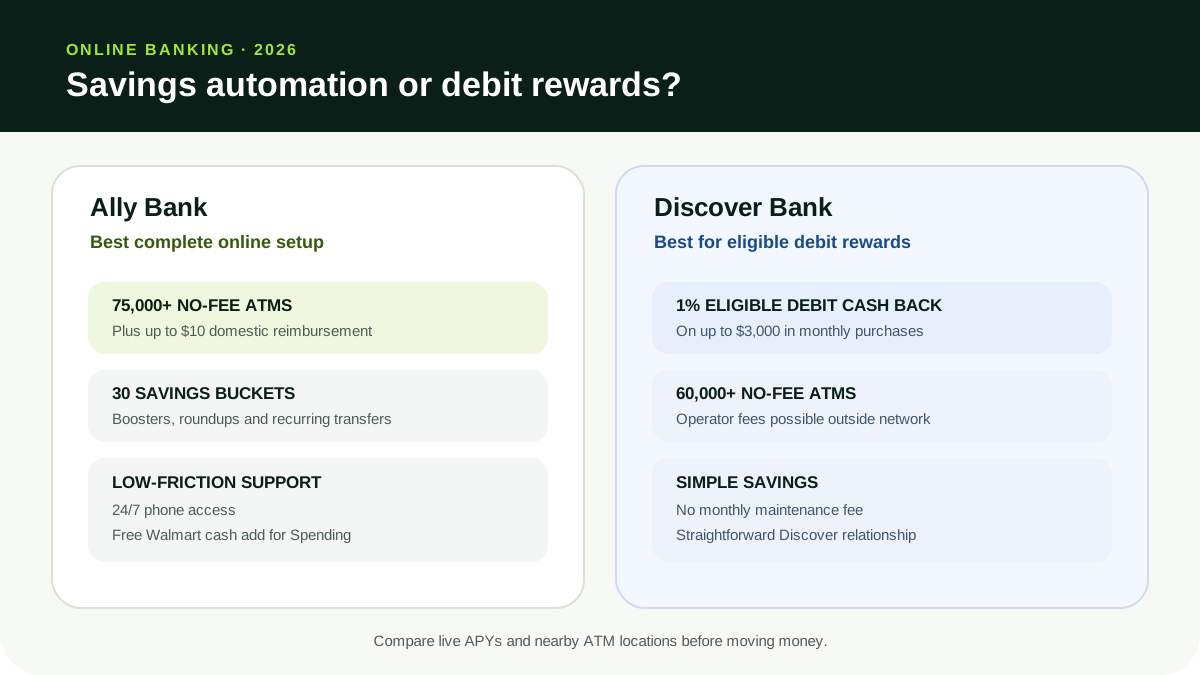
Ally Bank wins overall at 4.6/5 versus Discover Bank at 4.3/5. Both offer low-friction online banking without monthly maintenance fees on their flagship deposit accounts, but Ally has the stronger all-around system: 75,000+ no-fee ATMs, up to $10 per statement cycle in domestic out-of-network ATM reimbursements, 24/7 phone support, and unusually useful savings buckets and boosters. Discover remains compelling for debit-card users who can earn 1% cash back on up to $3,000 in eligible purchases each month. Choose Ally for a complete online checking-and-savings setup; choose Discover when debit rewards matter more than automation.
Head-to-head
| Feature | Ally Bank | Discover Bank |
|---|---|---|
| DollarScout Rating | 4.6/5 ★ | 4.3/5 ★ |
| Monthly Fee | $0 monthly maintenance fee and $0 minimum opening deposit for Ally Savings | Existing Discover deposit accounts continue with no account fees under the published merger FAQ |
| APY | Competitive variable APY shown on Ally’s live rates page; no minimum balance to earn it | Existing savings, money market, CD, and retirement accounts continue earning interest; verify the current statement and account portal |
| Deposit Insurance | Ally Bank deposits are FDIC-insured within ownership-category limits | Discover and Capital One deposits are now generally combined at Capital One, N.A. by ownership category |


Category-by-category breakdown
Fees
APY
Digital Experience
Access & ATM Network
Customer Service
Detailed analysis
The short answer
Ally is the better primary online bank; Discover is the better debit-rewards account. DollarScout rates Ally 4.6/5 and Discover 4.3/5. Ally leads on APY quality, ease of use, ATM access, and service in our scoring, while both earn excellent fee scores.
Neither is a traditional branch bank. The decision therefore turns on the online workflow around the account: how money arrives, how savings goals are organized, where cash is withdrawn or deposited, and what happens when support is needed.
| Decision factor | Ally Bank | Discover Bank |
|---|---|---|
| Flagship checking fee | No monthly maintenance fee | No monthly maintenance fee |
| Savings minimum | No minimum opening deposit on published Savings terms | No minimum deposit on published Online Savings terms |
| ATM access | 75,000+ Allpoint and MoneyPass ATMs; up to $10 domestic reimbursement per cycle | 60,000+ no-fee network ATMs; operator fees can apply outside the network |
| Standout tool | Up to 30 savings buckets plus automated boosters | 1% cash back on up to $3,000 in eligible monthly debit purchases |
| Cash deposits | App-generated barcode at participating Walmart service desks for Spending | Confirm current eligible methods before relying on cash deposits |
| Branches | None | None |
Savings accounts and APY
Ally Savings is the more developed savings product. It has no minimum opening deposit, applies its variable rate across the account balance, and lets customers divide one account into as many as 30 named buckets. Interest still accrues on the combined balance; a bucket is an organizational layer, not a separate uninsured subaccount.
Discover Online Savings also publishes no minimum opening deposit and no monthly maintenance fee. Its value proposition is simpler: a conventional online high-yield account attached to the Discover banking interface. That can be preferable for someone who wants a clean balance without behavioral prompts or automated transfers.
Do not compare only the large APY number. Calculate annual interest as balance multiplied by APY, then subtract any lost interest while funds are in transit and any fee at the funding bank. A 0.20-percentage-point difference is about $20 a year on $10,000 before tax. Workflow and reliability can be worth more than repeatedly chasing small rate moves.
Checking and debit rewards
Ally renamed its checking product the Spending Account. It pays interest under its current rate tiers, has no monthly maintenance or overdraft fee, offers bill pay and Zelle, and works closely with savings buckets. The account is designed to be the operating hub for an Ally savings system.
Discover Cashback Debit takes a different approach. It advertises 1% cash back on up to $3,000 in qualifying debit-card purchases per month, which creates a theoretical maximum of $30 monthly. ATM transactions, peer-to-peer payments, loan payments, account funding, and other excluded transaction types do not qualify; returns or reversals can reduce rewards.
Debit rewards should not encourage weaker payment security or overspending. A credit card can provide a grace period and stronger practical separation from the checking balance, but only when paid in full. Discover's cash back is most relevant for a person who intentionally uses debit and whose normal merchants code as eligible purchases.
Fees and minimums
Both banks are strong on routine fees. Their flagship checking and savings accounts avoid monthly maintenance charges and minimum-balance hurdles. That makes either materially simpler than an account that requires recurring deposits or a relationship balance merely to avoid a monthly fee.
“No monthly fee” does not mean every service is free. Outgoing wires, expedited delivery, stop payments, returned deposits, cashier's checks, and uncommon account services can have separate rules. Read the current fee schedule and deposit agreement, not just the marketing page.
Overdraft treatment also matters. A bank may decline a transaction, transfer from a linked account, or approve an item under its policy. The absence of an overdraft fee does not make the negative balance free money: the customer still owes the deficit, and repeated problems can restrict the account.
ATM access
Ally publishes access to more than 75,000 Allpoint and MoneyPass ATMs in the United States. It also reimburses up to $10 per statement cycle for fees charged by other domestic ATM owners. The reimbursement is useful in a location with poor network coverage, although international and other excluded fees need separate review.
Discover publishes more than 60,000 no-fee network ATMs. A machine outside that network can add its own operator surcharge even when Discover does not impose a bank fee. Always check the locator immediately before a withdrawal because third-party machines can enter or leave a network.
Network size is not the same as local convenience. Search home, work, regular travel routes, and any rural destination. If the nearest listed machine is inside a store with limited hours, the nominal network advantage may not be useful.
Depositing cash and checks
Ally now supports free cash additions to the Spending Account through an app-generated barcode at participating Walmart Money Centers or customer-service desks. Published limits include $20 to $999 per transaction, up to $1,000 per day, and five cash-add transactions per month. Cash cannot be mailed or deposited at an Ally ATM, and the barcode workflow currently applies to Spending rather than Savings, Money Market, or CDs.
Both banks support mobile check deposit subject to eligibility, limits, holds, image quality, and funds-availability rules. A displayed balance is not always available to spend. Preserve the paper check until the deposit is accepted and the bank's retention period passes.
Anyone paid heavily in cash should test the nearest eligible location before making either account primary. A local credit union or branch account can serve as a cash intake account while Ally or Discover holds savings.
Savings automation
Ally's clearest advantage is automation. Buckets label goals inside one savings account. Recurring transfers, roundups from the Spending Account, and Surprise Savings can move money automatically. Surprise Savings analyzes linked checking activity and transfers amounts it considers safe, subject to Ally's published limits and controls.
Automation is helpful only when it is predictable. Start with a small recurring amount, keep a checking buffer, turn on balance alerts, and review the first month of transfers. A tool that moves money before a rent or tax payment can cause more harm than the extra interest helps.
Discover offers scheduled transfers and ordinary online savings management without the same bucket-and-booster emphasis. That restraint can be an advantage for customers who already budget elsewhere and do not want another automated decision layer.
Withdrawal limits and transfer timing
Ally currently limits certain savings withdrawals and transfers to 10 per statement cycle. It says it does not charge an excessive-transaction fee, but may close an account when the limit is exceeded more than occasionally. Bucket-to-bucket movements do not themselves move money out of the account.
Discover's deposit agreement controls its transaction limits, external transfers, holds, and account-closure rights. For either bank, an ACH transfer can take multiple business days and a new external link may require verification. Keep near-term bills in checking instead of assuming high-yield savings is instantly available.
Test transfers in both directions before closing an old bank. Confirm daily and monthly limits, cutoff times, weekend treatment, and whether an outbound transfer initiated at the receiving bank is faster or slower.
Customer support and account ownership changes
Ally provides phone support 24 hours a day, seven days a week. DollarScout scores its Customer Service at 4.5/5 versus Discover's 4.3/5. Wait times and outcomes still vary, so evaluate support with the problems that matter: a locked debit card, disputed ACH, mobile-deposit hold, wire, or beneficiary change.
Capital One completed its acquisition of Discover Financial Services in 2025 and is moving Discover deposit products in stages. Capital One says Discover Online Savings will become 360 Performance Savings and that customers will receive advance instructions; other accounts can move on different schedules. Until a notice arrives, use the currently assigned site and agreement rather than guessing at a migration date.
Capital One also states that Capital One and Discover deposits became jointly insured as of November 18, 2025. Customers holding both brands must aggregate applicable balances and use the FDIC estimator rather than assuming two names create permanent separate insurance limits.
FDIC insurance
Ally Bank and Discover Bank deposit accounts are FDIC-insured subject to the federal rules. The standard limit is $250,000 per depositor, per insured bank, for each ownership category. Checking and savings at the same bank in the same single-owner category are combined for that limit; creating multiple buckets or accounts does not multiply coverage.
Different ownership categories can receive separate coverage when all requirements are satisfied. Large balances, trusts, joint accounts, beneficiaries, or deposits affected by a bank merger deserve a calculation in the FDIC's EDIE tool rather than a rule-of-thumb estimate.
Which bank should you choose?
Choose Ally Bank when you want one online system for spending and savings, goal buckets, automated saving, a larger published ATM network, limited domestic ATM-fee reimbursement, and round-the-clock phone access.
Choose Discover Bank when eligible debit-card spending is substantial, 1% cash back will be used naturally, and you prefer a simpler savings workflow inside an existing Discover relationship.
Choose a branch bank or credit union instead when cash deposits are frequent, in-person help is important, same-day official checks or wires are routine, or local ATM availability is poor. A two-bank setup can combine local cash service with online yield.
Final verdict
Ally wins because its low-fee accounts form a more complete system. Savings buckets, boosters, 75,000+ no-fee ATMs, up to $10 in domestic out-of-network reimbursement, and 24/7 support solve more everyday problems. Discover remains a credible alternative, especially when its eligible debit cash back produces more certain value than Ally's organization tools.
Which one is right for you?
- Best for Automated saving, buckets, and a complete online-bank workflow: Ally BankView Ally Accounts
- Best for Broader published ATM access and limited out-of-network reimbursement: Ally BankView Ally Accounts
- Best for Eligible debit-card cash back: Discover BankCheck Current Accounts
- Best for Simple savings inside an existing Discover relationship: Discover BankCheck Current Accounts
Final verdict
Ally Bank is the stronger 2026 default for online banking because it combines low-fee checking and savings with goal automation, broader published ATM access, limited domestic ATM-fee reimbursement, and 24/7 support. Discover Bank is the better specialist choice for customers who already use debit heavily enough to benefit from its eligible 1% cash-back program.
Frequently asked questions
Sources and verification
Scores and product facts come from the underlying DollarScout reviews and were checked against these primary sources.
- Ally Bank current accounts and rates
- Ally Spending Account features and ATM terms
- Ally Savings and Money Market FAQ
- Ally deposit and cash-addition FAQ
- Ally Bank Deposit Agreement
- Discover Online Banking accounts
- Discover online banking features and debit rewards
- Discover National Deposit Account Agreement
- Capital One Discover acquisition FAQ
- Capital One Discover savings transition and joint insurance notice
- FDIC understanding deposit insurance
- FDIC Electronic Deposit Insurance Estimator
- CFPB bank accounts and services
Related content
More from DollarScout on this topic.
