
AARP membership at a glance
AARP is a U.S. nonprofit, nonpartisan membership organization whose mission and advocacy focus on people age 50 and older. Membership itself is broader: anyone age 18 or older may join. The paid membership combines a benefits program, publications, digital and local resources, selected discounts, a rewards program, and participation in an organization that advocates on issues affecting older Americans.
It is important to separate those layers. AARP produces information, programs, publications, and advocacy, but many commercial member benefits are supplied by unaffiliated companies. Joining AARP does not mean AARP becomes the insurer, bank, travel agency, wireless carrier, or retailer behind every offer in its directory.
| Review question | DollarScout finding |
|---|---|
| Best for | Adults 50-plus and households that can identify several benefits or resources they will actually use |
| Price checked | $15 for the first year with automatic renewal; $20 standard annual rate |
| Eligibility | Anyone age 18 or older, subject to benefit-specific restrictions |
| Household access | One secondary membership for another adult in the household at no added cost |
| Main strength | Exceptional breadth for a low annual price |
| Main limitation | Savings and eligibility vary, and many commercial offers use separate third-party terms |
What AARP is—and what membership buys
AARP says it was founded in 1958 and describes itself as a nonprofit, nonpartisan organization serving Americans age 50-plus and their families. Its work includes advocacy around Social Security, Medicare, prescription-drug costs, caregiving, fraud prevention, financial security, and age-related issues. It also publishes information and tools across health, money, work, travel, technology, entertainment, and daily life.
The annual membership is not simply a discount card. It includes access to member benefits, a subscription to AARP The Magazine and AARP Bulletin, member-only digital material, a secondary household membership, and enhanced participation in AARP Rewards. Some information, tools, games, events, and advocacy resources are available to registered users or the public, so a shopper should not assume every AARP page requires payment. The membership decision should focus on benefits or material that are genuinely member-only.
Nor is membership an insurance policy or financial account. AARP’s official description explains that it is not an insurance company and that products carrying the AARP name can be offered by third parties. A member considering auto, life, Medicare, dental, banking, credit-card, identity-protection, travel, or other partner products must evaluate the actual provider, price, eligibility, contract, licensing, complaint process, and privacy policy. The AARP relationship is relevant context, not a substitute for product-level due diligence.
Price, terms, and automatic renewal
Value scores 4.6/5. On July 19, 2026, AARP’s public membership page displayed $15 for the first year when the member enrolls in automatic renewal, compared with a $20 standard annual rate. The page also listed multi-year options. Promotional messages can differ by campaign or timing, so the amount shown during final enrollment is the authoritative charge.
The first-year figure should not be described as a permanent $15 price. It is tied to automatic renewal and presented as a saving from the standard rate. AARP’s FAQ says an automatic-renewal member receives a reminder before the charge, and the membership pages say renewal can be cancelled. A careful buyer should save the confirmation, record the renewal date, and verify the amount shown for the next term rather than projecting the introductory price indefinitely.
The low standard price makes the value threshold achievable. At $20 per year, an eligible hotel, restaurant, wireless, auto-service, entertainment, or shopping discount could cover the dues. That does not mean every member will save money. A discount has no economic value if it causes an unnecessary purchase, is available publicly, loses to a better coupon, requires a more expensive booking channel, or applies only to a product the member would not otherwise choose.
The free secondary household membership improves the calculation. Two adults can use eligible member benefits under one paid primary membership. It does not make every benefit transferable, double every discount, or override provider limits. Each offer controls who can redeem it, how often it can be used, and whether the secondary member must present a card or use a registered account.
Who can join
AARP’s age-requirement page states that anyone 18 or older can become a member. This is frequently misunderstood because AARP’s mission, content, and advocacy center on the 50-plus population. An adult under 50 can join and use benefits that are not restricted by law or contract.
That final qualification matters. Some insurance products, health programs, local offers, events, or other benefits may have age, residency, availability, underwriting, purchase-channel, or legal requirements. Membership does not guarantee eligibility for every displayed product. It also does not guarantee that an offered insurance product is available or appropriate for a particular person.
The strongest fit remains an adult approaching or over 50 who values both the commercial benefits and the organization’s aging-related resources. Younger adults can still find travel, dining, shopping, technology, entertainment, or household value, but they should check the exact benefits they intend to use instead of joining on the strength of the overall catalog.
Benefit breadth
Benefit Breadth receives 4.8/5, the highest category score. AARP’s current directory spans travel, restaurants, shopping and groceries, gas and auto services, entertainment, technology and wireless, home services, work and finances, insurance, health and wellness, family caregiving, advocacy and community, publications, and educational resources. The AARP Now app can hold a digital membership card and help members find benefits and events, while AARP Rewards adds activities and redemption opportunities under separate program rules.
The catalog’s range is genuinely useful because it mixes frequent expenses with occasional decisions. Restaurant, hotel, car-rental, fuel, wireless, and retail offers can create repeat use. Caregiving guides, fraud resources, job material, retirement tools, webinars, local events, and publications may provide non-cash value even when no coupon is redeemed.
Breadth can also create noise. A directory containing hundreds of offers is not the same as a wallet containing hundreds of savings. Some offers require a code, member login, reservation channel, linked loyalty account, advance purchase, minimum spend, specific location, or presentation of the membership card. Some discounts cannot be combined with other promotions. Some benefits are available without membership. Offers can be added, changed, or removed.
A practical evaluation should begin with five repeatable needs, not the full directory. Search the current catalog for the household’s actual hotel brands, restaurants, phone provider, auto services, prescriptions, entertainment, caregiving situation, or financial-research tools. Open the detailed terms for each candidate and compare it with the best price available outside AARP. Only then estimate annual value.
Third-party providers and royalties
Terms & Partner Transparency scores 4.0/5. AARP’s current member-benefits guide states that some benefits are provided by third parties rather than AARP or its affiliates. It also discloses that some providers pay a royalty fee for the use of AARP intellectual property and that those amounts support AARP’s general purposes. AARP’s privacy site publishes a list of licensed service providers with which it shares limited categories of member personal data for contracted products, services, or discounts.
Those are meaningful disclosures. They explain why an AARP-branded insurance or financial offer can be operated by another company and why a member may leave AARP.org for a provider site. AARP’s outbound notice says the external site will use a different privacy policy and terms of service.
The score stops at 4.0 because the relationship is easy to miss when a user focuses on the familiar AARP name or the discount headline. The material terms are distributed across the benefit page, provider site, privacy policy, licensed-provider list, and sometimes product-specific disclosures. DollarScout would prefer every commercial benefit page to make the operating company, AARP’s role, material compensation relationship, key eligibility limits, data sharing, and complaint owner immediately visible in one compact panel.
For the member, the correct sequence is straightforward: identify the provider, read its terms, compare the total price, review the privacy notice, and determine who will handle service or claims. AARP membership alone should never be treated as proof that a third-party product is the cheapest, safest, or best fit.
Ease of use and access
Ease of Use earns 4.4/5. Members can obtain immediate digital access after joining, use a digital card, print a card, or request a physical card. The website groups benefits by category, and the AARP Now app centralizes the card, content, benefits, and local information. A free secondary household membership can be added and managed through the membership account.
The main friction is not basic enrollment; it is redemption across a large partner ecosystem. A member may need to move between AARP and a provider, copy a code, sign into another loyalty program, call a number, book through a designated portal, or show a card in person. The steps and cancellation owner vary by offer. A saved-benefits list and a small household reference note can be more useful than browsing the full catalog each time.
The AARP name also appears across membership, free registration, rewards, publications, advocacy, foundation work, and commercial benefits. These are related but not interchangeable. A user should pay attention to whether an item is member-only, public, supplied by AARP, or fulfilled by a third party.
Privacy and data sharing
AARP maintains a detailed privacy policy describing information collection, advertising and analytics, communications, disclosures, licensed service providers, and consumer choices. Its separate licensed-provider list says limited types of member personal data can be shared with unaffiliated entities that make AARP-branded products, services, or discounts available. Those providers are required to use the data for the contracted offering, according to AARP’s description.
The scope can change when a member actively applies for a partner product. An insurance quote, bank account, health product, travel booking, or identity-protection service can require information far beyond a membership record, and the receiving company’s policy will govern that interaction. The member should read the provider’s notice before submitting sensitive data and should not assume preferences selected in an AARP account automatically control a separate provider account.
Customer service, cards, and cancellation
Customer Service receives 4.0/5. AARP publishes account self-service, membership FAQs, online help, a telephone contact number, digital-card access, printed-card options, and replacement-card support. Its FAQ explains how to add or update the secondary household member and manage automatic renewal.
We cap the score because DollarScout did not call, submit a ticket, request a refund, replace a card, or measure resolution time. More importantly, support responsibility can split when a third-party benefit is involved. AARP can help with membership access or account details, while the provider may control a reservation, policy, product, bill, claim, refund, or service complaint. The benefit’s terms should identify the correct channel before a member shares account information.
Cancelling automatic renewal is not the same as cancelling every third-party product obtained through a benefit. A member who bought an insurance policy, subscription, travel reservation, or other partner service must follow that provider’s cancellation and billing rules separately.
How to decide whether AARP is worth it
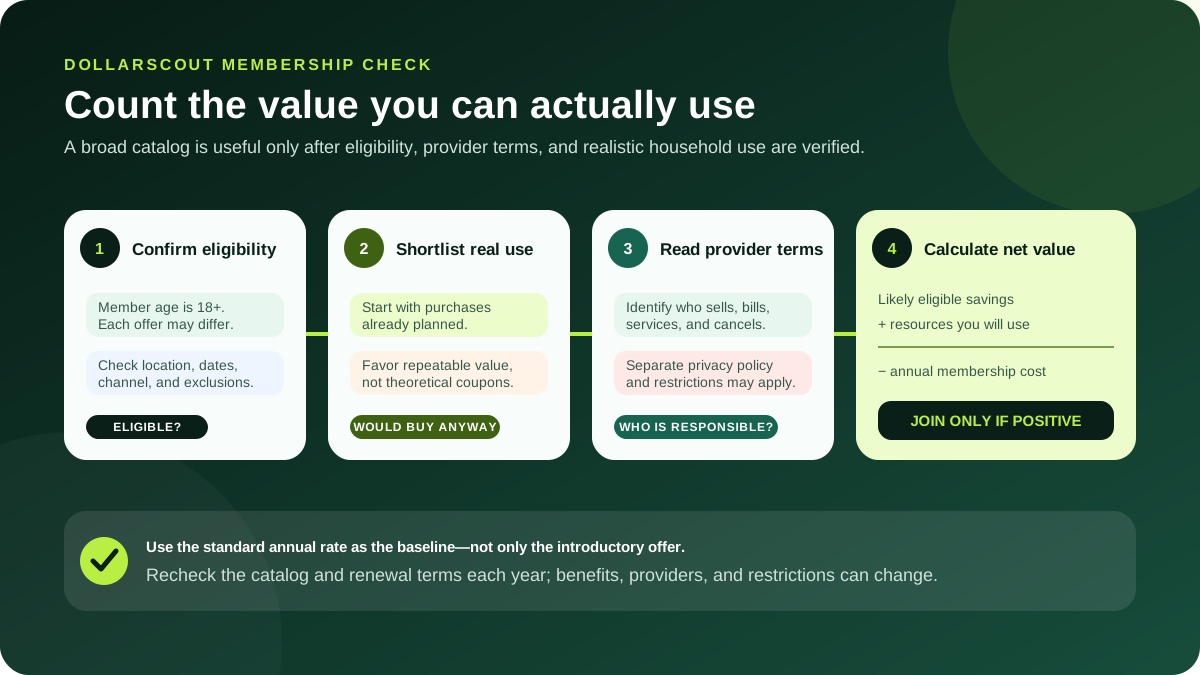
Use a conservative calculation:
- Start with the standard annual rate, not only the introductory offer.
- List benefits tied to purchases or needs already planned.
- Verify eligibility, location, dates, booking channel, exclusions, and stacking rules.
- Compare the AARP price with the best public, loyalty-program, employer, credit-card, or direct price.
- Count only savings likely to be redeemed, then add non-cash resources you genuinely value.
- Set a renewal reminder and repeat the check before the next charge.
A household that can document $40 of repeatable annual savings has a comfortable margin over a $20 standard membership. A household that can identify only a theoretical $10 hotel discount on a trip it may not take does not yet have a value case. Advocacy, publications, fraud resources, caregiving tools, events, and educational material may still justify joining, but that is a personal benefit judgment rather than measurable cash savings.
Who should join
AARP is a strong fit for:
- Adults 50-plus who want aging, caregiving, retirement, health, fraud, and advocacy resources alongside discounts.
- Households with two adults who can use the included secondary membership.
- Travelers, diners, drivers, shoppers, or technology users who can identify eligible repeatable offers.
- People who will use AARP publications, digital resources, webinars, rewards, or local programming.
- Caregivers and families looking for practical information as well as commercial benefits.
It is easier to skip or delay when:
- You cannot identify a current member-only benefit or resource you expect to use.
- A public coupon, direct booking, employer plan, credit-card benefit, or competing membership is consistently better.
- You expect membership to guarantee eligibility for insurance, health, or financial products.
- You do not want automatic renewal and have not selected or confirmed a non-renewing term.
- You are unlikely to review third-party terms before purchasing.
Bottom line
AARP earns 4.4/5 because it combines a low standard price, unusually broad benefit categories, a second household membership, publications, and substantial practical resources. Benefit Breadth and Value lead the score. Ease of Use is strong at the membership level, while partner redemption adds friction. Transparency is supported by real third-party, royalty, and privacy disclosures, but consumers must actively connect those disclosures to individual offers. Customer Service is based on documented channels, not response-time testing.
The membership is worth considering when the household can name the benefits and resources it will use before enrolling. Treat the $15 first-year offer as an automatic-renewal promotion, budget from the $20 standard rate, and verify the final checkout. For every partner product, identify who provides it and compare the full terms independently. AARP membership can open the door to value; it does not make every offer behind that door the right purchase.
