Many products on this page are from partners who compensate us. This doesn't influence our ratings. Our opinions are our own.
Lemonade vs Allstate: 2026 Insurance Comparison
By Sophie Brown, Senior Finance Editor · Updated Jul 2026 · Fact-checked Jul 19, 2026
Allstate earns 4.4/5 overall and is the stronger choice for broad auto-and-property bundling, agent support, complex homes, and households needing multiple endorsements. Lemonade earns 4.1/5 and is better for an eligible renter with straightforward coverage who values app-first purchase and claim intake. Lemonade wins price, Allstate wins coverage, discounts, and customer service, and claims experience is a tie in DollarScout's rubric.
Head-to-head
| Feature | Lemonade | Allstate |
|---|---|---|
| DollarScout Rating | 4.1/5 ★ | 4.4/5 ★ |
| Pricing | Lemonade reports renters prices starting at $5/month and an average around $16/month as of January 2026; the actual premium depends on state, address, risk, coverage, limits, deductible, underwriting, and discounts | Personalized premium based on state, driver or property risk, coverage, deductibles, discounts, underwriting, and purchase channel; Allstate states auto price can vary online, by call center, or through an agent |
| Coverage Types | Renters, homeowners, condo, car, pet health, and term life; product, policy form, underwriting company, optional coverage, and bundle eligibility differ by state | Auto, homeowners, renters, condo, landlord, motorcycle, ATV, boat, umbrella, business, life, identity, and other products; selected RV, pet, event, travel, flood, and specialty offers route to affiliates or partners |
| Availability | Not every product is nationwide: Lemonade Car is currently listed in AZ, CA, CO, IL, IN, OH, OR, TN, TX, and WA; homeowners is listed in 24 states plus D.C.; verify the live address quote | Allstate agents serve all states and D.C., but product, underwriting company, new-business eligibility, discounts, Drivewise, Milewise, coverage, and price vary by state, channel, and risk |


Category-by-category breakdown
Price
Coverage
Claims Experience
Discounts
Customer Service
Detailed analysis
The short answer
Choose Lemonade for simple app-first renters insurance; choose Allstate for a broader agent-supported household relationship. DollarScout rates Allstate 4.4/5 overall and Lemonade 4.1/5. Lemonade leads price. Allstate leads coverage, discounts, and customer service. Claims experience is a tie because the 0.2-point score gap is treated as a tie under the comparison rubric used for this page.
| Decision factor | Lemonade | Allstate |
|---|---|---|
| Best starting use | Straightforward renters policy | Auto, home, renters, or multi-policy household |
| Service model | App-first, digital purchase and claim intake | Agent, phone, web, and app |
| Advertised renters entry price | Starts at $5/month; personalized quote required | Starts at $5/month; personalized quote required |
| Coverage breadth | Renters, home, condo, car, pet, term life; availability varies | Broad personal, property, vehicle, identity, life, and business options |
| Discounts | Simpler menu, including eligible bundles and protective devices | Broader multi-policy and state-specific menu |
| Best fit | Eligible renter comfortable self-serving | Household with complex or multiple policies |
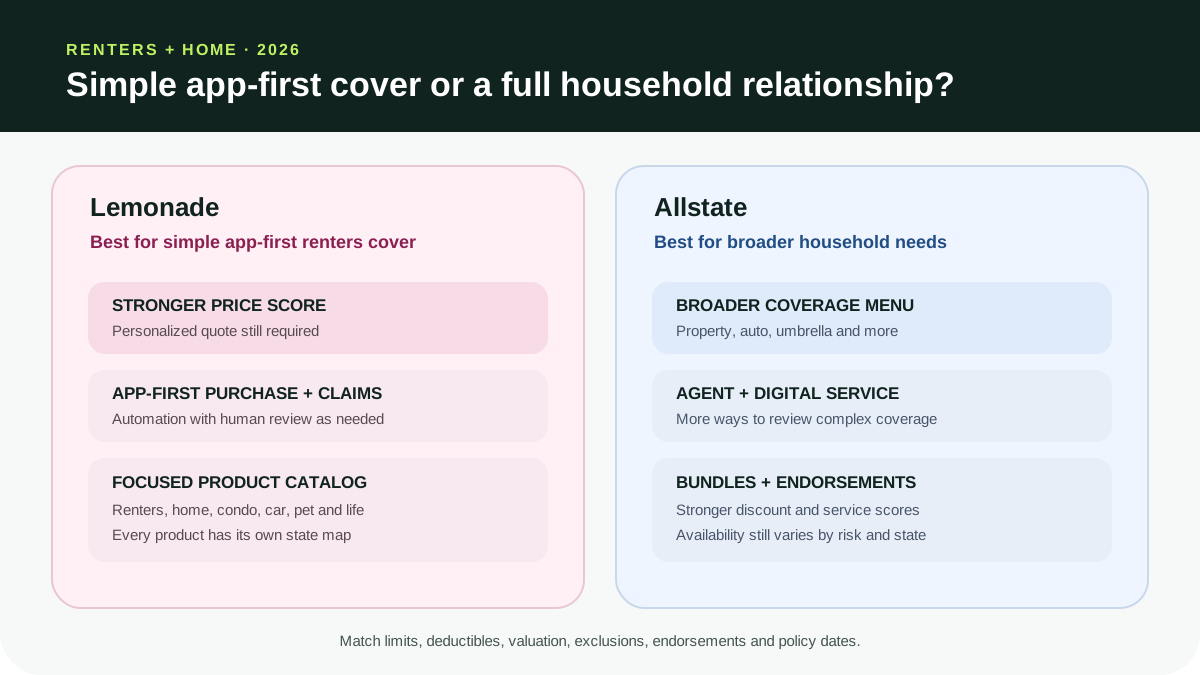
Price: Lemonade wins, but quote details decide
DollarScout scores Lemonade 4.4/5 and Allstate 4.0/5 for price. Lemonade's lean digital model and low advertised renters entry point make it the price winner. Lemonade also reports an average renters price around $16 per month as of January 2026, but that figure is descriptive—not a quote for the reader.
Allstate also markets renters policies starting at $5 per month. The apparent tie in marketing does not establish equal coverage. A premium depends on address, building, local loss exposure, occupancy, prior claims, property and liability limits, deductible, valuation, endorsements, discounts, payment choice, underwriting company, and state rules.
Compare the annual total, not only a monthly installment. Identify policy and installment fees, required down payment, automatic-renewal terms, and whether a bundle discount changes another policy's price. A $4 monthly difference is only $48 annually; a valuation or sublimit difference can be worth far more after a loss.
Coverage breadth: Allstate wins clearly
Lemonade sells renters, homeowners, condo, car, pet health, and term life products, with product-specific state availability and underwriting entities. That set can work well for a renter who later adds a pet or, in an eligible state, car coverage. It does not match Allstate's overall breadth.
Allstate offers auto, homeowners, renters, condo, landlord, motorcycle, ATV, boat, umbrella, identity, business, and life options, plus selected products placed through affiliates or partners. A household with several vehicles, rental property, a home-based business, high liability needs, or specialty items has more routes to assemble coverage and obtain agent guidance.
Product breadth is not proof that one bundled contract covers everything. Confirm the insurer named on each declarations page, particularly for partner products, and document separate claims contacts and deductibles.
What a renters policy generally covers
Both renters offerings can include personal property, personal liability, guest medical payments, and additional living expense or loss-of-use coverage for a covered loss, subject to policy limits, exclusions, and conditions. A landlord's property policy generally does not insure the tenant's belongings or personal liability.
Standard renters coverage does not mean every cause or item is covered without limits. Flood and earthquake losses are commonly excluded or require separate coverage. Jewelry, art, collectibles, firearms, business property, water backup, identity fraud, and certain electronics can have sublimits or need endorsements. Roommates are not automatically insured merely because they share an address.
Create a home inventory with photographs, serial numbers, purchase evidence, and estimated replacement cost. Then select a personal-property limit based on the inventory rather than the smallest default offered by a quote flow.
Replacement cost vs actual cash value
Lemonade states that its renters personal-property coverage uses replacement cost under current product explanations, subject to the policy and deductible. That means a covered item is valued without simply deducting depreciation, though the claim process, limit, sublimit, and replacement documentation still matter.
Allstate explains that the declarations and policy indicate whether property uses actual cash value or a reimbursement provision. Do not assume the least expensive quote includes the desired valuation. Actual cash value generally subtracts depreciation; replacement cost value generally pays the cost of a like-kind replacement under policy conditions.
The NAIC warns that valuation can materially change a claim payment. Ask each company how settlement works before and after replacement, what deadline applies to replacement-cost reimbursement, and whether roofs or selected property use different valuation.
Deductibles, limits, and exclusions
A deductible is the portion of a covered property loss the policyholder pays before insurance contributes. A higher deductible can reduce the premium but should remain affordable after an emergency. Liability and guest-medical claims can operate differently, so read the policy rather than applying the property deductible to every scenario.
Match personal-property, liability, medical, and loss-of-use limits across quotes. For homeowners coverage, also match dwelling, other structures, ordinance or law, roof settlement, water backup, service line, equipment breakdown, and extended replacement features where relevant.
Neither a chatbot nor an agent's summary replaces the policy. Save the quote, application, declarations, endorsements, and full contract, and ask for ambiguous answers in writing.
Claims: a tie with different experiences
Lemonade scores 4.2/5 and Allstate 4.4/5 for claims experience. DollarScout treats that difference as a tie rather than creating a winner from a narrow editorial margin. Lemonade's advantage is rapid app-based intake: the policyholder can explain the loss, submit information, and receive automated handling for some straightforward claims. Automation does not guarantee instant approval, and complex or higher-risk claims can be sent to human review.
Allstate supports claim reporting and tracking through its app, online account, phone service, and claims personnel. Its broader field and agent-supported structure can be more comfortable for a large home loss, temporary housing, contractor estimates, or a claim spanning several coverages. The local sales agent is not necessarily the adjuster or decision-maker.
For either insurer, mitigate further damage when safe, document the scene, preserve damaged property unless instructed otherwise, keep temporary-expense receipts, and ask the adjuster to confirm coverage, deductible, inventory requirements, and deadlines.
Digital service vs agent service
Lemonade is built for a customer who wants to quote, buy, change, and begin a claim in an app. That can remove scheduling and paperwork friction for a conventional renter with a simple inventory and no unusual exposure. A buyer who dislikes automated intake or wants a person to identify missing endorsements may find the model too self-directed.
Allstate combines local agents with centralized phone, web, app, and chat options. An agent can be useful when coordinating auto, home, umbrella, landlord, life, and identity products or explaining property endorsements. Office responsiveness and expertise still vary, and an agent relationship does not alter the written policy.
DollarScout scores Allstate 4.4/5 versus Lemonade 4.0/5 for customer service because Allstate offers more ways to obtain human help. Test both before purchase with a specific question about a valuable item, roommate, home business, water backup, dog liability, or replacement-cost settlement.
Discounts and bundles: Allstate wins
Allstate scores 4.6/5 and Lemonade 3.9/5 for discounts. Allstate offers a broader menu that can include multi-policy, protective-device, claims-free, responsible-payer, new-home, early-signing, automatic-payment, and other state-specific opportunities. Eligibility, duration, and covered portions vary.
Lemonade offers eligible bundles and can recognize protective devices or other underwriting factors, but its menu is intentionally simpler and depends heavily on product and state availability. Bundling renters with pet or another Lemonade product should be priced as a final total, not judged by a percentage alone.
Ask for the dollar value of every discount and what happens at renewal. A bundle can create a lower combined price, but it can also make switching one policy harder. Compare the bundle against the best separate-policy combination.
Availability is product-specific
Lemonade's company presence should not be confused with nationwide availability for each policy. Lemonade Car is currently listed in Arizona, California, Colorado, Illinois, Indiana, Ohio, Oregon, Tennessee, Texas, and Washington. Homeowners is listed in 24 states plus the District of Columbia. Renters, condo, pet, and life have their own state and eligibility maps. The address quote is the controlling check.
Allstate agents serve all states and D.C., and its renters page describes nationwide availability, but products, underwriting companies, new-business appetite, discounts, and endorsements still vary by location and risk. Catastrophe-exposed property can have special deductibles or limited new-policy availability.
Never cancel current insurance until the replacement policy is issued and its effective date, property address, named insureds, mortgagee or interested party, coverage, limits, deductibles, and endorsements are correct.
Lemonade Giveback is not a customer refund
Lemonade's Giveback program can direct a portion of unused premium associated with eligible groups to selected charitable causes, subject to company rules. Lemonade's current terms say Giveback is discretionary, can be changed, and is not a contractual obligation to the policyholder.
Do not subtract a projected Giveback from the premium or treat it as cash back. Choose the policy on coverage, price, claims process, underwriting company, and service fit. The charitable mechanism can be a preference, but it is not policyholder protection.
Which customers should choose Lemonade?
Choose Lemonade for an eligible renter with standard personal property, comfort with digital self-service, a preference for fast onboarding, and a written quote that provides the needed replacement-cost terms, limits, endorsements, and deductible at a good price.
It is less suitable for a complex home, extensive scheduled property, several business or vehicle risks, limited product availability, or a customer who wants an agent to review the complete household.
Which customers should choose Allstate?
Choose Allstate for a household bundling auto and property, a homeowner who needs endorsement guidance, a landlord or umbrella customer, someone wanting a local agent, or a family with several insurance needs. Its wider coverage and discount categories justify the higher overall rating.
Allstate is not automatically better when the risk is simple. A renter who receives equivalent coverage from Lemonade at a materially lower price and prefers app service can rationally choose Lemonade.
Final verdict
Allstate wins overall because it can support more complex property, auto, liability, and household needs through a broader catalog and several service channels. Lemonade wins the focused use case of simple, eligible, app-first renters insurance. Compare the actual declarations—not starting prices—and pay particular attention to property valuation, exclusions, sublimits, deductible, insurer, and state availability.
Which one is right for you?
- Best for Simple eligible renters policy bought and managed in an app: LemonadeGet a Quote
- Best for Digital-first customer with straightforward property: LemonadeGet a Quote
- Best for Auto-and-property bundle or complex household: AllstateGet a Quote
- Best for Agent guidance, endorsements, landlord, or umbrella needs: AllstateGet a Quote
Final verdict
Allstate wins 4.4/5 to 4.1/5 for broad household coverage, agent access, bundles, endorsements, and multiple service channels. Lemonade is the better focused option for an eligible renter who wants a simple app-first experience and receives equivalent coverage at a lower final premium. Claims experience is a tie under the rubric.
Frequently asked questions
Sources and verification
Scores and product facts come from the underlying DollarScout reviews and were checked against these primary sources.
- Lemonade renters insurance
- Lemonade renters and homeowners FAQ
- Lemonade renters insurance coverage FAQ
- Lemonade claims process
- Lemonade product availability
- Lemonade terms of service and Giveback terms
- Allstate renters insurance
- Allstate renters declarations guide
- Allstate homeowners insurance
- Allstate claims
- Allstate claims FAQ
- Allstate help and support
- Allstate insurance products
- NAIC replacement cost vs actual cash value
- NAIC renters insurance consumer guidance
Related content
More from DollarScout on this topic.
