Many products on this page are from partners who compensate us. This doesn't influence our ratings. Our opinions are our own.
How to File an Insurance Claim
By Sophie Brown, Senior Finance Editor · Updated Jul 2026 · Fact-checked Jul 18, 2026
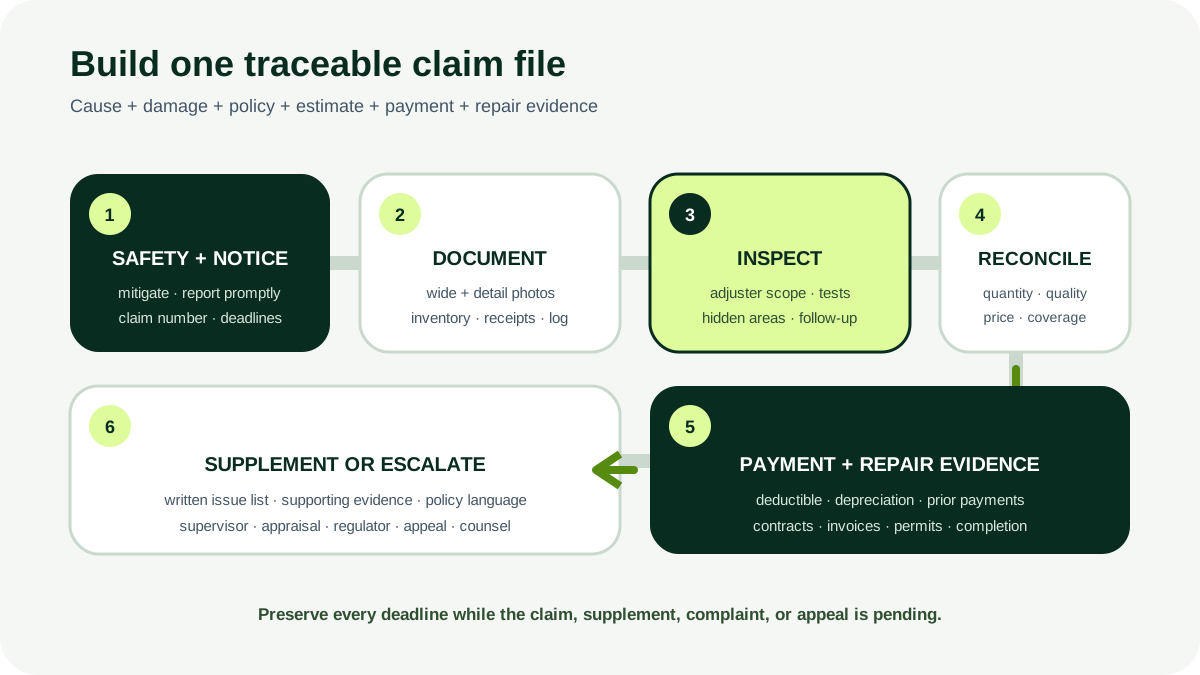
An insurance claim is a documented request for the benefits promised by a specific contract. A strong claim does not begin with a payout estimate; it begins with safety, prompt notice, damage mitigation, a preserved record of the cause and loss, and a line-by-line comparison between the policy and the adjuster’s estimate. This guide covers property and auto claim controls while flagging the state, policy, flood, health, and liability rules that require separate treatment.
Key takeaways
- Protect people first, prevent additional damage when safe, and report the loss through a verified insurer channel without waiting for a perfect inventory.
- Photograph wide views and details before cleanup, preserve damaged materials when safe, save receipts, and maintain a dated claim log.
- Ask for the claim number, assigned adjuster, applicable coverages, deductibles, limits, required forms, and every contractual or legal deadline in writing.
- Compare the adjuster’s scope and estimate line by line with contractor evidence; request a supplement for documented missed or mispriced covered damage.
- Do not sign broad assignments, pay unverified contractors, or hire a public adjuster without checking licensing, fees, cancellation rights, and authority in your state.
Make the property and people safe
Call emergency services when anyone is injured, a fire is active, a structure is unstable, utilities are hazardous, a crime is occurring, or road safety is at risk. Follow evacuation and reentry instructions. Insurance documentation never outranks safety.
When safe, take reasonable steps to prevent additional damage: shut off a leaking water supply, cover a broken opening temporarily, move undamaged property away from water, or arrange secure storage. Do not make permanent repairs or destroy evidence before asking the insurer how to document the loss, unless delay creates a health or safety hazard.
Keep receipts for emergency lodging, boards, tarps, pumps, towing, storage, cleaning, meals above normal cost, and other mitigation. Payment depends on coverage, necessity, and limits, but undocumented spending is harder to evaluate.
Locate the policy that was active at the time of loss
Find the declarations page, policy form, endorsements, renewal notices, and proof of payment. Confirm the legal insurer, policy number, insured property or vehicle, effective dates, named insureds, lienholder or mortgage company, limits, and deductibles.
Several policies may be involved. Wind and flood can cause damage during the same storm. A condominium master policy and unit-owner policy can divide building responsibility. Auto liability, collision, medical, workers’ compensation, health, travel, or another party’s policy may respond to different portions.
Do not decide coverage only from a mobile-app label. The cause, timing, definitions, exclusions, duties after loss, and endorsements control. Preserve every policy version rather than relying on a portal that may later display only the renewal.
Report the claim promptly through a verified channel
Use the number on the policy, insurer’s official website, authenticated app, or known agent. After a catastrophe, fake adjusters and claims numbers can appear in ads, messages, and social posts.
Report known facts:
- date, approximate time, and location;
- what happened and the apparent cause;
- injuries or immediate hazards;
- broad categories of damage;
- emergency actions already taken;
- police, fire, building, or incident report numbers;
- safe contact and temporary address.
Avoid guessing about hidden damage, admitting legal fault, or signing a recorded statement you do not understand. Cooperate with legitimate requests, but ask the purpose and preserve a copy.
Obtain the claim number and ask:
- Who is the assigned adjuster and how can identity be verified?
- Which coverages, limits, deductibles, and special deductibles may apply?
- What immediate work is authorized?
- Which forms, estimates, inventories, or statements are required?
- What are the notice, proof-of-loss, repair, replacement, appeal, appraisal, and lawsuit deadlines?
- Does the policy provide towing, rental, temporary housing, or an advance?
- How should documents be submitted, and how will receipt be confirmed?
Rules and timelines differ by contract, state, and program. Flood insurance has specialized federal forms and deadlines; do not transfer a deadline from a homeowners claim to an NFIP claim.
Create a claim log immediately
Use a spreadsheet or notebook with:
- date, time, channel, and direction of contact;
- name, employer, role, phone, and email of each person;
- what was asked, promised, approved, or disputed;
- documents sent and confirmation received;
- appointments and deadlines;
- expenses and payment status;
- next action and owner.
Save email as files, export portal messages, screenshot status changes, and confirm important calls in a short follow-up email. Do not record calls unless permitted by applicable law.
Store evidence in an encrypted location with a backup. Claim files contain addresses, identity records, signatures, financial information, and details useful to criminals.
Document the scene before cleanup
When safe and lawful, capture:
- wide video showing every affected room, vehicle side, or property area;
- medium views connecting the damage to its location;
- close-ups of materials, water lines, impact points, burns, stains, and serial numbers;
- the apparent source, such as a broken pipe or damaged roof opening;
- undamaged adjacent areas for comparison;
- temporary repairs before, during, and after work;
- debris or discarded items before removal.
Do not alter original files. Preserve timestamps and metadata. Add a plain-language index rather than renaming away useful information.
For contents, list description, quantity, brand, model, serial number, approximate age, purchase source, original cost if known, and current replacement evidence. Receipts help, but card statements, manuals, product registrations, family photographs, email confirmations, cloud backups, and retailer histories can also support ownership.
If hazardous items must be discarded, ask the insurer first when practical; photograph them thoroughly and retain safe samples such as flooring or fabric if allowed. FEMA’s NFIP checklist specifically emphasizes documenting multiple angles, model and serial information, and retaining evidence when health rules permit.
Distinguish mitigation from permanent repair
Mitigation reduces further loss; permanent repair restores the property. A policy can require reasonable protection of damaged property while also requiring inspection before permanent work.
Use written, itemized emergency-work authorizations. Identify labor, equipment, materials, quantities, daily rates, disposal, and taxes. Avoid blank contracts or open-ended direction to perform everything an insurer might pay.
Ask whether the insurer has a preferred contractor. You generally still need to understand who contracts with whom, who warranties the work, and whether using or declining the network changes any guarantee.
Never assume an insurer’s initial verbal approval removes all limits. Get scope and authorization in writing.
Prepare for the adjuster inspection
Company adjusters work for the insurer. Independent adjusters may be hired by the insurer during ordinary or catastrophe volume. The insurer pays both. A public adjuster is hired and paid by the policyholder, where permitted, and is not the insurer’s representative.
Before inspection, prepare:
- a one-page event timeline;
- room-by-room or panel-by-panel damage list;
- photographs and videos;
- home inventory or vehicle equipment list;
- emergency invoices and receipts;
- contractor or mechanic observations;
- policy questions and suspected hidden areas.
Attend the inspection or designate a trusted adult. Point out every damaged area without directing a technical conclusion you cannot support. Ask whether destructive testing, an engineer, specialist, moisture mapping, diagnostic scan, or follow-up inspection is needed.
Request the adjuster’s scope and estimate. California’s claims guide distinguishes the scope—damage, quality, and measurements—from the finished priced estimate. A walk-through is not a final valuation.
Reconcile the estimate line by line
An estimate can omit a room, use the wrong dimensions, assume a lower material grade, exclude taxes or permits, price insufficient labor, or fail to include detach-and-reset work. Contractor quotes can also include upgrades, uncovered maintenance, vague lump sums, or inflated catastrophe pricing.
Build a reconciliation table:
| Item | Insurer scope and quantity | Contractor evidence | Policy issue | Requested correction |
|---|---|---|---|---|
| Damaged material | What the estimate identifies | Photos, measurements, testing | Covered cause or exclusion | Add, remove, or clarify |
| Repair method | Spot repair or full replacement | Manufacturer or trade evidence | Matching or repair standard | Explain required method |
| Unit price | Labor and material assumption | Itemized local quote | Reasonable covered cost | Update supported price |
| Code work | Included or omitted | Permit/code requirement | Ordinance-or-law limit | Allocate to correct coverage |
Submit a supplement with specific evidence rather than “the payment is too low.” Ask for a written response to each disputed line and the policy language supporting any denial.
Do not treat a contractor’s estimate as automatic coverage. Coverage determines which damage is payable; estimating determines the amount of covered damage.
Understand deductibles and payment stages
Confirm whether the deductible is flat, percentage-based, per event, per coverage, or special to wind, hail, hurricane, earthquake, flood, or another peril. Translate percentages into dollars using the policy’s stated base.
Property replacement-cost claims can be paid in stages. An insurer may issue actual cash value first and recoverable depreciation after qualifying repair or replacement. Ask:
- which line items include depreciation;
- whether depreciation applies to labor as permitted by the contract and law;
- the deadline and evidence for recovering it;
- whether a written extension is available;
- how supplements affect prior calculations.
A mortgage company may appear on a structure payment and release funds as repairs progress. Contact its loss-draft department early. Do not endorse or deposit a multi-party check without understanding the required process.
Liability claims work differently. The insurer may investigate defense and indemnity obligations, appoint counsel, reserve rights, or request cooperation. Forward legal papers immediately; response deadlines can be short.
Track additional living expense or loss of use
Ask whether the cause is covered and whether the residence is considered uninhabitable under the policy. Record the household’s normal spending and the necessary increase caused by displacement.
Keep hotel or lease agreements, deposits, pet fees, storage, moving, laundry, transportation, and food receipts. A restaurant bill is not automatically payable in full; the relevant amount may be the increase over normal food spending.
Confirm the dollar limit, duration, review schedule, approved housing, and expected repair timeline. Notify the adjuster before a long lease or material change. Flood policies under the NFIP do not provide standard additional-living-expense coverage, illustrating why identifying the responding policy matters.
Review every payment and coverage letter
For each payment, preserve the cover letter and map the amount to:
covered estimate − deductible − depreciation − prior payments = current payment, adjusted for the insurer’s method.
Check whether the payment is an advance, undisputed amount, partial settlement, or final payment. Read release language before signing or depositing. State law can affect the consequences, and depositing a check does not have one universal effect.
A denial or reservation-of-rights letter should identify the facts, policy provisions, and decision. Compare the cited form numbers with the policy you preserved. Ask for clarification and missing claim-file documents where available.
Choose the correct dispute path
Start with the adjuster and claim supervisor. Provide a concise issue list and evidence. If disagreement concerns price or amount rather than coverage, the policy may contain appraisal or another valuation process. Appraisal generally is not a substitute for resolving whether a peril is covered.
Options may include:
- internal reconsideration or supplement;
- insurer complaint or escalation unit;
- mediation or appraisal where available;
- state insurance department inquiry or complaint;
- FEMA appeal for an eligible NFIP denial;
- licensed public adjuster, attorney, engineer, accountant, or other specialist;
- litigation or arbitration according to applicable rights and deadlines.
These paths can interact. FEMA states that an NFIP appeal generally must be filed within 60 days of the denial letter and that filing an appeal does not extend the one-year lawsuit period described by the program. Use the rules for the actual policy, not these NFIP deadlines for an unrelated claim.
A regulator can explain requirements, receive complaints, and investigate market conduct, but may not determine every private coverage or factual dispute. Preserve contractual and legal deadlines while a complaint is pending.
Evaluate a public adjuster carefully
The NAIC notes that many states license public adjusters, some restrict when they may solicit after a disaster, and some limit who may negotiate a claim. Verify the person and firm directly with the state insurance department.
Read the fee percentage, what payments the fee applies to, expenses, cancellation period, authority to communicate or endorse checks, contract duration, dispute process, and what happens if the insurer already offered payment. A public adjuster can provide expertise but does not create coverage and is not automatically economical for every claim.
Do not confuse an insurer’s independent adjuster with a policyholder’s public adjuster.
Avoid repair and disaster fraud
The FTC recommends confirming contractor licensing with state or local government, checking insurance, and using a written contract. Avoid cash demands, full payment before completion, pressure to sign immediately, and people claiming a government or insurer endorsement that cannot be verified.
Read any assignment of benefits, direction to pay, power of attorney, lien, financing agreement, or contingency fee. These can transfer control or proceeds. Do not sign an assignment merely because someone says it is required to inspect a roof or begin emergency drying.
Verify adjusters and inspectors independently. FEMA does not charge for disaster assistance or inspections. Never provide a policy login, MFA code, bank credential, or identity document through an unsolicited link.
Finish the evidence trail after repair
Keep signed contracts, change orders, invoices, proof of payment, permits, inspection approvals, warranties, photographs, and material specifications. Document that damaged items were repaired or replaced and submit recoverable-depreciation evidence before the applicable deadline.
Update the home inventory and policy limits. Correct property data discovered during the claim. Save the complete file for future loss, tax, warranty, sale, and litigation needs according to appropriate retention guidance.
Bottom line
A successful claim is not a single phone call. Make the scene safe, report promptly, preserve the contract, document before cleanup, keep a communication log, obtain the adjuster’s scope, reconcile estimates line by line, and track every deadline and payment. Escalate with specific evidence and the correct state or program process. The goal is a transparent claim file in which the cause, damage, requested amount, policy provision, and final decision can all be traced.
Related content
Frequently asked questions
Sources
Related content
More from DollarScout on this topic.
