How to Shop for Auto Insurance
By Sophie Brown, Senior Finance Editor · Updated Jul 2026 · Fact-checked Jul 18, 2026
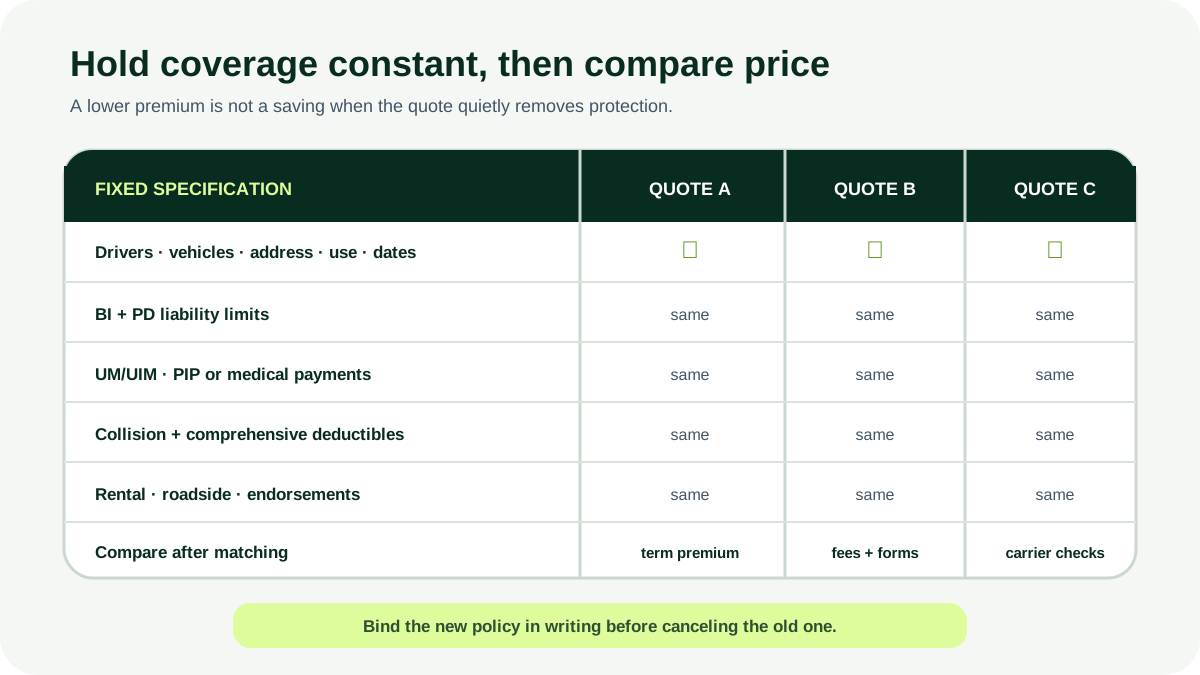
Shopping for auto insurance is a coverage-design exercise before it is a price comparison. State requirements set a legal floor, lenders and lessors may add physical-damage obligations, and every insurer prices the same household differently. A defensible process fixes drivers, vehicles, use, limits, deductibles, endorsements, and dates before requesting quotes—then verifies the underwriting company, exclusions, fees, and final policy before replacing existing coverage.
Key takeaways
- Choose coverage and limits before requesting quotes so every insurer prices the same risk specification.
- State minimum liability limits are legal thresholds, not an estimate of what a serious injury or multi-vehicle loss can cost.
- Liability, UM/UIM, PIP or medical payments, collision, comprehensive, rental, roadside, and gap solve different problems.
- Compare the legal underwriting company, written term premium, installment fees, deductibles, exclusions, complaint record, and licensing—not only a monthly number.
- Keep the old policy active until the new insurer confirms the final coverage and effective date in writing, then verify any refund or balance.
Build the coverage request before collecting prices
An auto quote is meaningful only when the input and requested contract are the same. A low quote can reflect lower liability limits, missing uninsured-motorist coverage, higher deductibles, excluded drivers, fewer days of rental coverage, or a shorter policy term.
Create one specification with:
- every household driver and license status;
- each vehicle identification number, ownership, garaging address, and annual mileage;
- commuting, business, school, delivery, rideshare, and occasional use;
- financing or lease status;
- desired coverage limits and deductibles;
- optional endorsements and service limits;
- exact effective date and payment preference.
Disclose facts accurately. An incorrect address, omitted driver, understated mileage, or undisclosed commercial use can change the premium and affect a claim. If an insurer instructs you to exclude a household member, ask what the exclusion means and obtain it in writing.
Verify the legal requirements in your state
Auto insurance is regulated primarily by states. Required liability, personal injury protection, medical payments, uninsured or underinsured motorist coverage, proof of insurance, cancellation, and claim rules vary. Some coverage must be offered but can be rejected in writing; some is mandatory; some is unavailable in a particular form.
Use your state insurance department and motor-vehicle agency, not an affiliate comparison page, for current requirements. The NAIC maintains a directory of state insurance departments.
Minimum compliance does not necessarily protect the driver’s finances. The NAIC’s consumer shopping guide notes that the insured remains responsible for bodily injury and property damage above the policy limit. A legal-minimum property-damage limit can be exhausted by one newer vehicle or several damaged vehicles.
Driving across state lines, moving, garaging a vehicle elsewhere, or entering another country can change the rules. Ask specifically before a relocation or international trip.
Understand each coverage as a separate decision
Bodily injury liability
This coverage can pay covered claims for injuries the insured driver causes to other people, including medical cost, lost income, and other damages, up to the limit. It can also fund a legal defense under the policy terms.
Split limits might be displayed as three numbers. The first two commonly represent the most paid for bodily injury to one person and for all bodily injury in one accident. Read the contract; shorthand is not a substitute for definitions.
Property damage liability
This can pay for covered damage the insured causes to another person’s vehicle or other property. It does not repair the insured’s own car. A collision involving several vehicles, a building, guardrail, or commercial equipment can exceed a low limit quickly.
Uninsured and underinsured motorist coverage
UM/UIM can protect insured people when an at-fault driver has no liability insurance or too little, subject to state and policy rules. Bodily-injury and property-damage versions can be separate. Hit-and-run requirements, deductibles, stacking, offsets, and definitions vary.
Do not confuse UM/UIM with liability. Liability protects against covered claims made by others because of the insured’s fault; UM/UIM protects eligible insureds from another driver’s inadequate insurance.
Personal injury protection and medical payments
PIP can pay defined medical expenses and, in some states and policies, lost income, replacement services, or funeral expense without first establishing fault. Medical-payments coverage is generally narrower. Health insurance does not make these automatically unnecessary because deductibles, networks, passengers, coordination rules, and nonmedical benefits differ.
Collision
Collision can pay to repair or replace the insured vehicle after collision with another vehicle or object, minus the deductible and subject to actual-cash-value or other settlement terms. A lender or lessor may require it.
The decision for an owned older car is not simply whether annual premium exceeds vehicle value. Compare the vehicle’s realistic settlement value, deductible, premium, emergency fund, replacement transportation, and ability to absorb a total loss.
Comprehensive or other-than-collision
This commonly covers listed or defined noncollision events such as theft, vandalism, fire, falling objects, animal impact, or weather, subject to the contract. It usually has its own deductible. Glass treatment can differ by state and endorsement.
“Full coverage” has no standardized contractual meaning. The NAIC expressly cautions that there is no single full-coverage package. Always list the actual coverages.
Rental reimbursement and transportation expense
This can pay a daily amount up to a maximum number of days or total dollars while the insured vehicle is unavailable after a covered loss. It does not necessarily cover a rental after breakdown, maintenance, or every liability-only claim. Check the daily cap, duration, eligible transportation, and whether rental-company taxes and fees are included.
Roadside assistance and towing
Review service events, mileage limits, dispatch terms, reimbursement versus direct service, lockout, fuel, battery, and whether repeated use affects eligibility. Compare with automaker, credit-card, wireless, or membership benefits to avoid duplicate cost.
Gap coverage and loan or lease payoff
A vehicle can be worth less than the loan balance. Gap coverage may pay some difference after a covered total loss, but can exclude overdue payments, rolled-in negative equity, warranties, add-ons, deductibles, or a percentage above vehicle value. Compare insurer, lender, lease, and dealer terms. Cancel duplicate coverage and understand refund rules.
Choose liability limits from the loss, not the law
Estimate a severe plausible event involving multiple injured people, lost wages, and expensive property. Then examine assets, income, future earnings exposure, household risk, defense terms, and the cost of higher limits. Legal protections from creditors differ by state and do not make an uncovered judgment harmless.
Ask whether the policy uses split limits or a combined single limit, whether defense costs reduce the limit, and whether claims involving permissive drivers receive the same limit.
A personal umbrella policy may add liability limits above qualifying auto and home or renters policies. It normally requires specified underlying limits and may exclude vehicles, drivers, business use, or conduct. Price the required base limits and umbrella together.
Pick deductibles with an emergency-fund test
Collision, comprehensive, and some UM/UIM property claims commonly have separate deductibles. A higher deductible can reduce premium but increases the amount needed immediately after a loss.
For each choice, record:
Annual premium savings ÷ additional deductible exposure.
If raising a deductible from $500 to $1,000 saves a hypothetical $80 per year, the household accepts $500 more loss exposure for that $80 annual reduction. That is an illustration, not a quote. Consider claim frequency, but do not assume a break-even calculation predicts an accident.
Choose an amount that can be paid while also covering towing, temporary transportation, medical deductibles, and a replacement down payment. Different deductibles by vehicle can be sensible when values and cash reserves differ.
Check drivers, vehicles, and use
Confirm how the policy handles:
- licensed household residents;
- a child away at school;
- roommates and domestic partners;
- permissive occasional drivers;
- excluded drivers;
- newly acquired or replacement vehicles;
- borrowed and rented vehicles;
- employer-owned vehicles;
- rideshare, delivery, courier, or other paid use;
- trailers, custom equipment, mobility adaptations, and modifications;
- vehicles stored seasonally or driven very little.
Rideshare-platform coverage may apply only during defined app periods and can leave gaps between personal and commercial coverage. A personal policy can exclude delivery or livery activity. Obtain the endorsement and phase definitions before relying on an app’s summary.
Request matched written quotes
Ask each insurer for the declarations-style quote and coverage forms or specimen policy. Build a matrix:
| Field | Quote A | Quote B | Quote C |
|---|---|---|---|
| Legal underwriting company | |||
| Policy term and effective date | |||
| BI / PD liability limits | |||
| UM/UIM limits and rejection status | |||
| PIP / medical payments | |||
| Collision / comprehensive deductibles | |||
| Rental and roadside limits | |||
| Endorsements and exclusions | |||
| Term premium | |||
| Installment, card, or membership fees | |||
| Discounts and expiration conditions |
Compare term premium, not just monthly payment. A monthly figure can hide a down payment, installment charge, or different term length. Ask whether the quote is final or conditional on motor-vehicle, claims, credit-based insurance, mileage, inspection, or other underwriting data permitted in the state.
If the final premium differs, request the changed input and rerun the comparison.
Evaluate the insurer and distribution channel
A familiar agency or website can place policies with multiple legal carriers. Identify the exact company that issues the contract and pays claims. Verify its license with the state insurance department. Review official complaint information and available financial-strength evidence in context; complaint volume should be interpreted relative to business size and methodology.
Understand whether the seller is a captive agent, independent agent, broker, or direct insurer and who owes which duties under state law. Ask how service, policy changes, and claims are handled after purchase.
Do not send a driver’s license, Social Security number, or payment through an unsolicited message. Verify domain, agent license, and company contact independently.
Treat discounts as conditional contract inputs
Common discounts can involve multiple vehicles, multiple policies, safe driving, low mileage, defensive-driving courses, student status, vehicle safety, anti-theft equipment, automatic payment, paperless delivery, or advance purchase. Availability and calculation vary.
Record the qualification, amount, expiration, and documentation. A bundle can be more expensive overall even when one policy shows a discount. Compare the combined home or renters plus auto total and both contracts.
Usage-based or telematics programs may collect mileage, location, time, acceleration, braking, phone movement, or other driving data. Ask what is collected, how long it is retained, who receives it, whether participation can increase premium, how a trip is corrected, and what happens when a driver or device changes.
Read exclusions and endorsements before binding
Check limits or exclusions for delivery, rideshare, business use, named drivers, household residents, racing, intentional acts, Mexico, custom parts, diminished value, original-equipment parts, betterment, rental vehicles, and vehicle-storage conditions.
An endorsement overrides standard language. Obtain every referenced form. Marketing statements such as “accident forgiveness” or “new car replacement” need eligibility, duration, vehicle age, mileage, prior-loss, and renewal conditions.
Switch coverage without creating a gap
Ask the new insurer for written confirmation showing legal company, vehicles, drivers, coverages, limits, deductibles, effective date, time, term premium, and payment received. A quote or application is not always proof that coverage bound.
Only then cancel the old policy effective after the new one begins. Confirm any earned premium, cancellation fee, refund, automatic payment, and lienholder notice. Do not simply stop paying; a cancellation for nonpayment can create a lapse record and collection balance.
Send new proof to the lender, lessor, employer, state, or other party when required. Verify that digital insurance cards are accepted where driving.
Review at renewal and after life changes
Re-shop or at least revalidate after a move, new driver, new vehicle, payoff, marriage, divorce, job or mileage change, rideshare activity, household change, major ticket, claim, or policy rewrite. Update annual mileage honestly.
At renewal, compare limits and forms, not only the premium increase. Inflation and vehicle repair technology can change property-damage exposure. A carrier can change discounts, forms, deductibles, or underwriting company with proper notice under state rules.
Keep old declarations, cancellation confirmation, and claim-free or continuous-coverage evidence.
Bottom line
The best auto-insurance shopping process fixes the contract before comparing price. Verify state rules, choose liability and first-party coverages for the household’s actual loss exposure, set fundable deductibles, disclose every driver and use, and collect matched written quotes. Validate the carrier and final policy, then switch only after binding proof prevents a gap. A cheap unmatched quote is not a savings measurement.
Frequently asked questions
Sources
Related content
More from DollarScout on this topic.
