Many products on this page are from partners who compensate us. This doesn't influence our ratings. Our opinions are our own.
How to Build Credit
By Sophie Brown, Senior Finance Editor · Updated Jul 2026 · Fact-checked Jul 18, 2026
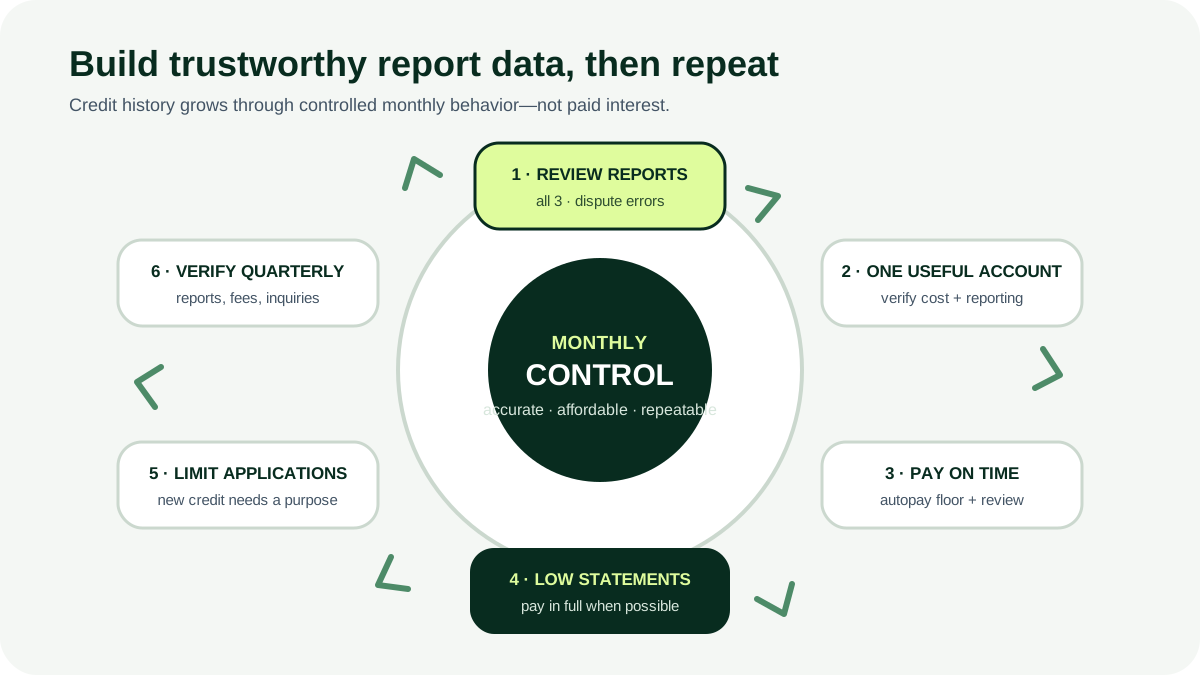
Building credit means creating accurate credit-report data that shows obligations handled on time over many months. It does not require paying interest, buying a “tradeline,” or applying for several cards. The safest plan starts with all three reports, adds one affordable account that actually reports, automates the payment floor, controls statement balances, and reviews the data on a fixed schedule.
Key takeaways
- Start with your credit reports, not a score screenshot; reports contain the account and payment data used by scoring models.
- Use AnnualCreditReport.com, the federally authorized source, and dispute material errors with both the reporting company and the furnisher.
- One well-managed reporting account can establish history; confirm fees, reporting coverage, deposit rules, and graduation terms before opening it.
- Pay every account on time and keep card statement balances low relative to limits; carrying interest is not required to build credit.
- Expect gradual progress, limit applications, monitor for fraud, and evaluate the plan over months rather than daily score changes.
Understand the system you are trying to influence
A credit report is a record assembled by a consumer reporting company. It can include credit accounts, payment status, balances, limits, inquiries, collections, and certain public-record information. A credit score is a number produced by applying a scoring model to report data at a particular time. You can have multiple scores because lenders, bureaus, and products may use different models, versions, and report dates.
The practical objective is not to manipulate one number. It is to build accurate, stable report data: payments made as agreed, manageable revolving balances, limited unnecessary applications, and time. The CFPB identifies payment history, amounts owed or utilization, credit-history length, new credit, and credit mix as common influences, but no public universal formula applies to every score.
Pull all three reports before opening anything
Use AnnualCreditReport.com, which identifies itself as the only official site explicitly directed by federal law to provide the free reports. The CFPB also directs consumers there or to 877-322-8228. Requesting your own reports does not hurt your credit score.
Review Equifax, Experian, and TransUnion separately because the contents can differ. Create a simple inventory:
| Field | What to verify |
|---|---|
| Identity | Name variations, addresses, phone numbers, employers |
| Accounts | Ownership, issuer, account number suffix, dates, status |
| Payment history | Any late mark that conflicts with records |
| Balances and limits | Whether recent data is plausible |
| Collections | Debt identity, ownership, dates, and status |
| Inquiries | Company and date; distinguish account review from applications |
Save dated copies securely. A credit report contains sensitive information, so do not email it casually or upload it to an unknown “credit repair” tool.
Dispute errors with evidence
An error is not a negative item you dislike; it is information that is inaccurate or incomplete. The CFPB recommends disputing with both the consumer reporting company and the company that furnished the information. Follow the instructions on the report, identify each disputed field, explain why it is wrong, and include copies—not originals—of supporting documents.
Keep the report, dispute, attachments, confirmation, and response. Do not file a false identity-theft claim or pay a company to create a new credit identity. Accurate negative information generally cannot be removed merely because a repair company sends a form letter.
If identity theft is suspected, use IdentityTheft.gov for a recovery plan and consider security freezes. A freeze restricts access to a report and can make fraudulent account opening harder; it does not erase history or build a score. Place and lift freezes directly with each bureau and keep the credentials secure.
Choose one first product that reports
If the reports have little or no active credit, choose one affordable account based on function and reporting—not marketing. Common starting options include:
Secured credit card
A secured card usually requires a refundable security deposit and provides a revolving limit. Verify:
- which nationwide bureaus receive reports and how often;
- annual, application, maintenance, late, and foreign-transaction fees;
- minimum deposit and whether the deposit earns interest;
- grace period and purchase APR;
- path to an unsecured card or deposit refund;
- whether the issuer performs a hard inquiry.
Use it for one small planned expense, wait for a statement, and pay the statement balance in full by the due date. The deposit is not a prepaid balance; purchases still create a bill.
Credit-builder loan
With many credit-builder products, payments go toward a locked savings balance that is released after the term, minus fees or interest. Confirm total cost, reporting bureaus, late-payment policy, access to funds, early-payoff treatment, and what happens if payments become unaffordable. A product that builds savings but creates late payments defeats the purpose.
Authorized-user status
An account owner may add another person as an authorized user, and some issuers may report that history. Results depend on issuer reporting and the account's condition. The primary user remains responsible for the bill; the authorized user generally is not a co-borrower. High balances, late payments, account closure, or removal can reduce the benefit or harm the reports. Verify reporting and use this only in a trusted relationship.
Rent, utility, and subscription reporting services can add data, but not every bureau, score, or lender uses it. Compare fees and privacy terms; do not assume reported alternative data has the same effect as a traditional account.
Create a payment system with two safeguards
Payment history is a foundational input, so make the due date hard to miss. Use two layers:
- Set autopay for at least the required minimum from an account with a cash buffer.
- Schedule the full statement balance or make a manual payment early enough to clear by the due date.
Autopay is a safeguard, not permission to stop checking. Review the statement for the amount, bank account, due date, duplicate transactions, fraud, and returned payments. Turn on alerts for a posted statement, approaching due date, high balance, large purchase, and failed payment.
If full payment is temporarily impossible, pay at least the minimum on time and stop new spending while making a recovery plan. Contact the issuer before the due date when hardship threatens payment. One score goal should never take priority over housing, food, utilities, insurance, or required taxes.
Manage the reported balance, not a magic percentage
Credit utilization compares revolving balances with limits. A $150 reported balance on a $1,000 limit is 15% utilization for that account. Models can consider both individual-account and total utilization.
There is no universal rule that carrying exactly 30% is good. Lower utilization generally presents less revolving debt, but the best operational target is a balance the budget can pay in full. On a very small limit, an ordinary purchase can create a high percentage even if it is affordable. Make an early payment before the statement closes when necessary, or spread planned activity carefully without opening unnecessary accounts.
The statement closing date and payment due date serve different purposes. Issuers commonly report around a statement cycle, while the due date determines whether the billed payment is on time. Paying only by the due date can still leave a high statement balance reported. Paying before the statement closes can reduce the amount that appears, but verify the issuer's reporting pattern rather than assuming every issuer is identical.
You do not need to carry a balance or pay interest to show activity. A small purchase that appears on the statement and is then paid in full can establish use without revolving debt.
Limit applications and account churn
An application can produce a hard inquiry and, if approved, a new account with little age. The CFPB advises applying only for credit you need. Many applications in a short period can signal risk and make the system difficult to manage.
Before applying:
- check reports for errors or freezes;
- use a prequalification tool only after confirming whether it uses a soft or hard inquiry;
- review the full pricing disclosure, not just an approval claim;
- decide what unique purpose the account will serve;
- confirm the payment fits even if income drops.
Space applications according to an actual need, not a score-app notification. Do not close a useful no-fee account simply because a score moved; closing can reduce available credit and eventually affect age. Do not keep a costly or unsafe account merely for score theory either. Finance decisions come first.
Use a 12-month operating plan
Month 0: baseline
Pull all three reports, inventory accounts, dispute supported errors, freeze reports if appropriate, list every due date, and calculate current card utilization. Create a secure document with account contacts and alert settings—not passwords.
Months 1–3: establish control
Open at most one appropriate reporting product if necessary. Put one predictable expense on a card, set the two-layer payment system, and keep the bank buffer. Check each statement and avoid all other applications unless essential.
Months 4–6: verify reporting
Review reports through the official source and confirm the account, limit, status, and payments appear accurately. Do not panic if reporting timing differs by bureau. Investigate a persistent omission with the issuer. Recalculate utilization and remove subscriptions that create unexpected balances.
Months 7–9: strengthen the system
Continue on-time payments. Build emergency savings so the credit account does not become the first response to every expense. If using a secured card, review published graduation terms without demanding a product change that creates new fees or an inquiry.
Months 10–12: evaluate outcomes
Pull reports again, compare the dated baseline, verify disputes, and review total fees and interest paid. A successful year shows accurate reporting, no late payments, controlled balances, and fewer reactive applications. A particular score increase cannot be promised because the starting file and model differ.
Avoid expensive shortcuts
Red flags include guaranteed score increases, instructions to dispute accurate information, “credit privacy numbers,” synthetic identities, rented tradelines, upfront pressure, and a demand for your bureau credentials. The CFPB warns that legitimate credit repair cannot remove accurate current negative information.
Also avoid borrowing merely for account mix. Paying avoidable interest for a theoretical scoring benefit is poor personal finance. Add an installment loan only when the underlying purchase or structured savings product makes sense on its own.
Measure progress with an evidence dashboard
Track monthly:
- required payments made on time;
- statement balances and limits;
- total fees and interest;
- applications and inquiries;
- report errors opened and resolved;
- cash buffer available for autopay.
Check scores occasionally from a transparent source, but label the model, bureau, and date. Comparing different scores without those labels creates false alarms. A lender may use another score entirely.
Bottom line
Build credit by producing trustworthy data for a long time. Start with accurate reports, choose one low-cost account that actually reports, automate the payment floor, pay statements in full when possible, keep reported balances controlled, and limit applications. Review the reports quarterly or at meaningful milestones. The boring, repeatable system is the strategy.
Related content
Frequently asked questions
Sources
Related content
More from DollarScout on this topic.
