Many products on this page are from partners who compensate us. This doesn't influence our ratings. Our opinions are our own.
How to Pick Your First Rewards Credit Card
By Sophie Brown, Senior Finance Editor · Updated Jul 2026 · Fact-checked Jul 18, 2026
A first rewards card should turn ordinary paid-in-full spending into simple, usable value. It should not change what you buy, create a balance, or depend on credits you would never use. This guide builds a scorecard from your last 12 months of spending, compares annual fee and redemption value, reads the complete agreement, and installs payment controls before the first purchase.
Key takeaways
- Choose a rewards card only if you can pay the statement balance in full; revolving interest can overwhelm rewards.
- Use actual past spending to compare flat-rate, category, cash-back, and travel structures instead of chasing the largest advertised rate.
- Subtract the annual fee and value credits only at the amount you would willingly pay for them without the card.
- Review APRs, fees, grace period, bonus rules, exclusions, redemption minimums, expiration, and change terms before applying.
- Prefer a simple redemption you will use, set full-statement autopay with alerts, and earn any welcome bonus through planned spending only.
Pass the pay-in-full test first
Rewards are a rebate attached to credit. They are not a reason to borrow. The CFPB's card-shopping worksheet advises consumers who have carried balances, or expect to, to focus on lower interest rates; low-rate cards may not offer rewards. Consumers who consistently pay in full can compare rewards with annual fees.
Run a stress test before choosing:
- Have the last six credit-card statements been paid in full and on time?
- Is there enough checking-account buffer for autopay?
- Would an annual fee still be comfortable during a low-income month?
- Can spending stay within the existing budget even when a bonus is offered?
If the answer is no, a no-fee, low-cost card—or no new card—can be the better choice. A single month of interest can erase a year of ordinary rewards.
Build a spending profile from evidence
Export or review the last 12 months of bank and card transactions. Exclude rent or bills that cannot be paid by card without a surcharge, reimbursed work spending that is uncertain, cash advances, and purchases that would not qualify for rewards.
Group the remaining card-eligible spending:
| Category | Annual eligible spend | Notes |
|---|---|---|
| Groceries | Your total | Check merchant-category exclusions |
| Dining | Your total | Include delivery only if it codes the same way |
| Gas/transit | Your total | Warehouse and app transactions may differ |
| Travel | Your total | Separate direct bookings from portals |
| Online or rotating categories | Your total | Apply realistic caps and activation |
| Everything else | Your total | Use the base earning rate |
Merchant category codes—not the store description in your head—often control bonus eligibility. A grocery purchase at a warehouse club may not earn a supermarket multiplier. A hotel booked through a third party may not qualify for a hotel benefit. Read the issuer's category definitions and use conservative assumptions.
Choose the simplest rewards family that fits
Flat-rate cash back
A single earning rate on eligible purchases is easy to forecast and redeem. It suits varied spending, modest category totals, and anyone who values low maintenance. Check whether cash back can be deposited, redeemed as a statement credit, or only used after a threshold.
Category cash back
Higher rates apply to stated categories, sometimes with quarterly activation or spending caps. It fits a stable spending concentration and a cardholder willing to track the rules. Calculate the base rate after the cap and assign zero extra value to a category you rarely use.
Flexible points
Points may redeem for cash, issuer travel, gift cards, or transfers to partners. Flexibility can be valuable, but value varies by method and availability. A high earning multiplier is meaningless until paired with the cents-per-point value you can realistically obtain.
Airline or hotel cards
Co-branded cards can offer checked-bag, status, free-night, or hotel benefits. They fit repeated use of one program and reliable access to the benefit. They are a poor first choice when travel is infrequent, award inventory is uncertain, or the cardholder cannot use the benefit before it expires.
Calculate net annual value conservatively
Use this model:
Net annual value = usable rewards + personally valued benefits − annual fee − expected extra costs.
For a hypothetical no-fee card earning 2% on $18,000 of eligible annual spending, gross rewards are $360. For a hypothetical $95-fee category card producing $430 in usable rewards, net value before other costs is $335. The no-fee card is ahead unless the second card provides at least $25 of additional value that you would otherwise pay for.
Do not price a $100 statement credit at $100 merely because the issuer does. If it requires spending at a merchant you would not normally use, its personal value may be zero or much less. Do not count lounge visits, checked bags, or insurance without confirming eligibility and estimating actual use.
Also include foreign-transaction fees, portal price differences, surcharges, and the opportunity cost of a redemption. Rewards never justify paying more to a merchant than an equivalent cash or debit option.
Treat a welcome bonus as temporary
A welcome bonus can improve first-year value, but it should not decide the long-term fit. Record:
- eligible application channel and deadline;
- required net purchases and qualifying period;
- excluded transactions, returns, and annual fee treatment;
- prior-card or prior-bonus restrictions;
- when rewards post and what account status is required;
- clawback or abuse language.
Build the requirement from planned expenses already in the budget. Do not prepay uncertain services, manufacture transactions, carry a balance, or buy items merely to cross a threshold. If normal spending cannot meet it with a buffer for returns, value the bonus at zero.
Compare first-year and ongoing value separately. A card that only wins in year one needs an exit or retention decision before the next annual fee, and closing or changing it can affect benefits, available credit, and unredeemed rewards.
Read the complete cost disclosure
The rewards page is not the entire contract. Review the application disclosure, cardholder agreement, rewards terms, and benefit guides. The CFPB database can help locate general agreements, while the issuer must provide the agreement for your account.
Capture:
- purchase APR and whether it varies;
- annual fee and when it posts;
- balance-transfer and cash-advance APRs and fees;
- foreign-transaction, late, returned-payment, and authorized-user fees;
- grace period and how to retain it;
- minimum interest or other pricing conditions;
- rights to change terms, rewards, partners, or benefits.
The CFPB's 2024 rewards circular identifies practices that can harm consumers, including devaluing earned rewards, hiding material conditions in vague language, and failing to deliver rewards because of technical or partner problems. Treat program terms and operational reliability as part of value, not fine-print trivia.
Set a redemption floor before applying
Define the minimum value and effort you will accept. For cash back, the value is usually straightforward once the method and minimum are known. For points, use:
Cents per point = cash value of the reward ÷ points required × 100.
A $300 trip that costs 30,000 points returns 1.0 cent per point before taxes, fees, and lost rewards. If the same trip is genuinely available for $240 elsewhere, the relevant value is $240, or 0.8 cents per point—not the portal's reference price.
Test the path before committing:
- Is cash or statement-credit redemption available?
- Is there a minimum or fixed increment?
- Can points expire through inactivity or account closure?
- Are travel prices competitive outside the portal?
- Are partner transfers irreversible and award seats limited?
- Can another person use the rewards, and under what name rules?
For a first card, a slightly lower theoretical maximum can be worth more than a complicated program that goes unused.
Evaluate protections as contracts, not slogans
Cards may advertise rental coverage, trip delay, baggage protection, purchase protection, extended warranty, cell-phone protection, or travel assistance. Read the current benefit guide for eligibility, exclusions, coverage limits, claim deadlines, documentation, and whether coverage is primary or secondary.
Value a benefit only if the normal purchase qualifies and the claim process is acceptable. “Travel protection” is not one standardized product. Benefits may change separately from the basic credit agreement.
Zero-liability advertising also does not remove the need to monitor. Set transaction alerts, report unauthorized use promptly, and preserve statements and receipts.
Check application readiness
Pull all three credit reports from AnnualCreditReport.com and dispute supported errors before applying. Review issuer eligibility language and, if available, a prequalification process that clearly states whether it uses a soft inquiry. Prequalification is not a guarantee.
Do not apply for several rewards cards to find out which one approves. Applications can add inquiries, and new accounts increase operational complexity. Choose one candidate that fits the report profile and budget. If denied, read the adverse-action notice and address the stated reasons before considering another application.
Income on an application must be accurate under the issuer's instructions. Do not inflate it or count money the application rules do not permit.
Install controls before the first charge
After approval:
- Set autopay for the full statement balance from a funded account.
- Also enable due-date, statement, purchase, high-balance, and failed-payment alerts.
- Confirm the first statement closing and due dates.
- Record the welcome-bonus window and progress conservatively.
- Add only planned budget categories to the card.
- Review the statement every month even when autopay is active.
A full-statement autopay generally preserves the grace period when the agreement provides one, but verify the issuer's terms. Keep at least the statement amount available before withdrawal. If cash flow cannot support full payment, stop using the card and switch the goal from earning rewards to minimizing interest and restoring payment control.
Compare candidates with a weighted scorecard
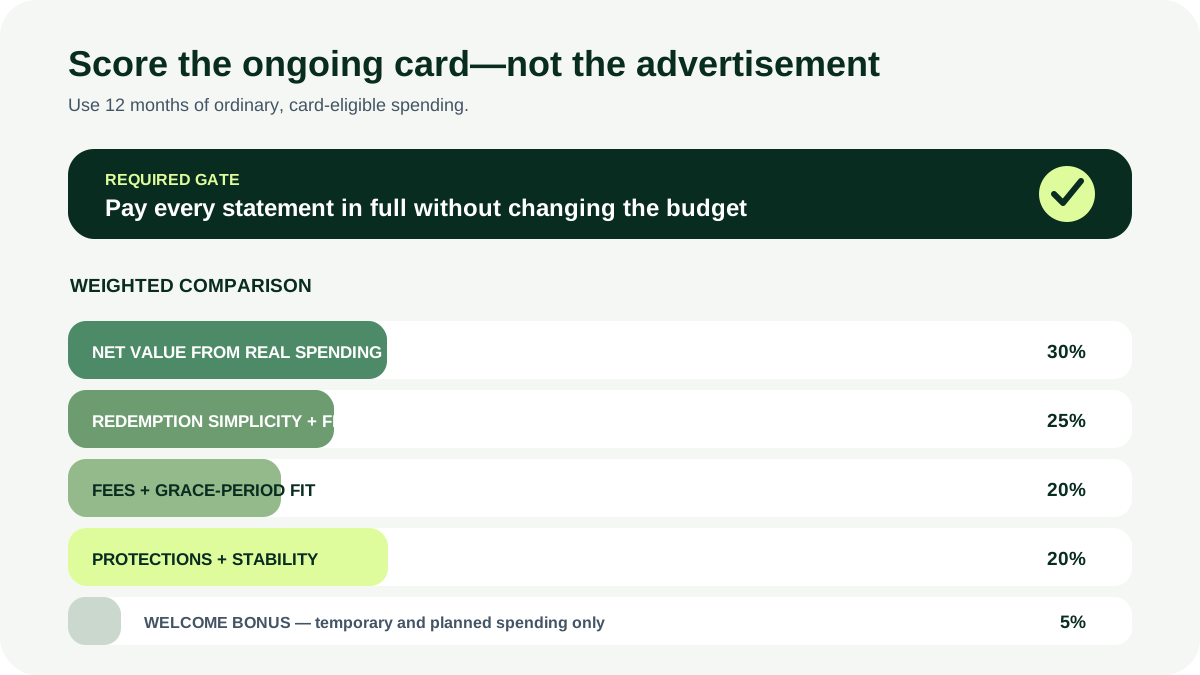
Eliminate any card that fails the pay-in-full, fee, or redemption gate. Then score the survivors. A practical first-card weighting might be:
| Factor | Weight |
|---|---|
| Net value from normal spending | 30% |
| Redemption simplicity and floor | 25% |
| Fees and grace-period fit | 20% |
| Useful protections | 10% |
| Program stability and support | 10% |
| Welcome bonus | 5% |
Change weights to match your priorities, but keep the temporary bonus small enough that it cannot mask an expensive ongoing product. Save the offers and date the comparison because terms change.
Review the card annually
Before each annual fee, compare actual rewards redeemed, benefits used, fees, interest, and time spent with the original forecast. Verify that category rules and redemption values still fit. Check for expiring benefits and redeem transferable value before a planned closure.
Possible outcomes include keeping the card, requesting a product change, downgrading, or closing. Ask whether a change preserves account history and points, whether it creates a new account or inquiry, and whether benefits end immediately. Never let score anxiety trap you in a product whose fee or spending pressure no longer makes sense.
Bottom line
The best first rewards card is usually the one you can operate perfectly: no carried balance, no forced spending, a fee justified by actual use, and a redemption path you understand. Use a year of real spending, calculate net value conservatively, read every relevant agreement, and automate the full statement payment. Rewards should follow the budget, never lead it.
Related content
Frequently asked questions
Sources
Related content
More from DollarScout on this topic.
