Many products on this page are from partners who compensate us. This doesn't influence our ratings. Our opinions are our own.
Chase vs Capital One: 2026 Bank Comparison
By Sophie Brown, Senior Finance Editor · Updated Jul 2026 · Fact-checked Jul 18, 2026
Capital One wins overall at 4.6/5 versus Chase at 4.0/5 for most everyday banking customers. Its 360 Checking and 360 Performance Savings accounts have no monthly service fee or minimum-balance requirement, its savings product pays a competitive variable APY, and checking customers get 70,000+ fee-free ATMs. Chase is still the stronger choice when 5,000 branches, cash handling, banker access, or an existing Chase and J.P. Morgan relationship matter enough to justify fee-waiver management and lower standard savings yield. Choose Capital One for low-maintenance value; choose Chase for full-service physical banking.
Head-to-head
| Feature | Chase | Capital One |
|---|---|---|
| DollarScout Rating | 4.0/5 ★ | 4.6/5 ★ |
| Monthly Fee | Chase Total Checking: $15 or $0 with qualifying deposits, balances, or a linked eligible account | $0 monthly fee and $0 minimum balance on 360 Checking and 360 Performance Savings |
| APY | Location- and product-dependent; standard Chase savings is not positioned as a high-yield account | One variable APY on all 360 Performance Savings balances; verify the live rate before opening |
| Deposit Insurance | Deposits at JPMorgan Chase Bank, N.A. are FDIC-insured within ownership-category limits | Capital One and Discover deposits are combined at Capital One, N.A. by ownership category for current FDIC coverage |


Category-by-category breakdown
Fees
APY
Digital Experience
Access & ATM Network
Customer Service
Detailed analysis
The short answer
Capital One is the better low-fee bank; Chase is the better branch bank. DollarScout rates Capital One 4.6/5 and Chase 4.0/5. Capital One leads decisively in Fees and APY, edges Chase in Ease of Use, and publishes a much larger fee-free ATM network. Chase leads in physical service and receives the higher Customer Service score because a customer can escalate many problems through a branch.
This is not a simple online-versus-offline comparison. Capital One operates branches and Cafés in selected markets, while Chase has a strong mobile app. The difference is coverage and product economics: Chase makes broad physical access available nationwide but attaches waiver rules to standard accounts; Capital One makes its flagship 360 accounts simpler but cannot match Chase's teller footprint.
| Decision factor | Chase | Capital One |
|---|---|---|
| Flagship checking | Chase Total Checking: $15 monthly fee or $0 with one qualifying condition | 360 Checking: no monthly service fee or minimum balance |
| Flagship savings | Chase Savings: $5 monthly fee or $0 with one qualifying condition | 360 Performance Savings: no monthly service fee or minimum balance |
| Savings yield | Standard relationship-bank rate; check ZIP-specific sheet | Competitive variable high-yield rate; check live page |
| Physical access | 5,000 branches and 14,000+ Chase ATMs | Selected branches and Cafés; 70,000+ fee-free ATMs |
| Out-of-network ATM | $3 U.S. or $5 outside U.S. on standard accounts, plus operator fees | Capital One does not charge on 360 Checking; operator may charge |
| Best fit | Cash, teller, complex service, broad relationship banking | Fee simplicity, high-yield savings, digital-first everyday banking |
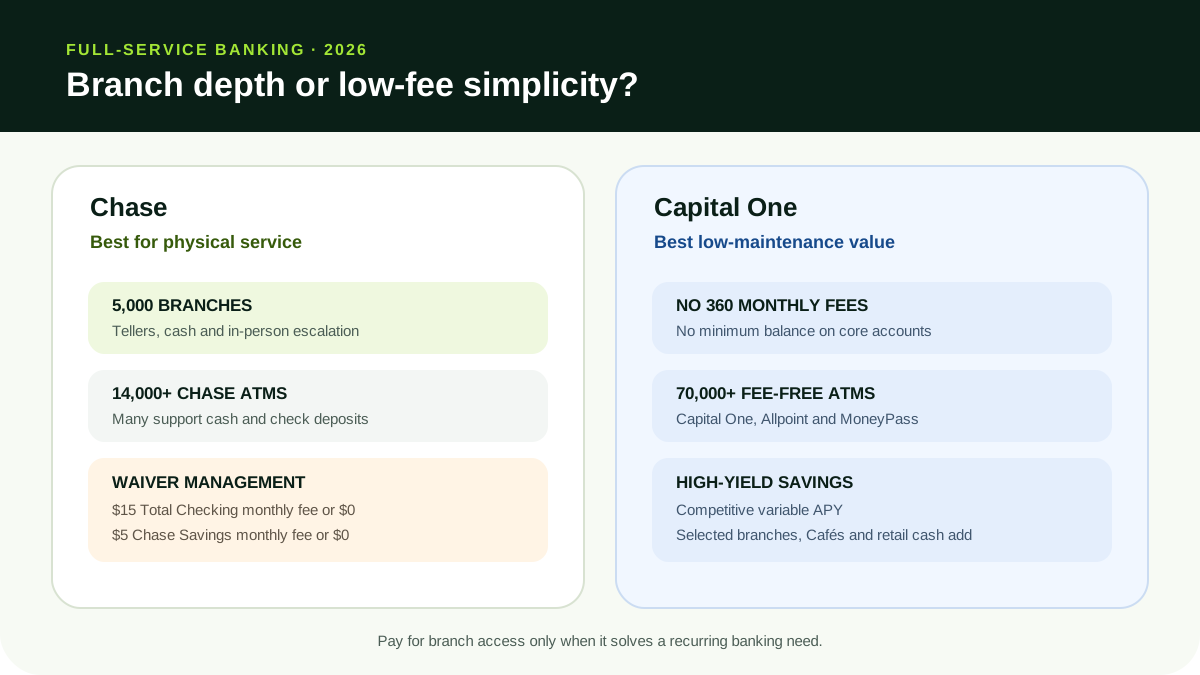
Checking fees
Chase Total Checking charges $15 per monthly statement period unless at least one waiver applies. Current conditions include $500 or more in qualifying electronic deposits, a $1,500 beginning-of-day balance, or a $5,000 average beginning-of-day balance across the account and eligible linked deposits or investments. Qualifying linked-account rules also apply.
The direct-deposit threshold is achievable for many payroll customers, but it creates an ongoing dependency. A job change, payroll coding error, transfer that does not count, or moved investment balance can turn a free month into a $15 month. Twelve unwaived fees total $180 a year.
Capital One 360 Checking has no monthly cycle service charge and no minimum balance requirement. There is no fee-waiver calendar to monitor. The account pays a small variable checking APY under its current disclosure, although the main economic advantage is avoiding routine fees rather than the interest on transaction money.
Savings yield and fees
Chase Savings has a $5 monthly service fee unless a waiver applies. Published options include maintaining at least $300 at the beginning of each day, making at least $25 in Autosave or other repeating automatic transfers from a Chase checking account, linking a qualifying checking account, or meeting certain age and relationship conditions.
The standard Chase savings rate is generally not designed to compete with online high-yield accounts. Because rates can vary by relationship and location, check the exact rate sheet rather than relying on a national comparison. A $5 fee on a small balance can exceed all interest earned.
Capital One 360 Performance Savings has no monthly cycle service charge, no minimum opening deposit, and a variable high-yield APY applied under its disclosure. The live rate is more important than a number copied into an article because the bank can change it before or after opening.
On $20,000, every 1.00 percentage point of APY is roughly $200 in annual interest before tax if the rate remains constant. That difference can outweigh a checking bonus or branch convenience. Keep enough in checking for bills and evaluate the rest at the live savings rates.
Branches and in-person service
Chase publishes access to 5,000 branches. That footprint is the core reason to choose it. Branches can accept cash and checks, issue certain official items, help with wires, notarization where available, identity verification, account changes, and problems that are difficult to resolve through chat.
Service availability still varies. Not every branch has a notary, safe-deposit box, foreign currency, investment specialist, or appointment slot. Verify the exact branch and service before traveling.
Capital One has branches in selected markets and Cafés in a smaller set of cities. A Café is not a full branch and may offer self-service banking plus ambassadors rather than a traditional teller line. Customers outside Capital One's physical markets should treat 360 as online-first.
ATM networks
Chase operates more than 14,000 ATMs. They support withdrawals, many cash and check deposits, transfers, balance access, and selected bill payments. A standard Total Checking withdrawal at a non-Chase ATM costs $3 in the United States or $5 outside the United States and its territories, before an operator surcharge or foreign-exchange adjustment.
Capital One publishes more than 70,000 fee-free ATMs across its own, Allpoint, and MoneyPass networks for eligible checking accounts. Its 360 Checking disclosure says Capital One does not charge a fee at another bank's ATM, although that machine's owner can still impose one.
Capital One wins the ATM category on breadth and issuer fees; Chase wins for deposit-capable proprietary machines connected to branches. Search actual locations around home, work, travel, and any campus or rural area rather than comparing national totals alone.
Cash deposits
Chase is easier for regular cash income. Customers can deposit at staffed branches and compatible Chase ATMs, subject to account, machine, identification, and funds-availability rules. A teller receipt also creates a clear escalation path if a deposit is miscounted.
Capital One supports free Add Cash in Store for eligible consumer accounts through its mobile app at participating retailers. Published limits allow up to $999 per transaction, $1,500 per day, $5,000 per month, and 10 cash additions per month. Locations and operational limits can vary, and a smartphone is required.
Retail cash addition is useful for occasional deposits but not a perfect branch substitute. Test a small deposit, keep the receipt, confirm posting, and avoid waiting until a bill is due. A cash-heavy business needs a business account designed for its volume, not a personal workaround.
Overdraft policies
Chase can charge a $34 Overdraft Fee per paid transaction when nightly processing leaves the account overdrawn by more than $50, with up to three fees per business day. Chase Overdraft Assist avoids the fee when the end-of-day deficit is $50 or less, or when a larger deficit is reduced to $50 or less by the end of the next business day under the cutoff rules.
Chase also offers free transfers from a linked eligible savings account when enough money is available. An unpaid or declined transaction can still create merchant consequences even if the bank does not charge an overdraft fee.
Capital One offers auto-decline, free savings transfer, and no-fee overdraft options. No-fee overdraft requires at least $250 in eligible deposits during two of the previous three calendar months. New accounts are not immediately eligible, approval is discretionary, and any negative balance must be repaid promptly.
Capital One's policy eliminates the per-item bank fee for an approved overdraft, but it does not promise payment. The safest configuration is real-time alerts, a checking buffer, linked savings, and auto-decline for transaction types that should never create debt.
Apps, transfers, and everyday tools
Both apps support mobile check deposit, bill pay, Zelle, alerts, debit-card controls, direct deposit, external transfers, and digital wallets. Chase's app connects checking and savings with its credit cards, mortgages, auto loans, and J.P. Morgan investing. Capital One connects banking with its credit-card ecosystem and credit monitoring.
Ease depends on the task. Capital One removes more account-maintenance decisions. Chase offers more relationship controls and branch appointments but can present multiple account tiers, waiver tests, and linked-balance rules.
Before switching, test an ACH transfer in each direction, add every bill payee, inspect daily transfer and mobile-deposit limits, and keep the old account open through one full statement cycle. Do not close it until direct deposits, automatic debits, refunds, checks, and peer-to-peer links have moved.
Customer service
DollarScout scores Chase 4.4/5 for Customer Service versus Capital One's 4.3/5. Chase earns the narrow edge because its nationwide branches create another service channel. That does not guarantee a faster fraud claim, wire recall, or deposit-hold release; specialized departments often control those cases.
Capital One publishes phone support seven days a week and provides app and web servicing. A local branch or Café may help in covered markets, but many 360 customers will resolve problems remotely.
For either bank, record the date, representative, case number, promised action, and documents sent. Follow the formal error-resolution process in the deposit agreement when an electronic transfer or debit-card dispute is involved.
FDIC insurance after the Discover integration
Chase and Capital One are FDIC-insured banks. The standard limit is $250,000 per depositor, per insured bank, for each ownership category. Checking and savings held in the same ownership category at one bank are combined.
Capital One completed its acquisition of Discover, and Capital One states that its and Discover's deposit accounts became jointly insured as of November 18, 2025. A customer with balances under both brands must no longer assume each brand automatically creates a separate $250,000 allowance. Use EDIE and current transition notices, especially while Discover accounts move to Capital One products.
Banking and investment products in one app are not all insured. Stocks, mutual funds, crypto assets, annuities, and safe-deposit-box contents are outside ordinary FDIC deposit coverage.
Relationship value
Chase can be rational for a household that naturally qualifies for waivers, uses nearby branches, holds Chase cards, and values one login with J.P. Morgan investments. But investment balances should not be moved merely to save $15 a month without comparing advisory fees, fund costs, cash yield, and service.
Capital One is rational for a household that wants 360 Checking, high-yield Savings, and Capital One credit cards without deposit-account maintenance. Its selected branches, Cafés, ATMs, and retail cash network give it more physical flexibility than a pure online bank.
Which bank should you choose?
Choose Capital One when avoiding routine fees, earning a competitive savings yield, and accessing 70,000+ fee-free ATMs matter more than teller coverage. It is the more forgiving default for digital-first consumers.
Choose Chase when a nearby branch is used regularly, cash deposits are substantial, complex transactions need in-person help, or an existing relationship naturally waives fees without parking money at a weak yield.
Use both strategically when Chase handles cash and branch work while Capital One holds high-yield savings. Track FDIC limits separately and avoid keeping excess money in a low-yield account solely for convenience.
Final verdict
Capital One wins because 360 Checking and 360 Performance Savings remove the monthly-fee and minimum-balance traps while offering competitive savings and broad ATM access. Chase's 5,000 branches are a genuine advantage, but customers should pay for that advantage only when they actually use it and can waive fees without sacrificing more interest elsewhere.
Which one is right for you?
- Best for No-waiver checking and high-yield savings: Capital OneView Capital One Accounts
- Best for Broad fee-free ATM access and no issuer fee outside network: Capital OneView Capital One Accounts
- Best for Nationwide branches, teller service, and cash deposits: ChaseView Chase Accounts
- Best for Complex relationship banking and in-person escalation: ChaseView Chase Accounts
Final verdict
Capital One is the stronger 2026 default for fee-conscious customers: its flagship checking and high-yield savings products have no monthly service fee or minimum balance, and its ATM network is broad. Chase is worth choosing when its national branches, proprietary deposit ATMs, and relationship service solve recurring problems and its fees are waived naturally.
Frequently asked questions
Sources and verification
Scores and product facts come from the underlying DollarScout reviews and were checked against these primary sources.
- Chase Total Checking current product terms
- Chase Total Checking fees and waiver details
- Chase checking account comparison and network
- Chase Savings fees and waiver details
- Chase overdraft services
- Chase Deposit Account Agreement and fee schedule
- Capital One 360 bank accounts
- Capital One 360 Checking disclosure
- Capital One savings accounts and current rate
- Capital One 360 Savings account disclosure
- Capital One overdraft options and qualification
- Capital One Discover savings transition and FDIC notice
- FDIC understanding deposit insurance
- CFPB bank accounts and services
Related content
More from DollarScout on this topic.
