Many products on this page are from partners who compensate us. This doesn't influence our ratings. Our opinions are our own.
How to Switch Banks
By Sophie Brown, Senior Finance Editor · Updated Jul 2026 · Fact-checked Jul 18, 2026
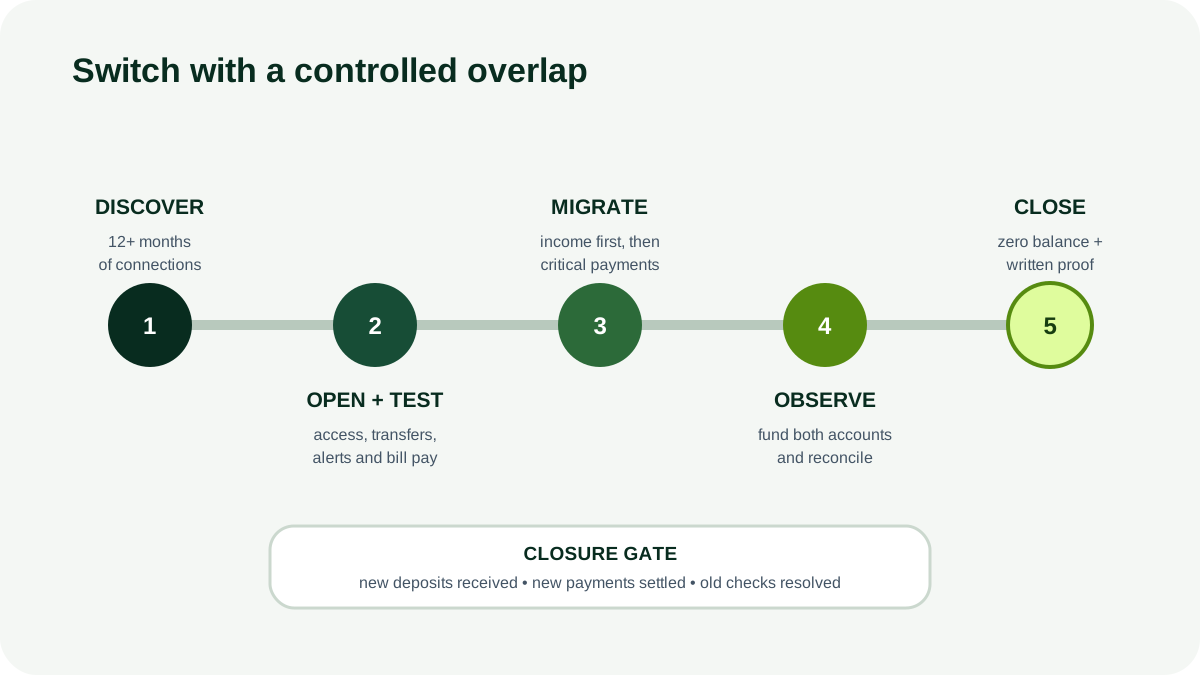
A safe bank switch is a controlled overlap, not a one-day transfer. Open and test the new account, inventory every deposit and withdrawal tied to the old one, move each instruction, and close only after pending items have cleared. This checklist turns that sequence into an auditable migration.
Key takeaways
- Open and verify the new account before changing payroll, benefits, or automatic payments.
- Use at least 12 months of statements to find annual charges, infrequent deposits, and checks that may still clear.
- Keep both accounts funded during an overlap period and confirm each transaction at the new destination.
- Do not close the old account until outstanding checks, refunds, peer-to-peer links, and automatic debits are resolved.
- Obtain written closure confirmation and retain statements, tax forms, and the migration log.
Treat the switch like a payment-system migration
Your checking account may be connected to payroll, government benefits, rent, utilities, credit cards, loan payments, subscriptions, tax refunds, payment apps, brokerage transfers, and paper checks. Moving the balance without moving those instructions can create returned payments, late fees, overdrafts, or a paycheck sent to a closing account.
The CFPB's sequence is sound: open the new account first, list scheduled deposits and withdrawals, reroute them, leave enough in the old account for uncleared items, transfer the remaining money only after the new flow works, and get written confirmation when the old account closes.
Phase 1: choose and open the replacement
Confirm that the account solves the reason for switching. Compare monthly fees, waivers, minimums, ATM access, branch needs, cash deposits, ACH and wire limits, check availability, joint ownership, mobile controls, customer support, and interest. Verify an insured bank through FDIC BankFind or a federally insured credit union through the NCUA.
Read the opening disclosure and fee schedule before funding. Record the legal institution name, routing number, masked account number, opening date, minimum opening deposit, and any bonus requirements. Save a copy of the terms; web pages and promotions can change.
Use a small initial deposit and complete these tests:
| Test | Evidence to keep |
|---|---|
| Sign-in and multifactor authentication | Recovery methods work |
| Incoming transfer | Date initiated, available date, amount |
| Outgoing transfer | Limit, fee, arrival date |
| Debit card or ATM | Activation and intended access path |
| Bill pay, if needed | Payee created and test payment delivered |
| Alerts | Low balance and transaction alert received |
Do not reroute essential income until you can access the new account and the identifying details have been checked against an official statement or secure account page.
Phase 2: build a complete connection inventory
Review at least 12 months of old-account statements; 18 months is safer when annual insurance, memberships, property taxes, or professional renewals may exist. Search email for “autopay,” “direct debit,” “payment scheduled,” “subscription,” and the last four digits of the old account.
Create a migration ledger:
| Connection | Direction | Typical date | Amount pattern | Changed? | First new-account result |
|---|---|---|---|---|---|
| Employer payroll | In | Every other Friday | Variable | Pending | — |
| Electric utility | Out | 12th | Variable | No | — |
| Credit card | Out | 20th | Statement balance | No | — |
| Tax refund profile | In | Irregular | Variable | Review | — |
Include ACH instructions, debit-card subscriptions, checks, payment apps, digital wallets, brokerage links, merchant refunds, cash-back redemptions, and transfers to savings. A replaced debit card number does not update a merchant that debits the routing and account numbers.
Separate transactions into critical, recurring, and optional. Payroll, benefits, housing, insurance, loans, taxes, and utilities move first. Cancel subscriptions you no longer want rather than migrating them automatically.
Phase 3: move incoming money first
Update employer payroll through the employer's approved process. The change may take one or more pay cycles, so ask when it becomes effective and inspect the next deposit. For Social Security or other benefits, use the issuing agency's official process rather than a link received by message.
Move other incoming instructions such as pension, marketplace payouts, payment processors, tax-preparation profiles, brokerage withdrawals, and transfers from relatives. A saved routing number in a tax account is not the same as a currently pending tax refund; determine whether a payment is already in flight before editing it.
Keep the old account open and able to receive funds until at least one expected cycle has landed correctly at the new account. If income timing is uncertain, maintain enough cash across both accounts to cover the next round of obligations.
Phase 4: move payments deliberately
Change each automatic payment at the biller's official website or app. Confirm the displayed account ending, effective date, and next scheduled amount. Take a screenshot or save the confirmation email without exposing full account details in an insecure document.
For critical bills, do not assume that changing a stored bank account changes a payment already scheduled. Inspect the upcoming payment separately. Some billers verify a new bank account with microdeposits or require several days before it can be used.
Update debit-card subscriptions only after the new card is active. Review mobile wallets, transit accounts, toll tags, peer-to-peer services, and retailer accounts. If the old bank provides bill pay, cancel future instructions there only after equivalent payments are scheduled from the new account.
Paper checks require special treatment. List every check number, payee, amount, and date that has not cleared. Leave money in the old account until those checks clear or are properly stopped and replaced. Never withdraw the check's funding simply because the recipient has delayed depositing it.
Phase 5: run both accounts in parallel
The overlap is a control, not wasted time. Keep a reserve in each account based on unresolved activity. Check both accounts frequently and reconcile every transaction to the migration ledger.
A practical closure gate requires all of the following:
- At least one expected payroll or other main deposit has arrived in the new account.
- Critical automatic payments have successfully settled from the new account.
- No scheduled old-account bill payments remain.
- All known paper checks and debit-card transactions have cleared or been resolved.
- Expected refunds, disputes, and merchant credits have a valid destination.
- The old account has no negative balance, pending fee, or required minimum tied to an upcoming date.
There is no universal number of days for the overlap. One complete monthly billing cycle is a useful minimum for many households; a longer period may be appropriate when checks, annual charges, benefits, or disputes remain open.
Transfer the residual balance safely
Once the closure gate is satisfied, transfer most of the remaining balance through a tested method. Consider transfer limits, wire or cashier's-check fees, and funds-availability holds at the new institution. A large incoming check may not be fully available immediately.
Leave a small documented cushion until the last reconciliation. Then ask the old institution for the exact payoff or closing balance and whether accrued fees or interest will post. Avoid reducing the account to zero without formally closing it; a fee or delayed debit could reopen a negative balance.
Close and preserve evidence
Follow the institution's required closure method. It may allow secure message, phone, branch, or written request. Ask for written confirmation showing the account is closed with a zero balance. Record the date, representative or confirmation number, and destination of any final check.
Download statements before online access disappears. Keep records needed for taxes, disputes, warranties, reimbursements, and proof of payment. Save any year-end interest form that may arrive after closure and keep contact details current so the bank can deliver it.
Destroy unused checks and debit cards securely after closure. Remove the old account from payment apps, wallets, accounting software, password-manager notes that are no longer needed, and external-account lists at other institutions.
Avoid common switch failures
Do not close immediately after the first new paycheck, rely on memory for recurring charges, send the entire balance before outstanding checks clear, or assume a merchant refund will follow a replacement card. Do not share login credentials with a “switching service” unless you have independently assessed the provider and its permissions.
Watch for bonus terms. Closing too early may forfeit a bonus or trigger a clawback, while keeping an unwanted account open may create a fee. The decision should be based on the written terms, not an estimated reward.
If the old bank reports a negative balance or refuses closure, request the transaction history and fee explanation in writing. Resolve legitimate outstanding items and use the bank's complaint channel; the CFPB accepts complaints about financial products and services after an attempt to work with the company.
Bottom line
Switching banks safely is a staged migration: verify the new account, inventory every connection, reroute income, move payments, observe a full overlap, reconcile, and close with written evidence. The extra account balance held during transition is a temporary control against missed payments and fees. Precision matters more than speed.
Related content
Frequently asked questions
Sources
Related content
More from DollarScout on this topic.
