Many products on this page are from partners who compensate us. This doesn't influence our ratings. Our opinions are our own.
How to Choose a High-Yield Savings Account
By Sophie Brown, Senior Finance Editor · Updated Jul 2026 · Fact-checked Jul 18, 2026
A high-yield savings account should protect cash, pay a competitive variable return, and let you reach the money when its purpose requires it. “High yield” is a marketing description, not a regulatory category, so the right comparison includes insurance, APY conditions, fees, transfer mechanics, service, and the identity of the institution holding the deposit.
Key takeaways
- Verify the bank in FDIC BankFind or the credit union with the NCUA before comparing rates.
- Compare APY on the balance you expect to keep, including tiers, caps, promotions, fees, and qualification rules.
- Test deposit and withdrawal timing; an emergency account is only useful if its access path works.
- Understand whether a financial app is itself a bank or places funds at one or more partner banks.
- Recheck the account after opening because variable rates, fees, and service quality can change.
“High yield” does not define the account
Banks can describe a savings account as high yield, premium, online, or rewards-based. Those names do not create a fixed rate or a special insurance category. The legally and operationally important facts are in the account disclosures: the annual percentage yield, whether it is variable, minimum balances, fees, transaction rules, compounding and crediting, and the institution that owes the deposit.
Choose in this order: safety, fit, total return, then convenience preferences. A spectacular advertised APY is irrelevant if the offer applies to only a small tier, requires activity you will not maintain, expires quickly, or sits behind an unclear deposit arrangement.
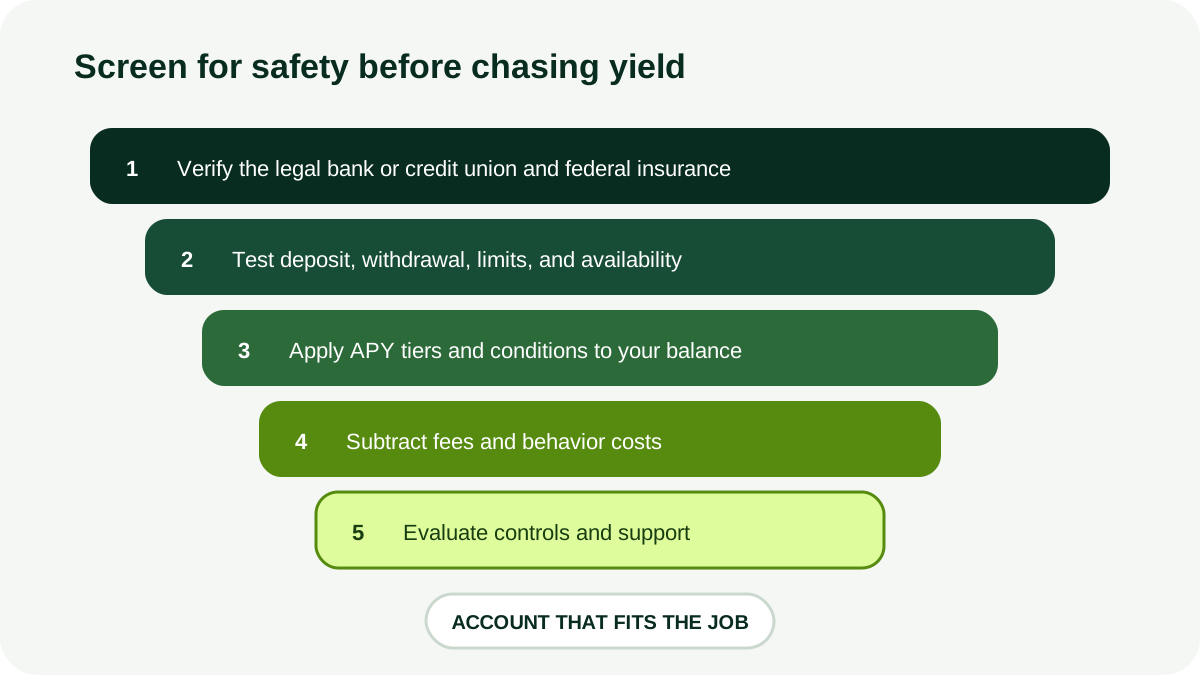
Step 1: define the cash job
Write down the amount, purpose, and likely withdrawal horizon. An emergency fund needs dependable access and no market risk. A property-tax reserve needs a known withdrawal month. Cash for tomorrow's bills belongs in checking, not in a remote savings account selected solely for yield. Money that will not be used for several years may need a broader investment decision rather than automatic placement in cash.
Classify the balance:
| Purpose | Likely horizon | Access priority | Useful account feature |
|---|---|---|---|
| Emergency reserve | Uncertain | High | Tested transfers, no withdrawal penalty |
| Annual bills | Known within 12 months | Medium | Buckets or clear labels |
| Near-term purchase | Months to a few years | Medium | Competitive APY, stable user experience |
| Operating cash | Days to weeks | Very high | Better suited to checking |
This prevents rate chasing from separating money from the way it will actually be used.
Step 2: verify who holds the deposit
For a bank, search the legal institution name in the FDIC's BankFind Suite. Do not rely only on an FDIC logo, an app-store description, or the name printed on a debit card. BankFind lets the public locate current and former FDIC-insured institutions and review institution details.
For a credit union, verify federal share insurance through the NCUA. FDIC insurance does not cover credit-union shares; the National Credit Union Share Insurance Fund does. Standard federal protection is generally described as $250,000 per depositor or member, per insured institution, for each qualifying ownership category, subject to the applicable agency's rules and records.
A technology company may offer an interface while one or more partner banks hold customer funds. That can support pass-through insurance only if the arrangement and records satisfy the rules. Identify the partner bank, understand when funds leave the app provider and reach the bank, read what happens while a transfer is in transit, and include other deposits you already hold at the same partner bank when estimating coverage.
Do not interpret “eligible for FDIC insurance” as a guarantee that every balance in every state of a transaction is insured. The FDIC directly insures deposits at insured banks, not stocks, mutual funds, crypto assets, or the failure of a nonbank company.
Step 3: read APY as a conditional number
APY is the standardized annual measure designed to reflect interest and compounding under the disclosed assumptions. It makes offers more comparable than a raw interest rate, but it does not promise that a variable APY will remain unchanged for a year.
Record these fields for every candidate:
| Field | Question to answer |
|---|---|
| Current APY | Is it variable, promotional, or guaranteed for any period? |
| Balance tiers | Which dollars receive each APY? Is there a cap? |
| Qualifications | Are direct deposit, card purchases, or monthly deposits required? |
| Minimums | Is there a minimum to open, earn interest, or avoid a fee? |
| Fees | Monthly, excess activity, outbound wire, statement, closure, or dormant account? |
| Crediting | How often is interest compounded and credited? |
Compare dollars, not slogans. If Account A pays 4.00% APY and Account B pays 4.25%, a stable $10,000 balance produces a maximum advertised difference of roughly $25 over a year before taxes, assuming those APYs persist and their conditions apply. One $10 monthly fee would reverse that advantage. The exact interest depends on balance timing, rate changes, and the institution's disclosed calculation.
Ignore rankings that present a live rate without an “as of” date. A useful review separates durable product features from a rate that can change tomorrow.
Step 4: inspect movement and availability
Ask how money enters and leaves: linked external account, ACH push or pull, wire, check, ATM, branch, or internal transfer. Review daily and monthly limits, new-account restrictions, hold times, and whether an outbound transfer can be expedited. The bank's mobile experience matters less than completing the exact action you will need.
After opening, transfer a small amount in, wait until it is available, and transfer part back out. Save the dates and any limit displayed. Do not wait for an emergency to discover that a new external link requires verification or that the default outbound limit is too low.
The Federal Reserve removed the federal six-per-month transfer limit for savings deposits in 2020, but institutions can retain their own disclosed policies. Check the account agreement rather than assuming unlimited movement.
Step 5: calculate the real cost of conditions
Requirements can impose opportunity and attention costs. A $5,000 cap at a headline APY may leave the rest earning much less. A direct-deposit requirement may prevent using the account as a secondary reserve. Required debit purchases can conflict with the reason for separating savings from spending.
Build a simple comparison with your expected average balance:
- Apply each APY tier only to the dollars in that tier.
- Estimate interest for a scenario where the rate falls as well as where it stays constant.
- Subtract unavoidable fees.
- Value any cash bonus separately and check holding-period or clawback terms.
- Exclude benefits that require behavior you will not maintain.
Do not count a sign-up bonus as recurring yield. If the account must remain open for a period, keep the terms and calendar the date before moving funds.
Step 6: evaluate service and controls
Useful controls include transaction alerts, low-balance alerts, multifactor authentication, the ability to lock access, clear statements, beneficiary management, and downloadable records. Search the institution's current complaint and support channels. Test a nonurgent support question before depositing a large reserve.
Joint owners and payable-on-death beneficiaries affect access, estate handling, and insurance calculations. Add them deliberately and verify the account title. A nickname such as “House Fund” does not create a different ownership category or separate insurance coverage.
Red flags that should stop the application
Pause when the legal bank is not disclosed, the advertised return is described as risk-free but the balance is not a deposit, the APY conditions are hard to locate, support cannot explain withdrawals, or the company pressures you to fund before providing the account agreement. Screenshots of a logo are not verification.
Also avoid sending savings through a payment requested by a stranger. Deposit insurance protects against an insured bank's failure; it does not reverse an authorized scam payment or protect an investment loss.
Monitor after opening
Save the opening disclosure and first statement. Each month, reconcile deposits, withdrawals, and credited interest. Every quarter, check the APY, fee schedule, linked accounts, and whether the product still fits its purpose. Update contact information and beneficiaries when circumstances change.
Switching for every small rate change can create transfer delays, tax forms, dormant accounts, and tracking risk. Set a threshold: move only when the expected net benefit over a reasonable period exceeds the work and the new account passes the same safety and access checks.
Bottom line
The best high-yield savings account is an insured deposit arrangement you can verify, understand, and operate. Start with the cash job, confirm the institution, model the APY on your actual balance, subtract conditions and fees, and test withdrawals. Yield is important, but protection and usable access are what make the account suitable for savings.
Related content
Frequently asked questions
Sources
Related content
More from DollarScout on this topic.
