Many products on this page are from partners who compensate us. This doesn't influence our ratings. Our opinions are our own.
How to Open a Brokerage Account
By Sophie Brown, Senior Finance Editor · Updated Jul 2026 · Fact-checked Jul 18, 2026
A brokerage account lets you hold cash and buy investments such as stocks, bonds, mutual funds, and ETFs through a registered firm. The application may take minutes, but the decisions built into it—ownership, taxes, cash versus margin, sweep treatment, fees, trading permissions, and beneficiaries—can last for years. This guide shows how to choose and verify a broker, read the agreements, fund the account safely, and test the full workflow before transferring substantial assets.
Key takeaways
- Choose the legal ownership and tax treatment before comparing app features or promotions.
- Confirm whether the application opens a cash or margin account; some firms make margin the default, and margin can expose assets to forced sale.
- Verify the firm and professionals through FINRA BrokerCheck, read Form CRS, identify the clearing firm, and confirm SIPC membership independently.
- Compare total cost, investment access, order handling, cash sweep, transfers, service, security, and records—not only stock commissions.
- Fund with a small test transfer, verify the account title and instructions, enable strong security, and review the first confirmation and statement.
Know what service you are opening
A brokerage account is held at a broker-dealer and allows the customer to buy and sell investments. A brokerage relationship is not automatically an ongoing investment-advisory relationship. A separate advisory account may give an adviser discretion or continuous portfolio-management duties and usually charges an asset-based or other ongoing fee.
One firm can offer both services. Read the firm’s Form CRS, account agreement, Regulation Best Interest disclosures, advisory Form ADV when relevant, and fee schedule to identify:
- which legal entity provides the service;
- whether the relationship is brokerage, advisory, or both;
- who makes each investment decision;
- how the firm and professional are paid;
- material conflicts of interest;
- the standard that applies to recommendations;
- where to find disciplinary history.
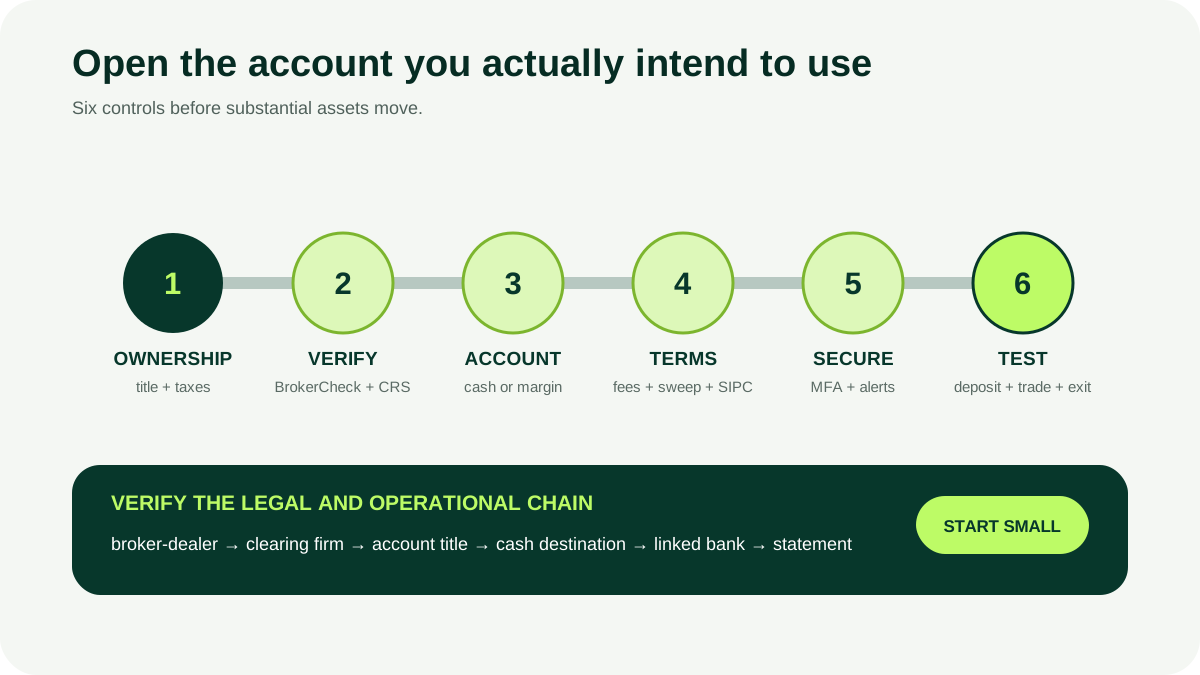
Choose the account ownership and tax treatment first
The account title determines who owns and controls the assets. Common registrations include:
| Account form | Core question to resolve |
|---|---|
| Individual taxable | Does one adult need flexible access and sole control? |
| Joint taxable | Which joint ownership form applies under state law, and what happens at death? |
| Traditional or Roth IRA | Is the investor eligible, and do contribution and withdrawal rules fit the goal? |
| Rollover IRA | Should workplace-plan assets remain separately identified, and what future rollover options matter? |
| Custodial account | Who is the custodian, who is the minor owner, and when does control transfer? |
| Trust account | Does the title match the trust, and does the trustee have authority to act? |
| Entity account | Do formation documents and authorized-person records support the business or organization? |
Do not choose solely for a bonus or because it appears first in the app. Ownership affects taxes, creditor and estate issues, access, reporting, and Securities Investor Protection Corporation treatment. For joint, trust, custodial, inherited, business, or estate accounts, legal and tax advice may be warranted.
A taxable brokerage account does not have the same contribution and withdrawal limits as an IRA, but dividends, interest, distributions, and realized gains may be taxable. A retirement account can have valuable tax treatment while restricting contributions and withdrawals. Match the account to the goal before selecting investments.
Decide between cash and margin explicitly
Investor.gov and FINRA describe two general brokerage account types:
- In a cash account, purchases must be paid in full.
- In a margin account, the firm can lend money against account securities, and the customer pays interest.
Margin is not merely a faster cash account. If collateral falls, the firm can demand more assets, raise its maintenance requirement, and sell securities—potentially without advance notice—to protect the loan. Losses can exceed the cash initially deposited.
Some applications default to margin. Read the selected option before signing. If the plan does not require borrowing, short selling, or a margin-only feature, ask what a cash account supports and choose intentionally.
A cash account also has rules. Most U.S. stocks, ETFs, and many other securities now generally settle one business day after the trade date. Buying and selling without properly paying for the purchase can create Regulation T violations and account restrictions. Learn how the broker displays settled cash, buying power, pending deposits, and withdrawal availability.
Verify the firm independently
Do not rely on an app-store listing, social profile, advertisement, or a link sent in a message. Identify the exact legal broker-dealer and verify it using official databases.
- Search the firm and any professional in FINRA BrokerCheck.
- Review registrations, business activities, disclosures, disciplinary events, and the firm’s relationship summary.
- Confirm the website and phone number through the official record rather than the solicitation.
- Identify the carrying or clearing firm that will custody assets and appear on statements.
- Confirm SIPC membership through SIPC’s member resources.
- If advisory services are involved, review the adviser’s SEC or state registration and Form ADV.
Registration does not guarantee honesty, performance, or suitability, but an unregistered or impersonated firm is a critical warning. Be especially cautious when a person moves the conversation to an encrypted chat, promises guaranteed returns, demands cryptocurrency or a wire to an unrelated recipient, or discourages independent verification.
Compare what the account can actually hold and do
Build a requirements list before comparing brokers:
- U.S. stocks and ETFs;
- mutual funds and whether transaction-fee or load schedules apply;
- Treasury, municipal, corporate, or agency bonds;
- fractional shares and which securities qualify;
- recurring purchases and dividend reinvestment;
- new issues, certificates of deposit, or foreign securities;
- retirement accounts, custodial accounts, trusts, or business accounts;
- options, margin, short selling, or futures only if genuinely needed and understood;
- cash-management, checks, debit card, bill pay, or collateral features;
- research, tax lots, performance reporting, and data export;
- human support, branch access, accessibility, and account recovery.
“Offers bonds” can mean an inventory chosen by the firm rather than broad access. “Fractional shares” may apply only to a limited list, may use market orders, and may not transfer in kind. Read the product and execution terms.
Calculate the total cost
The SEC emphasizes that small fees can materially reduce long-term portfolio value. Compare a realistic year of activity, including:
- stock, ETF, mutual-fund, option, and bond transaction charges;
- bid-ask spreads and markups or markdowns;
- fund expense ratios and sales loads;
- advisory or managed-account fees;
- subscription, platform, data, inactivity, paper-statement, and wire fees;
- margin rates and how the balance tiers work;
- foreign-security and currency-conversion charges;
- outgoing account-transfer, closure, reorganization, and returned-payment fees;
- cash-sweep yield and the opportunity cost of idle cash.
Order routing can also affect execution quality. The SEC notes that brokers choose where to route customer orders and may receive payment for order flow. A broker still has a duty to seek reasonably available best execution, but “zero commission” does not mean every venue, price, or conflict is identical. Review execution-quality and routing disclosures if trading cost matters to the strategy.
Understand SIPC, FDIC, and cash sweeps
SIPC protection is often misunderstood. SIPC can help restore missing cash and eligible securities when a SIPC-member brokerage firm fails financially and customer assets are missing, subject to legal limits and account-capacity rules. It does not protect against market losses, a security becoming worthless, unsuitable advice, or every type of asset.
SIPC currently states a maximum protection of $500,000 per customer capacity, including a maximum of $250,000 for a claim for cash. Multiple accounts are not automatically separate simply because they have different account numbers. Ownership capacity matters.
Idle brokerage cash can be handled in different ways:
- kept as a broker-dealer cash balance;
- swept to one or more bank deposits;
- invested in shares of a money market mutual fund.
These are not equivalent. SIPC explains that a bank sweep deposit is a bank liability rather than a security claim against the broker; it may instead qualify for pass-through FDIC insurance if program requirements are met. Money market mutual-fund shares are securities and can lose value, though they may be eligible for SIPC treatment when held at a member broker. Read the sweep program, participating-bank list, deposit allocation, interest rate, limits, and opt-out choices.
Insurance does not replace diligence. Verify the legal custodian and review statements promptly.
Read the account agreement before accepting it
Save a dated copy of every agreement and disclosure. Search for:
- margin consent and the firm’s liquidation rights;
- securities lending or fully paid lending;
- cash-sweep authorization;
- arbitration and dispute provisions;
- electronic delivery and deemed receipt;
- beneficiary or transfer-on-death terms;
- discretionary authority;
- account freezes and restrictions;
- order-routing and fractional-share handling;
- fees and the right to change them;
- privacy, data sharing, and marketing permissions;
- trusted-contact authorization;
- treatment of abandoned, inactive, or deceased-customer accounts.
Do not assume that an unchecked marketing box reverses a separate contractual consent. Ask for written clarification when a feature can lend securities, borrow money, share data, or move cash.
Gather application information securely
Federal rules require firms to identify customers and collect financial and regulatory information. A typical application can request:
- legal name, date of birth, residential address, citizenship, and tax identification number;
- government identification;
- employment and employer information;
- income, net worth, liquid net worth, tax bracket, and investment experience;
- investment objectives, time horizon, liquidity needs, and risk tolerance;
- affiliations with a broker-dealer, exchange, public company, or political organization;
- bank details and the source of funds;
- trusted contact and beneficiary information.
Provide accurate information only through the verified firm’s encrypted site or official app. Avoid public Wi-Fi, shared devices, links in unsolicited messages, and emailed copies of sensitive documents unless the firm provides an approved secure process.
The firm may require additional documents or decline the application. A delay for identity review is not a reason to send documents to an unverified “support agent.”
Configure security before funding
Use a unique password stored in a reputable password manager. Enable the strongest multifactor authentication the firm supports; an authenticator app, passkey, or hardware key generally resists more attacks than reusable security questions.
Also configure:
- login and new-device alerts;
- trade, withdrawal, wire, bank-link, profile-change, and password-reset alerts;
- a trusted contact who cannot normally trade but can help the firm address suspected exploitation or loss of contact;
- beneficiaries where appropriate;
- paperless delivery to a monitored email address;
- device and session review;
- verbal password or transfer lock if offered.
Never share a one-time code with someone who calls. A genuine support representative should not need remote access to a device or ask the customer to move assets to a “safe” account.
Fund with verified instructions and a small test
Common methods include ACH transfer, wire, check, direct deposit, and an account transfer from another broker. Each differs in speed, reversibility, hold periods, and cost.
Before moving money:
- Confirm the destination account title and number inside the authenticated portal.
- Obtain wire instructions through an official channel and verify unexpected changes independently.
- Understand deposit holds, available-to-trade credit, and withdrawal restrictions.
- Send a small test amount.
- Confirm receipt and the displayed account ownership.
- Keep the bank and brokerage confirmations.
An Automated Customer Account Transfer Service transfer can move eligible positions between firms, but not every asset transfers in kind. Fractional shares, proprietary mutual funds, alternatives, certain annuities, or unsupported securities may be sold, delayed, or rejected. Ask the receiving broker to review the current statement before initiating the transfer.
Do not liquidate a portfolio merely because a form says transfer. Selling can create taxes, spreads, market exposure, surrender charges, or loss of features. Compare an in-kind transfer, partial transfer, and planned liquidation.
Preserve tax lots and account records
After an incoming transfer, verify each security, quantity, acquisition date, and cost basis. Basis data can arrive after the positions. Keep old statements and confirmations rather than assuming all history will migrate.
Set or review the broker’s default tax-lot disposal method. First-in, first-out, average basis where allowed, and specific identification can produce different tax results. Specific identification generally requires timely instructions and confirmation.
For retirement transfers and rollovers, verify whether the movement is trustee-to-trustee, direct, or indirect and whether withholding or a deadline applies. A seemingly minor transfer method can have tax consequences.
Test the complete operating cycle
Before consolidating a large balance:
- place a small, understood trade;
- inspect the order preview and execution report;
- confirm the correct security and account;
- find settled cash and pending activity;
- locate tax lots, statements, and disclosures;
- contact support with a real question and measure the response;
- test a small withdrawal back to the verified bank;
- export a statement or activity file;
- confirm alerts arrived without exposing sensitive details.
This test reveals more than a promotional feature list. It can expose confusing interfaces, slow support, unexpected holds, missing records, or unsuitable defaults while the account is still small.
Review the first statement and every one after it
SIPC urges investors to review confirmations and statements and report errors in writing. Check:
- opening and ending cash and positions;
- every trade, transfer, dividend, interest payment, and fee;
- margin debit or interest that should not exist;
- account title and contact information;
- cash-sweep destination and rate;
- tax withholding and cost basis;
- unfamiliar journals, linked banks, or authorized persons.
Save the complaint and delivery evidence if something is wrong. Prompt reporting can protect both recovery options and the factual record.
Final opening checklist
Before making the account primary, answer yes to each:
- The ownership and tax type match the goal.
- Cash versus margin was selected intentionally.
- The exact broker and professional were verified in official records.
- The clearing firm and SIPC status are known.
- The fee schedule and cash-sweep terms were read.
- Needed investments, order types, tax lots, and transfers are supported.
- Strong authentication, alerts, trusted contact, and beneficiaries are configured.
- Funding instructions were verified and a test transfer succeeded.
- The first trade, withdrawal, confirmation, and statement were reviewed.
- A current copy of all agreements and records is stored securely.
Bottom line
The best brokerage account is not simply the app with the shortest application or the largest bonus. It is the correctly titled account at a verified firm whose investments, total costs, cash treatment, service, security, execution, tax records, and transfer rules match the investor’s actual plan. Choose cash or margin deliberately, test the operation with a small amount, and keep independent records from the first day.
Related content
Frequently asked questions
Sources
Related content
More from DollarScout on this topic.
