
How to Pay Off Debt Fast
Paying debt faster requires more than choosing “avalanche” or “snowball.”
Short answer
The fastest safe debt plan starts with verified terms, protected essentials, current minimums, and a small liquidity buffer. Choose avalanche for interest efficiency or snowball for earlier balance closures, direct one sustainable extra amount to the target, and roll every completed payment forward. Contact creditors before a missed payment, compare total costs rather than monthly payments, and reject debt-relief promises that require trust before evidence. Speed is the product of a plan that can be repeated until the final verified balance reaches zero.
At a glance
9min read
Start with control, not speed
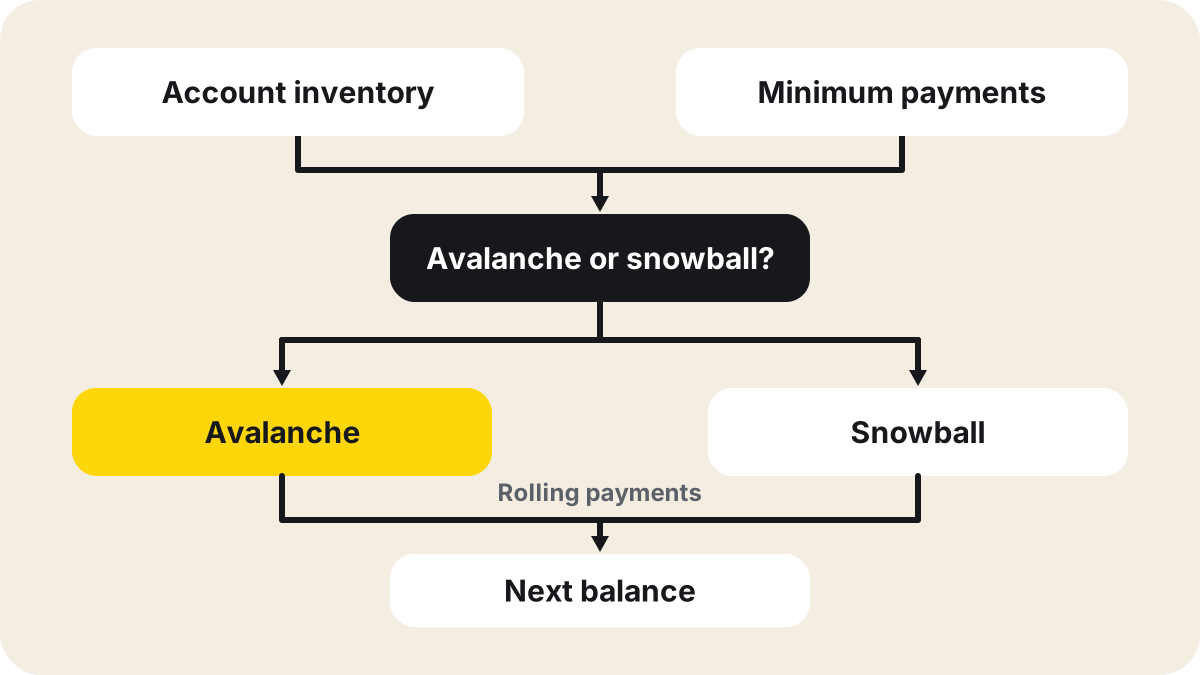
Step 1: create a complete debt inventory
Step 2: stabilize cash flow and protect minimums
Step 3: choose avalanche or snowball
How to make the plan faster without making it brittle
Key takeaways
- 1
Build the plan from current statements, including APRs, minimums, due dates, fees, and promotional-rate expirations.
- 2
Keep every required payment current, then direct one fixed extra amount to a named target balance.
- 3
The avalanche method usually reduces interest cost; the snowball method creates faster balance closures.
- 4
Contact creditors early if a payment may be missed and get any alternative arrangement in writing.
- 5
Treat advance-fee promises, guaranteed debt elimination, and instructions to stop communicating with creditors as warning signs.
Read the guide
A workable plan must verify every balance and rate, protect essential bills and minimum payments, create a repeatable extra-payment amount, and avoid debt-relief offers that make the situation worse. This guide provides the sequence, math, and safeguards needed to build that plan.
Start with control, not speed
“Fast” debt repayment is useful only if the plan remains current on housing, utilities, insurance, food, required transport, and every contractual minimum. A strategy that sends too much to one card and then misses another bill creates fees, credit damage, or new borrowing. The first goal is a stable payment system; speed comes from the amount consistently paid above minimums and the order in which balances receive it.
Keep reading
The FTC advises people who are behind on bills to contact creditors before a debt collector becomes involved and try to arrange a manageable payment plan. That makes timing important.
Do not wait for a missed payment to discover the lender’s hardship, due-date, or payment-plan options. If the budget cannot cover essentials and minimums, the immediate task is triage and creditor contact, not an aggressive payoff schedule.
Step 1: create a complete debt inventory
Use the latest statement or lender portal for every account. Record the creditor, account type, current balance, annual percentage rate, minimum payment, due date, fixed or variable rate, fees, delinquency status, collateral, and any promotional expiration. For student, tax, medical, secured, or collection debt, record the servicer and status separately because rights, consequences, and available programs differ.
| Field | Why it matters |
|---|---|
| Current balance | Establishes the payoff base and progress measure |
| APR or interest rate | Drives priority under the avalanche method |
| Minimum and due date | Must remain protected while another balance is targeted |
| Promo expiration | A deferred or introductory rate can change the correct order |
| Fixed or variable | A variable rate can change future cost |
| Fees and delinquency | May require immediate resolution before normal payoff ordering |
| Secured status | Missing payment can put an essential asset at risk |
Keep reading
Reconcile the list to the budget and bank activity. A credit report can help locate reported accounts, but the current statement is needed for terms, payment instructions, and an up-to-date payoff amount. Do not include the same debt twice under an original creditor and a collector without verifying who currently owns or services it.
If a collector contacts you about an unfamiliar balance, verify the debt before treating a phone request as payment instructions. The CFPB explains that debt collectors must provide required information and offers guidance for disputing, responding, and understanding collection rights. Legal deadlines and limitation periods vary, so obtain qualified legal help where needed rather than relying on a generic payoff rule.
Step 2: stabilize cash flow and protect minimums
List essential bills and required payments on a calendar. Align due dates with income where creditors allow changes.
Keep reading
Turn on account alerts and use autopay for minimums only after confirming that the funding account will hold enough money. Autopay prevents forgetfulness, not overdrafts.
Keep a starter emergency reserve appropriate to the household before committing every available dollar. Without any buffer, a necessary repair can return directly to a paid-down card. The reserve does not need to be the final three-to-six-month target before debt reduction begins; it needs to address the next likely disruption and make the payoff plan less fragile.
Calculate the extra-payment amount from a reconciled budget. If income is $4,600 and essential costs, minimums, saving, and a modest discretionary allowance total $4,150, the proposed extra amount is $450.
Test it against one or two months of actual transactions. A repeatable $400 transfer is more effective than planning $600 and reversing it after every irregular bill.
Step 3: choose avalanche or snowball
With the debt avalanche, pay all minimums and send the full extra amount to the highest-cost debt, normally the highest APR, while considering imminent promotional expirations and special terms. When that balance closes, roll its former minimum plus the extra payment to the next-highest-cost balance. This method generally minimizes interest when account terms and payments remain otherwise equal.
Consider this inventory:
| Debt | Balance | APR | Minimum |
|---|---|---|---|
| Card A | $7,000 | 24% | $210 |
| Card B | $2,000 | 18% | $70 |
| Personal loan | $4,000 | 9% | $130 |
Keep reading
With the debt snowball, pay all minimums and target the smallest balance first, regardless of rate. Closing an account sooner can simplify the plan and create a visible win.
Afterward, roll the closed account’s payment to the next-smallest balance. The tradeoff is that a larger high-rate balance may accrue interest longer.
With $400 extra per month, the avalanche directs $610 to Card A while Card B and the loan receive their minimums. The snowball directs $470 to Card B while the other accounts receive minimums. Once the target reaches zero, the payment rolls forward; it is not released back into routine spending.
The exact payoff date and interest total depend on the issuer’s balance method, compounding, payment timing, fees, rate changes, and new transactions. A simple spreadsheet estimate can compare strategies, but the lender’s statement and payoff quote control. Stop using target cards for new purchases if possible; mixing repayment with new charges makes progress and interest harder to measure.
How to make the plan faster without making it brittle
First, automate the base extra payment after a dependable deposit. Second, define a windfall rule before money arrives—for example, 60% of a tax refund, bonus, sale proceeds, or cash gift to the current target, 20% to reserves, and 20% to a named current need. The percentages can differ; the value is preventing an unplanned all-or-nothing decision.
Keep reading
Third, redirect payments that disappear. When a device installment, subscription, or other obligation ends, add its former amount to the target before lifestyle spending absorbs it.
Fourth, examine large recurring expenses and income opportunities. Renegotiating insurance, changing an unused service, adding documented overtime, or selling an unneeded asset can change the payoff date more than repeatedly cutting a small category.
Finally, request a lower rate or hardship option directly from the creditor, especially before delinquency. Ask how a change affects the rate, fees, minimum, account status, available credit, and credit reporting.
Record the representative, date, and terms, and request written confirmation. A reduced payment that extends the term may help immediate cash flow but does not necessarily reduce total cost.
Consolidation, counseling, and settlement are different
A consolidation loan replaces multiple debts with one account. Compare the new APR, origination fee, term, total scheduled payments, fixed or variable rate, and whether unsecured debt becomes secured.
Keep reading
A lower monthly payment can result from a longer term rather than a lower cost. Do not treat available credit on paid cards as new spending capacity.
A debt management plan is commonly administered through a credit-counseling organization. Creditors may agree to concessions while the consumer makes one plan payment.
Review setup and monthly fees, included accounts, expected duration, missed-payment consequences, and how participation is reported. A legitimate counselor should examine the full financial situation rather than promise a result before reviewing it.
Debt settlement usually seeks to resolve a balance for less than the amount claimed, often after payments have stopped. That can involve fees, collection activity, credit damage, lawsuits, and possible tax consequences.
It is not the same as a lower-rate payoff plan. The FTC warns that for-profit companies selling debt-relief services by phone cannot charge a fee before they settle or reduce a debt and the consumer has made at least one payment under the agreement.
State law and the exact service can add requirements, so verify current rules and obtain professional advice for serious distress.
Debt-relief warning signs
Slow down when a company guarantees that unsecured debt will disappear, demands payment before delivering a result, claims access to a secret government program, tells you to stop communicating with creditors without explaining consequences, or asks for sensitive information before providing written terms. Search the company name with terms such as “complaint,” “review,” or “scam,” and verify any claimed license or accreditation with the relevant organization or regulator.
Keep reading
The FTC’s 2026 consumer alert specifically warns about debt-relief impersonators who use official-looking documents and personal details to appear credible. Do not trust caller ID, an embossed letter, or knowledge of a balance as proof. Contact the creditor or agency through a number independently obtained from a statement or official website.
When the standard sequence should change
Bring delinquent essential or secured obligations under control before optimizing credit-card interest. Rent, mortgage, utilities, required insurance, taxes, court obligations, and a loan secured by an essential vehicle can carry consequences that outweigh the mathematical benefit of targeting the highest APR elsewhere. Promotional financing may also require special treatment if deferred interest or a sharply higher rate begins on a stated date.
Keep reading
If collectors are involved, preserve notices and communication records. Do not ignore a lawsuit or court deadline.
If the budget remains negative after reasonable changes, or debts cannot be repaid within a realistic period, consult a reputable nonprofit credit counselor, consumer-law attorney, tax professional, or bankruptcy attorney as appropriate. General education cannot determine legal rights, tax treatment, or the best insolvency option for an individual case.
Review progress each month
Reconcile every posted payment, interest charge, and fee. Update balances from statements, not estimates.
Keep reading
Confirm that minimums cleared, the extra payment reached the intended account, and no new target-card purchases were introduced. Track total debt, target balance, interest charged, and months of essential cash reserve.
A falling total balance with every account current is more meaningful than a dramatic payment followed by new borrowing.
When a balance closes, confirm the final payoff amount and any trailing interest. Save the statement showing zero, remove autopay only after no further amount is due, and decide deliberately whether the account should remain open based on fees, spending risk, credit profile, and personal needs. Then schedule the rolled payment to the next target immediately.
Frequently asked questions
Is the avalanche or snowball method better?
The avalanche generally minimizes interest by targeting the highest-cost debt first. The snowball closes the smallest balance first and may provide faster visible progress. Both require all minimums to remain current and the freed payment to roll to the next debt.
Should I drain savings to pay debt?
Keeping no liquidity can send the next necessary expense back to credit. Protect essential bills and maintain a starter reserve appropriate to likely household shocks, then compare the debt cost with the value of additional cash beyond that reserve.
More answers (3)
Does debt consolidation reduce what I owe?
Not automatically. It replaces debts with a new account. Compare APR, fees, term, total payments, rate type, collateral, and repayment behavior; a lower monthly payment may simply extend the schedule.
What should I do if I cannot make a minimum payment?
Contact the creditor as early as possible, explain the verified budget constraint, ask about hardship or payment options, and request written terms. Protect housing, utilities, food, insurance, and other essentials while seeking qualified counseling or legal help when needed.
Can a debt-relief company charge before settling a debt?
The FTC states that a for-profit company selling debt-relief services by phone cannot charge before it settles or reduces a debt and the consumer makes at least one payment under that agreement. Verify the exact service, current law, written fees, and company credentials.
Sources (4)
Facts checked Updated- FTC — How To Get Out of Debtconsumer.ftc.gov
- FTC — Looking for Debt Relief? How to Avoid a Scamconsumer.ftc.gov
- CFPB — Debt Collection Consumer Toolsconsumerfinance.gov
- Consumer.gov — Making a Budgetconsumer.gov
Fact-check dates show when the published facts were checked against the cited sources. They do not guarantee that terms have stayed the same.